


It's been 25 years since the fall of the Soviet Union. How has religious freedom fared in this part of the world?

 Your new post is loading...
 Scoop.it! It's been 25 years since the fall of the Soviet Union. How has religious freedom fared in this part of the world? 

David Stiger's curator insight,
October 22, 2018 10:20 AM
For post-Soviet countries, power and fear might be freedom's greatest challenges. On one hand, there is a dominant religious institution - Eastern Orthodox Christianity - seeking to grow its influence and power. This might be a goal for a religion that is not popular elsewhere around the world (many Americans only know of Protestants and Roman Catholics, completely oblivious to the third major branch). They may see their geographic location as especially important - serving as a home-base of spiritual operations to launch evangelical missions, build coalitions, and influence national policies that shape society in a way their particular brand of Christianity approves of. On the other hand is fear of extremist groups which have resorted to terrorism to achieve their objectives. Countries like Russia, Kazakhstan, Belarus, Tajikistan, and Azerbaijan have all placed restrictions on minority faiths, such as Muslims and Protestants, requiring these groups to register with the state. Geographically, the Islamic world, which is in a constant state of turmoil, lies directly south of the post-Soviet Union, making Islam a key focus as immigrants and ideas easily flow into the region. This need for state approval is a form of control which clearly hampers independence and freedom of expression. The irony in all of this is that fear of extremism leads to more extreme measures of security. This toxic process will only sow discord, distrust, and animosity between sub-populations leading to civil unrest.

Matt Danielson's curator insight,
October 22, 2018 5:49 PM
It is not surprising to me as a history major that they is still suppression of religious freedom in many former soviet territories. The more westernized countries have less of an issue than the countries farther from the west. This is partially due to them wanting to join Nato which requires religious freedom for joining. The more Islamic countries to the south seem to have the most difficulties with religious freedoms (as do a majority of Islamic nations). Russia would also have some problems from years of atheism being forced by the communist party. Somehow the Eastern Orthodox religion was able to hold on through out it all, but they seem to be the only;y religion openly accepted in Russia.

Kelvis Hernandez's curator insight,
November 1, 2018 10:45 AM
After years and years of suppression under the Atheistic USSR, many would not be unreasonable to have believed that when the USSR fell they would be able to practice their religion however they would like. Unfortunately, nothing changes in a day and when fear is a tactic learned from their former occupiers. Many countries still use the growing terrorism in the region to suppress their own citizen's rights to religious freedom. Countries such as Turkmenistan, Tajikistan, and Uzbekistan are of great concern where Religious minorities, mainly Muslims, are rounded up and registered, monitored during religious practices or severely restricted. It is not a surprise that this is happening is former-USSR countries, but you must understand it takes time for deeply rooted behaviors to change.
Sign up to comment
Scoop.it!
Duck and Cover - Bert the Turtle shows what to do in case of nuclear crisis. Children are drilled in protective actions when told, alarms sound, childre
Scoop.it!

Written language, the hallmark of human civilization, didn't just suddenly appear one day. Thousands of years before the first fully developed writing systems, our ancestors scrawled geometric signs across the walls of the caves they sheltered in. Paleoanthropologist, rock art researcher and TED Senior Fellow Genevieve von Petzinger has studied and codified these ancient markings in caves across Europe. The uniformity of her findings suggest that graphic communication, and the ability to preserve and transmit messages beyond a single moment in time, may be much older than we think.
Scoop.it!
View full lesson: http://ed.ted.com/lessons/gerrymandering-how-drawing-jagged-lines-can-impact-an-election-christina-greer District lines, and the groups o
Scoop.it!
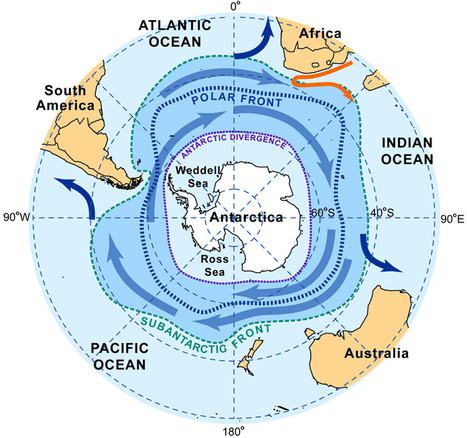
"The Southern Ocean extends from the coast of Antarctica north to 60 degrees south latitude. The Southern Ocean is now the fourth largest of the world's five oceans (after the Pacific Ocean, Atlantic Ocean, and Indian Ocean, but larger than the Arctic Ocean). The International Hydrographic Organization (IHO) has declared, named, and demarcated the Southern Ocean as a fifth, separate ocean."

Katie Kershaw's curator insight,
April 24, 2018 12:22 PM
This is slightly embarrassing to admit, but I have never heard of the Southern Ocean. I think it is because, as mentioned in class the other day, we do not talk about the Southern Hemisphere very often. When looking a globe this entire ocean is on the bottom and pretty much out of sight. I thought that it was interesting that the creation of this ocean was created within my lifetime because all of the rest of the world’s oceans are well documented throughout history. Even though the water in the Southern Ocean has been there just as long as the other oceans, it hadn’t been designated as an ocean. I think another reason that I haven’t heard much about the Southern Ocean is because it doesn’t really have any direct impacts on Americans. All of our trade routes avoid this area of the world, we don’t have any landclaims within the ocean, and very few Americans have actually gone to Anarctica. This article also talks about the boundaries and the conflict regarding how far north the boundaries of the ocean would be. Most members of the IHO supported the boundary being at 60 degrees. However, 7 countries pushed to have the boundary set at 50 degrees. The reason most countries supported the 60 degree boundary is because it doesn’t add any land outside of Anarctica to the ocean. Although this article doesn’t state which countries wanted the boundary at 50 degrees, I am guessing its countries with land very far south, like Argentina, Chile, Australia, and maybe South Africa. This would allow them control over the Southern Ocean that they can’t get with the current boundaries. It is interesting that it took until 2002 for the point to be raised that the Southern Ocean is district enough from the other oceans, that it should be considered a separate ocean.

Zavier Lineberger's curator insight,
May 3, 2018 11:25 AM
(Oceania) Geography experts now claim the waters around Antarctica will join the Atlantic, Pacific, Indian, and Arctic as the fifth ocean. Almost every member of the International Hydrographic Organization declared the existence of the South Ocean, which extends to 60° S latitude and is double the size of the United States. While it might seem trivial, the Southern Ocean has the most powerful water current, a different circulation, and a unique ecosystem, marking it separate from other bodies of water.

K Rome's curator insight,
October 6, 2018 7:30 PM
The Atlantic, Pacific, Indian, and Artic as an American student growing up those were the Oceans that I grew up learning about. So to see an article talking about the Southern Ocean comes as kind of a surprise. We learn as young American students about "Atlantic trade" or our West Coast with "Pacific Trade" we as young students learn about the mysterious Indian Ocean and the unattainable Artic Ocean, but for some reason the Southern Ocean has been left out. The Southern Ocean as the article explains is the 5th and newest Ocean. Ocean scientist thought it was necessary to name the the body of water south of the Pacific but north of the Artic. While it might not seem that important to some it is key to identify with areas. When we discuss Atlantic trade for the most part in the United States we know we are discussing trade with the Europeans or on our East Coast. When discussing Pacific trade we understand that to be West Coast and probably dealing with China or other Asian countries. As an Australian resident or student they grow up learning about this key body of water to them. They can use it to identity where they are and where they are going. We can also use the body of water to discuss different weather pattern and effects on the countries in Oceania region of the world. An interesting read if you want to learn more about our forgotten 5th Ocean.
Scoop.it!
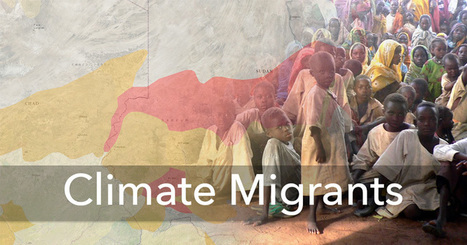
Climate change has already displaced tens of thousands of people. If it continues unabated, it could lead to one of the largest mass human migrations in history.
Scoop.it!

The amazing image was taken from 828 metres above sea level, at the top of the Burj Khalifa. It consists of 70 different photos stitched together.
Scoop.it!

The Zaatari refugee camp in Jordan is one of the largest Syrian camps in the world. In the fall, we visited the camp live with our audience. Here’s what we heard from the refugees and from you.
Scoop.it!

This group advocates designing cities with emotional well-being in mind.
Scoop.it!

hat #edchat #commoncore #ccss Simulations: Integrating the Standards by Brooke Feldman Without the ability to travel time and visit distant lands, one of the best ways to engage middle school students in history is through simu... Via Darren Burris
|
Scoop.it!

From
time

What's the difference between a hydrogen bomb and an atomic bomb? One is bad, the other's worse, and now North Korea may have both
Scoop.it!
Students learn about the atom and radioactivity. WDTVLIVE42 - Transport, technology, and general interest movies from the past - newsreels, documentaries
Scoop.it!
This video explains what is the United Nations what is it's importance in the world. Is it powerful and can it control nations. Can it be called the Globa
Scoop.it!

By simplifying gerrymandering we see how problematic it really is.
Scoop.it!

While this cartoon is flippant, the attached Washington Post article is not. In the culumative congressional voting, Democrats have more votes but won fewer seats than the Republicans. Many are starting to question the redistricting process after the 2010 census.
Tags: gerrymandering, political, mapping, census.

Landon Conner's curator insight,
February 11, 2016 8:34 AM
Democrats have won the popular vote roughly. But the Republicans are set to have the secone biggest house majority in 60 years according to the article. Republicans were favored in more house districts compared to democrats. Most of this is because democrats are in urban areas. LDC 
Brealyn Holley's curator insight,
February 11, 2016 8:53 AM
Since the redistricting has to do with the Republicans, which they have taken over more seats, but the Democrats have won the poll by a numerous number. You could see this from either side. A republican sees this as a good thing and the democrats would see this as a bad thing for them. ~BH 
Cohen Adkins's curator insight,
February 23, 2016 5:32 PM
Gerrymandering can cause problems in the political word.Not only can it make unfair elections but it can cause voters to become frustrated at how even though one region has more votes,the region is then seperated where its splitting the majority in half so they dont have the majority vote anymore. -C.A
Scoop.it!
Air date July 29, 2016 Newsfix Houston, TX. Written, edited, shot by Michael Barbagallo
Scoop.it!
"The Sargasso Sea occupies almost two thirds of the North Atlantic Ocean. Within this sea, circling ocean currents accumulate mats of Sargassum seaweed that shelter a surprising variety of fishes, snails, crabs, and other small animals. The animal community today is much less diverse than it was in the early 1970s, when the last detailed studies were completed in this region. This study shows that animal communities in the Sargasso Sea are definitely changing. The next step is to find out why."

Ivan Ius's curator insight,
January 22, 2017 7:38 PM
Geography Concepts: Spatial Significance, Patterns and Trends, Interrelationships
Scoop.it!

We'd like to share this critical thinking skills cheatsheet for you to use with your students. Get them asking questions on any topic! Via Ana Cristina Pratas
Scoop.it!
"Both sides claim the West Bank as legitimately belonging to them. Over time, and especially as Israeli politics has shifted rightward, the settler movement has become an institutionalized part of Israeli society. Support comes in the form of building permits, public investment, and even incentives for Israelis to move into the West Bank. While peace talks remain frozen, the settlements continue to grow, making any possibility of a Palestinian state in the West Bank faint."

David G Tibbs's curator insight,
March 22, 2018 1:25 PM
The settlements started out has a religious spreading. However, that has dramatically changed over time due to economic reasons. Not only that the amount of government support for the people living in these lands are incredible, even in an outpost that is deemed illegal. The country occasionally goes into illegal areas and tear down houses to show a tough face on them. The government and its people theorized that more will come home and that the populations in the settlements will grow to half a million. The international community and Israeli must come up with a strategy before it gets to the point of no turning back. 
Taylor Doonan's curator insight,
March 23, 2018 12:55 PM
This video gives some in depth background on how Israel and Palestine are severely intermingled. It goes into the history of the creation of Israel and it talks extensively about the West Bank region and who lives there and who controls what parts. The region is very intertwined and more Israelis are moving into the region and how it would become more and more difficult to separate the region into two states.

brielle blais's curator insight,
April 1, 2018 4:34 PM
This shows how important clear and distinct boarders are for different countries. In this case, that is important because Palstine feels their land is justing getting taken, while Israel argues they are returning to their homeland. Either way, the rest of the world believes what Israel is doing is illegal and Palestine should have it's own autonomy as a state, in a two-state system.
Scoop.it!

In almost every country in the world, average ages are rising fast, putting pressure on city councils, health-care systems, and national economies. And the solution may be the empowerment of older people themselves.
Scoop.it!
The conflict is really only 100 years old. Subscribe to our channel! http://goo.gl/0bsAjO Read more about the Israel-Palestine conflict at
Scoop.it!

After reading a novel, actual changes linger in the brain, at least for a few days, report researchers. (Neuroscience is cool. Interesting find.
|






