I've used similar videos in my classes and students are usually quite shocked to see how a city like Bangkok, Thailand operates. I've used this as a 'hook' for lessons of population growth, urbanization, economic development, sustainability, megacities and city planning.
On the one hand this disturbed me. All I kept thinking when I saw the people go back on the tracks is that they could easily be killed.In fact, I wonder how many accidents have ever occurred near this area. All it would take is some sort of malfunction on the train in which the horn wasn’t sounding to provide ample warning or someone gets in another person’s way so there isn’t enough time to close down the shop. On the other hand, this made me realize just how efficient a population could become at using space. Everything was timed so that the entire area moved out of the way without an issue. So rather than let any land go to waste, the area uses it despite the risk to its population. Though it really isn't like the population has a choice though. So in instances where there is such overpopulation, it is interesting to see how well the society can adapt to the phenomenon. I do wonder what would happen if the country becomes more developed and the population declines. Would this type of land continue in the future or be disband? I know that in our country there are many laws that would make this illegal, but our country also has the space avoid developing the land in such a manner. When comparing it to the laws of the United States, I would think the country would eventually drift away from this use of land when possible. However, now that I watch the video, I have a new appreciation for maximizing land and I hope that the efficient could continue. Just in a less scary manner.
Talk about using every inch of space available to you. I find this video crazy not only because of the safety hazards, but just how people seem to go about this like it is normal. This would never take place in America!
An absolute amazing dynamic is seen in this video. To say that Bangkok is trying to use most of its open space up would be an understatement. In developed countries, you would not only never see this happen but you would not even see a thought of doing something like this. There are violations every where you look.
This is a great site that lets learners explore open access TV from around the world. https://tvexplorer.live/ Great for developing language skills and exploring different pronunciations from different regions.
"Lack of choice, not desire" is reason for global fertility crisis, say UN in a new report, after a massive new global survey. The Sky News data and forensics team breaks down the key details.
At the Morgan Library in New York, an unfinished manuscript from 1400s France can teach us how Medieval artists crafted their exquisitely detailed works.
This is a free web based app that enables young children to make and share stories together. It’s very colourful and easy to use. The stories can be written(with or without the help of AI) recorded using voice or webcam. Something kids will love.
Restricting the volume of high-emitting vehicles roaming city streets carries many benefits, from clearing the air to quieting the urban din and beyond. Recognition of this simple fact has led to the proliferation of clean air zones, designated regions within a city where vehicles must meet strict pollution standards or pay a fee to operate […]
Hitler invaded much of Europe during World War II, but one country remained untouched—Switzerland. Discover the military strategy, geography, and defensive preparations that made invading Switzerland a risky decision. This short explains one of the most fascinating stories from WWII history. #worldwar2 #hitler #militaryhistory #war #historyfacts #warstories #shorts
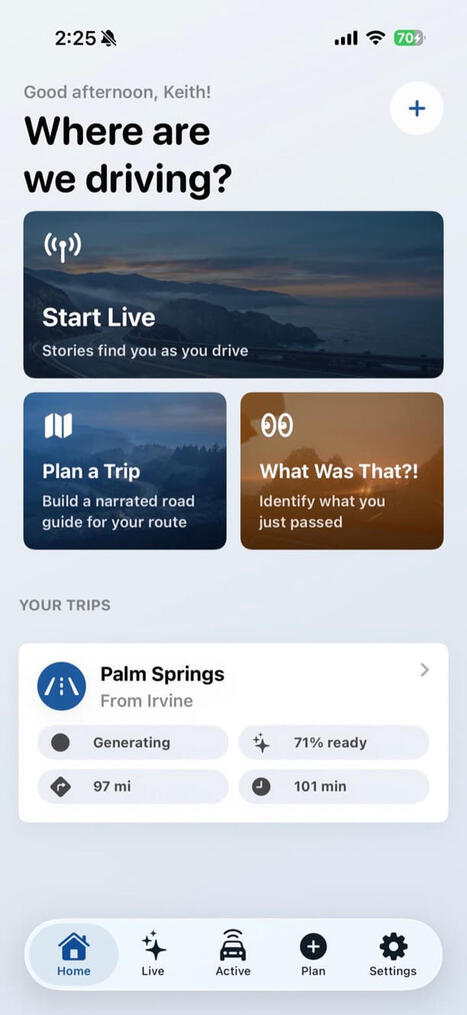
Passenger Seat is a friendly travel companion for the car. As you drive, it tells you about the history, landmarks, and towns you would otherwise pass right by, hands free.
Learn how to create history reconstructions here: beacons.ai/majesticaistudio
From a small collection of villages on the banks of the Tiber to the greatest empire the ancient world had ever seen — and then the long, extraordinary unravelling of it all. In 44 minutes, we cover the full sweep of Roman history: the founding myths, the Republic, the brutal beauty of the Roman army, the assassination of Caesar, the rise of Augustus, the emperors who built it and the emperors who nearly destroyed it, the gladiators, the aqueducts, the roads that still exist today, and the slow collapse of a civilisation that shaped virtually everything about the world we live in. This is Rome — all of it — told the way it deserves to be told.
The Persian Qanat: Ancient Desert Engineering. Discover the incredible engineering feat of the Persian Qanat, an ancient system dating back 3,000 years. These remarkable tunnels, found in the deserts of Iran, have provided a reliable water supply for centuries. Learn about the meticulous construction process, the annual maintenance required, and how this technology spread across the world through trade and conquest.
When William of Normandy invaded England in 1066, it began a transformation of the Old English language. The Norman conquerors replaced the Anglo-Saxon ruling class, bringing with them their Anglo-Norman language, which was based on Old French. Over time, the two languages blended. Old English grammar became simpler, and the English vocabulary expanded with the addition of French words. The result was a new stage of the English language: Middle English, spoken around 1100 to 1500. During this time, Geoffrey Chaucer wrote The Canterbury Tales, one of the most famous examples of Middle English literature. Chaucer’s writing — and the English language in general — was not uniform at this time. Spellings varied and were often phonetic, and pronunciation differed by region; Chaucer often used whichever version of a word fit his rhyme. There were some differences between the Middle English alphabet and our ...Read More
Amid warnings from the WTO that world merchandise trade could slip into outright decline this year and with Red‑Sea shipping lanes still only partly restore…
What we’re showing This chart shows annual births per 1,000 people across the world’s six most populous countries, based on UN data. Key takeaway Birth…
To get content containing either thought or leadership enter:
To get content containing both thought and leadership enter:
To get content containing the expression thought leadership enter:
You can enter several keywords and you can refine them whenever you want. Our suggestion engine uses more signals but entering a few keywords here will rapidly give you great content to curate.


 Your new post is loading...











On the one hand this disturbed me. All I kept thinking when I saw the people go back on the tracks is that they could easily be killed.In fact, I wonder how many accidents have ever occurred near this area. All it would take is some sort of malfunction on the train in which the horn wasn’t sounding to provide ample warning or someone gets in another person’s way so there isn’t enough time to close down the shop. On the other hand, this made me realize just how efficient a population could become at using space. Everything was timed so that the entire area moved out of the way without an issue. So rather than let any land go to waste, the area uses it despite the risk to its population. Though it really isn't like the population has a choice though. So in instances where there is such overpopulation, it is interesting to see how well the society can adapt to the phenomenon. I do wonder what would happen if the country becomes more developed and the population declines. Would this type of land continue in the future or be disband? I know that in our country there are many laws that would make this illegal, but our country also has the space avoid developing the land in such a manner. When comparing it to the laws of the United States, I would think the country would eventually drift away from this use of land when possible. However, now that I watch the video, I have a new appreciation for maximizing land and I hope that the efficient could continue. Just in a less scary manner.
Talk about using every inch of space available to you. I find this video crazy not only because of the safety hazards, but just how people seem to go about this like it is normal. This would never take place in America!
An absolute amazing dynamic is seen in this video. To say that Bangkok is trying to use most of its open space up would be an understatement. In developed countries, you would not only never see this happen but you would not even see a thought of doing something like this. There are violations every where you look.