RÉSEAUX SOCIAUX & SANTÉ : INFORMER. ÉCHANGER. COMPRENDRE.
481.8K views | +5 today

How social business is transforming healthcare

From www.mmm-online.com

In India, poor women are trained to provide low-cost, door-to-door diabetes services in rural communities. This is a critical service; 70% of India's population lacks reliable access to medical services, including blood glucose testing. In the US, the Health Leads program takes aim at non-medical issues, such as lack of transportation to a doctor's appointment or not enough food at home, that undermine health.

For these programs and others like them, the message is clear: Improving health and healthcare requires new thinking and fresh ideas. Social entrepreneurs, including the founders of these programs, are at the forefront of new ideas in healthcare (and many other industries).

Most people have heard of social entrepreneurs. What they may not know is that some large healthcare companies are also playing a role in social entrepreneurship. Driven by a need to remain competitive and a desire to bring about positive change, these companies are pursuing a strategy—social business—that combines profit with purpose.

In some ways, social business is a natural fit for global healthcare companies. Being on the front lines and supporting new approaches is a logical extension of their core mission of promoting better health through discovery and innovation.

They understand that the current system is inadequate to address global healthcare issues. Access, affordability and patient value can all be dramatically improved. Social business can help spark creativity and create new pathways to improve access, affordability and delivery of healthcare services, and improve the patient experience.

Some healthcare companies are pursuing social business through partnerships. In one example, healthcare company Boehringer Ingelheim is working with Ashoka, an organization that supports social entrepreneurs, in a partnership called “Making More Health” (MMH).

Among the projects MMH supports are Reg4ALL, the first participant-controlled, cross-disease registry for health and disease data. The platform enables patients to connect with researchers who need participants for life-saving clinical trials.

In addition to large-scale partnerships, there are a number of other ways for companies to get involved in social business. They can provide resources and support, such as “lending” their skilled executives to small organizations or providing financial support for promising ventures. They can engage their employees in strategic volunteerism, among other options.

Whatever form it takes, engaging in social business and interacting with health innovators and social entrepreneurs has multiple benefits. In one scenario, an employee could bring a workable idea or the seed of an idea back to his or her employer. That idea could develop into a program or treatment that could improve lives and have great commercial potential.

Every engagement won't result in a commercial success, of course, but there are other benefits that are equally important. Employees who have been in the field or engaged with a nonprofit in some way will return to their jobs with more knowledge about the patients they serve, what their needs are and how to improve healthcare delivery.

Exposure to different cultures, geographies and conditions can be illuminating. Back on the job, employees can bring new insights to their work. They may also have developed important soft skills, such as project management and how to work in low-resourced environments, that they might not have gained doing their usual job.

Also, at a time when employees are looking for meaning in their work, social business offers companies an opportunity to demonstrate how they act on their values. For both employer and employee, a shared mission creates loyalty and a strong bond.

It's evident that healthcare, like many other industries, is being called on to do more with less. Social business is a key factor in creating success in challenging circumstances. Sarrell Dental, a provider in Alabama, is just one example of the power of innovation to drive efficiency and better results.

Sarrell is the only full-time Medicaid dental provider in Alabama. With the goal of improving access to oral healthcare, Sarrell developed a new business model for offering quality dental care to children covered by Medicaid. The bold model has allowed it to scale dramatically, all while lowering the cost of care to the government.

While Sarrell is a nonprofit, its model demonstrates that healthcare innovation is the way forward. In 2012, the organization had more than 130,000 patient visits and generated $15.6 million in revenue, according to a May 15, 2013, article in the Birmingham Business Journal.

Global healthcare companies are looking to—and supporting—the social entrepreneurs who “disrupt” the industry. With the help of social business, with its twin goals of generating profits and social good, the future of healthcare is emerging: Innovative service delivery models and new partnerships that make care more efficient and more valuable for patients.

Whether those developing models take shape through glucose testing in Bangalore or volunteers helping patients find safe housing in Boston, social business is transforming healthcare.


David Mattioli's curator insight, November 5, 2014 7:00 AM

This article compliments the value-driven approach that we are implementing and aligns nicely with our Enterprise goal.  We must continue to help our members fill in the gaps and break down the barriers that prevent them from achieving their best health. 


How Social Sharing Impacts Healthcare

From healthinformatics.uic.edu

Social media is occasionally overlooked as a legitimate way to measure patient sentiment and health outcomes. However, early adopters who are on the leading edge of online sharing and collaboration have found that having a social presence can build loyalty and trust among their most important populations.

Many exciting changes are currently trending in the social media space. Let’s look at three that can have a positive impact on your future:

Engaging Younger Patients

We all know that people use social media to share their lives moment by moment. Their candidness includes personal health-related information about themselves, their friends, and family members. The 18-to-24 age group is especially open with what’s being shared on their social networks.

A study by Search Engine Watch reported that a full 90 percent of people under 24 would trust health information posted online by their friends. This is a key point for healthcare organizations and professionals who want to connect with younger patients who are still making decisions about their healthcare needs.

Collecting Patient Information

This trend is a game-changer for health informatics professionals as people become increasingly comfortable with sharing their health data online – with other patients, doctors, hospitals, and insurance and pharmaceutical companies.

Advancement of this trend into the public sector will make it easier to collect surveillance informatics on local, regional, and national health and wellness measures. This includes the spread of illnesses flu, food poisoning patterns, antibiotic-resistant bugs, and more.  Be sure to keep an eye on developments in this area if you are focusing your masters in health informatics on the public health sector.

Building Professional Networks

According to MedTechMedia, less than one-third of healthcare workers are using social media for professional reasons. This means that there is a lot of room to put yourself out there as a potential candidate for new opportunities.

Aside from LinkedIn and other professional networks, be sure to follow desirable employers on Facebook. The most socially savvy healthcare systems will have both a consumer Facebook page and an employment-specific Facebook presence.

You should also make a point to visit the career web sites of potential employers. Some will have the option for you to join their online talent networks, which is an excellent way to get notified of new jobs, web chats, and open house hiring events.


No comment yet.

[Infographic] Healthcare and Social Media - Additive Analytics Blog

From www.additiveanalytics.com

The IMS Institute recently published a paper describing the new ways in which social media usage is shaping healthcare. Both patients and physicians are increasingly turning to the internet—including social media—for healthcare information. Today, 70-75% of Americans with internet access have used the internet to find health information. 42% of survey respondents reported that they …
No comment yet.

Australian Medical Board tests social media landscape with advertising guidelines

From blogs.crikey.com.au


The release in 2012 of a preliminary consultation paper on a social media policy for health professionals by the Australian Health Practitioner Regulation Agency (AHPRA) prompted a fast and fierce social media storm.

As Croakey reported at the time, the document – which was later revised – took a fairly dim view of social media, focusing mainly on its potential to breach laws and guidelines relating to the advertising of regulated health services.

Active tweep and Victorian surgeon Jill Tomlinson says she is now dismayed that the “lack of understanding of social media communication” shown by the AHPRA then has now “spilled over” into the Medical Board  of Australia’s proposed guidelines for advertising regulated health services that will take effect next month.

Of particular concern, she says, is the requirement that medical practitioners will need to ask any individual who writes online about their clinical care, or any website that hosts the online comments, to remove the comments – despite the regular flouting to be seen of existing AHPRA advertising guidelines.

Dr Tomlinson has written an open letter to the Medical Board of Australia, saying the new guidelines demonstrate a lack of understanding of Web 2.0 technologies and communication , threaten to censor patient feedback, and risk changing the landscape of Australian healthcare social media. She asks, perhaps only a little rhetorically:

“When practitioners follow the new Guidelines, how far should they go with their “reasonable attempts” to have the offending posts removed?  If Google or a major forum fails to act according to my request, should I hire a forensic computer scientist, obtain a Supreme Court search warrant, and sue?”

***

Dr Tomlinson writes:

“Dear Medical Board Members,

RE: Proposed “Guidelines for advertising regulated health services”

In 2012 the Australian Health Practitioner Regulation Agency (AHPRA) released a consultation paper on its proposed social media policy. Feedback from the Australian healthcare social media community was swift andnegative. I am relieved that AHPRA has subsequently revised its proposed policy, but I am dismayed that AHPRA’s lack of understanding of social media communication has spilled over into the Medical Board’s proposed “Guidelines for advertising regulated health services” that will take effect on March 17, 2014.

According to Section 6.2.3 of the proposed Medical Board advertising Guidelines, from next month medical practitioners will need to ask any individual who writes online about their clinical care, or any website that hosts the online comments, to remove the comments.

The existing AHPRA advertising guidelines are regularly flouted online. I frequently see examples of advertising that AHPRA has deemed “unacceptable”. For example, a competition where liking a Facebook Page gives you a chance to win $2,000 of cosmetic injectables. Facebook Pages with hundreds of testimonials. Online advertising of a competition where buying $50 of alcoholic drinks at a bar gives you a chance to win an overseas breast augmentation holiday. Facebook posts featuring solicited glamour photographs of women who have allegedly had breast augmentation performed by the surgeon behind the Page. Articles and social media posts that do not contain the “necessary warning statement” for surgical or invasive procedures. Claims that a practitioner provides superior services to other practitioners (An example: “Dr XXX is the best surgeon in Australia without a doubt! What an amazing experience…absolutely life changing …the best surgery I’ve ever had. No bruises…and very minimal pain. Best treatment and the best staff…thank you from the bottom of my heart”). A doctor’s website that says that testimonials are not permitted but provides a direct link to a website containing 22 patient reviews on his profile page. All of these examples breach s.133 of the National Law.

Advice that I have received from AHPRA about how to apply the existing guidelines suggests that there is confusion about how and when they should be applied. In 2012 I telephoned AHPRA asking if I needed to provide a warning statement on educational articles on my business website that describe hand fracture treatment. I felt it was unnecessary to advise individuals who were reading about hand fracture treatment that “Any surgical or invasive procedure carries risks. Before proceeding, you should seek a second opinion from an appropriately qualified health practitioner.” The AHPRA representative checked with the “medical team”, then informed me that the guidelines did not apply to this situation. I was advised that it was not possible for AHPRA to provide this advice in writing. I received no response to two website enquiries I submitted to AHPRA regarding this matter.

I have two medical practice Facebook Pages that I keep free of testimonials, as required by the existing guidelines. I have specifically selected a type of Facebook Page that does not offer people the opportunity to rate my business out of 5 and provide a review. I have deleted positive feedback that my patients have placed on the Pages. I feel uncomfortable about deleting unsolicited and heartfelt feedback posted by my patients, as it seems rude and unappreciative. However, I must do so to remain compliant with s.133 of the National Law. The lack of common sense in section 6.2.3 of the proposed Guidelines has me questioning whether I should instead apply the Guidelines selectively according to my own logic and whims.

When practitioners follow the new Guidelines, how far should they go with their “reasonable attempts” to have the offending posts removed?  If Google or a major forum fails to act according to my request, should I hire a forensic computer scientist, obtain a Supreme Court search warrant, and sue? I think that’s probably above and beyond the call, but I also recognise that my logic is not concordant with that of the Board’s. Will reporting a patient’s positive Facebook status update as “harassment” suffice if I keep a screenshot of the Support Dashboard as evidence? And what do I do if my doctor-patient relationship is adversely affected by these attempts at patient censorship?

Online feedback offers doctors an opportunity to reflect and to change their practice where indicated to improve the care provided to future patients. What is the purpose of asking all patients and websites to remove online patient feedback? Do you wish to censor patients? Are you trying to keep the medical profession shrouded in secrecy? Has a recent internal review suggested that the Medical Board needs to create additional compliance and administrative work for doctors? No other Medical Board in the world has seen fit to propose such a requirement.

Research shows[1] that the main reason Australian health professionals choose not to engage in social media for healthcare and practice promotion is a lack of understanding of Web 2.0 technologies and communication. I suspect the proposed Guidelines reflect the Board’s lack of expertise in this area. You wouldn’t implement clinical practice guidelines that were developed by individuals who have no experience or expertise in the field. So why would you again propose to implement Guidelines pertaining to Web 2.0 communications that have been developed by individuals who have no experience or expertise in this field?

Please reconsider the proposed Guidelines. Remove the requirement for doctors to attempt to censor patient feedback. And in the future, please consult with individuals who have expertise in the field before introducing guidelines that will change the landscape of Australian healthcare social media.

Sincerely,

Dr Jill Tomlinson
MBBS(Hons), PG Dip Surg Anat, FRACS(Plast), GAICD
Plastic, Reconstructive and Hand Surgeon

No comment yet.

Healthcare Social Media is still growing exponentially – Just look at #HIMSS14

From www.symplur.com


Have we reached peak growth of healthcare social media? The numbers we are seeing doesn’t seem to indicate so. More and more stakeholders in healthcare wether they are patients, providers or other third parties are still flocking to the social web in greater and greater numbers.

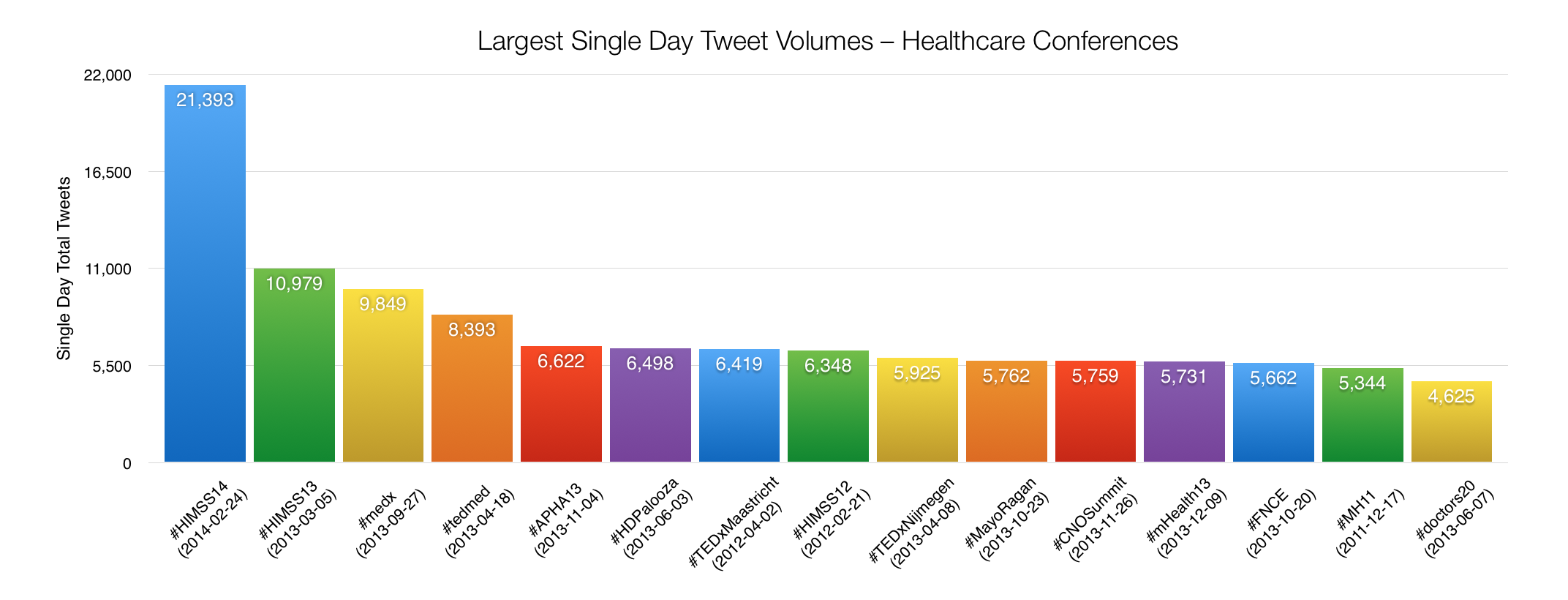
Just look at what the healthcare conference #HIMSS14 accomplished this week. The graph below shows the top 15 healthcare conferences by single day tweet volume.


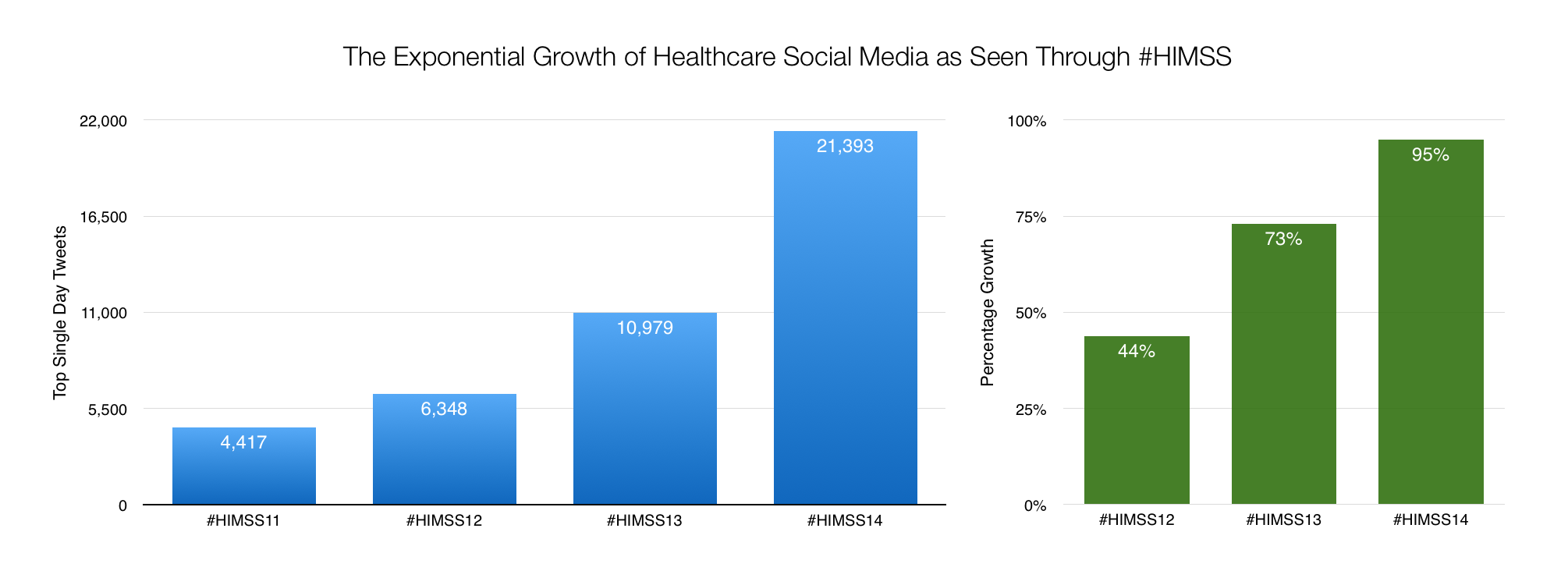
We’ve never quite seen anything like the tweet volume we witnessed from #HIMSS14 this Monday. 21,393 tweets in a single day is indeed a new record for all healthcare conferences. But what is interesting about this graph is the rate of growth year over year. Let’s take a closer look at that in the graph below.


We’re still comparing the top single day during the conferences. The takeaway here is that the growth of healthcare social media, and in particularly Twitter, within this and many other healthcare conferences is not only at double digits – it’s growing at an exponential rate.

No comment yet.

Analysis of Pharma Engagement on Twitter – Pfizer, Sanofi and Novartis lead the race

From digitalblog.exlpharma.com

While Pfizer leads in followers, Sanofi US leads the way # of tweets and Novartis leads in engagement on Twitter

It is quite an obvious f
No comment yet.

Medical Marketing Tips: Your Social Media Persona

From healthworkscollective.com


The popularity of social media in its various forms—Facebook, Twitter, LinkedIn, blog, etc.—is a fairly recent phenomenon. And for a large segment of society, it is social media that stitches together the blanket of connectivity that we can’t seem to do without.

At last count, about 73 percent of online adults used social media sites regularly. The numbers skew a bit female, and a bit younger, but social networking is fairly pervasive and nearly ubiquitous. [Pew Social Networking Fact Sheet]

As a result, social media is an excellent resource in the marketing toolbox of physician’s offices, group practices, hospitals and others in the healthcare spectrum. But—and this is where the problem comes into the picture—for some healthcare entities the social media presence is less effective than it could be.

Many experienced social media users produce good to excellent results. But others, it seems, never get enough traction and their results rank poor to frustrating. Although every situation that we diagnose is unique in its strengths and weaknesses, we’ve identified core ideas that can improve Return-on-Investment, and often, take the effort to the next higher level of effectiveness.

Upgrade your social media persona…

Generally, these tips apply to more than one social media platform. For starters, we’ll assume that you have a written plan, specific goals, a social media policy, assigned responsibilities and a clearly defined target audience(s). (If you don’t have these, you’ll need this foundation before you can build further.) Then…

Maintain a consistent focus. If your social media presence is for business, then stick to business. It’s a common mistake to publish or tweet material that jumps between business and personal topics. That isn’t to say that your tone of voice can’t be friendly, personable and/or reflect your personality. But an audience that expects authoritative information will be confused by weekend cheer-tweets for your old college team.

It’s a dialog, not a monologue. Social media output—having someone do a little “post here” and “tweet there”—is less than half of the real task. The higher level of social media success requires an active, interesting and ongoing discussion that involves and engages your connections.

Listen at least as much as you speak. A corollary to dialog is the need to monitor what’s being said, asked or discussed within the social gathering point. Listen carefully (and often) to identify new discussion topics, questions and answers, and to provide observations, comments or corrections. (By extension, be aware of what the competition is doing, saying or discussing.)

Concentrate on quality and type of content. Social media posts, regardless of the platform, should be authoritative, add value, be helpful, inspire sharing and/or be original. Can you ask a provocative question? How can you make a “dry fact” have greater interest to the audience? What can you provide that is new, or have a different perspective?

Credibility of content. Check your facts and details. Provide attribution, sources and references when appropriate. And don’t rely on auto-correct for spelling.

Use monitoring tools and analytics. Computer- and Internet-based social media has far more analytics-power under the hood than most people realize. Consider using a social media software (such as SproutSocial or others) to reveal details about your audience demographics, trends and usage, and engagement.

Give social media a front seat in the office. Too often we find a detailed Internet marketing plan that leaves “social media stuff” to get done as a secondary (i.e. afterthought) chore, or by a junior staff person. Effective social media placement, and quantifiable results, requires consistent and qualified care and attention. If it’s not really important, the neighbor’s middle school kid will be adequate.

 
No comment yet.

What doctors need to remember in social media

From nancypjean.wordpress.com


Back in 2011, I wrote a post about why doctors should be careful when using social media. Not that I’m changing my stance on that, but I think social media, and clinicians’ use of it, has come a long way in just a short amount of time. If it was accepted before, it’s expected now!

So what prescription should a doctor write for himself when it comes to using social media? The answer is pretty simple. Use it, and remember what it’s for!

Recently, the Rhode Island Board of Medical Licensure and Disciplineissued guidelines for doctors on how to use social media appropriately. I’m glad they did this for two reasons – it lets doctors know that it’s OK to post out there in the big social sphere, and they won’t lose their license by doing so. It also gives them the dos and don’ts of what to do. And that’s always a good thing.

There are a lot of doctors out there who figured out a long time ago that social media is a great tool. They are leaders in the field, and their use of social media has allowed them to voice their opinion on hot health topics, to serve as thought leaders on the healthcare industry and the use of social media, and to simply share information.

Two that immediately come to mind are Kevin Pho (@KevinMD on Twitter and on his blog) and Wendy Sue Swanson (@SeattleMamaDoc on Twitter and a blogger for Seattle Children’s Hospital). They learned early on the power of social media and have been touting the benefits of connecting with people through these channels for years. They’ve been tweeting, speaking at conferences, and becoming leaders in the industry through their openness, their acceptance of new technology to reach more people, help people, and perhaps just maybe, make people healthier.

Then there’s the other side of the coin. There have been some well publicized cases of physicians using social media inappropriately. In one such case, a R.I. physician posted protected patient information on Facebook. She was fined, and she removed her Facebook account.  In another, more recent case, a physician clearly stepped over the line talking about a patient’s chronic lateness and of a stillbirth.

That’s why having official guidelines is not only recommended, but is  a necessary part of hospital business these days, at least in my humble opinion. Well before the R.I. Board of Medical Licensure and Discipline developed its guidelines, we developed our own for our physicians. We felt that by arming our physicians with the information they needed, they would be less likely to get into trouble, and perhaps be less timid about using social  media  as a communication tool.

When the R.I. Board came out with its guidelines, we saw it as an opportunity to remind our own physicians of the guidelines we already had in place, and in case they missed them, we provided a link to the state-wide guidelines. From our own @RIHospital, I’m thrilled that one of our emergency medicine doctors, Megan Ranney, M.D. (@MeganRanney), has taken to Twitter like a pro. She was also interviewed by the Associated Press for a story on the release of the new guidelines.

In the article, Ranney is quoted as saying, ‘‘I do think you have to use your professional judgment.” She also gives good advice – think twice before posting something.

For hospitals in today’s social world, keeping your doctors abreast of the many uses of social media is an important part of the communications and marketing efforts for any hospital. Get them on board, let them comment, let them blog – being “social” can help position your hospital’s brand positively, if, of course, the tools are used appropriately.

Do you support doctors’ use of social media at your hospital? Would you want to connect with your doctor through social networks? I’d love to hear from you!

No comment yet.

Expanding Physician Communication with Social Media

From curbsideconsult.tumblr.com

Dr. Miguel-Angel Perales, Deputy Chief of Adult Bone Marrow Transplant Service and Director of the Adult Bone Marrow Transplantation Fellowship Program at Memorial Sloan Kettering Cancer Center, said recently on a webinar about online physician collaboration:

No comment yet.

Curating Content via Social Media: A New Role for Physicians

From wingofzock.org

Social media in health care is all the rage. Set up a Twitter account, get a Facebook page—heck, even start a Pinterest account for your office or group. Mix it together with a little video content, SEO, and a flashy URL, and you may be able to find some ROI from your social media efforts. It’s modern. It sounds complicated and advanced. And many social media experts who are dabbling in health care are pushing the merit and success of this marketing strategy.


But should this be the role social media plays in a physician practice? Should hospitals use Twitter as a digital billboard with viral potential? Marketing is important, but is it appropriate for physicians who are entering the social media space?


I believe that serving as content curators is more aligned with the oath we took. Social media provides a contemporary platform for physicians to acquire, screen, compile, and manage information we want our patients to have.


Read more: http://wingofzock.org/2014/03/06/curating-content-via-social-media-a-new-role-for-physicians/

No comment yet.

Les « instagrameurs », une nouvelle race d’influenceurs ?

From pro.01net.com

En janvier, Instagram connaissait une croissance plus rapide que Facebook et Twitter. Une aubaine pour les marques ? Une étude dresse une cartographie des utilisateurs les plus suivis de l’application de partage de photos.
No comment yet.

Doctors and social media: It's time to embrace change

From medcitynews.com

I recently took on a position of medical journal editor. It is with the Journal of Kentucky Medical Association. It’s been a good learning experience. Part of the job of...


Denise Silber's curator insight, March 6, 2014 4:46 PM

add your insight...


Linkfluence, leader de l'e-réputation avec le rachat de TrendyBuzz

From www.lesechos.fr

Acteur du Big Data dans le domaine en pleine effervescence de la « social media intelligence », à savoir l'écoute et l'analyse des médias...
No comment yet.

FDA Wants to Monitor Social Media Chatter About Product Risks

From www.nextgov.com

Blog and social media buzz monitoring could help the agency better communicate drug risks.
No comment yet.

Tech Trends 2014, Social activation

From dupress.com

The power of social activation is unleashed when others advocate an organization’s message in their own words to their network.


Over the years, the focus of social business has shifted from measuring volume to monitoring sentiment and, now, toward changing perceptions. In today’s recommendation economy, companies should focus on measuring the perception of their brand and then on changing how people feel, share, and evangelize. Companies can activate their audiences to drive their message outward—handing them an idea and getting them to advocate it in their own words to their own network.

From passive to active tense

Organizations have spent the last several years chasing the tantalizing prospect of “social.” Within the enterprise, social represents a bastion of hope for productivity and collaboration—a chance to effectively navigate who knows what, who knows whom, how work gets done, and how decisions get made. We’re still in the opening frames of a broad wave of social-driven enterprise transformation,1 as a recent study by MIT Sloan Management Review and Deloitte confirms. That study revealed that 69 percent of executives thought social business would be critical to their organizations in the next three years.2

Social businesses3 ideally rally around well-defined business problems, supported by committed communities with well-defined incentives for participation. To take full advantage of this potential, age-old organizational constraints need to be identified and rewired. Hierarchies, biases, standardized operating procedures, rigid job descriptions, and other embodiments of institutional inertia can stunt progress.

Meanwhile, the flurry of activity around external social channels continues. Social media has become a frequent online destination, commanding 27 percent of global time spent on the web.4 Not surprisingly, social monitoring and listening were some of the earlier investments companies made in the social arena. Social efforts leaned on the enabling tools that allowed passive data collection, tracking the volume of surface-level activity and broad-stroke awareness—followers, likes, mentions, and click-throughs to their own corporate channels. As the numbers grew, premature victory was announced. But volume doesn’t tell you much—good, bad, or indifferent.


rob halkes's curator insight, March 5, 2014 9:13 AM

Great insights in this Deloitte blog on changing from passive to active use of social media. The more so, while it refers well to the research done by Deloitte in cooperation with MIT Sloan Management Review on the trends of "social" in business. Inspiring!

See also the download of the report!

Twitter tested as monitor of HIV risk

From www.healthcareitnews.com

A new UCLA-led study suggests that real-time social media, such as Twitter could be used to track HIV and drug related behavior to detect potential outbreaks – and ultimately, as a tool for prevention efforts.
No comment yet.

Is Your Company A Business Intelligence Leader Or Laggard?

From blogs.sap.com

there seems to be a correlation between companies that report strong corporate performance (in terms of a year-on-year growth rate) and a highly agile BI environment, according to Forrester Consulting. Why? Because companies that are leveraging the latest innovations in BI technology are better able to predict trends, react quickly to changing requirements, and access the business-critical information they need – when and where they need it – to make better business decisions.

No comment yet.

The Impact of European Healthcare Conferences

From www.symplur.com

2013 was a remarkable year for healthcare conferences. We like to call 2013 the year healthcare conferences became social. More than 1,080 healthcare confe
Denise Silber's curator insight, March 6, 2014 4:41 PM

Thank you Marie Ennis O'Connor for this great article.


Digital Listening Drives a New Relationship with Doctors

From social.eyeforpharma.com

True pull-marketing needs individual customer segmentation

For the pharmaceutical industry, digital technology has enabled much more efficient and regular connectivity with its principal customers
No comment yet.

Not just 'social listening' but social understanding

From www.pharmaceuticalcommerce.com

How new social health analytics tools are supercharging pharma's quest for patient insights
No comment yet.

Pharma, patients and social media. What’s the story?

From www.starmedical.co.uk

Over the last 12 months, many people – myself included – have spoken about the ways in which the pharmaceutical marketplace is really beginning to embrace the digital revolution; mobile technology, social media…the list of tactics goes on and on. But in contrast, the study 'Engaging Patients through Social Media', published in January 2014 by the IMS Institute for Healthcare Informatics, has suggested that pharma is not as comfortable with digital techniques as we might think. You can request a copy of the report here. 

'Engaging Patients through Social Media': the findings  

The report begins with an assessment of the changing role of the 'engaged' patient and the impact of digital in healthcare. The report then goes on to discuss the level of social engagement achieved with the top three most popular social media channels – Facebook, Twitter and You Tube - by the top 50 pharmaceutical companies; each company's performance has been ranked in terms of reach, relevance and relationships.

Researchers found that half of the top 50 pharmaceutical companies do not engage with consumers or patients on social media about healthcare-themed topics.

Johnson & Johnson ranked 1st in reach, relevance and relationships indices; in the IMS Health Social Media Engagement Index – an amalgamation of all 3 indicies – Johnson & Johnson came out on top again with a score of 70. Overall, J&J’s closest competitor is GlaxoSmithKline, in second place with a score of 25. In tenth place is UCB, scoring 9.

How can pharma move forwards with social media?

The IMS concludes that 'in general, the industry needs to become less risk averse to new engagements with stakeholders to remain relevant in the overall healthcare discussion.’ Responding to online interactions and managing the large volumes of data that social media generates are two key challenges; the report recommends that pharma seeks support from outsourced tools that help companies monitor and respond to social media.

Early movers are testing the social waters with the trial and error approach, but to be successful, pharma companies must also recognise that social media is unpredictable and mistakes are inevitable; pharma companies must have a robust contingency plan in place for response during times when plans go awry.

What do you think?

Ultimately, patients are using social media and digital channels to become more informed about their health and to help them manage illness; Eyeforpharma reports that globally, 83% of people are using online resources to find information about chronic illnesses. How do you think pharma should adapt? What’s pharma doing well, and not so well, when it comes to social media.

No comment yet.

For virtual health care, a disconnect with regulations

From www.washingtonpost.com

Former lawmakers, firms form coalition that seeks to reform federal, state rules hampering technology.
No comment yet.

Who uses social media? What are some health-related examples?

From www.slideshare.net

The Pew Research Center has collected demographic data for users of Facebook, Pinterest, LinkedIn, Twitter, and Instagram. Susannah Fox crowdsourced examples...
No comment yet.