Your new post is loading...

|
Scooped by
Nicolas Weil
September 24, 2012 4:20 PM
|
SkySQL released its first version of a configuration tool for deploying databases to a cloud environment. To start, the company will offer its configuration tool for use on Amazon Web Services (AWS). It will later extend its service to other cloud and bare metal environments. The service is compliant with the three most used MySQL distributions, namely MariaDB, MySQL database, and Percona Server.
|
|
Scooped by
Nicolas Weil
September 24, 2012 3:46 AM
|
Cloud-based solutions are increasingly gaining traction, although technical, regulatory and attitudinal reasons are preventing many systems from transitioning to the cloud. Combining existing on-premise solutions with cloud-based components will increase flexibility and reach, while improving reliability and security. This article explores hybrid cloud scenarios that combine cloud with traditional delivery methods; these include cloud-based front-ends, secure service tunneling, elastic computing and cloud-based disaster recovery.
|
|
Scooped by
Nicolas Weil
September 17, 2012 4:28 AM
|
In the telecommunication industry, the ability of business domain Order Provisioning to invoke services dynamically at runtime is one of the critical requirements . The Service Broker as a controller is the main means of composing agnostic services dynamically. Composed services, together with other related enterprise artifacts, must be successfully discovered and exposed in various ways, which are clearly defined by a Service Inventory taxonomy. The main subject of this article will be creating an effective Inventory taxonomy. It will be discussed in the following pages, together with the Service Broker, and Service Messaging architecture.
|
|
Scooped by
Nicolas Weil
September 4, 2012 4:02 PM
|
"Eureka is a REST based service that is primarily used in the AWS cloud for locating services for the purpose of load balancing and failover of middle-tier servers. We call this service, the Eureka Server. Eureka also comes with a java-based client component, the Eureka Client, which makes interactions with the service much easier. The client also has a built-in load balancer that does basic round-robin load balancing. At Netflix, a much more sophisticated load balancer wraps Eureka to provide weighted load balancing based on several factors like traffic, resource usage, error conditions etc to provide superior resiliency. We have previously referred to Eureka as the Netflix discovery service."
|
|
Scooped by
Nicolas Weil
August 27, 2012 6:27 AM
|
Never say never. VMware is about to join the OpenStack Foundation, a group initially backed by other industry giants as a counterweight to VMware’s server virtualization dominance. Intel and NEC are also on deck to join as Gold OSF members.
|
|
Rescooped by
Nicolas Weil
from Cloud Central
August 23, 2012 10:43 AM
|
Rackspace has changed the game again with the OpenStack-powered open cloud. The Rackspace Cloud is now built on OpenStack, the open source cloud operating system that we founded and is backed by a community of developers and organizations. We’re committed to leveraging open source technologies and open standards to help our customers avoid the threat of vendor lock-in and to foster innovation. The infographic below explores some of the benefits of open environments and highlights the successes of other open projects that have altered the course of business computing.
Via Peter Azzopardi
|
|
Rescooped by
Nicolas Weil
from Dev Breakthroughs
August 7, 2012 4:37 AM
|
Following your awesome feedback about our post from March, Free Cloud Services for Application Developers, the Xeround team put our heads together to produce an expanded list of 43 free cloud resources that can make life easier for application developers. All free of charge. Everything we do focuses on freeing up your IT resources and need to invest in any special tools or expertise, so that you can concentrate on what you do best – cranking out kick-ass code. Enjoy! Covered areas include : - Cloud IDEs - Source Code Management - Issue Tracking - Cloud Databases and Open Source DBs - CMS - Payment Gateways - IaaS/PaaS/Code Hosting - Load Testing - Monitoring - Knowledge Base/Helpdesk - Web Analytics
|
|
Scooped by
Nicolas Weil
July 9, 2012 5:56 PM
|
Presented June 28th 2012 at Silicon Valley Cloud Computing Group : 1) How Netflix does resilience engineering to tolerate failures and latency. 2) Changes in approach to API architecture to allow optimizing service endpoints to each of the hundreds of unique streaming devices for optimal performance rather than making all device clients use the same one-size-fits-all API that is optimized for none.
|
|
Scooped by
Nicolas Weil
June 28, 2012 12:06 AM
|
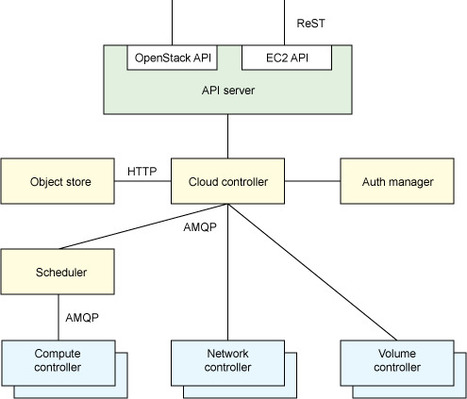
Cloud computing is no longer a technology on the cusp of breaking out but a valuable and important technology that is fundamentally changing the way we use and develop on-demand applications. As you would expect, Linux and open source provide the foundation for the cloud (for public and private infrastructures). Explore the anatomy of the cloud, its architecture, and the open source technologies used to build these dynamic and scalable computing and storage platforms.
|
|
Scooped by
Nicolas Weil
June 27, 2012 1:56 AM
|
Its been over six months since I did my roundup of 11 API service providers on ProgrammableWeb. I've been seeing enough new entries into the space, I think its time to do another roundup, providing a single list of API service providers for you to explore.
|
|
Scooped by
Nicolas Weil
June 20, 2012 3:30 AM
|
Many see service oriented architecture as laying the groundwork for cloud. But at one well-known company, cloud has instigated the move to SOA. As Netflix, the internet and mail-based subscription service for movies and TV programs, moved to the cloud, the company saw an opportunity to recast the mold for how they build and deploy software. The company moved to a more decentralized model, in which individual business units took ownership of the services they were building, deploying and managing. READ ALSO http://techblog.netflix.com/2012/06/netflix-operations-part-i-going.html
|
|
Scooped by
Nicolas Weil
May 25, 2012 8:46 AM
|
Brian Moyles and Gareth Bowles from Netflix describe the continuous integration system that lets them build and deploy the Netflix streaming service fast and at scale.
|
|
Scooped by
Nicolas Weil
May 16, 2012 4:53 AM
|
NVIDIA today kicked off the GPU Technology Conference (GTC) by unveiling technologies that accelerate cloud computing using the computing capabilities of the GPU. NVIDIA's cloud GPU technologies are based on the company's new Kepler GPU architecture, designed for use in large-scale data centers. Its virtualization capabilities allow GPUs to be simultaneously shared by multiple users. NVIDIA claims that its ultra-fast streaming display capability eliminates lag, making a remote data center feel like it's just next door. And its extreme energy efficiency and processing density lowers data center costs. MORE ON SAME TOPIC : http://www.engadget.com/2012/05/16/nvidia-tesla-gpus/
|
|
|
Scooped by
Nicolas Weil
September 24, 2012 3:49 AM
|
In recent years, a lot of research on the Semantic Web, described by Tim Berners Lee has been done. Semantic Web technologies can help overcome the challenges we face today in traditional SOA projects. Realizing service-orientation's full potential will require integrating SOA and Semantic Web technologies. In this article I will explore how and where semantic web technologies can be adopted to lift traditional SOA to a next level, and form a solid foundation for flexible business solutions and innovative pervasive computing platforms. Read also part 2 : http://www.servicetechmag.com/I66/0912-3
|
|
Scooped by
Nicolas Weil
September 17, 2012 4:30 AM
|
The emergence of cloud computing has resulted in an increase in data centers, primarily due to rising global demand. The newly emerging cloud paradigm is heavily based on the Software-as-a-Service (SaaS) concept that provides services on-demand, utilising resources more effectively within cloud environments. Service component architecture (SCA) has been developed based on software components to build cloud services and architecture. This article discusses SaaS characteristics and how they can be designed with service components. In this research, we have developed a number of component models that have been designed for supporting cloud design characteristics and their associated architectural layers. This work has also developed a series of best practice design guidelines for service component design that support the componentization of cloud applications.
|
|
Scooped by
Nicolas Weil
September 17, 2012 4:25 AM
|
Some consider cloud computing to be a cure-all for virtually any type of IT infrastructure. And while the cloud certainly delivers on many of its promises, it will never truly provide all that it's capable of unless it's optimized for integration with other applications and evolution for new requirements. What is the best way to provide this? Use a services-oriented architecture (SOA) as the fabric upon which to build your cloud-based applications. In this article, we'll outline the reasons why a SOA is so important for the cloud, and some principles to consider when creating your cloud platform on a SOA.
|
|
Rescooped by
Nicolas Weil
from Cloud Central
September 3, 2012 3:37 AM
|
Service Oriented Architecture was hailed as the next major leap ahead in the ICT industry and was predicted by many to be as big a leap forward as that achieved with Object-Oriented software design patterns. For example, in 2006, Joseph Bih introduced SOA in a research article as an innovative new way to conduct e-business. While much published and promoted in the marketplace, SOA adoption has been the subject of significant controversy, not least of which is the publication of a landmark article by now Gartner Fellow Anne Thomas Manes in January 2009 in which SOA was declared "dead". This publication examines the health of SOA as a relevant paradigm in the ICT industry three years after some market opinion leaders declared SOA dead. [...] As expected, with the advent of any next evolutionary step, thriving software empires will naturally leverage their existing market dominance to promote their products to fulfil the technology needs to ensure that businesses keep abreast with emerging ICT technology trends. As a result, many large enterprises adopted a top-down SOA approach after acquiring licenses for new purported SOA killer applications and frameworks. SOA is however an IT enterprise reorganisation journey and most certainly not a product or a few quantified projects. Prior to acquiring software licenses to support a SOA initiative, any business needs to reorganise their IT approach. In our opinion at globetom, SOA adoption must take place using a bottoms-up approach. SOA is about gradually transforming your present IT assets into a Service Repository asset. With this approach, your assets gradually become your service repository and its underlying business processes that may leverage other finer-grained or atomic business services.
It is our view that the disillusionment that culminated in statements that SOA is dead originated from large enterprises that wrongfully believed SOA to be the silver bullet that will magically rectify highly fragmented and broken IT infrastructures with a major top-down approach. Some of these projects may have originated without the organisation even having adopted an Enterprise Service Bus (ESB) strategy.
Via Peter Azzopardi
|
|
Scooped by
Nicolas Weil
August 27, 2012 6:26 AM
|
Cloud computing and distributed applications are part of a greater shift to building out an ecosystem with inter-dependent parts. This may seem obvious, but what is less obvious is how the industry will interoperate and develop systems that let information flow through the ecosystem. Interoperability, and the challenge of maintaining control of operations in the face of it, is a central issue for those that operate distributed applications on the internet — or “in the cloud.”
|
|
Scooped by
Nicolas Weil
August 17, 2012 3:17 AM
|
WSO2, a global enterprise middleware corporation, has announced the launch of the 100% Open Source WSO2 API Manager after receiving applications from over 140 developers to participate in the beta program. The WSO2 API Manager is “an enterprise-ready, fully-open source, complete solution for creating, publishing and managing all aspects of an API and its life cycle in a scalable manner.” The WSO2 API Manager is the first Open Source API management product that allows developers to manage the entire lifecycle of APIs; from creating, publishing, blocking, deprecating and retiring. Traditional API management systems are often extremely complex and very costly to implement, which causes significant barriers to adoption. In the announcement, Dr. Sanjiva Weerawarana, WSO2 founder and CEO, is quoted as saying that the WSO2 API Manager: “democratizes API management by making it affordable to acquire the software, easy to control APIs and manage the API lifecycle, and simple to find and subscribe to APIs.”
|
|
Scooped by
Nicolas Weil
July 9, 2012 6:05 PM
|
As I discussed in my recent blog post on ProgrammableWeb.com, Netflix has found substantial limitations in the traditional one-size-fits-all (OSFA) REST API approach. As a result, we have moved to a new, fully customizable API. The basis for our decision is that Netflix's streaming service is available on more than 800 different device types, almost all of which receive their content from our private APIs. In our experience, we have realized that supporting these myriad device types with an OSFA API, while successful, is not optimal for the API team, the UI teams or Netflix streaming customers. And given that the key audiences for the API are a small group of known developers to which the API team is very close (i.e., mostly internal Netflix UI development teams), we have evolved our API into a platform for API development. Supporting this platform are a few key philosophies, each of which is instrumental in the design of our new system. These philosophies are as follows: - Embrace the Differences of the Devices
- Separate Content Gathering from Content Formatting/Delivery
- Redefine the Border Between "Client" and "Server"
- Distribute Innovation
|
|
Scooped by
Nicolas Weil
July 8, 2012 7:24 AM
|
Click through for nine database challenges found in the cloud, as identified by Razi Sharir, CEO of Xeround.
|
|
Scooped by
Nicolas Weil
June 27, 2012 2:01 AM
|
WSO2 API Manager is a complete solution for publishing APIs, creating and managing a developer community and for scalably routing API traffic. It leverages proven, production-ready, integration, security and governance components from the WSO2 Enterprise Service Bus, WSO2 Identity Server, and WSO2 Governance Registry. In addition, as it is also powered by the WSO2 Business Activity Monitor, the WSO2 API Manager is ready for massively scalable deployment immediately. As with all WSO2 products, the WSO2 API Manager is 100% open source. Designed for easy customization, it is extensively pluggable to integrate with existing infrastructure in your enterprise.
|
|
Scooped by
Nicolas Weil
June 25, 2012 4:12 PM
|
For the past several years Netflix developers have been using self-service tools to build and deploy hundreds of applications and services to the Amazon cloud. One of those tools is Asgard, a web interface for application deployments and cloud management. Like other open source Netflix projects, Asgard is released under the Apache License, Version 2.0.
|
|
Scooped by
Nicolas Weil
June 6, 2012 4:10 PM
|
After a year of testing the software in beta, Red Hat Wednesday launched its hybrid cloud management software, called CloudForms. CloudForms was designed to unify public and private cloud resources into a single system, even if the underlying clouds use different technologies. With CloudForms, applications can be moved between these clouds without the user or administrator worrying about configuration issues. It provides users with a self-service portal, and administrators with control and governance tools.
|
|
Scooped by
Nicolas Weil
May 25, 2012 6:45 AM
|
Latest version of the Netflix Cloud Architecture story was given at Gluecon May 23rd 2012.
|