Your new post is loading...

|
Scooped by
Loïc Lepiniec
November 15, 2014 3:02 AM
|
Regarder la vidéo «Paris-Saclay, le mag / n°4» envoyée par Paris-Saclay sur Dailymotion.
|
|
Scooped by
Loïc Lepiniec
November 11, 2014 10:38 AM
|
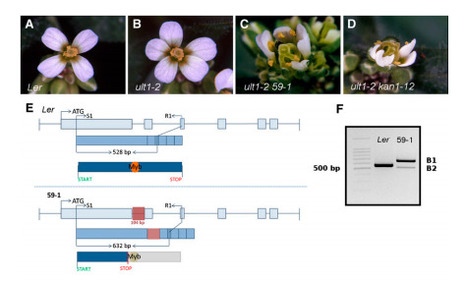
Organ formation relies upon precise patterns of gene expression that are under tight spatial and temporal regulation. Transcription patterns are specified by several cellular processes during development, including chromatin remodeling, but little is known about how chromatin-remodeling factors contribute to plant organogenesis. We demonstrate that the trithorax group (trxG) geneULTRAPETALA1 (ULT1) and the GARP transcription factor gene KANADI1 (KAN1) organize the Arabidopsis thaliana gynoecium along two distinct polarity axes. We show that ULT1 activity is required for the kan1 adaxialized polarity defect, indicating that ULT1 and KAN1 act oppositely to regulate the adaxial-abaxial axis. Conversely, ULT1 and KAN1 together establish apical-basal polarity by promoting basal cell fate in the gynoecium, restricting the expression domain of the basic helix-loop-helix transcription factor gene SPATULA. Finally, we show that ultalleles display dose-dependent genetic interactions with kan alleles and that ULT and KAN proteins can associate physically. Our findings identify a dual role for plant trxG factors in organ patterning, with ULT1 and KAN1 acting antagonistically to pattern the adaxial-abaxial polarity axis but jointly to pattern the apical-basal axis. Our data indicate that the ULT proteins function to link chromatin-remodeling factors with DNA binding transcription factors to regulate target gene expression.
|
|
Scooped by
Loïc Lepiniec
November 10, 2014 2:14 AM
|
|
|
Scooped by
Loïc Lepiniec
November 10, 2014 2:03 AM
|
|
|
Rescooped by
Loïc Lepiniec
from Plant Genomics
November 6, 2014 8:22 AM
|
Understanding the mechanisms underlying gene regulation is paramount to comprehend the translation from genotype to phenotype. The two are connected by gene expression, and it is generally thought that variation in transcription factor (TF) function is an important determinant of phenotypic evolution. We analyzed publicly available genome-wide chromatin immunoprecipitation experiments for 27 TFs in Arabidopsis thaliana and constructed an experimental network containing 46,619 regulatory interactions and 15,188 target genes. We identified hub targets and highly occupied target (HOT) regions, which are enriched for genes involved in development, stimulus responses, signaling, and gene regulatory processes in the currently profiled network. We provide several lines of evidence that TF binding at plant HOT regions is functional, in contrast to that in animals, and not merely the result of accessible chromatin. HOT regions harbor specific DNA motifs, are enriched for differentially expressed genes, and are often conserved across crucifers and dicots, even though they are not under higher levels of purifying selection than non-HOT regions. Distal bound regions are under purifying selection as well and are enriched for a chromatin state showing regulation by the Polycomb repressive complex. Gene expression complexity is positively correlated with the total number of bound TFs, revealing insights in the regulatory code for genes with different expression breadths. The integration of noncanonical and canonical DNA motif information yields new hypotheses on cobinding and tethering between specific TFs involved in flowering and light regulation.
Via Biswapriya Biswavas Misra
|
|
Scooped by
Loïc Lepiniec
November 4, 2014 7:43 AM
|
|
|
Scooped by
Loïc Lepiniec
October 29, 2014 8:55 PM
|
|
|
Scooped by
Loïc Lepiniec
October 16, 2014 3:31 PM
|
BMGIF - Molecular Biology, Mutagenesis, Histology and Imaging Services
|
|
Scooped by
Loïc Lepiniec
October 16, 2014 5:42 AM
|
Bilan de dialogues avec 7 biologistes sur les #OGM
|
|
Rescooped by
Loïc Lepiniec
from Plant Gene Seeker -PGS
October 13, 2014 1:10 PM
|
|
|
Scooped by
Loïc Lepiniec
October 10, 2014 2:03 AM
|
Slides from a 15-minute developer overview presented at the IAIC session at the 2014 ICAR meeting.
|
|
Scooped by
Loïc Lepiniec
October 9, 2014 3:55 AM
|
|
|
|
Scooped by
Loïc Lepiniec
November 14, 2014 1:29 PM
|
Epigenetic reprogramming consists of global changes in DNA methylation and histone modifications. In mammals, epigenetic reprogramming is primarily associated with sexual reproduction and occurs during both gametogenesis and early embryonic development. Such reprogramming is crucial not only to maintain genomic integrity through silencing transposable elements but also to reset the silenced status of imprinted genes. In plants, observations of stable transgenerational inheritance of epialleles have argued against reprogramming. However, emerging evidence supports that epigenetic reprogramming indeed occurs during sexual reproduction in plants and that it has a major role in maintaining genome integrity and a potential contribution to epiallelic variation.
|
|
Scooped by
Loïc Lepiniec
November 10, 2014 2:16 AM
|
|
|
Scooped by
Loïc Lepiniec
November 10, 2014 2:07 AM
|
The novel mutant allele hsi2-4 was isolated in a genetic screen to identify Arabidopsis mutants with constitutively elevated expression of a glutathione S-transferase F8::luciferase (GSTF8::LUC) reporter gene in Arabidopsis. The hsi2-4 mutant harbors a point mutation that affects the plant homeodomain (PHD)-like domain in HIGH-LEVEL EXPRESSION OF SUGAR-INDUCIBLE GENE2 (HSI2)/VIVIPAROUS1/ABI3-LIKE1 (VAL1). In hsi2-4 seedlings, expression of this LUC transgene and certain endogenous seed-maturation genes is constitutively enhanced. The parental reporter line (WT
LUC
) that was used for mutagenesis harbors two independent transgene loci, Kan
R
and Kan
S
. Both loci express luciferase whereas only the Kan
R
locus confers resistance to kanamycin.
|
|
Scooped by
Loïc Lepiniec
November 6, 2014 12:07 PM
|
Understanding the mechanisms underlying gene regulation is paramount to comprehend the translation from genotype to phenotype. The two are connected by gene expression, and it is generally thought that variation in transcription factor (TF) function is an important determinant of phenotypic evolution. We analyzed publicly available genome-wide chromatin immunoprecipitation experiments for 27 TFs in Arabidopsis thaliana and constructed an experimental network containing 46,619 regulatory interactions and 15,188 target genes. We identified hub targets and highly occupied target (HOT) regions, which are enriched for genes involved in development, stimulus responses, signaling, and gene regulatory processes in the currently profiled network. We provide several lines of evidence that TF binding at plant HOT regions is functional, in contrast to that in animals, and not merely the result of accessible chromatin. HOT regions harbor specific DNA motifs, are enriched for differentially expressed genes, and are often conserved across crucifers and dicots, even though they are not under higher levels of purifying selection than non-HOT regions. Distal bound regions are under purifying selection as well and are enriched for a chromatin state showing regulation by the Polycomb repressive complex. Gene expression complexity is positively correlated with the total number of bound TFs, revealing insights in the regulatory code for genes with different expression breadths. The integration of noncanonical and canonical DNA motif information yields new hypotheses on cobinding and tethering between specific TFs involved in flowering and light regulation.
|
|
Scooped by
Loïc Lepiniec
November 4, 2014 7:52 AM
|
Le film d'animation de Locacell et Microcell : le triple zéro. Un engrais starter maïs et céréales qui, sans Azote, sans Phosphore et sans Potassium permet un
|
|
Scooped by
Loïc Lepiniec
November 4, 2014 7:20 AM
|
More than twenty of Europe's most prominent plant scientists today signed a joint letter warning that Europe will never meet agricultural targets unless it starts allowing GM crops
Via CIMMYT, Int., Mary Williams
|
|
Scooped by
Loïc Lepiniec
October 17, 2014 4:44 PM
|
Private companies, Become a SPS’ Innov partner Plant innovation accelerator
|
|
Scooped by
Loïc Lepiniec
October 16, 2014 12:27 PM
|
Highlights
•
Multiple CLE peptides signal through the multi-functional CLV1 receptor kinase.
•
Root meristem development is regulated by CLE and GLV/RGF polypeptide signals.
•
Lateral root emergence relies on auxin-induced, IDA-dependent signaling.
•
Root protoxylem differentiation depends on a CLE45–BAM3 signaling module.
•
ESF1 and CLE8 polypeptides non-cell autonomously control early embryogenesis.
Intercellular communication mediated by small signaling molecules is a key mechanism for coordinating plant growth and development. In the past few years, polypeptide signals have been shown to play prominent roles in processes as diverse as shoot and root meristem maintenance, vascular differentiation, lateral root emergence, and seed formation. Signaling components such as CLV1 and the IDA-HAE/HSL2 signaling module have been discovered to regulate distinct developmental processes in different tissues. Recent studies have also uncovered novel polypeptide–receptor interactions, intracellular components and downstream target genes, adding complexity to our picture of polypeptide signaling networks. Finally, new families of plant polypeptides, such as the GLV/RGF/CLEL and ESF factors, are being identified, the functions of which we are only beginning to understand.
If lobbyists succeed in blocking EU proposals to end a ban on GM seeds, crop biotech in Europe could be lost forever t’s an unfashionable thing to admit, but sometimes what happens in the European Parliament really matters. This week, unnoticed by almost everyone, MEPs will consider proposals by the European commission and member states to overturn a ban on the cultivation of genetically modified (GM) crops in Europe. But it’s a step that could be undermined if anti-GM lobbyists get their way. This little-noticed debate could be crucial for the future of European agriculture. For nearly 15 years the European Union maintained a de-facto ban on any GM cultivation despite repeated advice from independent scientists that GM should be allowed to go ahead. This ban operated because certain countries, such as France and Hungary, have made it clear that they will never approve a GM crop under any circumstances, thereby preventing any other member state within the EU’s single market from allowing farmers to plant biotech seeds. No-one thinks that the French and Hungarians, who seem to have integrated anti-GM superstition into their cultural DNA, are going to change their minds anytime soon. So the proposals put in front of the European Parliament by the commission and member states (via the European council) were intended to allow anti-biotech countries to opt out of any pending GM crop approvals. The likes of France and Hungary would no longer have to advance their customary spurious scientific justifications: a religious-like aversion to new plant breeding technology will do just fine.... Continue reading...
Via Christophe Jacquet
|
|
Rescooped by
Loïc Lepiniec
from Panorama de presse
October 13, 2014 1:08 PM
|
L'économiste français Jean Tirole a été récompensé du prix Nobel de l'Economie, ce lundi. Grand spécialiste de l'«économie industrielle», il a influencé de nombreux chercheurs français et étrangers par ses travaux, notamment sur les liens entre l'économie et la psychologie, mais aussi sur les flux financiers et l'entreprise. On lui doit également la théorie de la Concurrence imparfaite, qui remet en cause le modèle libéral américain.
Via École polytechnique
|
|
Scooped by
Loïc Lepiniec
October 9, 2014 3:23 PM
|
|


 Scoop.it!