ICT Security-Sécurité PC et Internet
114.2K views | +0 today
ICT Security-Sécurité PC et Internet
ICT Security + Privacy + Piracy + Data Protection - Censorship - Des cours et infos gratuites sur la"Sécurité PC et Internet" pour usage non-commercial... (FR, EN+DE)...
Curated by Gust MEES
Your new post is loading...
Scooped by Gust MEES
November 18, 2014 11:52 AM
Scoop.it!

Félix Braz a été reçu par l’assistant spécial du Président Obama pour des questions de cyber-sécurité | Luxembourg | CyberSecurity

Félix Braz a été reçu par l’assistant spécial du Président Obama pour des questions de cyber-sécurité | Luxembourg | CyberSecurity | ICT Security-Sécurité PC et Internet | Scoop.it

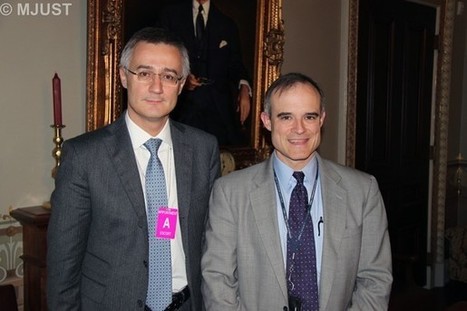
Dans le cadre de ses entrevues à Washington DC, le ministre de la Justice Félix Braz a eu le 17 novembre 2014 à la Maison Blanche un entretien avec J. Michael Daniel, assistant spécial du Président Obama pour les questions de cyber-sécurité.


Le ministre de la Justice a souligné que le Luxembourg consacre des efforts constants et croissants à la sécurité de l’espace cyber tant pour le domaine privé que public. Ceci d’autant plus que le Luxembourg est un acteur majeur en Europe dans le commerce électronique, qu’il constitue une plaque tournante des médias (RTL) et qu’il héberge le plus grand opérateur mondial de satellites avec la SES. En outre, le Luxembourg est en train de devenir un centre d’excellence pour les paiements mobiles.

Gust MEES's insight:

Dans le cadre de ses entrevues à Washington DC, le ministre de la Justice Félix Braz a eu le 17 novembre 2014 à la Maison Blanche un entretien avec J. Michael Daniel, assistant spécial du Président Obama pour les questions de cyber-sécurité.


Le ministre de la Justice a souligné que le Luxembourg consacre des efforts constants et croissants à la sécurité de l’espace cyber tant pour le domaine privé que public. Ceci d’autant plus que le Luxembourg est un acteur majeur en Europe dans le commerce électronique, qu’il constitue une plaque tournante des médias (RTL) et qu’il héberge le plus grand opérateur mondial de satellites avec la SES. En outre, le Luxembourg est en train de devenir un centre d’excellence pour les paiements mobiles.

Scooped by Gust MEES
November 16, 2014 2:31 PM
Scoop.it!

BASHLITE Affects Devices Running on BusyBox | Routers | CyberSecurity

BASHLITE Affects Devices Running on BusyBox | Routers | CyberSecurity | ICT Security-Sécurité PC et Internet | Scoop.it

When news of the Shellshock vulnerability broke out at the end of September, we spotted several attacks that leveraged the said vulnerability, thus manifesting the prevalence or even evolution on how attackers used the exploit. For instance, attackers used Shellshock to target SMTP servers, launch botnet attacks, and even to download KAITEN source code among others.

Gust MEES's insight:

When news of the Shellshock vulnerability broke out at the end of September, we spotted several attacks that leveraged the said vulnerability, thus manifesting the prevalence or even evolution on how attackers used the exploit. For instance, attackers used Shellshock to target SMTP servers, launch botnet attacks, and even to download KAITEN source code among others.


No comment yet.
Scooped by Gust MEES
November 15, 2014 3:47 AM
Scoop.it!

Law Enforcement Agencies in Tor: Impact Over the Dark Web

Law Enforcement Agencies in Tor: Impact Over the Dark Web | ICT Security-Sécurité PC et Internet | Scoop.it
The recent shutdown of SilkRoad 2.0 was just a small part of the events affecting the Tor network that unfolded last week.


Cybercrime, just like any other illegal activity, is hard to eradicate completely. Whenever illegal services are taken down, the gap created will always be filled by other criminals willing to profit from the opportunity. The reality we have to accept is that there will always be demand for such services.


Learn more:


- http://www.scoop.it/t/securite-pc-et-internet/?tag=TOR


Gust MEES's insight:
The recent shutdown of SilkRoad 2.0 was just a small part of the events affecting the Tor network that unfolded last week.


Cybercrime, just like any other illegal activity, is hard to eradicate completely. Whenever illegal services are taken down, the gap created will always be filled by other criminals willing to profit from the opportunity. The reality we have to accept is that there will always be demand for such services.


Learn more:


- http://www.scoop.it/t/securite-pc-et-internet/?tag=TOR


No comment yet.
Scooped by Gust MEES
November 14, 2014 6:25 PM
Scoop.it!

U.S. Authorities Are Reportedly Gathering Phone Data Using Fake Celltowers On Planes

U.S. Authorities Are Reportedly Gathering Phone Data Using Fake Celltowers On Planes | ICT Security-Sécurité PC et Internet | Scoop.it
Edward Snowden may have gone public with his NSA leaks more than 18 months ago, but the rate at which we learn new information about government spying programs shows little sign of slowing. Witness today, the Wall Street Journal published a report claiming that the U.S. Justice Department is “snagging [mobile data belonging to] a large number of innocent Americans’” via technology that can identify criminal suspects using planes.

The WSJ cites sources who claim that the U.S. Marshals Service is using fake cell towers on airplanes — dubbed ‘dirtboxes’ — in order to access data from phones located on the ground.

Essentially, the dirtboxes pose as legitimate network operators, providing signal to devices which, it is claimed, can allow them to prize registration and identification information from a ‘target’. When successful, this removes the time-consuming need to go through mobile operators to gain these details during searches for suspects, it is argued.


Learn more:


- http://www.scoop.it/t/securite-pc-et-internet/?tag=Spy+Airplanes


Gust MEES's insight:
Edward Snowden may have gone public with his NSA leaks more than 18 months ago, but the rate at which we learn new information about government spying programs shows little sign of slowing. Witness today, the Wall Street Journal published a report claiming that the U.S. Justice Department is “snagging [mobile data belonging to] a large number of innocent Americans’” via technology that can identify criminal suspects using planes.

The WSJ cites sources who claim that the U.S. Marshals Service is using fake cell towers on airplanes — dubbed ‘dirtboxes’ — in order to access data from phones located on the ground.

Essentially, the dirtboxes pose as legitimate network operators, providing signal to devices which, it is claimed, can allow them to prize registration and identification information from a ‘target’. When successful, this removes the time-consuming need to go through mobile operators to gain these details during searches for suspects, it is argued.


Learn more:


- http://www.scoop.it/t/securite-pc-et-internet/?tag=Spy+Airplanes


No comment yet.
Scooped by Gust MEES
November 14, 2014 6:15 PM
Scoop.it!

The Feds Are Now Using 'Stingrays' in Planes to Spy on Our Phone Calls | Privacy

The Feds Are Now Using 'Stingrays' in Planes to Spy on Our Phone Calls | Privacy | ICT Security-Sécurité PC et Internet | Scoop.it
It’s bad enough the government has been skulking around in cars and vans with a little device that can impersonate a cell phone tower and track you.

Now, in a move that should surprise no one, it’s taking to the skies to expand its tracking reach, in a move that would also allow it to collect data on more people at once.

That’s according to a new report from the Wall Street Journal indicating that the government has been using Cessna planes outfitted with special phone surveillance equipment to track suspects. But the surveillance system is designed to pick up the phone signals of anyone within range. The range of the equipment is currently unknown, but it means that data on potentially tens of thousands of phones could be collected during a single flight.


Learn more:


- http://www.scoop.it/t/securite-pc-et-internet/?tag=Spy+Airplanes


Gust MEES's insight:
It’s bad enough the government has been skulking around in cars and vans with a little device that can impersonate a cell phone tower and track you.

Now, in a move that should surprise no one, it’s taking to the skies to expand its tracking reach, in a move that would also allow it to collect data on more people at once.

That’s according to a new report from the Wall Street Journal indicating that the government has been using Cessna planes outfitted with special phone surveillance equipment to track suspects. But the surveillance system is designed to pick up the phone signals of anyone within range. The range of the equipment is currently unknown, but it means that data on potentially tens of thousands of phones could be collected during a single flight.


Learn more:


- http://www.scoop.it/t/securite-pc-et-internet/?tag=Spy+Airplanes


No comment yet.
Scooped by Gust MEES
November 14, 2014 10:29 AM
Scoop.it!

Aux Etats-Unis, des avions pour surveiller les téléphones

Aux Etats-Unis, des avions pour surveiller les téléphones | ICT Security-Sécurité PC et Internet | Scoop.it
Les autorités américaines disposent d'un outil surprenant pour mener certaines filatures, nous apprend le Wall Street Journal, jeudi 13 novembre.
Selon le quotidien américain, qui cite des sources anonymes au ministère de la justice, l'unité de police du ministère, les US Marshals, ont recours à de petits avions de tourisme pour surveiller les communications des téléphones portables de leurs suspects.

Ces aéronefs, capables de survoler la quasi-totalité de la population américaine, sont équipés d'appareils imitant les antennes-relais auxquelles se connectent les téléphones portables pour communiquer. En se faisant passer pour ces antennes, ils peuvent tromper le téléphone d'un suspect et capter des informations nécessaires à sa localisation.


Learn more:


- http://www.scoop.it/t/securite-pc-et-internet/?tag=Spy+Airplanes


Gust MEES's insight:

Les autorités américaines disposent d'un outil surprenant pour mener certaines filatures, nous apprend le Wall Street Journal, jeudi 13 novembre.
Selon le quotidien américain, qui cite des sources anonymes au ministère de la justice, l'unité de police du ministère, les US Marshals, ont recours à de petits avions de tourisme pour surveiller les communications des téléphones portables de leurs suspects.

Ces aéronefs, capables de survoler la quasi-totalité de la population américaine, sont équipés d'appareils imitant les antennes-relais auxquelles se connectent les téléphones portables pour communiquer. En se faisant passer pour ces antennes, ils peuvent tromper le téléphone d'un suspect et capter des informations nécessaires à sa localisation.


Learn more:


- http://www.scoop.it/t/securite-pc-et-internet/?tag=Spy+Airplanes


No comment yet.
Scooped by Gust MEES
November 10, 2014 4:22 PM
Scoop.it!

United States Postal Service Hacked

United States Postal Service Hacked | ICT Security-Sécurité PC et Internet | Scoop.it
Here’s what we know:

The hack was seemingly focused not on nabbing customer credit cards, but on employee data. The hackers likely had access to confidential data on all 800,000 USPS employees. That includes names, social security numbers, addresses, and pretty much anything else you’d put on a job application.
Customer credit card information seemingly wasn’t exposed. However, anyone who called USPS customer support from January 1st to August 16th of 2014 might have had information stolen, depending on what information they provided to the CS rep; things like names, addresses, telephone numbers, and email addresses.
The intrusion was first detected in mid-September, nearly 2 full months before being disclosed. The USPS says this delay was because “communicating the breach immediately would have put the remediation actions in
jeopardy…”
Gust MEES's insight:

Here’s what we know:

  • The hack was seemingly focused not on nabbing customer credit cards, but on employee data. The hackers likely had access to confidential data on all 800,000 USPS employees. That includes names, social security numbers, addresses, and pretty much anything else you’d put on a job application.
  • Customer credit card information seemingly wasn’t exposed. However, anyone who called USPS customer support from January 1st to August 16th of 2014 might have had information stolen, depending on what information they provided to the CS rep; things like names, addresses, telephone numbers, and email addresses.
  • The intrusion was first detected in mid-September, nearly 2 full months before being disclosed. The USPS says this delay was because “communicating the breach immediately would have put the remediation actions in
    jeopardy…”


No comment yet.
Scooped by Gust MEES
November 10, 2014 11:31 AM
Scoop.it!

Thoughts and Concerns about Operation Onymous | The Tor Blog

Thoughts and Concerns about Operation Onymous | The Tor Blog | ICT Security-Sécurité PC et Internet | Scoop.it

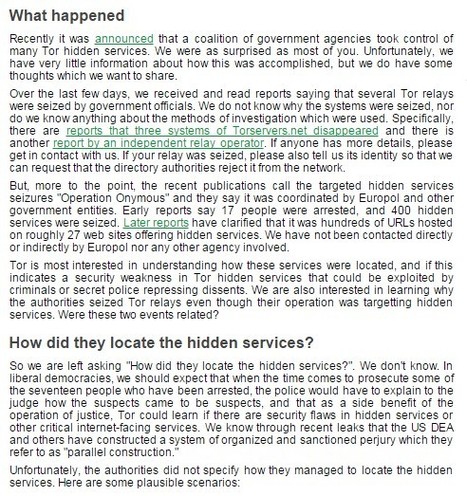
Learn more:


- http://www.scoop.it/t/securite-pc-et-internet/?tag=TOR


Gust MEES's insight:

Learn more:


- http://www.scoop.it/t/securite-pc-et-internet/?tag=TOR


No comment yet.
Scooped by Gust MEES
November 9, 2014 8:45 AM
Scoop.it!

53 million email addresses stolen in Home Depot breach

53 million email addresses stolen in Home Depot breach | ICT Security-Sécurité PC et Internet | Scoop.it
In addition to the 56 million credit cards exposed in the recent breach at Home Depot, investigators have now revealed that more than 53 million email addresses were stolen too.
Gust MEES's insight:
53 million email addresses stolen!!!


No comment yet.
Scooped by Gust MEES
November 7, 2014 3:50 PM
Scoop.it!

How Did The FBI Break Tor?

How Did The FBI Break Tor? | ICT Security-Sécurité PC et Internet | Scoop.it
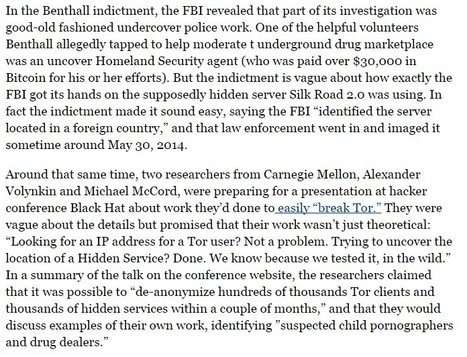
If you control enough of the Tor network, it’s possible to get a kind of bird’s eye view of the traffic being routed through it. It was clear that Tor thought the Carnegie Mellon researchers were responsible. The researchers refused to talk to the press, but a conference spokesperson told Reuters the talk was canceled because the researchers hadn’t cleared the release of their work through their department, the Software Engineering Institute, which is funded by the Defense Department.


At the time, many assumed that the university pulled the plug on the talk because of the gray legal zone it was in, with the researchers casually intercepting Web traffic. But maybe it got pulled because the researchers were revealing a law enforcement technique that the government did not want publicized. If nothing else, it’s highly likely the information the researchers collected about “drug dealers and child pornographers” made its way into law enforcement hands. McCord said he was “unable to comment on the matter.” Carnegie Mellon’s SEI declined comment about the canceled talk and about whether it had provided information from the research to law enforcement.


Learn more:


- http://www.scoop.it/t/securite-pc-et-internet/?tag=TOR


Gust MEES's insight:
If you control enough of the Tor network, it’s possible to get a kind of bird’s eye view of the traffic being routed through it. It was clear that Tor thought the Carnegie Mellon researchers were responsible. The researchers refused to talk to the press, but a conference spokesperson told Reuters the talk was canceled because the researchers hadn’t cleared the release of their work through their department, the Software Engineering Institute, which is funded by the Defense Department.


At the time, many assumed that the university pulled the plug on the talk because of the gray legal zone it was in, with the researchers casually intercepting Web traffic. But maybe it got pulled because the researchers were revealing a law enforcement technique that the government did not want publicized. If nothing else, it’s highly likely the information the researchers collected about “drug dealers and child pornographers” made its way into law enforcement hands. McCord said he was “unable to comment on the matter.” Carnegie Mellon’s SEI declined comment about the canceled talk and about whether it had provided information from the research to law enforcement.


Learn more:


- http://www.scoop.it/t/securite-pc-et-internet/?tag=TOR


No comment yet.
Scooped by Gust MEES
November 6, 2014 3:40 PM
Scoop.it!

Not Just Silk Road 2: Feds Seize Two Other Drug Markets and Counting | Cybercrime

Not Just Silk Road 2: Feds Seize Two Other Drug Markets and Counting | Cybercrime | ICT Security-Sécurité PC et Internet | Scoop.it
On Thursday the FBI along with other law enforcement agencies including the Department of Homeland Security and Europol announced that it had seized the Silk Road 2, perhaps the most well-known drug market to appear on the Dark Web since the takedown of the original Silk Road last year. What it didn’t announce is that at least two other drug market sites have also been busted, and more takedowns are likely coming. The drug markets Hydra and Cloud 9 now both display the same “This Hidden Site Has Been Seized” notices as the Silk Road 2, emblazoned with the logos of the FBI and Europol. Several other popular dark net markets were down Thursday morning, as well, though they didn’t display that banner. An FBI spokesperson tells WIRED that there will be more than three market seizures in total, with the full extent of the operation set to be revealed by Friday.

The string of drug market busts appears to be part of Operation “Onymous,” a global law enforcement effort that has already led to the arrest of three people. Yesterday the FBI arrested Blake Benthall in San Francisco and accused him in a criminal complaint of running the Silk Road 2 drug site under the pseudonym “Defcon.” Two other suspects were arrested separately in Dublin, and cops say they’ve seized from them $250,000 worth of drugs and as much as $2.5 million worth of bitcoin. An FBI spokesperson confirms that the arrests are part of a “coordinated law enforcement action,” but not part of the same case.


Learn more:


- http://www.scoop.it/t/securite-pc-et-internet/?tag=TOR


Gust MEES's insight:

On Thursday the FBI along with other law enforcement agencies including the Department of Homeland Security and Europol announced that it had seized the Silk Road 2, perhaps the most well-known drug market to appear on the Dark Web since the takedown of the original Silk Road last year. What it didn’t announce is that at least two other drug market sites have also been busted, and more takedowns are likely coming. The drug markets Hydra and Cloud 9 now both display the same “This Hidden Site Has Been Seized” notices as the Silk Road 2, emblazoned with the logos of the FBI and Europol. Several other popular dark net markets were down Thursday morning, as well, though they didn’t display that banner. An FBI spokesperson tells WIRED that there will be more than three market seizures in total, with the full extent of the operation set to be revealed by Friday.


The string of drug market busts appears to be part of Operation “Onymous,” a global law enforcement effort that has already led to the arrest of three people. Yesterday the FBI arrested Blake Benthall in San Francisco and accused him in a criminal complaint of running the Silk Road 2 drug site under the pseudonym “Defcon.” Two other suspects were arrested separately in Dublin, and cops say they’ve seized from them $250,000 worth of drugs and as much as $2.5 million worth of bitcoin. An FBI spokesperson confirms that the arrests are part of a “coordinated law enforcement action,” but not part of the same case.


Learn more:


- http://www.scoop.it/t/securite-pc-et-internet/?tag=TOR


No comment yet.
Scooped by Gust MEES
October 31, 2014 9:57 AM
Scoop.it!

Apple Pay rival CurrentC hacked | Cyber Security

Apple Pay rival CurrentC hacked | Cyber Security | ICT Security-Sécurité PC et Internet | Scoop.it
CurrentC, the merchant's answer to NFC payment systems, has been hacked during its pilot program.
Gust MEES's insight:

CurrentC, the merchant's answer to NFC payment systems, has been hacked during its pilot program.


No comment yet.
Scooped by Gust MEES
October 22, 2014 10:28 AM
Scoop.it!

Microsoft warns users about 0-day behind PowerPoint attacks

Microsoft warns users about 0-day behind PowerPoint attacks | ICT Security-Sécurité PC et Internet | Scoop.it

Might put out patch in update, might chuck it out sooner.

The bug (CVE-2014-6352) can be triggered by sending a specially crafted Microsoft Office files to intended targets before tricking them into opening the booby-trapped files. "Currently, attacks using PowerPoint files are known to exist, but all Office file types can be used to carry out this attack," Jonathan Leopando, a technical communications staffer at Trend Micro, warns in a blog post.


Gust MEES's insight:

The bug (CVE-2014-6352) can be triggered by sending a specially crafted Microsoft Office files to intended targets before tricking them into opening the booby-trapped files. "Currently, attacks using PowerPoint files are known to exist, but all Office file types can be used to carry out this attack," Jonathan Leopando, a technical communications staffer at Trend Micro, warns in a blog post.

No comment yet.
Scooped by Gust MEES
November 18, 2014 11:19 AM
Scoop.it!

Microsoft to release Windows security fix today | UPDATE asap!!!

Microsoft to release Windows security fix today | UPDATE asap!!! | ICT Security-Sécurité PC et Internet | Scoop.it

An out-of-band update to all Windows versions will be released today. This is MS14-068, one of two updates held back on the November Patch Tuesday.

Gust MEES's insight:

An out-of-band update to all Windows versions will be released today. This is MS14-068, one of two updates held back on the November Patch Tuesday.


No comment yet.
Scooped by Gust MEES
November 15, 2014 3:58 AM
Scoop.it!

iOS tombe et Windows Phone résiste lors d’une compétition de hackers

iOS tombe et Windows Phone résiste lors d’une compétition de hackers | ICT Security-Sécurité PC et Internet | Scoop.it
L’iPhone 5S a été mis à mal par une équipe de Corée du Sud, qui a réussi à profiter d'une combinaison de deux bugs dans Safari pour en prendre le contrôle. Le Samsung Galaxy S5 non plus n'a pas réisté aux assauts des hackers. Deux équipes ont profité de failles dans la gestion du protocole NFC pour en prendre le contrôle. le Nexus 5 a lui aussi été piraté via NFC, grâce à une technique étonnante, qui a consisté à forcer un appairage Bluetooth entre deux appareils.
Gust MEES's insight:

L’iPhone 5S a été mis à mal par une équipe de Corée du Sud, qui a réussi à profiter d'une combinaison de deux bugs dans Safari pour en prendre le contrôle. Le Samsung Galaxy S5 non plus n'a pas réisté aux assauts des hackers. Deux équipes ont profité de failles dans la gestion du protocole NFC pour en prendre le contrôle. le Nexus 5 a lui aussi été piraté via NFC, grâce à une technique étonnante, qui a consisté à forcer un appairage Bluetooth entre deux appareils.

Gust MEES's curator insight, November 15, 2014 4:02 AM
L’iPhone 5S a été mis à mal par une équipe de Corée du Sud, qui a réussi à profiter d'une combinaison de deux bugs dans Safari pour en prendre le contrôle. Le Samsung Galaxy S5 non plus n'a pas réisté aux assauts des hackers. Deux équipes ont profité de failles dans la gestion du protocole NFC pour en prendre le contrôle. le Nexus 5 a lui aussi été piraté via NFC, grâce à une technique étonnante, qui a consisté à forcer un appairage Bluetooth entre deux appareils.


Scooped by Gust MEES
November 14, 2014 10:24 PM
Scoop.it!

81% of Tor users can be de-anonymised by analysing router information, research indicates

81% of Tor users can be de-anonymised by analysing router information, research indicates | ICT Security-Sécurité PC et Internet | Scoop.it
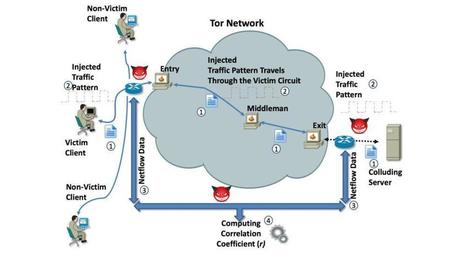
Cisco routers contain traffic-flow software which can help an attacker deduce the identity of a Tor client.


Learn more:


- http://www.scoop.it/t/securite-pc-et-internet/?tag=TOR


Gust MEES's insight:
Cisco routers contain traffic-flow software which can help an attacker deduce the identity of a Tor client.


Learn more:


- http://www.scoop.it/t/securite-pc-et-internet/?tag=TOR


No comment yet.
Scooped by Gust MEES
November 14, 2014 6:19 PM
Scoop.it!

US government uses fake cell towers, flown on airplanes, to harvest phone data and track down criminals

US government uses fake cell towers, flown on airplanes, to harvest phone data and track down criminals | ICT Security-Sécurité PC et Internet | Scoop.it
Proving yet again that the US government can show a surprising soupçon of tenacity when it comes to invading privacy and occasionally catching a terrorist, a new report claims that the US Marshals Service -- since 2007 -- has been criss-crossing the country with small airplanes equipped with fake cell towers. These small aircraft (fixed-wing Cessnas) intercept communications between your mobile phone and the carrier's legitimate cell tower, allowing the US Marshals to find and triangulate the ex


Learn more:


- http://www.scoop.it/t/securite-pc-et-internet/?tag=Spy+Airplanes


Gust MEES's insight:
Proving yet again that the US government can show a surprising soupçon of tenacity when it comes to invading privacy and occasionally catching a terrorist, a new report claims that the US Marshals Service -- since 2007 -- has been criss-crossing the country with small airplanes equipped with fake cell towers. These small aircraft (fixed-wing Cessnas) intercept communications between your mobile phone and the carrier's legitimate cell tower, allowing the US Marshals to find and triangulate the ex


Learn more:


- http://www.scoop.it/t/securite-pc-et-internet/?tag=Spy+Airplanes


No comment yet.
Scooped by Gust MEES
November 14, 2014 11:18 AM
Scoop.it!

OnionDuke: APT Attacks Via the Tor Network | Cyber Security

OnionDuke: APT Attacks Via the Tor Network | Cyber Security | ICT Security-Sécurité PC et Internet | Scoop.it

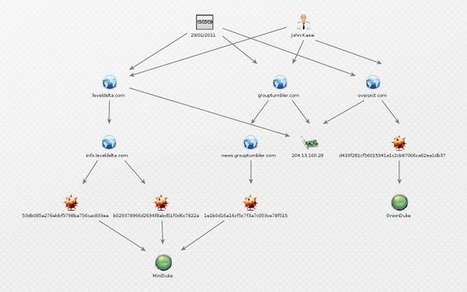
Recently, research was published identifying a Tor exit node, located in Russia, that was consistently and maliciously modifying any uncompressed Windows executables downloaded through it. Naturally this piqued our interest, so we decided to peer down the rabbit hole. Suffice to say, the hole was a lot deeper than we expected! In fact, it went all the way back to the notorious Russian APT family MiniDuke, known to have been used in targeted attacks against NATO and European government agencies.


The malware used in this case is, however, not a version of MiniDuke. It is instead a separate, distinct family of malware that we have since taken to calling OnionDuke.


Learn more:


- http://www.scoop.it/t/securite-pc-et-internet/?tag=TOR


Gust MEES's insight:

Recently, research was published identifying a Tor exit node, located in Russia, that was consistently and maliciously modifying any uncompressed Windows executables downloaded through it. Naturally this piqued our interest, so we decided to peer down the rabbit hole. Suffice to say, the hole was a lot deeper than we expected! In fact, it went all the way back to the notorious Russian APT family MiniDuke, known to have been used in targeted attacks against NATO and European government agencies.


The malware used in this case is, however, not a version of MiniDuke. It is instead a separate, distinct family of malware that we have since taken to calling OnionDuke.


Learn more:


- http://www.scoop.it/t/securite-pc-et-internet/?tag=TOR


No comment yet.
Scooped by Gust MEES
November 13, 2014 7:45 PM
Scoop.it!

WSJ: A Secret U.S. Spy Program Is Using Planes to Target Cell Phones

WSJ: A Secret U.S. Spy Program Is Using Planes to Target Cell Phones | ICT Security-Sécurité PC et Internet | Scoop.it
This is a huge deal. If the details in the WSJ are accurate, this program is as invasive and disturbing as the NSA surveillance programs exposed last year.


American Civil Liberties Union chief technologist Christopher Soghoian told the WSJ that this was "a dragnet surveillance program. It's inexcusable and it's likely—to the extent judges are authorizing it—[that] they have no idea of the scale of it."


Learn more:


- http://www.scoop.it/t/securite-pc-et-internet/?tag=Spy+Airplanes


Gust MEES's insight:

This is a huge deal. If the details in the WSJ are accurate, this program is as invasive and disturbing as the NSA surveillance programs exposed last year.


American Civil Liberties Union chief technologist Christopher Soghoian told the WSJ that this was "a dragnet surveillance program. It's inexcusable and it's likely—to the extent judges are authorizing it—[that] they have no idea of the scale of it."


Learn more:


- http://www.scoop.it/t/securite-pc-et-internet/?tag=Spy+Airplanes


No comment yet.
Scooped by Gust MEES
November 10, 2014 11:37 AM
Scoop.it!

Darkhotel: Angriff über Hotel-WLAN wird raffiniert

Darkhotel: Angriff über Hotel-WLAN wird raffiniert | ICT Security-Sécurité PC et Internet | Scoop.it
Der Security-Dienstleister Kaspersky warnt vor einer fiesen Masche, dem Angriff auf einzelne Hotelgäste über das geschützte WLAN. Das Szenario trägt den Namen "Darkhotel".


Learn more:


- http://gustmees.wordpress.com/2013/05/27/dangers-of-wifi-in-public-places/


Gust MEES's insight:
Der Security-Dienstleister Kaspersky warnt vor einer fiesen Masche, dem Angriff auf einzelne Hotelgäste über das geschützte WLAN. Das Szenario trägt den Namen "Darkhotel".


Learn more:


- http://gustmees.wordpress.com/2013/05/27/dangers-of-wifi-in-public-places/

No comment yet.
Scooped by Gust MEES
November 9, 2014 8:53 AM
Scoop.it!

How Attackers Can Use Radio Signals and Mobile Phones to Steal Protected Data | Cyberespionage

How Attackers Can Use Radio Signals and Mobile Phones to Steal Protected Data | Cyberespionage | ICT Security-Sécurité PC et Internet | Scoop.it
Dubbed “AirHopper” by the researchers at Cyber Security Labs at Ben Gurion University, the proof-of-concept technique allows hackers and spies to surreptitiously siphon passwords and other data from an infected computer using radio signals generated and transmitted by the computer and received by a mobile phone. The research was conducted by Mordechai Guri, Gabi Kedma, Assaf Kachlon, and overseen by their advisor Yuval Elovici.

The attack borrows in part from previous research showing how radio signals (.pdf) can be generated by a computer’s video card (.pdf). The researchers in Israel have developed malware that exploits this vulnerability by generating radio signals that can transmit modulated data that is then received and decoded by the FM radio receiver built into mobile phones. FM receivers come installed in many mobile phones as an emergency backup, in part, for receiving radio transmissions when the internet and cell networks are down. Using this function, however, attackers can turn a ubiquitous and seemingly innocuous device into an ingenious spy tool. Though a company or agency may think it has protected its air-gapped network by detaching it from the outside world, the mobile phones on employee desktops and in their pockets still provide attackers with a vector to reach classified and other sensitive data.
Gust MEES's insight:

Dubbed “AirHopper” by the researchers at Cyber Security Labs at Ben Gurion University, the proof-of-concept technique allows hackers and spies to surreptitiously siphon passwords and other data from an infected computer using radio signals generated and transmitted by the computer and received by a mobile phone. The research was conducted by Mordechai Guri, Gabi Kedma, Assaf Kachlon, and overseen by their advisor Yuval Elovici.

The attack borrows in part from previous research showing how radio signals(.pdf) can be generated by a computer’s video card (.pdf). The researchers in Israel have developed malware that exploits this vulnerability by generating radio signals that can transmit modulated data that is then received and decoded by the FM radio receiver built into mobile phones. FM receivers come installed in many mobile phones as an emergency backup, in part, for receiving radio transmissions when the internet and cell networks are down. Using this function, however, attackers can turn a ubiquitous and seemingly innocuous device into an ingenious spy tool. Though a company or agency may think it has protected its air-gapped network by detaching it from the outside world, the mobile phones on employee desktops and in their pockets still provide attackers with a vector to reach classified and other sensitive data.

No comment yet.
Scooped by Gust MEES
November 7, 2014 4:25 PM
Scoop.it!

Windows Version of WireLurker Malware Discovered | Cyber Security | CyberCrime

Windows Version of WireLurker Malware Discovered | Cyber Security | CyberCrime | ICT Security-Sécurité PC et Internet | Scoop.it


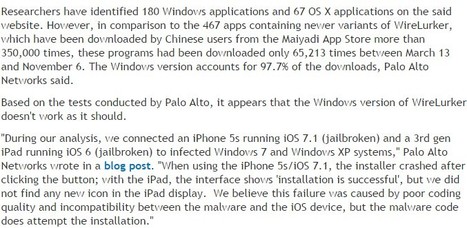
Researchers have pointed out an interesting aspect of the iOS malware. The threat contains binary code for 32-bit ARMv7, 32-bit ARMv7s, and 64-bit ARM64 architectures. This makes WireLurker the first iOS malware that targets the ARM64 architecture.

The Maiyadi App Store on which the initially discovered variants were hosted seems to be linked to the creators of the malware, Palo Alto said. One piece of evidence is the bundle identifier named "com.maiyadi.installer" in the OS X samples. The samples also include copyright information referencing Maiyadi.

The C&C servers user by WireLurker are currently inactive, and Apple has taken steps to ensure that its users are protected, including the revocation of the stolen code signing certificates used by the malware creators to run the malicious iOS apps on non-jailbroken devices.


Learn more:


- http://www.scoop.it/t/apple-mac-ios4-ipad-iphone-and-in-security?q=wirelurker

Gust MEES's insight:
Researchers have pointed out an interesting aspect of the iOS malware. The threat contains binary code for 32-bit ARMv7, 32-bit ARMv7s, and 64-bit ARM64 architectures. This makes WireLurker the first iOS malware that targets the ARM64 architecture.

The Maiyadi App Store on which the initially discovered variants were hosted seems to be linked to the creators of the malware, Palo Alto said. One piece of evidence is the bundle identifier named "com.maiyadi.installer" in the OS X samples. The samples also include copyright information referencing Maiyadi.

The C&C servers user by WireLurker are currently inactive, and Apple has taken steps to ensure that its users are protected, including the revocation of the stolen code signing certificates used by the malware creators to run the malicious iOS apps on non-jailbroken devices.


Learn more:


- http://www.scoop.it/t/apple-mac-ios4-ipad-iphone-and-in-security?q=wirelurker


No comment yet.
Scooped by Gust MEES
November 7, 2014 8:28 AM
Scoop.it!

Huge raid shuts 400 'dark net' sites

Huge raid shuts 400 'dark net' sites | ICT Security-Sécurité PC et Internet | Scoop.it

Silk Road 2.0 and 400 other sites believed to be selling illegal items including drugs and weapons have been shut down.

The sites operated on the Tor network - a part of the internet unreachable via traditional search engines.

The joint operation between 16 European countries and the US saw 17 arrests, including Blake Benthall who is said to be behind Silk Road 2.0.

Experts believe the shutdown represents a breakthrough for fighting cybercrime.

Six Britons were also arrested, including a 20-year-old man from Liverpool, a 19-year-old man from New Waltham, a 30 year-old-man from Cleethorpes and a man and woman, both aged 58, from Aberdovey, Wales.

All were interviewed and bailed according to the National Crime Agency.

Tor is home to thousands of illegal marketplaces, trading in drugs, child abuse images as well as sites for extremist groups.


Learn more:


- http://www.scoop.it/t/securite-pc-et-internet/?tag=TOR


Gust MEES's insight:

Silk Road 2.0 and 400 other sites believed to be selling illegal items including drugs and weapons have been shut down.

The sites operated on the Tor network - a part of the internet unreachable via traditional search engines.

The joint operation between 16 European countries and the US saw 17 arrests, including Blake Benthall who is said to be behind Silk Road 2.0.

Experts believe the shutdown represents a breakthrough for fighting cybercrime.

Six Britons were also arrested, including a 20-year-old man from Liverpool, a 19-year-old man from New Waltham, a 30 year-old-man from Cleethorpes and a man and woman, both aged 58, from Aberdovey, Wales.

All were interviewed and bailed according to the National Crime Agency.

Tor is home to thousands of illegal marketplaces, trading in drugs, child abuse images as well as sites for extremist groups.


Learn more:


- http://www.scoop.it/t/securite-pc-et-internet/?tag=TOR


No comment yet.
Scooped by Gust MEES
November 6, 2014 3:27 PM
Scoop.it!

Feds Shutter Illegal Drug Marketplace Silk Road 2.0, Arrest 26-Year-Old San Francisco Programmer

Feds Shutter Illegal Drug Marketplace Silk Road 2.0, Arrest 26-Year-Old San Francisco Programmer | ICT Security-Sécurité PC et Internet | Scoop.it
Federal authorities have shut down Silk Road 2.0 and other anonymous narcotics marketplaces in what seems to be a coordinated global sting.


Learn more:


- http://www.scoop.it/t/securite-pc-et-internet/?tag=TOR


Gust MEES's insight:

Federal authorities have shut down Silk Road 2.0 and other anonymous narcotics marketplaces in what seems to be a coordinated global sting.


Learn more:


- http://www.scoop.it/t/securite-pc-et-internet/?tag=TOR


Mandy Burris's comment, November 7, 2014 12:51 AM
I’m sure that Benthall doesn’t feel like he did anything wrong and that he was making money protesting the tyranny of a society that does not allow dangerous and addictive drugs to be used recreationally. As long as there are people willing to be the keystone in endeavors like this we will have to continue to become more creative in how to catch these people and stop the import of those drugs. Sounds like the international cooperation on this investigation could be very interesting to observe and understand.
Scooped by Gust MEES
October 29, 2014 3:31 PM
Scoop.it!

Schneier, Diffie, ex-MI5 bod, privacy advocates team up on Code Red

Schneier, Diffie, ex-MI5 bod, privacy advocates team up on Code Red | ICT Security-Sécurité PC et Internet | Scoop.it
Project will fight intrusive surveillance


Security experts including Bruce Schneier and Whitfield Diffie are teaming up with privacy advocates to form a new privacy group that aims to champion privacy against the growing tide of intrusive government surveillance.


The project, Code Red, is due to begin in January with the aim of becoming a "strategic think tank and campaign clearinghouse to provide new resources and tactical advice to human rights groups across the world". The project reflect concerns that that government surveillance and intrusion has escalated – despite the national security disclosures by whistleblower Edward Snowden.


Gust MEES's insight:
Project will fight intrusive surveillance


Security experts including Bruce Schneier and Whitfield Diffie are teaming up with privacy advocates to form a new privacy group that aims to champion privacy against the growing tide of intrusive government surveillance.


The project, Code Red, is due to begin in January with the aim of becoming a "strategic think tank and campaign clearinghouse to provide new resources and tactical advice to human rights groups across the world". The project reflect concerns that that government surveillance and intrusion has escalated – despite the national security disclosures by whistleblower Edward Snowden.

No comment yet.