 Your new post is loading...

|
Scooped by
Gust MEES
April 25, 2017 5:30 AM
|
|
|
Scooped by
Gust MEES
April 12, 2017 12:15 PM
|
Tausende Clouds in Deutschland anfällig für Cyber-Attacken Datum16.03.2017Über 20.000 in Deutschland betriebene Clouds, die veraltete Versionen der Software ownCloud und Nextcloud einsetzen, weisen zum Teil kritische Sicherheitslücken auf. Angreifer können durch diesen unsicheren Betrieb auf die in der Cloud gespeicherten Daten zugreifen, sie manipulieren oder veröffentlichen. Betroffen sind u.a. die Cloud-Anwendungen großer und mittelständischer Unternehmen, öffentlicher und kommunaler Einrichtungen, von Energieversorgern, Krankenhäusern, Ärzten, Rechtsanwälten und privater Nutzer. Bereits seit Anfang Februar benachrichtigt das CERT-Bund des Bundesamts für Sicherheit in der Informationstechnik (BSI) deutsche Netzbetreiber über diese dem BSI bekannten betroffene Cloud-Systeme. Provider sind aufgerufen, ihre Kunden, die die Clouds in Eigenverantwortung betreiben, entsprechend zu informieren. Bislang hat jedoch nur rund ein Fünftel der bekannten betroffenen Unternehmen, Institutionen und Privatnutzer reagiert und die Sicherheitslücken durch bereits längere Zeit verfügbare Updates geschlossen. Learn more / En savoir plus / Mehr erfahren: http://www.scoop.it/t/securite-pc-et-internet/?&tag=Cloud-Security
|
|
Scooped by
Gust MEES
April 10, 2017 11:34 AM
|
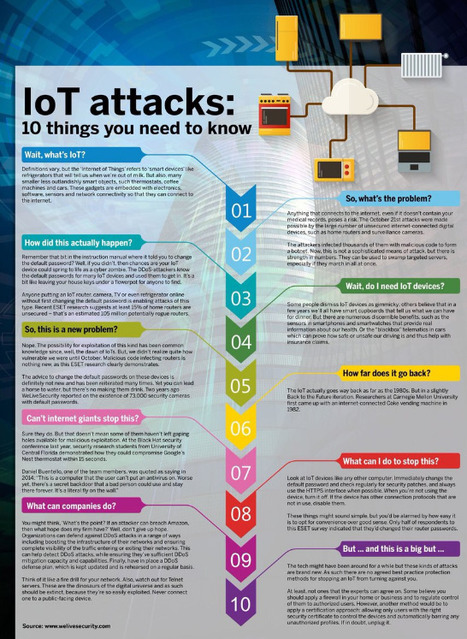
In its 2017 malware forecast, SophosLabs warned that attackers would increasingly target devices connected to the Internet of Things (IoT) – everything from webcams to internet-connecting household appliances. Late last week, we saw another example of how the trend is playing out.
Security vendor Radware warned that malware called BrickerBot is in the wild, designed to brick IoT devices by damaging their storage capability and scrambling kernel parameters. The company detected two versions of the malware in its honeypot servers – BrickerBot.1 and BrickerBot.2. The first attacks were detected March 20, targeting Linux-based IoT devices running the BusyBox toolkit. The honeypot recorded 1,895 PDoS (Permanent Denial of Service) attempts by BrickerBot from several locations around the world over four days.
To block the attack, Radware recommended users:
Change the device’s factory default credentials.
Disable Telnet access to the device.
Network Behavioral Analysis can detect anomalies in traffic and combine with automatic signature generation for protection.
User/Entity behavioral analysis (UEBA) to spot granular anomalies in traffic early.
An IPS should block Telnet default credentials or reset telnet connections. Use a signature to detect the provided command sequences. Learn more / En savoir plus / Mehr erfahren: http://www.scoop.it/t/securite-pc-et-internet/?tag=Internet+of+things
|
|
Scooped by
Gust MEES
April 9, 2017 3:27 PM
|
The stakes couldn’t be any higher in the global cybersecurity arena.
From Russia’s alleged role in the DNC hacks to this month’s revealing Vault 7 leak of nearly 9,000 CIA documents, it should now be clear that keeping data safe is of paramount importance for any organization. Leaks and hacks are causing irreparable damage across the board – and it is now more essential than ever before for individuals, organizations, and countries to be aware of common cybersecurity threats and how to prevent them.
IS YOUR COUNTRY PREPARED FOR CYBER ATTACKS?
Today’s infographic comes to us from CompariTech, and it breaks down the countries most prepared for cyber attacks, as well as those that are the most susceptible targets for cyber criminals. Learn more / En savoir plus / Mehr erfahren: http://www.scoop.it/t/securite-pc-et-internet/?&tag=Cyberattacks
|
|
Scooped by
Gust MEES
April 7, 2017 12:45 PM
|
Malware Amnesia bildet IoT/Linux-Botnet
Die Schadsoftware erkennt und löscht virtuelle Maschinen, um Entdeckung und Analyse durch Sicherheitsforscher zu vermeiden. Zuerst entdeckt wurde sie auf digitalen Videorekordern. Sicherheitsforscher befürchten ähnlich umfangreiche DDoS-Attacken wie durch Mirai-Botnets.
von Bernd Kling am 7. April 2017 , 18:14 Uhr
Die Malware Amnesia setzt eine neue Technik ein, um einer Entdeckung zu entgehen. Die Sicherheitsfirma Palo Alto Networks sieht sie als erste Linux-Malware, die virtuelle Maschinen erkennen und löschen kann. Das soll sich gegen von Sicherheitsforschern eingerichtete Sandboxes mit Analysewerkzeugen richten. Die Malware löscht sich außerdem selbst, um keine weiteren Spuren zu hinterlassen.
Learn more / En savoir plus / Mehr erfahren: http://www.scoop.it/t/securite-pc-et-internet/?&tag=Amnesia http://www.scoop.it/t/securite-pc-et-internet/?&tag=Amnesia&tag=BrickerBot
|
|
Scooped by
Gust MEES
April 7, 2017 11:33 AM
|
Researchers have uncovered a rash of ongoing attacks designed to damage routers and other Internet-connected appliances so badly that they become effectively inoperable.
PDoS attack bots (short for "permanent denial-of-service") scan the Internet for Linux-based routers, bridges, or similar Internet-connected devices that require only factory-default passwords to grant remote administrator access. Once the bots find a vulnerable target, they run a series of highly debilitating commands that wipe all the files stored on the device, corrupt the device's storage, and sever its Internet connection. Given the cost and time required to repair the damage, the device is effectively destroyed, or bricked, from the perspective of the typical consumer.
Over a four-day span last month, researchers from security firm Radware detected roughly 2,250 PDoS attempts on devices they made available in a specially constructed honeypot. The attacks came from two separate botnets—dubbed BrickerBot.1 and BrickerBot.2—with nodes for the first located all around the world. BrickerBot.1 eventually went silent, but even now the more destructive BrickerBot.2 attempts a log-on to one of the Radware-operated honeypot devices roughly once every two hours. The bots brick real-world devices that have the telnet protocol enabled and are protected by default passwords, with no clear sign to the owner of what happened or why. Learn more / En savoir plus / Mehr erfahren:
|
|
Scooped by
Gust MEES
March 30, 2017 3:03 PM
|
Une anomalie de sécurité précédemment non divulguée dans un ancien serveur Web Windows ne sera pas corrigée, même si des centaines de milliers de serveurs exécutent encore le logiciel obsolète.
La vulnérabilité dans Internet Information Services (IIS 6) a été exploitée à distance depuis juillet dernier, selon deux chercheurs en sécurité d'une université de technologie chinoise. Ces derniers ont d'ailleurs publié cette semaine le PoC d'un exploit sur Github.
La version touchée d'IIS 6 a été livrée pour la première fois avec Windows Server 2003, mais n'est plus supportée depuis 2015.
Microsoft a fait savoir que par conséquent, il ne corrigerait probablement pas cette faille.
"Ce problème n'affecte pas les versions actuellement supportées" a déclaré un porte-parole de Microsoft. "Nous continuons à recommander aux clients de migrer vers nos derniers systèmes d'exploitation et de bénéficier d'une protection robuste et moderne."
Plus de 600.000 anciens serveurs IIS 6 sont toujours utilisés, principalement aux Etats-Unis et en Chine, d'après une recherche sur Shodan, un moteur de recherche pour les terminaux connectés à Internet. Learn more / En savoir plus / Mehr erfahren: http://www.scoop.it/t/securite-pc-et-internet/
|
|
Scooped by
Gust MEES
March 29, 2017 2:30 AM
|
A bill that has now passed both the U.S. Senate and House of Representatives would repeal a Federal Communications Commission rule issued last year that allows consumers to decide how internet service providers use their information. “Your ISP can already monetize you based on your demographics,” Sean Sullivan, Security Advisor at F-Secure, tells me. “Still, they feel that they’re behind Facebook and Google’s ad technology — and arguably they are. But the difference is you can avoid Google and Facebook. You can’t avoid your ISP.” There is still something that you can do that gives you more control over who has access to your browsing history. “Your ISP is privy to all the web destinations you visit, unless you’re using a VPN,” Sean says. “Then they’re only privy to seeing that you went to, for instance, VPN.F-Secure.com.” A VPN is a virtual private network and it puts all of your browsing data in the hands of one provider who encrypts it. Learn more / En savoir plus / Mehr erfahren: https://gustmees.wordpress.com/2013/12/21/privacy-in-the-digital-world-shouldnt-we-talk-about-it/
|
|
Scooped by
Gust MEES
March 23, 2017 6:43 AM
|
Last year, former US Federal Communications Commission (FCC) chairman Tom Wheeler proposed a rule that would prevent internet providers from selling customers’ private data to third parties without their consent; the rule passed in October 2016 with clear guidelines for how ISPs must secure permission before sharing information like browsing history and location data with advertisers.
Now, that ruling is under threat, as the Senate is set to vote on Thursday on whether to roll it back and once again allow ISPs like Comcast and AT&T to once again have their way with your data.
“This event was off the charts”
Gary Vaynerchuk was so impressed with TNW Conference 2016 he paused mid-talk to applaud us.
FIND OUT WHY
There’s no benefit for consumers in this; if your ISP can sell your data, you’ll likely be subject to more spam and targeted advertising than before, and your broadband provider will be able to make more money by granting you a connection than it already does.
If you’re wondering how we got here, the answer is the same as it almost always is with government policy: follow the money. Vocativ reports that the 22 Republican senators behind the move have received more than $1.7 million from the telecom industry since the 2012 US election.
There’s also a danger of the FCC not being able to create similar rules for protecting consumers’ privacy in the future, if this resolution is passed, thanks to the Congressional Review Act. Learn more / En savoir plus / Mehr erfahren: https://gustmees.wordpress.com/2013/12/21/privacy-in-the-digital-world-shouldnt-we-talk-about-it/ http://www.scoop.it/t/securite-pc-et-internet/?&tag=Privacy
|
|
Scooped by
Gust MEES
March 22, 2017 3:30 AM
|
LastPass has closed a remote code execution vulnerability on its Chrome extension, but according to Google Project Zero researcher Tavis Ormandy, issues remain on its Firefox extension, as well as details on another password-stealing vulnerability to come.
Writing in the Project Zero issue tracker, Ormandy said it was possible to proxy untrusted messages to LastPass.
"This allows complete access to internal privileged LastPass RPC commands," the researcher said. "There are hundreds of internal LastPass RPCs, but the obviously bad ones are things copying and filling in passwords (copypass, fillform, etc)."
MORE SECURITY NEWS
Secret Service laptop with Trump Tower plans stolen from car
Feature or flaw? How to hijack a Windows account in less than a minute
Internet of Things security: What happens when every device is smart and you don't even know it?
Microsoft Edge used to escape VMware Workstation at Pwn2Own 2017
Additionally, if a user has the LastPass binary component installed, the system was vulnerable to remote code execution.
|
|
Scooped by
Gust MEES
March 20, 2017 7:59 AM
|
|
|
Scooped by
Gust MEES
March 14, 2017 12:57 PM
|
|
|
Scooped by
Gust MEES
March 14, 2017 12:32 PM
|
Imagine losing all the photos, videos, messages, and documents you've stored on your computer. How much money would you be willing to pay to get it all back? Ransomware is malware that infects your computer, locks it, and demands payment for unlocking it. Learn more / En savoir plus / Mehr erfahren: http://www.scoop.it/t/securite-pc-et-internet/?tag=RANSOMWARE
|
|
|
Scooped by
Gust MEES
April 15, 2017 12:57 PM
|
|
|
Scooped by
Gust MEES
April 10, 2017 2:31 PM
|
Keine schnellen, simplen Antworten
Eine solche Veröffentlichung ist für Spezialisten interessant: Lässt sich aus dem Code herauslesen, welches irgendwo auf der Welt im Einsatz befindliche Tool von der CIA stammt und wie es getarnt wurde? Lassen sich gar vergangene Angriffe, die beispielsweise den Russen oder Chinesen zugeordnet wurden, nun dem amerikanischen Geheimdienst zuweisen? Unter dem Stichwort "Marble" etwa erschien ein Dokument mit Quellcode. Der Code gehört zu einem sogenannten Obfuscator, ein Programm, das von der CIA dafür genutzt worden sein könnte, eigene Schadsoftware zu verschleiern.
Simple, schnelle Antworten auf diese Fragen gibt es wohl nicht. Um Angriffe der CIA zuzuschreiben, bräuchte es "mehr Beweise", kommentierte etwa der Sicherheitsexperte Sean Sullivan von der finnischen IT-Sicherheitsfirma F-Secure Labs die "Marble"-Veröffentlichung. Sein Kollege Mikko Hyppönen sagte über Vault 7, es sei "keine Überraschung", dass die CIA solche Hacker-Werkzeuge nutze.
Die CIA dürfte es wie schon die NSA zu Zeiten der Snowden-Dokumente ärgern, wie viel nun über ihr Vorgehen bekannt wird. Denn Experten - und somit auch andere Geheimdienste - haben durch die veröffentlichten Dokumente einen detaillierten Einblick in die Arbeit und die interne Kommunikation der CIA. Und der normale Bürger kann jetzt zumindest nachvollziehen, was heute unter Geheimdienstmethoden zu verstehen ist. Learn more / En savoir plus/ Mehr erfahren: http://www.scoop.it/t/securite-pc-et-internet/?&tag=CIA http://www.scoop.it/t/securite-pc-et-internet/?&tag=Cyberespionage http://www.scoop.it/t/securite-pc-et-internet/?&tag=NSA http://www.scoop.it/t/securite-pc-et-internet/?&tag=Cyberattacks
|
|
Scooped by
Gust MEES
April 9, 2017 6:15 PM
|
|
|
Scooped by
Gust MEES
April 7, 2017 2:42 PM
|
Hacker zerstören das Internet of Insecure Things
Unbekannte versuchen zurzeit, sich in ungesicherte IoT-Geräte zu hacken und diese aktiv zu zerstören. Offenbar ein Versuch, die Geräte unschädlich zu machen, bevor sie Teil von Botnetzen wie Mirai werden.
Die IT-Sicherheitsfirma Radware hat auf ihren Honeypots einige bemerkenswerte Angriffsversuche beobachtet. Mit Hilfe von bekannten Standardpasswörtern versuchen die Angreifer, sich per SSH in ungesicherte Geräte einzuloggen. Anschließend führen sie verschiedene Kommandos aus, die dazu führen, dass die entsprechenden Geräte nicht mehr funktionieren. Die Vermutung:
Hier versucht jemand, das Internet of Things von unsicheren Geräten zu befreien. Radware taufte die Angriffe, die in zwei Wellen erfolgten, BrickerBot.1 und BrickerBot.2. Learn more / En savoir plus / Mehr erfahren: http://www.scoop.it/t/securite-pc-et-internet/?&tag=Amnesia&tag=BrickerBot
|
|
Scooped by
Gust MEES
April 7, 2017 11:50 AM
|
|
|
Scooped by
Gust MEES
April 5, 2017 5:45 PM
|
No More Ransom, conceived as a European resource, is adding new partners and new decryption tools in a boost to its now global anti-ransomware campaign.
Cheesy graphics notwithstanding, the site contains some useful tools.
No More Ransom, launched less than a year ago, is going from strength to strength as more partners from both law enforcement and the private sector join the programme.
No More Ransom was unveiled in July 2016 by the Dutch National Police, Europol, Intel Security and Kaspersky Lab in what was hailed as a new level of partnership between the public and private sectors to combat ransomware.
Learn more / En savoir plus / Mehr erfahren: http://www.scoop.it/t/securite-pc-et-internet/?&tag=RANSOMWARE
|
|
Scooped by
Gust MEES
March 29, 2017 11:09 AM
|
|
|
Scooped by
Gust MEES
March 24, 2017 9:42 PM
|
|
|
Scooped by
Gust MEES
March 22, 2017 5:25 AM
|
|
|
Scooped by
Gust MEES
March 21, 2017 7:33 AM
|
|
|
Scooped by
Gust MEES
March 14, 2017 1:24 PM
|
|
|
Scooped by
Gust MEES
March 14, 2017 12:48 PM
|
|


























Learn more / En savoir plus / Mehr erfahren:
http://www.scoop.it/t/securite-pc-et-internet/?&tag=RANSOMWARE
http://www.scoop.it/t/securite-pc-et-internet/?&tag=Phishing