



A phishing campaign is spammed out, tricking users into handing over their Google login credentials to fraudsters.

 Your new post is loading...
 Scoop.it! A phishing campaign is spammed out, tricking users into handing over their Google login credentials to fraudsters. No comment yet.
Sign up to comment
Scoop.it!

Using a computer without security could be riskier than leaving your home or car unlocked.
Scoop.it!

Ein Entwickler hat ein kleines Tool für Mac-Rechner entwickelt, mit dem schnell überprüft werden kann, ob der Rechner vom gefährlichen Flashback-Trojaner befallen ist. Auch Kaspersky hat ein solches Tool mittlerweile veröffentlicht.
Scoop.it!

As part of their awareness-raising activities, national Safer Internet Centres (SIC) across Europe create a series of resources for children, parents, teachers and other target groups. During Insafe training meetings, organised every six months, centres present their best practices to other members of the network, so all of them can benefit from the resources created within the network.
This time however, the stakes were raised as the SICs were invited to participate in the first ‘Insafe Resource Competition’. Each centre was asked to briefly present its resources in one of three pre-determined categories, after which the members of the audience gave their score, using a scorecard divided into nine categories of assessment.
Read more...
Scoop.it!

Google behebt zwölf Sicherheitslücken in Chrome 18 10. April 2012 von Stefan Beiersmann
Der Patch schließt Lücken in den Versionen für Windows, Mac OS X und Linux. Das Update enthält eine neue Version von Adobes Flash Player.
Google hat zudem einen Fehler bei der Verarbeitung von SSL-Zertifikaten entfernt und eigenen Angaben zufolge die Stabilität seines Browsers verbessert.
===> UPDATE!!! <===
Scoop.it!

After intercepting one of the domain names used by the Flashback/Flashfake Mac Trojan and setting up a special sinkhole server last Friday, we managed to gather stats on the scale and geographic distribution of the related botnet.
Scoop.it!

The growing sophistication of cyber-attacks and the proliferation of vulnerabilities resulting from the rise of mobile computing are forcing financial institutions to rethink data security and embrace new fraud-fighting techniques and technologies,...
Scoop.it!
At the moment, there are more than 100 million Mac OS X users around the world. The number has grown switfly during the past years we expect this growth to continue. Via Gust MEES
Scoop.it!

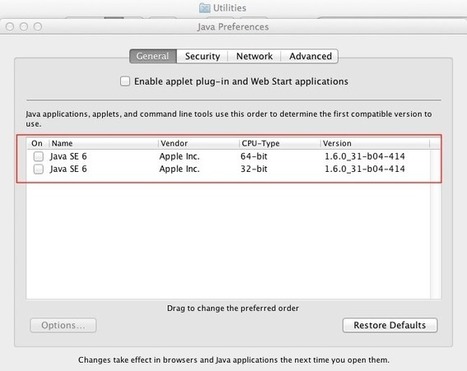
The Flashback botnet is an indication that Apple is not putting enough energy into security and that oracle isn't paying attention to Java security issues.
Scoop.it!

Malware called "Fakeflash" or "Flashback' is infecting Macs running OS X. It has given criminals access to more than 600,000 computers. One reason for the attack: Apple sells more Macs now and has about 12 percent market share.
Scoop.it!

Mac users: It’s time to be more vigilant about viruses.
Geise said that Macs were particularly affected in this attack because of a vulnerability in the Apple version of Java — the company stopped using Oracle’s releases of Java a couple of years ago, and supports its own versions.
Yet while Oracle had patched the problem with Java that caused this problem months ago, Apple had yet to address the problem until April 3, when it issued a patch for the vulnerability. It then released a second patch on April 5.
“Oracle had patched this but Apple didn’t patch it until very recently,” he said. “Exploits were seen in the wild since around early to mid-March.
That has been a full month of lead time to do bad stuff.”
Several experts have said that this appears to be one of the largest-ever attacks on Macs.
Scoop.it!

Le ministère de l'intérieur britannique a annoncé, ce samedi, qu'une enquête est en cours concernant les récentes cyber-attaques qui ont touché certains sites du gouvernement, dont le sien.
Scoop.it!

Anonymous has launched a Distributed Denial of Service (DDoS) against multiple UK government websites. |
Scoop.it!
Symantec's February Symantec Intelligence Report shows a new wave of cyber-attacks designed to impersonate a well-known business mediation and arbitration service in North America...
Scoop.it!

Mit Gratis-WLAN locken Cafés und Kneipen. Jetzt geraten die Gastwirte ins Visier von Anwälten. Wer haftet für Raubkopien?
Scoop.it!

Plus d’un demi-million de Mac auraient été infectés, selon Dr. Web, par un logiciel malveillant exploitant une faille Java. Celui-ci, surnommé Flashback, marque-t-il la fin d’une époque ?
Force est de constater qu’Apple n’a pas manqué de travailler à répandre lui-même cette image. Début 2009, l’entreprise présentait même son système d’exploitation comme «un havre de paix.»
Mais cette présentation était à tout le moins discutable. De fait, la division sécurité d’IBM indiquait à la même période que Mac OS X et Mac OS X Server comptaient chacun pour 14,3 % des vulnérabilités dévoilées en 2008.
Pour un environnement hyper sécurisé, on a vu mieux. Par la suite, les démonstrations d’exploits sur Mac OS X n’ont pas manqué.
De quoi donner de l’eau au moulin d’Eric Filiol, spécialiste de la cryptologie, qui rappelait alors que
===> «tous les environnements capables d’exécution [de code] sont potentiellement vulnérables.» <===
Et l’on ne saurait contredire cette affirmation aussi prudente que réaliste.
Scoop.it!

La république islamique d’Iran pourrait mettre en place d’ici cinq mois un Intranet national qui bloquerait l’accès au...
Scoop.it!

Country's minister of information and communication says national intranet will create a 'clean Internet.'
Millions of Internet users in Iran could soon be permanently cut off from the Web, social networks, and e-mail.
Scoop.it!
WHAT IS FLASHBACK/FLASHFAKE?
It is a family of malware for Mac OS X. The first versions of this type of threat were detected in September 2011. In March 2012 over 600 000 computers worldwide were infected by Flashback.
The infected computers have been combined in a botnet which enables cybercriminals to install additional malicious modules on them at will.
Check for FREE online (Kaspersky) if your Mac is infected and learn HowTo...
Also users can check if they’re infected with Flashfake by using Kaspersky Lab’s free removal tool http://support.kaspersky.com/downloads/utils/flashfake_removal_tool.zip
Scoop.it!

From
www

USTelecom's website goes down for about 24 hours due to a distributed denial-of-service attack...
Scoop.it!
Despite rising concerns that cyberattacks are growing more and more sophisticated, hackers used relatively simple methods for 97% of data breaches in 2011, according to a report compiled by Verizon.
Scoop.it!

The White House issued a statement in regards to our critical infrastructure – such as the electricity grid, financial sector, and transportation networks that...
From The Desk of President Obama: “We count on computer networks to deliver our oil and gas, our power and our water. We rely on them for public transportation and air traffic control… But just as we failed in the past to invest in our physical infrastructure – our roads, our bridges and rails – we’ve failed to invest in the security of our digital infrastructure…
This status quo is no longer acceptable – not when there’s so much at stake. We can and we must do better.”
Scoop.it!

Twitter a déposé plainte contre TweetAttacks, TweetAdder, TweetBuddy, Troption et Justinlover ; ils proposent des outils permettant d’envoyer en masse des messages sur Twitter. Pour le réseau social, il s’agit de combattre le spam à la source.
Scoop.it!

Researchers at NQ Mobile, working alongside researchers at North Carolina State University, have discovered Android malware that is controlled via SMS that can do a number of things on the compromised device including recording calls and and surrounding noise.
Scoop.it!
From
www
The Flashback Trojan has compromised an estimated 600,000 plus Macs, making it comparable to the massive Conficker worm botnet. |





