


In an effort to spread information, associates of Anonymous targeted the U.S. Bureau of Justice Statistics’ website, compromising nearly 2GB of data before the server was taken offline.
Read more:

 Your new post is loading...
 Scoop.it! In an effort to spread information, associates of Anonymous targeted the U.S. Bureau of Justice Statistics’ website, compromising nearly 2GB of data before the server was taken offline.
Read more:
No comment yet.
Sign up to comment
Scoop.it!

New start-up SaaSID today launches a product at CloudForce London that seeks to solve a pressing and growing problem: the authentication of personal devices to the cloud.
Read more:
Scoop.it!

So you may have heard of this term: Bring Your Own Device (BYOD). If you haven’t come across it, it simply refers to individuals taking their own smartphones, laptops and tablets to work to connect and ‘sync’ them with the company network.
Scoop.it!

At any given moment today, on-the-clock employees are updating their social media status, reading feeds and networking on business media sites.
Remember that hackers now target mobile devices such as smartphones and tablet PCs. Businesses should specify whether employees are permitted to access social networking sites from these devices and which apps may be used to do so.
Once policies are established, it may be necessary to reinforce them with a carefully considered combination of network monitoring and data protection technologies. In some cases, these technologies may already be in place as part of standard IT security measures.
===> If so, they should be configured to include social networking controls. <===
Read more:
Scoop.it!

Compromising anywhere from a few thousand to well over a million systems, botnets are used by cyber criminals to take over computers and execute illegal and damaging activities.
Read more:
Scoop.it!
Twitter Topic Text from https://twitter.com/#!/e_kaspersky
Text from SECURELIST by:
Dmitry Tarakanov
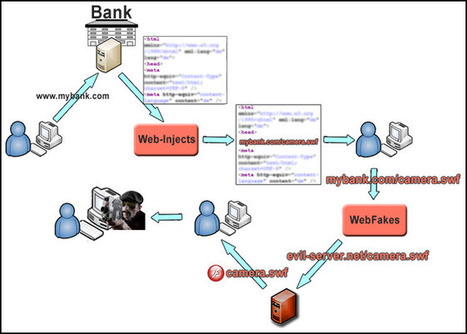
Malware now can spy using web camera. Who still has their cameras unblocked?
It seems that development of the main module of SpyEye stopped with last autumn’s version 1.3.48. But just because the authors are not developing this platform further, it doesn’t mean that SpyEye is no longer getting new functions.
This is not the first time that cybercriminals using online banks have tried to get video and audio footage of victims. My colleague Dmitry Bestuzhev recalls a case when a malicious program targeting clients of an Ecuadorian bank also had functionality to record video and audio footage on the infected computer and to send it to intruders.
This too was not related to optical client recognition - the Ecuadorian bank had no such feature implemented.
It all begs the question – why film your victim? Apparently, cybercriminals watch the user’s reaction when the theft is in process. As usual, money is stolen in the following way: the user types his/her login data into the bank site, but the code of the bank’s page is modified by malware directly in the browser and after authorization the user doesn’t see the bank account but the malware creates a window with a message saying, for example, “Loading... Please wait...”. At the same time, injected malicious code prepares to send the stolen money to an accomplice’s bank account.
Once that’s done, in order to confirm the transaction, cybercriminals have to persuade the user to enter a secret code, which could be received by SMS. This is when social engineering is used: the intruder’s program puts a request on the victim’s screen, something like: “We have strengthened security measures. Please confirm your identity entering the secret code we have sent to your phone.”
Very interesting, learn more: http://www.securelist.com/en/blog/208193513/Big_Brother
Scoop.it!

La Commission européenne vient de dégager 4 points sur lesquels la conduite de Google peut être condamnable au titre de l'abus de position dominante. Après avoir mené l'enquête, l'Europe a décidé de p...
Lire plus :
Scoop.it!
Twitter is without a doubt the best way to share and discover what is happening right now.
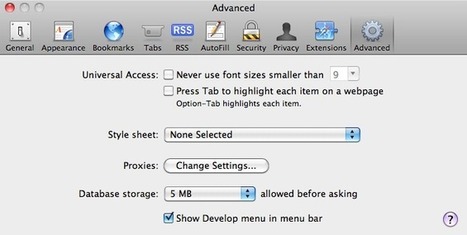
What is “Do Not Track”?
Do Not Track (DNT) is a privacy preference that users can set in their web browsers. The United States Federal Trade Commission has endorsed DNT as a simple way for users to inform integrated web services which offer content across the Internet (such as buttons, widgets, and other embedded features) that they do not want certain information about their webpage visits collected across websites when they have not interacted with that service's content on the page.
The DNT browser setting is now supported by recent versions of major browsers, including Firefox 5+, Internet Explorer 9+, and Safari 5.1+. If you are using Chrome 17.0 or higher, there is a third-party extension that enables DNT.
Read more...
Scoop.it!
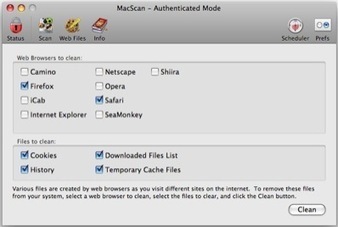
SecureMac released MacScan 2.9.3, which features tracking cookie detection and cleaning for Google’s Chrome browser.
MacScan is the premier Macintosh security program, protecting you against the latest malware and privacy threats for Apple Mac OS X, offering protection against keystroke loggers, trojan horses, and other spyware.
Read more...
Scoop.it!

A British man who spread a spyware Trojan horse posing as a patch for the popular video game "Call of Duty", has ended up with an 18 month jail sentence.
Scoop.it!

The European Commission is planning to force energy, transport and financial
“The European Commission will propose by the end of the third quarter of 2012 a new obligation for security breach notifications for the energy, transport, banking and financial sectors,” said an official working at the Commission's digital agenda department.
The official said that companies have an interest in beefing up their protection against cyber attacks, but that they were not doing enough to defend their infrastructure.
Read more...
Scoop.it!

Securing data simply by defending the network perimeter is no longer enough to satisfy the law. IT departments need to consider a different approach.
Read more...
Scoop.it!

Apple vient de publier un avis adressant 17 failles de sécurité dans QuickTime Media Player. La mise à jour est classée critique car plusieurs vulnérabilités fixées peuvent permettre l'exécution de code à distance.
L'une des vulnérabilités critiques adressées est CVE-2012-0671, que j'ai découverte et signalée à Apple plus tôt cette année.
Pour contextualiser, QuickTime est utilisé par 61% de tous les ordinateurs compatibles connectés à Internet, y compris 49% de tous les PC Windows et 98% des ordinateurs Apple (Source : Qualys BrowserCheck).
Même si vous n'utilisez pas QuickTime par défaut pour lire des films et des vidéos, il peut être utilisé comme lecteur multimédia pour le format PCT sur tous les navigateurs Web, y compris Chrome, Safari, Internet Explorer et Firefox.
Lire plus...
|
Scoop.it!

A recent study finds that major enterprises have yet to catch on to the importance of cyber security.
Read more:
Scoop.it!
Für die EU-Wettbewerbshüter ist klar: Googles Suchergebnisse bevorzugen die eigenen Dienste und benachteiligen diejenigen der Konkurrenz. Der Webgigant hat deshalb einige Wochen Zeit, um die Praxis zu ändern.
Weiter lesen: http://www.pctipp.ch/news/firmen/62262/eu_wettbewerbshueter_kritisieren_google.html
Scoop.it!

When you cross the street, you look both ways to make sure it’s safe. Staying safe on the Internet is similar. It takes some common sense steps.
- STOP: Before you use the Internet, take time to understand the risks and learn how to spot potential problems.
- THINK: Take a moment to be certain the path ahead is clear. Watch for warning signs and consider how your actions online could impact your safety, or your family’s.
- CONNECT: Enjoy the Internet with greater confidence, knowing you’ve taken the right steps to safeguard yourself and your computer. Protect yourself and help keep the web a safer place for everyone.
The Anti-Phishing Working Group (APWG) and National Cyber Security Alliance (NCSA) led the development of the STOP. THINK. CONNECT. campaign. The U.S. Department of Homeland Security provides the Federal Government's leadership for the STOP. THINK. CONNECT. campaign.
Read more and watch the videos: http://www.stopthinkconnect.org/
Scoop.it!

Consumers not paying attention to growing threats to Apple's Mac platform, leading security vendors to warn such mindset "worrying" and industry needs to do more to educate them of risks.
Read more: http://www.zdnetasia.com/mac-users-indifference-toward-security-worrying-62304850.htm
Scoop.it!
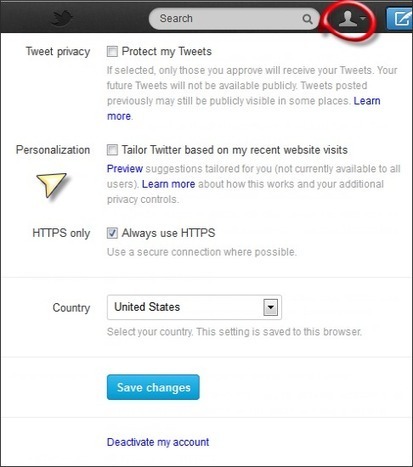
Did you know that Twitter, like Facebook, wants to know which websites you visit and has a system for tracking you from site to site anywhere it its ecosystem: eco-tracking.
Read more: http://blog.eset.com/2012/05/21/how-to-stop-twitter-tracking-the-websites-you-visit
Scoop.it!

From
europa

SPEECH/12/372 Joaquín Almunia Vice President of the European Commission responsible for Competition Policy Vice President Almunia's statement on the Google case Press room Brussels, 21 May 2012 In November 2010, the Commission launched an antitrust...
Read more:
Scoop.it!
It’s easy to get distracted by high profile security threats and let more subtle — but equally destructive — risks fall through the cracks.
IT administrators are often so busy just trying to keep up with the obvious security threats that many more problems fly under the radar.
Here are 10 security risks you may have in your organization that you are not aware of.
Read more: http://www.techrepublic.com/blog/10things/10-security-problems-you-might-not-realize-you-have/2768
Scoop.it!
In the online struggle for network security, Kansas State University cybersecurity experts are adding an ally to the security force: the computer network itself...
In the online struggle for network security, Kansas State University cybersecurity experts are adding an ally to the security force: the computer network itself...
As the study progresses, the computer scientists will develop a set of analytical models to determine the effectiveness of a moving-target defense system. They also will create a proof-of-concept system as a way to experiment with the idea in a concrete setting. "It's important to investigate any scientific evidence that shows that this approach does work so it can be fully researched and developed," DeLoach said. He started collaborating with Ou to apply intelligent adaptive techniques to cybersecurity several years ago after a conversation at a university open house.
Scoop.it!

The use of CCTV cameras for physical surveillance of all kinds of environments has become so pervasive that most of us don't give the devices a second thought anymore.
But, those individuals and organizations who actually use and control them should be aware that most of them come with default settings that make them vulnerable to outside attacks.
Read more...
Scoop.it!
US high-tech firms have teamed with German research institute Fraunhofer FOKUS to open a cybersecurity research center in Berlin.
The Cybersecurity Demonstration Center will be used to simulate attacks on IT infrastructure to develop new cyberattack defenses for the security industry.
US firms participating in the center are CSC, HP, EMC/RSA, McAfee, and Sourcefire.
Read more...
Scoop.it!

More than 80pc of IT managers think enterprises with a bring-your-own-device (BYOD) policy have a competitive advantage over other organisations, research commissioned by BT suggests.
Security concerns come with BYOD
Thirty-nine per cent of enterprises have experienced a security breach due to employees bringing in unauthorised devices – most commonly in the fast-moving consumer goods (FMCG) and pharmaceuticals sectors, according to the survey.
Read more...
Scoop.it!

Southwark Crown Court has sentenced a 21-year-old British man to a jail in prison after he admitted hacking into the Facebook account of a US citizen, and accessing private messages. |





