Your new post is loading...

|
Scooped by
Gust MEES
July 24, 2012 9:12 AM
|
|
|
Scooped by
Gust MEES
July 23, 2012 12:25 PM
|
|
|
Scooped by
Gust MEES
July 23, 2012 8:24 AM
|
SophosLabs reports on the top twelve spam relaying countries for April - June 2012. SophosLabs experts have released their latest "dirty dozen" report detailing the world's top spam-relaying countries - and have discovered that India has solidified its position as the biggest global contributor to the junk email problem. In fact, if you have a spam in your inbox, there's a more than one in ten chance that it was relayed from an Indian computer. Read more: http://nakedsecurity.sophos.com/2012/07/23/dirty-dozen-spam-india/
|
|
Scooped by
Gust MEES
July 21, 2012 10:10 AM
|
|
|
Scooped by
Gust MEES
July 19, 2012 11:20 AM
|
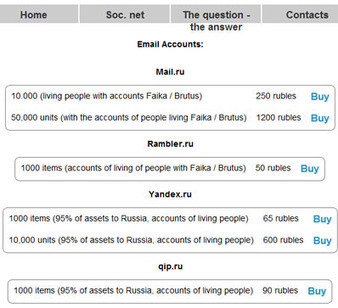
The recently unearthed website of a service specializing in selling access to compromised email and social networking accounts of Russian and Ukrainian users offers a fascinating glimpse into just how much one such account is worth to spammers. Wannabe spammers and social engineers can choose to buy accounts by the service, and should be ready to pay 190 rubles ($5.9) for 100 compromised Vkontakte accounts belonging mostly to Russian users, or 180 rubles ($5.6) for the same number belonging to mostly Ukrainian users. Facebook accounts are somewhat cheaper - 500 for 200 rubles ($6.2), and the same number of compromised Twitter account can be had for 250 rubles ($7.7). Read more to find out how others are earning money with your stolen data, you should: http://www.net-security.org/secworld.php?id=13275
|
|
Scooped by
Gust MEES
July 19, 2012 5:23 AM
|
|
|
Scooped by
Gust MEES
July 18, 2012 7:18 AM
|
|
|
Scooped by
Gust MEES
July 17, 2012 12:59 PM
|
Summary: Defense analyst John Arquilla believes the U.S. should stop prosecuting elite hackers and instead hire them to wage an online war against terrorists as well as other American enemies. He argues if the U.S.should stop prosecuting elite hackers and instead hire them to wage an online war against terrorists as well as other American enemies. He argues if the U.S. played its card rights with hackers, the war on terror would have been long over. Read more: http://www.zdnet.com/defense-expert-us-should-hire-hackers-to-conduct-cyberwarfare-7000000920/
|
|
Scooped by
Gust MEES
July 17, 2012 12:03 PM
|
Internet giant teams up with politicians and academics to host two-day summit in bid to disrupt illegal activity on the internet... The internet giant has launched a campaign against the secrecy and impunity of drug cartels, organ harvesters, cyber-criminals, violent radicals and traffickers in arms and people. It has assembled victims, law enforcers, politicians, academics and technology experts to devise strategies in a two-day summit in Los Angeles, starting Tuesday, called Illicit Networks: Forces in Opposition. Read more: http://www.guardian.co.uk/technology/2012/jul/17/google-tech-knowhow-internet-crime?CMP=twt_fd
|
|
Scooped by
Gust MEES
July 17, 2012 9:37 AM
|
|
|
Scooped by
Gust MEES
July 17, 2012 8:07 AM
|
Anonymous hacks oil giants, leaks employees' passwords In support of Greenpeace's efforts to stop companies drilling for oil in the Arctic, Anonymous has leaked around 1,000 email addresses belonging to five of the biggest multinational oil companies and its corresponding passwords (both in clear text and hashed). This leak is a continuation of a previous one from June, when the group dumped email login credentials of Exxon employees. This time Shell, BP Global, Gazprom and Rosneft were hit. Read more: http://www.net-security.org/secworld.php?id=13256&utm_source=dlvr.it&utm_medium=twitter
|
|
Scooped by
Gust MEES
July 16, 2012 5:38 PM
|
|
|
Scooped by
Gust MEES
July 16, 2012 9:59 AM
|
|
|
|
Scooped by
Gust MEES
July 23, 2012 5:33 PM
|
|
|
Scooped by
Gust MEES
July 23, 2012 8:47 AM
|
|
|
Scooped by
Gust MEES
July 22, 2012 2:59 PM
|
Drew Houston of Dropbox speaks during the Digital Life Design conference (DLD) at HVB Forum on January 23, 2012 in Munich, Germany. Dropbox is investigating whether its security was breached, leading to spam messages to users. Cloud services are the ballyhooed future of software, information storage, device management and whatever else you can think of that requires the use of a computer or device. Which is why Dropbox’s current investigation into itself gives pause. The preeminent cloud-company is checking to see whether its security has been breached, leading to a rash of spam emails sent to users. If such hack-attacks are not subdued when aimed at massive central information-storage servers, can the cloud be trusted? Read more: http://www.forbes.com/sites/karstenstrauss/2012/07/19/dropbox-security-breach-security-in-the-cloud/?ss=cio-network
|
|
Scooped by
Gust MEES
July 19, 2012 5:29 PM
|
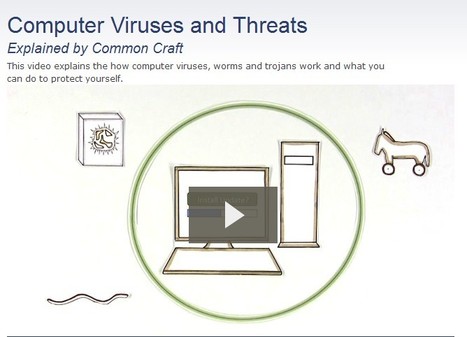
What it teaches
This video explains computer viruses by comparing them to human viruses and focuses on the role of prevention in being protected. Major points include:
- A basic look at computer viruses as computer programs that can spread like a disease and can be prevented by anti-virus software. - An introduction to worms, how they cause damage in networks and can be prevented by software updates. - An introduction to trojans, how they trick people into downloading a virus and how awareness is important for prevention. Check for more videos here: http://www.commoncraft.com/video/computer-viruses-and-threats
|
|
Scooped by
Gust MEES
July 19, 2012 9:57 AM
|
|
|
Scooped by
Gust MEES
July 19, 2012 4:06 AM
|
|
|
Scooped by
Gust MEES
July 17, 2012 4:18 PM
|
|
|
Scooped by
Gust MEES
July 17, 2012 12:55 PM
|
A Seattle hacking triumvirate has received a collective quarter-century behind bars.
With a combination of wardriving and malware implantation, they made off with $3m plundered from company acco... The three men, Joshuah Allen Witt, 35, John Earl Griffin, 36, and Brad Eugene Lowe, 39, have all now been given stiff prison terms. Lowe picked up the lightest sentence, ===> with six-and-a-half years, whilst Witt and Griffin were sent down for nearly eight years each. There are two lessons to be learned here. The first lesson is to make sure you get your WiFi security right - at work and at home. We've written up some simple guidelines before to help you do the right thing. To summarise, here are three things which do not provide WiFi security. Two of them provide a touch of safety against inadvertent connections, but none of these protect you against wardrivers: - WEP encryption. The security system in WEP (Wired Equivalent Privacy) is flawed and can easily and automatically be cracked. A wardriver will bypass WEP in 60 seconds - and that includes the time taken to park outside your office and boot up his laptop. Use WPA instead. - MAC address filtering. MAC (Media Access Control) addresses aren't secret. WiFi networks broadcast the MAC addresses of all currently-connected devices, so a wardriver already has a list of addresses he can use. - SSID hiding. The SSID (Service Set identifier) is your network name. Hiding it merely means your network doesn't openly advertise itself for use. But it isn't a secret - the SSID appears in other network traffic anyway, so the wardriver knows what it is. The second lesson is to be doubly vigilant after a physical break-in. Don't just look for what's missing, but what might have been left behind. Read more, a MUST for WiFi protection: http://nakedsecurity.sophos.com/2012/07/16/seattle-cybercrime-trio-sentenced-for-3m-hacking-spree-via-wifi-and-malware/
Symantec helps consumers and organizations secure and manage their information-driven world. However, IT departments tasked with keeping company networks and sensitive data safe are still struggling to get a handle on mobility. According to the same survey, mobility ranks as the leading IT risk among organizations, that includes being perceived as more risky than virtualization and even public cloud computing. ===> Device loss, data breach and mobile malware are some of the chief concerns. And these concerns are not unfounded. For the 12 month period leading up to the survey, the average cost of enterprise losses associated with mobility was $429,000. <=== To help enterprises take full advantage of mobility while also mitigating the very real risks associated with it, Symantec has built the strongest mobile security and management product portfolio available. Today, we announced significant updates to this portfolio that enhance our already industry-leading capabilities in mobile device management, mobile application management and mobile threat protection.
|
|
Scooped by
Gust MEES
July 17, 2012 9:04 AM
|
The Grum botnet is the world’s third largest botnet, producing some 17% of the total spam that floods email boxes daily. Researchers at malware intelligence firm FireEye are reporting that Dutch authorities have pulled the plug on two secondary servers used by the Grum botnet. The removal of the servers shines light on how quickly some law enforcement agencies work, given that proof of their existence is just over a week old. Read more: http://www.securityweek.com/dutch-police-takedown-ccs-used-grum-botnet
|
|
Scooped by
Gust MEES
July 17, 2012 6:49 AM
|
|
|
Scooped by
Gust MEES
July 16, 2012 4:15 PM
|
|