


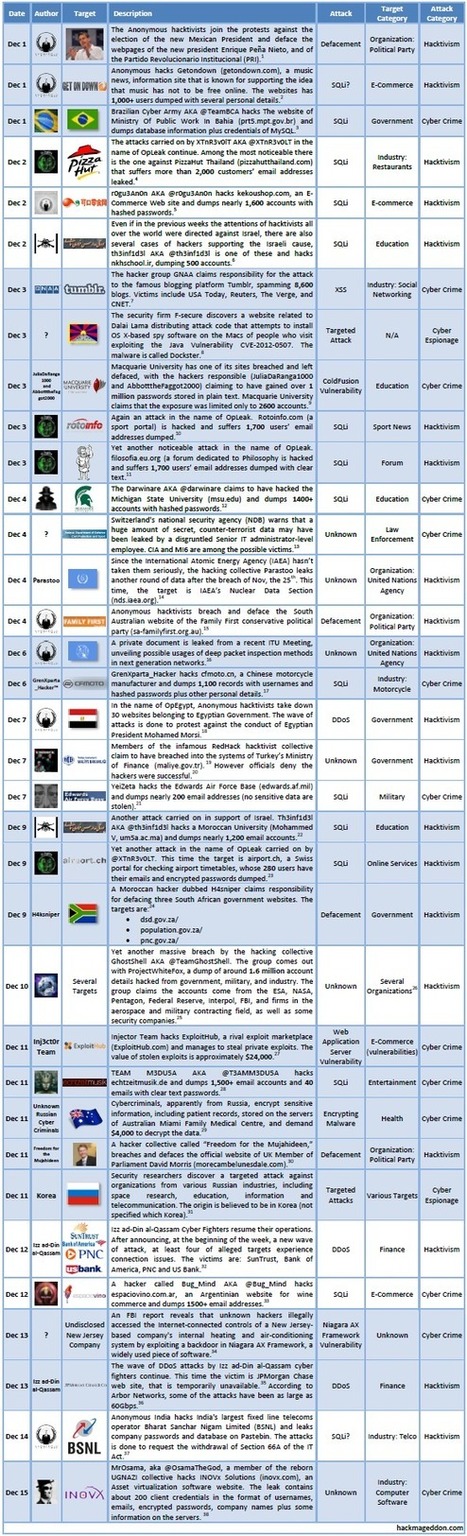

Christmas is coming quickly, we have just passed the first half of December, and hence it’s time for the first update of the Cyber Attacks Timeline for December. The Team GhostShell has decid...

 Your new post is loading...
 Scoop.it! Christmas is coming quickly, we have just passed the first half of December, and hence it’s time for the first update of the Cyber Attacks Timeline for December. The Team GhostShell has decid... No comment yet.
Sign up to comment
Scoop.it!

October 23, 2009
"Evil Maid" Attacks on Encrypted Hard Drives Earlier this month, Joanna Rutkowska implemented the "evil maid" attack against TrueCrypt. The same kind of attack should work against any whole-disk encryption, including PGP Disk and BitLocker. Basically, the attack works like this: Step 1: Attacker gains access to your shut-down computer and boots it from a separate volume. The attacker writes a hacked bootloader onto your system, then shuts it down. Step 2: You boot your computer using the attacker's hacked bootloader, entering your encryption key. Once the disk is unlocked, the hacked bootloader does its mischief. It might install malware to capture the key and send it over the Internet somewhere, or store it in some location on the disk to be retrieved later, or whatever.
Scoop.it!

Recent cyber attacks have proven that hackers and terrorists are trolling for ways to disrupt national infrastructure. We all recognize the problem, yet no one can agree on a solution.
Time is of the essence. Government and industry need to work together to ensure that companies are adequately addressing cyber risks that threaten the physical and economic security of our nation while respecting the values of freedom, openness and innovation fundamental to us all. ==================================================== Gust MEES's insight: Education is the key in long term, start with it: - http://gustmees.wordpress.com/2012/11/29/cyber-hygiene-ict-hygiene-for-population-education-and-business/
Gust MEES's insight:
Education is the key in long term, start with it:
Scoop.it!

“Necurs is a prevalent threat in the wild at the moment,” warns Microsoft, with more than 80,000 unique infections detected during November. Necurs is a rootkit delivered by drive-by downloading.
Scoop.it!

The Trojan in question has DDoS and Bitcoin-mining capabilities, but it's main function is to steal banking credentials.
The botnet operator spreads the malware via the Usenet discussion forum, which is also a popular platform for distributing pirated content. In order to hide its malicious nature, the file "weighs" 15MB, a great part of which is junk data. The rest consists of a ZeuS bot, a Tor client for Windows, the CGMiner bitcoin mining tool, and a copy of a DLL file used by CGMiner for CPU and GPU hash cracking. Read more, a MUST: http://www.net-security.org/malware_news.php?id=2357
Scoop.it!

Google's Chrome team appears to be looking to extend the way the browser connects with other devices, incorporating support for a new protocol that will enable Chrome apps to discover ... Learn more: - http://www.scoop.it/t/securite-pc-et-internet/?tag=smart-TV - http://www.scoop.it/t/21st-century-learning-and-teaching/?tag=Internet+of+Things - http://www.scoop.it/t/securite-pc-et-internet/?tag=Internet+of+things - http://www.scoop.it/t/securite-pc-et-internet/?tag=Quantum - http://www.scoop.it/t/securite-pc-et-internet/?tag=cyberwar - http://www.scoop.it/t/securite-pc-et-internet/?tag=NSA - http://www.scoop.it/t/securite-pc-et-internet/?tag=TAO
Gust MEES's insight:
A new branch for Google to get even more information (digital foot print) from each user to build up more its dominance on the market!
THE DANGER of THE INTERNET of THINGS!!!
Learn more: - http://www.scoop.it/t/securite-pc-et-internet/?tag=smart-TV - http://www.scoop.it/t/21st-century-learning-and-teaching/?tag=Internet+of+Things - http://www.scoop.it/t/securite-pc-et-internet/?tag=Internet+of+things - http://www.scoop.it/t/securite-pc-et-internet/?tag=Quantum - http://www.scoop.it/t/securite-pc-et-internet/?tag=cyberwar - http://www.scoop.it/t/securite-pc-et-internet/?tag=NSA - http://www.scoop.it/t/securite-pc-et-internet/?tag=TAO
Scoop.it!

FTC investigating whether firms are in breach of existing laws and says little progress made on ensuring children are protected...
Read more, a MUST: http://www.guardian.co.uk/technology/2012/dec/10/mobile-apps-children-ftc?CMP=twt_gu
Scoop.it!
The theme for the 10th Safer Internet Day will be online rights and responsibilities. The campaign will take place worldwide on Tuesday 5 February 2013. The ...
Scoop.it!

Kaspersky Lab released its annual Kaspersky Security Bulletin, which provides the overall malware and cyber-threat statistics for 2012.
===> The report revealed significant growth of Mac-specific malware and an explosive growth in the number of threats targeting the Android platform. <===
Overall, Kaspersky Lab detected and blocked more than 1.5 billion web-based attacks in 2012 and more than 3 billion infected files.
At the present time Kaspersky Lab detects and blocks more than 200,000 new malicious programs every day, a significant increase from the first half of 2012, when 125,000 malicious programs were detected and blocked each day on average.
===> Servers located in the United States were the most frequently used to host and deliver malicious objects (25.5% of all incidents). Russia occupies the second place with 19.6% followed by the Netherlands, Germany and the United Kingdom. <===
This is a significant change compared to years past: in 2010 the majority of malware was hosted in China. Changes in domain registration policies and other regulations taken by Chinese authorities resulted in the rapid decline of malicious hosts originating from the country.
Read more, a MUST: http://www.net-security.org/malware_news.php?id=2352
Scoop.it!

Purveyors of the Gameover trojan are using the wellknown Cutwail botnet to lure victims into downloading the banking malware.
A new wave of spam campaigns are dispensing "Gameover,” the ===> only banking trojan in the Zeus family to use peer-to-peer (P2P) communications to hide its activities. <===
Read more, a MUST: http://www.scmagazine.com/zeus-family-trojan-spreads-by-way-of-spam-botnet/article/271333/
Scoop.it!

Cracking encrypted passwords is getting increasingly easier as researchers come up with new ways of harnessing CPU, GPU and cloud power to perform the task.
Read more, a MUST: http://www.net-security.org/secworld.php?id=14077
Scoop.it!

This is Kaspersky Lab’s annual threat analysis report covering the major issues faced by corporate and individual users alike as a result of malware, potentially harmful programs, crimeware, spam, phishing and other different types of hacker activity.
Read more, a MUST: http://www.securelist.com/en/analysis/204792254/Kaspersky_Security_Bulletin_2012_Malware_Evolution
Scoop.it!

Download the free Sophos Security Threat Report, looking back over 2012 and exploring what security threats and trends we will all be facing tomorrow.
Read more, a MUST: http://nakedsecurity.sophos.com/2012/12/04/sophos-security-threat-report/
|
Scoop.it!

Christopher Chaney, who had pled guilty this year, heads to federal prison.
Scoop.it!

Taking your tablet online can make you vulnerable to an assortment of internet dangers, including identity theft and hackers. This is especially true if you’re taking advantage of a public hotspot ...
==================================================== Gust MEES Please read also my FREE course here: - http://gustmees.wordpress.com/2012/11/29/cyber-hygiene-ict-hygiene-for-population-education-and-business/ ====================================================
Scoop.it!

The U.S. has just announced that, "U.S. cannot sign revised telecommunications regulations in their current form."
Scoop.it!
Chrome 23, Internet Explorer 9 et 10, Flash 11.x, Java SE 6 et 7. Tous se voient proposer des mises à jour corrigeant des failles de sécurité critiques.
===> UPDATE asap!!! <===
Scoop.it!
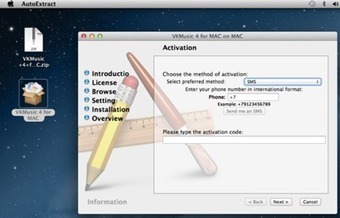
Russian anti-virus company Doctor Web informs users about a new Trojan for Mac OS X dubbed Trojan.SMSSend.3666.
Scoop.it!

1,630 Individuals from India Arrested for Cybercrimes in 2011
Scoop.it!

Mobile Device Security: What Senior Managers Should Know
This article provides clear, practical guidance on how you can make sure mobile ===> devices are a benefit rather than a risk for your organization. <===
Read more, a MUST:
Scoop.it!

Cybercrooks are putting up stickers featuring URLs embedded in Quick Response codes (QR codes) as a trick designed to drive traffic to dodgy sites.
Sian John, UK security strategist at Symantec, said: “There has been an explosion in the number of QR codes over the last couple of years, and cybercriminals are taking full advantage. Because QR codes just look like pictures it’s extremely difficult to tell if they’re genuine or malicious, making it easy to dupe passers-by into scanning codes that may lead to an infected site, or perhaps a phishing site.
===========================================
Gust MEES
Please check also:
- http://www.scoop.it/t/apps-for-any-use-mostly-for-education-and-free?tag=QR-Reader-App
===========================================
Read more: http://www.theregister.co.uk/2012/12/10/qr_code_sticker_scam/
Scoop.it!
A recent survey from the Ponemon Institute and ID Experts found that breaches are costing the health care industry an average of 7 billion annually.
Read more:
Scoop.it!
Blackberry has always had a reputation for taking particular care when it comes to security.
Read more, a good practice example:

Jocyl Garcia's curator insight,
May 17, 2013 8:45 AM
not evrythng dat u wanted and worked hard for always meant to be yours
Scoop.it!

Intercepts SMS messages from bank, defeating two-factor authentication.
A new version of the Zeus trojan—a longtime favorite of criminals conducting online financial fraud—has been used in attacks on over 30,000 electronic banking customers in Europe, ===> infecting both their personal computers and smartphones. <===
The sophisticated attack is designed to circumvent banks' use of two-factor authentication for transactions by intercepting messages sent by the bank to victims' mobile phones.
Read more, a MUST:
Scoop.it!
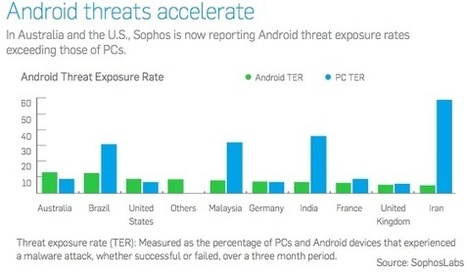
Attackers have expanded their attacks beyond the Windows platform to include Mac OS X and Android. 27 Percent of All Cybercrime Linked to the ‘Blackhole’ Exploit Kit, Sophos said.
Even though the overall market share for Mac OS X remains small compared to other platforms, the number of Mac threats are growing as more users switch. Flashback, the malware that reportedly infected hundreds of thousands of Apple systems in April was the largest mass attack this year, but it's not the only Mac malware out there. In a typical week, SophosLabs detects 4,900 pieces of OS X malware on Mac computers.
===> In a snapshot of Mac malware detected over a one-week period in August, SophosLab detected various variants of fake antivirus, codecs and Flash player. <===
Read more, a MUST:
|






