Your new post is loading...

|
Scooped by
mhryu@live.com
August 30, 12:28 AM
|
Many cellular processes are regulated through the conditional association of existing proteins, motivating methods that provide precise spatial control over protein proximity. Controlling and imaging protein proximity in living cells has traditionally relied on separate tools: chemical actuators to induce protein interactions and fluorescent reporters to monitor protein proximity. Chemically induced proximity (CIP) achieves this by using small molecules to conditionally recruit one protein to another. Here, we review the evolution of CIP strategies from non-covalent to covalent and hybrid systems, and discuss recent scaffold designs that combine proximity induction and optical reporting within a single molecular scaffold. These advances establish modern CIP scaffolds as unified platforms for simultaneously controlling and imaging protein interactions.
|
|
Scooped by
mhryu@live.com
August 30, 12:22 AM
|
Nitrogen availability is a major constraint on plant growth and agricultural productivity. Legumes and several other plant lineages circumvent this limitation by establishing symbiotic associations with nitrogen-fixing microorganisms, which convert atmospheric dinitrogen into ammonia that the host assimilates. Since root nodules were first recognized as sites of biological nitrogen fixation in the late 19th century, engineering this capacity in nonlegume crops has remained a long-standing goal. However, two key challenges remain: enabling intracellular rhizobial infection and establishing a molecular framework that supports nitrogen fixation. Recent advances in the molecular, cellular, and evolutionary mechanisms underlying root nodule symbiosis now provide a conceptual framework toward this goal. In this review, we synthesize these advances and outline staged strategies for engineering nitrogen-fixing symbiosis.
|
|
Scooped by
mhryu@live.com
August 30, 12:05 AM
|
Replacing large-scale fragments in human cells remains a substantial challenge. Here, we present a programmable gene replacement tool, named prime assembly (PA), which adapts prime editors to produce one or two pairs of 3′-flaps on both the genome and donor DNA. These 3′-flaps anneal to each other precisely, similar to Gibson assembly in DNA oligonucleotides, allowing megabase-scale genomic excision and/or kilobase-scale donor insertion at the gene of interest. PA accepts DNA plasmids and linear double-stranded DNA as donors, ranging from 1.0 to 6.5 kb in size. We demonstrate an efficiency of up to 57.8% in replacing endogenous sequences with a 2.9-kb donor DNA fragment in HEK293T cells, with an accuracy of >90% for integrated PA fragments. Furthermore, PA enables site-specific chimeric antigen receptor integration with up to 28.1% efficiency in primary human T cells. When PA containing a GFP donor is delivered to mice by hydrodynamic injection, an average integration efficiency of 4.3% is measured in GFP-positive hepatocytes. Large DNA fragments are annealed and inserted with prime editing.
|
|
Scooped by
mhryu@live.com
August 30, 12:01 AM
|
The convergence of synthetic biology, artificial intelligence (AI), and automation (SynBioxAI) creates research activities that simultaneously engage biosecurity, AI governance, export control, and data sovereignty frameworks – none of which are designed for convergent science. We conduct a comprehensive cross-jurisdictional analysis of this regulatory landscape across sixteen nations, identifying critical ambiguities where novel SynBioxAI objects fall between established regulatory categories. Through seven realistic collaboration scenarios, we demonstrate that regulatory friction is multiplicative rather than additive. We propose the SynBioxAI Regulatory Interoperability Toolkit (RIOT): a practical, seven-lens institutional framework that gives research institutions the capacity to navigate regulatory divergence efficiently and transparently. The convergence of synthetic biology, AI, and automation creates new challenges for regulatory frameworks. In this Perspective, the authors analyse national regulations and propose the SynBioxAI regulatory interoperability toolkit to give research institutes the capacity to navigate divergent regulatory landscapes.
|
|
Scooped by
mhryu@live.com
August 29, 11:39 PM
|
Silicate mineral weathering (dissolution) is a scalable strategy for capture and storage of CO2 but is too slow for industrial deployment. Bacteria can accelerate mineral dissolution by secreting siderophores, molecules that solubilize iron released from the mineral. Here we investigate how to deploy siderophore-producing bacteria at scale to continuously enhance dissolution of the mineral olivine. We demonstrate that natural genetic regulation precludes continuous siderophore production in mineral bioreactors. To overcome this limitation, we engineer the marine bacterium Alteromonas macleodii for enhanced siderophore production, conferring a 2.6-fold increase in the rate of olivine dissolution. Life-cycle analysis indicated that renewable feedstocks and minimal replenishment of modified cells are critical to achieve net CO2 removal at scale. With these guidelines, we constructed pilot-scale continuous mineral bioreactors that use unprocessed seawater and a renewable acetate feedstock to weather 4 kg of olivine. In reactors with engineered cells, we directly measured removal of 0.50 g CO2 per day from the air through alkalinity generation. Engineered bacteria speed up rock weathering for carbon capture in a seawater bioreactor.
|
|
Scooped by
mhryu@live.com
August 29, 10:42 PM
|
Thermophilic filamentous fungi are widely used for cellulase production at elevated temperatures; however, efficient recombinant protein production in these organisms remains limited because construction and screening of large transformant populations remain difficult. Here, Myceliophthora thermophila was engineered into a thermophilic fungal chassis through combinatorial deletion of genes associated with proteolysis, vesicle trafficking, and secretion, resulting in a hyper-secretory strain. An optimized expression cassette coupled with a laccase reporter enabled activity-based identification of productive transformants. Iterative genome engineering combined with QPix-assisted colony picking enabled parallel recovery and screening of fungal transformants, with 552 colonies recovered after transformation and dilution plating and 96 transformants further evaluated by ABTS-based plate screening. Targeted integration at the MtLacA locus enabled identification of productive recombinants through loss of laccase activity, and transformants frequently carried multicopy integrations. Through iterative screening and strain improvement, extracellular protein production reached ~1.1 g/L in shake-flask cultures and 5.9 g/L in a preliminary 5-L fermentation after 144 h using glucose as the carbon source. The chassis also supported the secretion of recombinant fungal enzymes and porcine growth factors. Collectively, these results establish a practical semi-automated workflow for recombinant protein production and strain engineering in thermophilic filamentous fungi.
|
|
Scooped by
mhryu@live.com
August 29, 5:17 PM
|
Gram-negative bacteria are protected by a three-layered cell envelope and must tightly coordinate the biosynthesis of phospholipids (PL), peptidoglycan (PG) and lipopolysaccharides (LPS) to maintain envelope integrity. In E. coli, the inner membrane protein LapB (YciM) plays a critical dual role in LPS homeostasis by acting as a scaffold for cytoplasmic LPS and PL biosynthesis enzymes and by promoting FtsH-dependent proteolysis of the key enzyme LpxC. Because LPS and PG biosynthesis compete for the shared precursor UDP-GlcNAc, we investigated whether MurA, catalyzing the first committed step of PG biosynthesis, is an integral component of the LapB complex. Using bacterial two-hybrid analysis, pull-down assays and microscale thermophoresis, we demonstrate that MurA directly interacts with LapB, LpxA, LpxC, LpxD, and FabZ. Together, these findings support a model in which PL, PG, and LPS biosynthesis enzymes are engaged in a protein–protein interaction hub that synchronizes the production of all three layers of the Gram-negative cell envelope in E. coli.
|
|
Scooped by
mhryu@live.com
August 29, 1:23 PM
|
Expansins and lectins facilitate microbial colonization, but their collaborative mechanisms across different colonization stages remain unclear, and fungal root attachment via these proteins requires further exploration. This study proposes a fungal early colonization hypothesis: Trichoderma harzianum uses the ThSWO-ThFFSL complex to promote hyphal attachment to rice roots. The results show that ThSWO loosens rice cell wall cellulose and forms biomolecular condensates via its intrinsically disordered region (IDR) and extensive O-glycosylation. These condensates specifically recruit the fungal fucose-binding lectin ThFFSL through fucose residues, and both colocalize in root surface cell wall crevices. After localization, ThFFSL guides hyphal growth and enhances adhesion, promoting fungal attachment within the crevices. Postattachment, T. harzianum secretes an O-glycosidase to deglycosylate ThSWO, dissociating the complex and mitigating root cell wall damage. Colonization assays confirm that ThSWO-ThFFSL synergy is crucial for efficient colonization. This study reveals an early attachment phase in fungal colonization driven by protein condensates and glycosylation modifications.
|
|
Scooped by
mhryu@live.com
August 29, 12:24 PM
|
Bacteria engage in social cooperations to ensure survival and reproduction in adverse environments. Numerous bacterial sociality genes (SGs) are dedicated to such cooperations. Mutant bacteria carrying loss-of-function mutations (LOFMs) in SGs are frequently shielded from purifying selection by cooperative wild-type peers. Yet, in absence of active purging, such mutants would persist and proliferate in bacterial populations, ultimately crippling cooperation. We propose the hypothesis of bottlenecked reproduction at foci of cooperation (BRFC) to address this problem. This hypothesis stipulates that bacterial reproduction at foci of cooperative colonization is bottlenecked, allowing extremely few individuals to initiate proliferation and dispersal. Note that mutant individuals carrying SG LOFMs are just as likely to escape as their wild-type peers. However, if this is to occur, the resulting mutant lineage, upon dispersing to a new site, would fail at renewed reproduction. Interrogation of this hypothesis should unveil bacterial vulnerabilities that can be exploited to combat bacterial diseases.
|
|
Scooped by
mhryu@live.com
August 29, 11:14 AM
|
The physicochemical controls governing metal acquisition, release, and redistribution across biological interfaces remain poorly understood. Biophytometallurgy—the microbially assisted release and recovery of plant-associated metals—was used to probe the directionality of the mechanisms controlling nickel and rare earth element (REE) release from Phytolacca during solid–liquid extraction. Bulk characterization did not support a dominant crystalline REE-phosphate-like host in hydroponically enriched shoots. Dissolution and rebinding experiments instead revealed chemically accessible nickel and REE pools, the latter of which had behaviors consistent with apparent equilibrium-like partitioning under mildly acidic conditions. During sulfur biooxidation, Acidithiobacillus ferrooxidans promoted REE release while providing a competing cell-associated REE sink. Consequently, aqueous REE concentrations reflected net redistribution among the separable plant, solution, and microbial phases instead of dissolution alone. These results establish a framework for studying metal partitioning across complex and coupled biological systems and support a route for aqueous REE recovery from plants without thermochemical conversion to ash.
|
|
Scooped by
mhryu@live.com
August 29, 10:44 AM
|
Viral population dynamics are shaped by production and loss. For viruses of microbes, high standing levels of viral abundances are interpreted as evidence of high rates of viral-induced cellular loss and viral production, followed by rapid extracellular viral decay. Here we reassess assumptions of rapid extracellular decay in 17 curated datasets, finding that biphasic decay either fits better or is statistically indistinguishable from exponential decay in approximately half the datasets. In addition to intrinsic heterogeneity in decay rates, biphasic decay at population scales can arise generically through aggregation mechanisms, where single virions decay and viral aggregates are protected. Integrating aggregation-induced biphasic decay into a virus-host model reveals that accounting for aggregation can recapitulate joint observations of high virion abundances and low infection prevalence, without assuming significant levels of uniformly inefficient infection. Together, our results suggest that durable extracellular virion persistence is environmentally relevant in shaping virus-microbe population dynamics.
|
|
Scooped by
mhryu@live.com
August 28, 4:39 PM
|
Building high-performance microbial cell factories requires dynamic coordination of resource allocation among cellular growth, target-product biosynthesis, and endogenous host metabolism. However, existing polyploid engineering strategies rely primarily on static manipulation of chromosome copy number. Although increasing gene dosage can enhance biosynthetic capacity, static designs cannot readily accommodate the changing metabolic demands encountered during fermentation. Here, we developed a metabolite-responsive dynamic polyploid engineering strategy that couples chromosome ploidy to the cellular metabolic state. We first constructed a high-performance L-threonine biosensor and used it to sense intracellular L-threonine levels and regulate ftsZ expression, a key cell-division gene, thereby establishing a dynamic polyploid system that requires neither exogenous inducers nor antibiotics. This system enabled engineered cells to progressively transition from polyploid to haploid during fermentation, accompanied by stage-specific remodeling of cellular physiology and metabolism. Physiological characterization revealed a marked increase in cell size and alterations in cell-envelope properties during the polyploid phase, followed by a gradual decrease in chromosome copy number as fermentation progressed. Transcriptomic and metabolomic analyses further demonstrated that dynamic ploidy transitions induced global metabolic network rewiring, remodeling the tricarboxylic acid cycle and amino acid metabolism while redirecting carbon flux toward the biosynthesis of aspartate-family amino acids. Ultimately, dynamic polyploid engineering substantially enhanced L-threonine production, enabling the engineered strain to achieve an L-threonine titer of 183.1 g/L and a yield of 0.67 g/g glucose in 5-L fed-batch fermentation without antibiotics or exogenous inducers. These findings show that dynamic regulation of chromosome ploidy can couple gene-dosage control with remodeling of cellular physiology and metabolic networks, providing a new engineering strategy to overcome the limitations of static polyploid designs and build high-performance microbial cell factories.
|
|
Scooped by
mhryu@live.com
August 28, 12:42 PM
|
Sialic acids (Sias) and related nonulosonic acids are critical components of glycoconjugates involved in host-pathogen interactions, immune regulation, and cell signalling. Despite their biotechnological relevance, the diversity of enzymes involved in Sia biosynthesis remains largely underexplored due to limitations in culture-dependent methods and the lack of (ultra) high-throughput screening strategies. Here, we report the development of a highly sensitive droplet-based microfluidic screening platform enabling the functional discovery of sialic acid aldolases in environmental metagenomes. The method integrates a fluorescence-coupled enzymatic cascade compatible with fluorescence-activated droplet sorting (FADS), allowing the screening of >10⁶ droplets per experiment, as well as a downstream validation strategy for the selected hits. Although some limitations were identified, the system demonstrated high sensitivity and was utilised for the screening of a metagenomic library from garden soil. During this campaign, a potential new sialic acid aldolase enzyme was identified. This work establishes a generalizable framework for measuring complex, multi-step enzymatic functions at ultrahigh throughput using coupled cascades in droplets
|
|
|
Scooped by
mhryu@live.com
August 30, 12:25 AM
|
The WalRK two-component system monitors cell wall biosynthesis, and its activity decreases when biosynthesis is inhibited. As WalRK is essential for many Gram-positive bacteria, including Staphylococcus aureus and Bacillus subtilis, directly inhibiting WalK would disrupt cell wall biosynthesis and result in cell death. This study presents the construction of new reporter strains with two WalRK-dependent promoters: PiseA and PssaA. These reporter strains enable indirect in vivo measurement of WalRK activity based on luminescence. We evaluated these reporters in combination with the established PliaI reporter system, which is regulated by LiaRS, in order to improve the identification of cell wall inhibitors during the screening of natural products. The WalRK-dependent PiseA reporter yielded specific responses to almost all known cell wall biosynthesis inhibitors, including β-lactams, tunicamycin, glycopeptides, daptomycin, and fosfomycin, with no discernible response to other antibiotic classes. Furthermore, combining the PliaI reporter system with the PiseA reporter enhanced the range of potential cell wall inhibitors that could be detected. Deleting the gene of the eukaryotic-like Ser/Thr kinase PrkC increased the PiseA signal obtained with certain antibiotics, as well as after a longer incubation period. Additionally, deletion of prkC lowered PliaI expression in the presence of lipid II-targeting antibiotics. Screening natural products with an unknown mode of action identified several compounds that elicited vancomycin-like patterns with the reporter systems, indicating potential cell wall inhibitory activity. Overall, combining WalRK and LiaRS reporters enables a rapid, complementary evaluation of cell wall stress responses, providing a powerful method for discovering new cell wall-targeting antibiotics.
|
|
Scooped by
mhryu@live.com
August 30, 12:14 AM
|
Methylotrophic yeasts are outstanding platforms for the production of recombinant proteins through precision fermentation. Growing demand for protein-based food ingredients requires economically viable secretion efficiency and space-time yields, as well as correct post-translational modifications to ensure proper food functionality. Here, we review recent advances and future potential in engineering methylotrophic yeasts for food protein production, with particular focus on Komagataella phaffii. We first summarisz the production of three categories of protein food ingredients: recombinant dairy proteins, proteins for plant-based and cultivated meat applications, and sweet-tasting proteins. Addressing the dual goals of improving both yield and quality, we then review synthetic biology and metabolic engineering strategies in methylotrophic yeasts, with emphasis on genome engineering and gene expression tools, protein secretory pathway engineering, and glycoengineering. Further advances in synthetic biology, integrated with industrial process development, will be critical to unlocking future precision fermentation systems based on methylotrophic yeasts.
|
|
Scooped by
mhryu@live.com
August 30, 12:01 AM
|
RNA molecules can move between organisms, even across different kingdoms, to regulate gene expression — a discovery that has reshaped our view of inter-organismal communication, particularly in host–pathogen interactions. A new study by He et al.
|
|
Scooped by
mhryu@live.com
August 29, 11:42 PM
|
Algal-bacterial interactions regulate the production and fate of marine particulate organic carbon (POC), yet their capacity to generate long-lived carbon sinks remains unclear. Using a two-year, nutrient-self-sustaining co-culture of Synechococcus and its mutualistic microbiota, we demonstrate that sustained algal-bacterial interactions promote the progressive accumulation of recalcitrant POC. Continuous release of algal-derived organic substrates, coupled with repeated microbial enzymatic reworking, produced inert organic particles, with ~26% resisting remineralization and forming a stable recalcitrant particulate carbon pool. Radiocarbon (Δ14C) analyses revealed an apparent age offset exceeding 400 years for POC formed within only two-year experiment. This “aged” signature likely results from algal assimilation of fossil-fuel-14C-depleted atmospheric CO2 followed by accumulation in generated recalcitrant POC. By demonstrating that apparent radiocarbon age can become decoupled from actual residence time, these results provide insights into the interpretation of “old” marine POC and highlight the important roles of algal-bacterial interactions in ocean particulate carbon sequestration. Sustained algae-bacteria interactions generate recalcitrant particulate organic carbon with aged radiocarbon signatures within years, revealing an overlooked ocean carbon storage pathway and complicating interpretations of old marine carbon pools.
|
|
Scooped by
mhryu@live.com
August 29, 10:48 PM
|
Prime editing has rapidly emerged as a versatile and precise genome engineering technology capable of introducing targeted substitutions, insertions, and deletions without requiring double-strand breaks or donor DNA templates. Since its initial development, substantial progress has been achieved through iterative innovations in core components, including Cas protein variants, reverse transcriptase engineering, and prime editing guide RNA (pegRNA) design. These advancements have significantly improved editing efficiency, fidelity, and target accessibility across diverse biological systems. In parallel, the development of large-fragment editing platforms such as TwinPE, PASTE, and PrimeRoot has expanded the scope of prime editing from small sequence modifications to kilobase-scale genome rewriting. Furthermore, the integration of artificial intelligence-driven design tools has transformed pegRNA optimization and system selection, enabling more predictable and efficient editing outcomes. This review provides a comprehensive overview of recent molecular innovations, large-fragment editing strategies, and computational approaches shaping the evolution of prime editing. Collectively, these developments position prime editing as a highly programmable and scalable platform with broad applications in medicine, agriculture, and synthetic biology.
|
|
Scooped by
mhryu@live.com
August 29, 10:39 PM
|
In 2016, researchers at the J. Craig Venter Institute produced JCVI-Syn3.0, a derivative of Mycoplasma mycoides subsp. capri Large Colony strain GM12 with a re-engineered, minimized genome. The minimal synthetic genome of 532 kbp encodes 473 genes, selected from ∼910 parent genes on the basis of their indispensability, that is, a lethal phenotype caused by a knockout of each such gene. Among these genes, 438 genes encode proteins, of which ∼150 were not assigned a molecular function or predicted cellular role. A decade later, despite community annotation efforts, 50–60 of these putative proteins still lack any assigned function. We analyzed the intrinsic sequence characteristics, evolutionary conservation, and three-dimensional AlphaFold models of this least understood subset of the JCVI-Syn3.0 genes. We predicted conserved sequence motifs and structural features and inferred molecular functions of six proteins likely involved in membrane transport or membrane interactions, and six proteins that apparently belong to bacterial immunity systems, such as putative antitoxins, an essential toxin-like protein, and a member of a previously unnoticed clade of Cas4-like nucleases. The spatial models produced for this challenging data set by the AlphaFold pipeline help dissect proteins into discrete domains, which are often more convenient to analyze by sequence similarity than whole proteins. In several cases, AlphaFold models also enable functional inference more directly, based on spatial matching of the models to the databases of known protein structures.
|
|
Scooped by
mhryu@live.com
August 29, 3:28 PM
|
Designing proteins for real-world applications requires the simultaneous satisfaction of multiple physicochemical properties. Structure-based de novo protein design has become the prominent design paradigm, successfully creating numerous proteins. Property optimization is commonly introduced during the sequence generation stage of protein design, i.e., inverse folding. Existing methods primarily rely on fine-tuning inverse folding models to design sequences with desired characteristics. However, multi-property optimization through fine-tuning demands datasets annotated with multiple properties—resources that remain extremely limited. Consequently, structure-based protein design has not yet achieved joint optimization of multiple properties. Here, we present Discriminator-Guided Inverse Folding (DGIF), a framework that guides the inverse folding model by adjusting its internal history states through an auxiliary discriminator module. The discriminator integrates multiple property predictors, each trained independently on a single-property dataset, thereby enabling multi-property optimization in the absence of datasets annotated with multiple properties. In addition to substantial improvements in key traits like thermostability and solubility, DGIF can generate protein sequences optimized for both properties simultaneously, with the designed proteins shifting markedly toward the Pareto front that represents optimal trade-offs. Experimental results validate the effectiveness of DGIF for multi-property protein design.
|
|
Scooped by
mhryu@live.com
August 29, 12:53 PM
|
Nitrous oxide (N2O), a potent greenhouse gas and the dominant ozone-depleting substance, is primarily emitted from soils. Understanding atmosphere-to-soil N2O uptake is crucial for harnessing the soil’s natural sink potential, yet its quantification and mechanistic drivers remain poorly constrained. Here, we disentangled gross N2O emission and uptake using the 15N2O pool dilution method, revealing key drivers in five cropland soils across China and in labile carbon–amended soils. In particular, the ratio of gross N2O uptake to emission—driven by the soil labile carbon to inorganic nitrogen [dissolved organic carbon/dissolved inorganic nitrogen (DOC/DIN)] ratio—showed pronounced variability (0.28 to 0.79), revealing a powerful but previously underestimated lever for regulating net N2O fluxes. Mechanistically, an elevated DOC/DIN ratio promoted complete denitrification by increasing electron supply, stimulating oxygen-depleting respiration, and enhancing nosZ gene abundance, achieving up to 51% N2O mitigation. Our findings underscore soils as dynamic N2O regulators and propose a carbon-nitrogen–coupled regulation framework, where labile carbon plays a critical role in regulating N2O dynamics.
|
|
Scooped by
mhryu@live.com
August 29, 11:31 AM
|
Plasmid transfer among bacteria is an important driver of the spread of antibiotic resistance. Surface-associated bacterial biomass is a hotspot for plasmid transfer due to the dense spatial packing of cells, but this biomass is often sparse (composed of discrete bacterial colonies). Compared to plasmid dynamics within a single colony, the determinants of plasmid transfer between discrete colonies are less understood. Yet, colonies routinely physically collide with each other as they grow and expand across surfaces. Here, we experimentally demonstrate that collisions between colonies of Stutzerimonas stutzeri and E. coli enable the spread of an antibiotic resistance-encoding plasmid, with the extent of transfer determined by the spatial distance between bacterial inocula. To better understand how spatial constraints influence the mechanisms underlying inter-colony plasmid spread, we applied an individual-based model simulating plasmid dynamics between colliding colonies. Our simulations quantitatively predict how the probabilities of plasmid transfer and loss affect plasmid spread as colonies grow and collide. These effects are modulated by the distances between colonies and the spatial positioning of plasmid-carrying cells along the collision boundary. Our study reveals that inter-colony plasmid transfer is determined by the interplay between plasmid transfer, plasmid loss, and spatial constraints, expanding our understanding of plasmid dynamics in the spread of antibiotic resistance genes.
|
|
Scooped by
mhryu@live.com
August 29, 10:57 AM
|
Calcium signaling is a fundamental cellular communication mechanism, well established in eukaryotes, that relies on calcium ions (Ca2+) acting both as first and second messengers to regulate diverse life-sustaining processes. In bacteria, although the significance of Ca2+ regulation is recognized, it is commonly attributed to its role as a first messenger, while the mechanistic basis for its capacity as a second messenger remains elusive. Previously, we have shown that Pseudomonas aeruginosa possesses the key prerequisites for intracellular Ca2+ (Ca2+in) signaling, including tightly controlled Ca2+in homeostasis, transient changes in Ca2+in levels in response to exogenous Ca2+, and Ca2+-regulated gene expression. In addition, we and others identified several key components of the Ca2+ signaling network, including Ca2+ sensors, transporters, and regulators. The remaining question is whether the levels of Ca2+in alter in response to any extracellular stimuli other than Ca2+. To determine this, we have used a cytoplasmic Ca2+ probe, R-GECO1, that produces a Ca2+-dependent fluorescence and tested a variety of extracellular stimuli, including ions, monosaccharides, amino acids, nucleotides, quorum-sensing signaling molecules, reactive oxygen species, and antibiotics. We observed changes in Ca2+in levels in response to several molecules, particularly glucose, asparagine, ATP, ADP, AMP, HOCl, and cycloserine. The results provide the first experimental evidence that, like eukaryotes, P. aeruginosa responds to select, chemically diverse host-related stimuli by altering its Ca2+in levels, supporting a potential signaling role of Ca²+in in bacteria.
|
|
Scooped by
mhryu@live.com
August 28, 4:42 PM
|
The widespread application of CRISPR/Cas genome editing for commercial crop improvement is currently hindered by a complex and restrictive intellectual property (IP) landscape. The recent development of OpenCRISPR-1, a fully AI-designed and open-source Cas9-like nuclease, provides a promising, IP-unencumbered alternative; however, its efficacy in dicotyledonous plants remains largely uncharacterized. Here, we report the successful adaptation of the OpenCRISPR-1 system for highly efficient targeted mutagenesis in dicots. We constructed a plant-optimized binary vector (pBSE-OpenCRISPR-1) and validated its editing capability across two species. In soybean (Glycine max), targeting the GmFAD2-1B gene via an Agrobacterium rhizogenes-mediated hairy root transformation system yielded a robust mutation rate of approximately 50%. In Nicotiana benthamiana, stable Agrobacterium-mediated transformation targeting the phytoene desaturase homologs (NbPDSa/b) achieved a 75% editing efficiency in T0 lines, with up to 13.8% of events displaying complete homozygous or biallelic mutations and the corresponding visible albino phenotypes. Deep amplicon and Sanger sequencing revealed a characteristic mutation profile dominated by 1-bp insertions and small deletions occurring two to three nucleotides upstream of the PAM. These results demonstrate that the AI-designed OpenCRISPR-1 system is a highly active and versatile nuclease for dicot genome engineering, offering a powerful, commercially unencumbered tool to accelerate global crop trait improvement.
|
|
Scooped by
mhryu@live.com
August 28, 4:23 PM
|
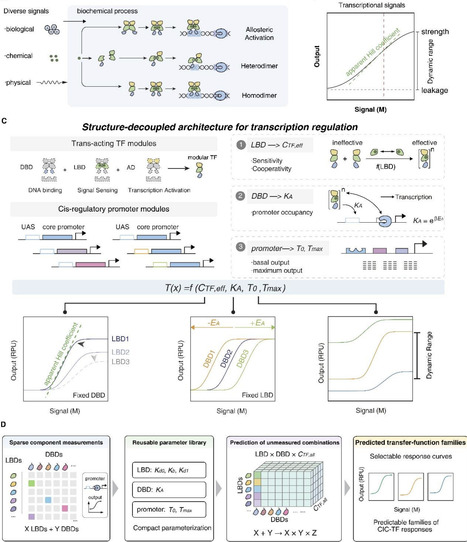
Predictive engineering of eukaryotic transcription is limited by the coupling of signal sensing, DNA binding, TF abundance and promoter output. Here we establish chimeric induced cooperativity (CIC), a modular architecture that separates LBD, DBD and AD functions and links them to promoters with tunable basal and maximal output. Module parameters can be recombined to predict new CIC-TF configurations and guide design before construction. Ligand-induced cooperativity reduces basal DNA occupancy while increasing induced occupancy, and effective DBDs combine low OFF-state activity with strong ON-state promoter occupancy rather than binding strength alone. Synthetic promoters independently control occupancy gain and output range. The same framework extends to repression and can be recalibrated with limited measurements in mammalian cells. In yeast, CIC-12 achieved a mean fold induction of 298-fold across 12 orthogonal sensors; an earlier CIC-10 chassis enabled model-guided optimization of an eight-gene vitamin B5 biosynthetic pathway. CIC establishes a programmable, model-guided design space for eukaryotic transcriptional control.
|