 Your new post is loading...

|
Scooped by
mhryu@live.com
Today, 12:10 AM
|
Enzymatic depolymerization of polyethylene terephthalate (PET) is a promising sustainable technology for mitigating global plastic pollution. Although the engineered thermostable enzyme LCCICCG exhibits considerable degradation potential, inefficient functional expression in heterologous hosts remains a major bottleneck for industrial application. This study introduces a deep learning-guided promoter engineering strategy to optimize soluble expression of LCCICCG in E. coli via precise transcriptional regulation. The moderate-strength tac promoter outperforms the conventional strong T7 system in facilitating functional expression. A hybrid convolutional neural network (CNN)-Transformer model, integrated with a genetic algorithm (GA), was developed to design spacer sequences between the −35 and −10 regions of the tac promoter, yielding a series of high-performance variants (DMtac). The top-performing variant, DMtac36, achieved a functional yield of 147.69 mg/L/OD₆₀₀, representing 1.53-fold and 4.92-fold increases over the wild-type tac and T7 systems, respectively. These results demonstrate that moderate transcriptional activity enhances functional expression and establish a robust computational framework for efficient biomanufacturing of PET hydrolases.
|
|
Scooped by
mhryu@live.com
November 18, 11:38 PM
|
Antimicrobial peptides (AMPs) offer a promising alternative to conventional antibiotics amid the growing global threat of antimicrobial resistance. Expanding AMP discovery requires both effective computational tools to accurately identify candidate peptides and access to underexplored biological resources that may harbor novel AMPs. However, the comparative performance of existing computational methods remains poorly understood, while ancient microbiomes have received limited attention as potential reservoirs of AMPs. Here, we systematically benchmarked six machine learning methods across with twelve feature configurations spanning sequence, structural, and protein language model features under a unified framework using eight curated AMP datasets. The best-performing methods were subsequently applied to three ancient metagenomic datasets representing the human gut (archaeological fecal sediments), human oral cavity (dental calculus), and mammoth-associated communities (teeth, skulls, and skin). In parallel, we employed reinforcement learning to select candidate peptides directly from ancient sequence pools without relying on modern AMP labels. Our benchmarking shows that protein language model embeddings provide the most informative features, and deep learning models, including convolutional, transformer-based, and recurrent architectures, outperform classical methods. Applying these models to ancient microbiomes identified candidates occupied the physicochemical space characteristic of AMPs but differed from those of candidates predicted from modern microbiome catalogs. We identified 111, 76, and 50 high-confidence candidate AMPs from the Neanderthal gut, ancient oral, and mammoth-associated communities, respectively. Reinforcement learning selected additional candidate AMPs with distinct properties compared with those predicted by models trained on modern AMP databases. Together, these findings establish a systematic benchmark for AMP prediction and highlight ancient microbiomes as an untapped source of antimicrobial peptide candidates. By integrating supervised machine learning with reinforcement learning, this study expands AMP discovery beyond modern microbiome catalogs and provides new opportunities to identify potentially novel AMPs.
|
|
Scooped by
mhryu@live.com
November 18, 11:15 PM
|
Biological nitrogen fixation is a primary source of nitrogen for many plants. Recent studies on nano-enabled atmospheric dinitrogen fixation demonstrate that selected nano-scale micronutrients enhance crop yield by strategically modulating various physicochemical mechanisms fundamental to nitrogen dynamics, thereby overcoming many of the inherent limitations of this important biological process.
|
|
Scooped by
mhryu@live.com
November 18, 4:49 PM
|
Cells suppress protein synthesis during starvation, but how translation recovers upon nutrient repletion remains poorly understood. To address this gap, we followed translational recovery in budding yeast after repletion of glucose, nitrogen, or phosphate, combining time-resolved metabolomics, structural proteomics, transcriptomics, and spike-in-calibrated ribosome profiling. Nutrient addition rapidly altered ribosome occupancy in distinct, transcript-specific programs. To identify their sequence determinants, we developed RiboNet, a deep learning framework that predicts ribosome load and positions along transcripts from mRNA sequence. RiboNet-guided in silico mutagenesis revealed reduced pausing at serine codons upon glucose repletion and transiently increased pausing at leucine codons following nitrogen repletion. These responses coincided with altered cognate tRNA charging and metabolite-associated structural changes in aminoacyl-tRNA synthetases. RiboNet also identified a conserved 5′ UTR motif, GAUY, that increased reporter protein output following glucose repletion. Our findings reveal how metabolic state alters the contributions of mRNA sequence features to translation initiation and elongation.
|
|
Scooped by
mhryu@live.com
November 18, 4:44 PM
|
Fungi encode diverse carbohydrate-processing functions, yet the genomic basis of their lignocellulose-degradation potential and its relevance to the human gut remain poorly understood. Here, we experimentally assessed cellulase-, xylanase-, and laccase-associated activities across 762 environmentally derived fungal isolates and sequenced 170 representative strains, retaining 160 genomes for genome–phenotype analyses. By integrating functional annotations with orthogroup presence–absence variation and machine-learning models, we identified lignocellulose-degradation-associated genomic features that improved phenotype prediction beyond conventional annotation alone. We then applied this framework to 2,116 publicly available fungal genomes and 704 cultivated gut fungal genomes from a previously published collection to construct a non-redundant catalogue of lignocellulose-degradation-associated genes (LDAGs), comprising canonical degradative enzymes, annotated phenotype-associated features, and candidate orthogroups. Across fungal lineages, xylanase-associated potential was broadly distributed, cellulase-associated potential showed an intermediate pattern, whereas laccase-associated oxidative potential was concentrated in a more restricted subset of taxa. Analysis of approximately 1,500 publicly available human gut metagenomes identified disease-associated differences in LDAG profiles in atherosclerotic cardiovascular disease (ACVD), inflammatory bowel disease (IBD), and obesity. Under stringent read-remapping criteria, total LDAG abundance differences remained significant in ACVD and IBD but were attenuated in obesity, whereas compositional differences persisted across all three cohorts with modest effect sizes. These fungal genomic signatures covaried with bacterial taxa, including E. coli, and pathways involved in central carbon and carbohydrate metabolism. Together, our findings establish a phenotype-informed genomic framework for resolving fungal lignocellulose-degradation potential and reveal its consistent association with disease-related bacterial and metabolic configurations in the human gut.
|
|
Scooped by
mhryu@live.com
November 18, 4:18 PM
|
Anaerobic ammonium oxidation (anammox) is an energy-efficient, low-carbon process for nitrogen removal, but the slow growth of anammox bacteria delays reactor start-up and limits biomass accumulation. CO2 fixation supplies carbon skeletons for autotrophic growth of anammox bacteria. Previous studies have described the main CO2 fixation pathways, but how nutrient supply supports carbon assimilation and cell growth remains poorly understood. This review examines the Wood–Ljungdahl pathway in anammox bacteria and how fixed carbon enters central metabolism to form biosynthetic precursors. CO2 fixation relies on inorganic carbon, energy, reducing power, metal cofactors, and one-carbon carriers such as tetrahydrofolate (THF). Carbonate buffering, trace element availability, growth factor supplementation, and potential nutrient exchange with associated microorganisms may also influence cultivation. Studies suggest that appropriate nutrient supply can improve reactor performance in some systems. Folate supplementation has increased the relative abundance of anammox bacteria in some cultures, while THF has enhanced inorganic carbon uptake in marine enrichments. Future studies should identify growth-limiting nutrients, clarify nutrient acquisition and exchange, and quantify the links among carbon assimilation, cell growth, and nitrogen removal in anammox bacteria. These insights could improve anammox bacterial cultivation and support stable nitrogen removal in anammox-based treatment systems.
|
|
Scooped by
mhryu@live.com
November 18, 4:07 PM
|
As a primary port of pathogen entry, the intestinal mucosa has developed a sophisticated set of defences to ward off infections. Investigating the human-specific intestinal barrier responses to pathogens is limited by the lack of models integrating the necessary architectural complexity with an autologous immune compartment. Here we developed engineered barrier models of the human small intestine and colon combining a multilineage epithelium, mucus layer, accessible microbial compartment and autologous tissue-resident immune cells. These tissues recapitulate morphological and functional properties that are region specific and compare with those of the native organ. We use the model to characterize the human epithelial response to Salmonella enterica subsp. enterica serovar Typhimurium at the single-cell level, uncovering the distinct gene regulatory networks that underpin luminal versus intracellular pathogen presence. Invaded epithelial cells initiate an IL-18 signalling axis that triggers cytotoxic T cell activation, resulting in epithelial shedding and barrier disruption. Overall, this work allows for the modular integration of epithelial, microbial and immune compartments, providing a versatile system for studying human intestinal physiology and pathologies. Engineered barrier models of the small intestine and colon that include immune cells and a microbial compartment enable characterizations of the human epithelial response to Salmonella Typhimurium at the single-cell level.
|
|
Scooped by
mhryu@live.com
November 18, 11:23 AM
|
The use of cyanobacteria as biotechnological chasses is considered a key point in the circular economy due to their scarce growth requirements and its capacity of fixing atmospheric CO2. However, for obtaining the most of their potential, it is often necessary to count with tools that allow the modification of the genetic expression. In this work, we have characterized a molecular toolkit for reliable control of gene expression control through induction or repression in Synechocystis sp. PCC6803 using SEVA plasmids. Different inducible promoters showing a variety of dynamic range, strength and leakiness using GFP our YFP as reporter genes were assayed. On the other hand, we also evaluated the gene repression in cyanobacteria by using CRISPRi technology, which allows to repress the gene transcription in a targeted manner. Employing an inducible promoter, a new SEVA-dCas9 based vector was built for Synechocystis sp. PCC6803. The vector contains dCas9 (DNase-dead Cas9 nuclease) under the tightly regulated PBADRSW promoter, which combines a theophylline-responsive riboswitch with a rhamnose-inducible promoter. The sgRNA expression cassette is also encoded on the same plasmid, resulting in a compact, self-contained CRISPRi system that simplifies genetic implementation and enables targeted gene. As a proof of concept, we demonstrated that the system enables reversible knockdown of a chromosomally integrated eYFP reporter driven by the constitutive Pc223 promoter in Synechocystis sp. PCC 6803. These results provide new insights into the genomic strategies and available promoters and CRISPRi-SEVA plasmids for the industrial cyanobacteria Synechocystis sp. PCC 6803 that would be valuable for further applications.
|
|
Scooped by
mhryu@live.com
November 18, 11:16 AM
|
Nucleic acids adopt a rich repertoire of non-canonical structures beyond the iconic double helix — G-quadruplexes, i-motifs, triplexes, R-loops, Z-DNA/Z-RNA, and junctions — with roles in genome stability, transcription, replication, and translation. Yet the biological evidence for these conformations varies widely, from direct in vivo validation to largely indirect biochemical inference. We organize this review around a distinctive therapeutic duality: non-canonical structures may serve as molecular targets for small molecules, peptides, and nucleic acid-based modulators, while some are also engineered as therapeutic agents in their own right. For each structural class, we critically assess structural principles, biological evidence, and detection methods, explicitly distinguishing direct in vivo validation from cell-based and biochemical observations and noting the limitations of current detection strategies. Comparing translational maturity across classes through the lens of target versus agent, we identify key challenges — structural selectivity, mechanistic attribution, target engagement, and delivery — that must be resolved to fully realize the therapeutic potential of non-canonical nucleic acid structures.
|
|
Scooped by
mhryu@live.com
November 18, 10:08 AM
|
Alcohol intoxication remains a pervasive driver of global mortality and multi-organ pathology, yet its clinical management is fundamentally limited by the saturation kinetics of hepatic enzymes and the rapid gastrointestinal absorption of ethanol. While ingestible bioelectronics have advanced physiological monitoring and neural modulation, autonomous systems that locally convert metabolically relevant toxins upon contact within the gastrointestinal tract remain underdeveloped. Here, we report a fully integrated, ingestible, and self-powered electro-capsule designed for localized intestinal ethanol interception. The device features a galvanic architecture utilizing biomimetically assembled manganese–ellagic acid (Mn–EA) mesocrystals. The device integrates a Zn-based galvanic component for self-powered operation with a Mn–EA/Au interface for contact-dependent ethanol conversion toward acetate, providing a host-independent auxiliary clearance pathway. In a rat model of acute intoxication, prophylactic administration reduced blood ethanol concentrations by ~58–68% across the 0.5–6 h observation window, shortened the duration of righting-reflex loss, and mitigated alcohol-induced neurobehavioral deficits and hepatic injury. This reduction in systemic ethanol exposure was achieved with minimal electrochemical interference from a representative biomolecule mixture in vitro. This work establishes a preclinical metabolic-bioelectronics platform for localized intestinal ethanol interception and motivates future scale-adjusted pharmacokinetic, gastrointestinal transit, and safety evaluations. Alcohol intoxication remains a leading cause of death and accidents. Here, the authors develop a self-powered electrocapsule that enables local intestinal ethanol conversion, reducing systemic ethanol exposure and associated toxicity in rats.
|
|
Scooped by
mhryu@live.com
November 18, 1:52 AM
|
Microbial communities often exhibit apparently complex dynamics driven by myriad interactions among community members and with their environments. Yet, practical modeling and control are often based on a limited number of observables, raising fundamental questions: are these observed dynamics low-dimensional? If so, how does the low dimensionality enable predictions with limited information? Here, we report an emergent simplicity that the temporal dynamics of observable microbial populations can be captured by low-dimensional representations. Using variational autoencoders, we define a critical latent dimension (Ec) that operationally quantifies the smallest latent dimension required for high-fidelity reconstruction of observable microbial dynamics under a specified criterion. Despite the complexity of unobserved background dynamics, we find Ec to be drastically lower than the community’s apparent degrees of freedom. Ec scales linearly with the number of observables, providing an empirical principle for determining representation complexity. This principle holds across simulations of pairwise interacting communities, consumer–resource dynamics, spatially distributed microbial patches, and plasmid transfer, experiments with engineered and environment-derived communities, and human microbiomes. Our findings establish a scaling law for microbial community dynamics and demonstrate that low-dimensional representations of observable dynamics retain information useful for selected prediction tasks without direct measurement of the complete community.
|
|
Scooped by
mhryu@live.com
November 18, 1:18 AM
|
Nanopores, originally developed for single-molecule nucleic acid analysis, are increasingly being applied to protein analysis. Whereas early studies established the feasibility of protein capture and detection, current work spans complementary goals including protein identification, molecular fingerprinting, sequence-related peptide analysis, and conformational-state sensing. Full-length proteins produce characteristic current fingerprints when passing through nanopores, while peptides and single amino acids offer higher resolution. Recent studies have even demonstrated sequence reconstruction based on overlapping peptide reads. Concurrently, the sensitivity of nanopores to protein conformation opens avenues for structural analysis. These advances suggest that nanopore protein analysis need not necessarily follow the DNA sequencing paradigm. Unlike nucleic acids, protein current signals are governed simultaneously by sequence, size, charge, and conformation. Therefore, full-length protein fingerprints may serve not only as classification tools but also as carriers of richer molecular information. We propose that the critical challenge ahead lies not in merely improving the identification accuracy of known proteins but in establishing robust, reliable correlations between current signatures and the molecular properties of proteins. Integrating full-length fingerprinting, sequence-related peptide analysis, and conformational measurements across complementary experimental modes may exploit the strengths of nanopores more effectively than pursuing protein sequencing alone.
|
|
Scooped by
mhryu@live.com
November 18, 1:11 AM
|
The ubiquity and toxicity of arsenic (As) have exerted strong selective pressure on microbial life, driving the evolution of specialized resistance pathways. The speciation of As strongly affects its mobility and toxicity. Virtually all extant microorganisms possess genes that act specifically on inorganic As—arsenite (AsIII) and arsenate (AsV)—to improve fitness in its presence. The use of As in microbial metabolism via AsV reduction or AsIII oxidation has been well documented, but remains relatively rare. However, virtually all microorganisms can detoxify inorganic As via the reduction of AsV and the efflux of AsIII, a well-characterized pathway encoded in the ars operon. Some can also methylate As, converting AsIII into monomethylarsenite (MMAsIII), dimethylarsenite (DMAsIII), and trimethylarsine (TMAsIII). Since TMAsIII is volatile, the transformation has potential for bioremediation applications. However, the biotic and abiotic factors conducive to As methylation in the environment are poorly understood. The gene encoding the responsible enzyme (arsM) is relatively widespread among both aerobic and anaerobic species, but the latter show limited methylation efficiencies in pure culture. Despite the ancient origins of the arsM gene—dating back to before the Great Oxidation Event—the biological role of As methylation in microorganisms remains unclear. In flooded soils, As methylation is enhanced, which results in higher environmental toxicity—MMAsIII and DMAsIII being more toxic than AsIII. Therefore, resistance pathways, such as efflux, demethylation, and oxidation, have evolved to specifically cope with such products. In contrast, some microorganisms can reduce MMAsV and DMAsV. It is assumed that the ability to produce and release MMAsIII and DMAsIII confers a competitive advantage because these may inhibit surrounding species. DMAsIII may also be a building block in the biosynthesis of more complex organic As compounds. The cryptic As speciation dynamics observed in soil reflect the interplay between diverse microbial species that may transform As in various ways. This review summarizes the state of knowledge on microbial As transformations—with an emphasis on As methylation—and how they affect As biogeochemical cycling.
|
|
|
Scooped by
mhryu@live.com
November 18, 11:56 PM
|
Melatonin is widely used to improve plant tolerance to drought, salinity, low temperature, and metal stress. Several studies also report changes in soil or root-associated microbial communities, but the processes responsible for these changes remain unclear. This review distinguishes exogenous melatonin treatment from endogenous phytomelatonin regulation and evaluates the evidence for changes in root physiology and root-zone chemistry, ecological filtering, community restructuring, colonization, and plant benefit. Current studies document changes in microbial composition, sometimes alongside changes in plant or soil chemistry. However, these observations do not establish directed recruitment or show that the altered microbiome contributes to stress tolerance. Defined microbial inoculants provide evidence of effects on host melatonin or stress responses, but whether melatonin-induced changes in natural microbial communities have similar effects remains unknown. We define the ecological terms needed to interpret these results and assess the evidence provided by each experimental design. Future studies should combine chemical and microbial measurements over time with chemotaxis and colonization assays, microbiome manipulation, metabolite addition, and rebuilding microbial communities with defined strains. These tests are needed to determine whether microbial changes contribute to the plant response to melatonin.
|
|
Scooped by
mhryu@live.com
November 18, 11:32 PM
|
Genome editing in plants is widely considered to be precise, yet genome architecture constrains its specificity. Across 47 plant species, genome size and ploidy shaped the predicted off-target landscapes of CRISPR systems, highlighting the importance of incorporating genome architecture into the molecular characterization and case-specific evaluation of edited crops.
|
|
Scooped by
mhryu@live.com
November 18, 4:54 PM
|
Near-infrared genetically encoded calcium ion (Ca2+) indicators (NIR GECIs) enable Ca2+ imaging at longer wavelengths than green or red fluorescent GECIs, providing reduced autofluorescence and phototoxicity, and improved compatibility with deep-tissue and multiplexed imaging applications. We have previously reported biliverdin (BV)-binding phytochrome-based NIR GECIs such as NIR-GECO2G that exhibit inverse fluorescence responses. Although inverse response GECIs can effectively report Ca2+ dynamics, their high baseline fluorescence in the resting apo state causes faster photobleaching and substantial out-of-focus background fluorescence, complicating signal interpretation. Here, using the inverse response NIR-GECO2G as the starting scaffold, we developed a direct response Ca2+ indicator, designated dNIR-GECO1.0, through iterative rounds of protein engineering and screening. dNIR-GECO1.0 exhibited greater molecular brightness than NIR-GECO2G, robust fluorescence in mammalian cells without exogenous BV supplementation, and a high dynamic range for reporting Ca2+ changes. A detailed mechanistic investigation identified the key mutations within the Ca2+ binding domain that were necessary to convert the inverse response indicator into a direct response indicator. Resonance Raman spectroscopic analysis provided insight into the specific changes in the BV chromophore resulting from the Ca2+-dependent conformational change.
|
|
Scooped by
mhryu@live.com
November 18, 4:46 PM
|
Nitrate (NO3–), nitrite (NO2–), and nitric oxide (NO) are key inorganic nitrogen compounds that compose the biogeochemical nitrogen cycle but are also biosynthons for bacterial natural products (NPs). This paper reviews the production of these inorganic nitrogen compounds during bacterial NP biosynthesis and their incorporation as nitro, N-nitroso, hydrazine, and diazo functionalities of NPs, with an emphasis on molecular mechanisms of the enzymes, when possible. In addition, emerging evidence for the use of nitrogen cycle enzymes for NP biosynthesis will be discussed.
|
|
Scooped by
mhryu@live.com
November 18, 4:29 PM
|
Genomic studies of antimicrobial resistance (AMR) rely on several independently curated reference databases, which describe the same genes under different names, in different structures and with different classifications. This makes results obtained with different databases difficult to compare. ARGeement maps the entries of AMRFinderPlus, the Comprehensive Antibiotic Resistance Database (CARD) and ResFinder/DisinFinder to each other by protein sequence, independently of their names. It characterises every link by its relation type, difference count and coverage, tracks the database versions, and produces a documented, immutable mapping for every release. The 17,920 entries of the release described here encode 17,959 protein sequences, corresponding to 9,337 unique proteins. For 64.4% of the cross-database entry pairs that encode the same protein, the names differ even when letter case is ignored, and 447 pairs show a genuine naming conflict. Conversely, 2.0% of the pairs with the same allele name do not encode the same protein. For synthetic variants created with known modifications, the original protein was among the best hits in 99.6% of the cases. In 100 complete RefSeq genomes annotated with AMRFinderPlus, the Resistance Gene Identifier (RGI) and ResFinder, the gene names agreed at 55.3%-75.6% of the loci called by both tools of a pair, whereas after mapping the two reference proteins were identical, near-identical or length variants at 89.6%-94.2%. These results show that name-based comparison is unreliable even for identical sequences, and that a sequence-based, versioned mapping is needed.
|
|
Scooped by
mhryu@live.com
November 18, 4:10 PM
|
Plants establish intimate relationships with rhizobacteria through the recognition and integration of a wide variety of molecules of different chemical nature, including some of the main phytohormones such as auxins, cytokinins, ethylene and gibberellins, as well as quorum-sensing signals and volatile organic compounds. The emission of bioactive molecules, which serve as communication signals, is species-specific and may change depending upon the composition of the bacterial community. Processes influenced by the bacteriome through their diffusible and/or volatile profiles range from nodulation, lateral root and root hair formation to strengthened immunity and greater resilience and adaptability under stressful environmental conditions. Plant proteins and cellular messengers for recognition of N-acyl-L-homoserine lactones, cyclodipeptides, and volatile organic compounds of bacterial origin have begun to be identified and include WRKY transcription factors, glycolytic glyceraldehyde-3-phosphate dehydrogenase, and signaling through MAP kinases. Understanding the diversity of bacterial signaling molecules and their networks continues to grow, positioning chemical synthesis as a promising approach to spread their application in sustainable agriculture. The strategies and mechanisms of plant growth promotion by rhizobacteria extend and reinforce symbiotic events enabling plants to perceive and integrate microbial information into responses that improve fitness under particular growth conditions and long-term productivity.
|
|
Scooped by
mhryu@live.com
November 18, 11:33 AM
|
The growth of marine microbial communities drives ocean biogeochemical cycles, yet the growth rates of individual species remain poorly understood. Copiotrophic bacteria, such as Vibrio species, are thought to live a feast-and-famine existence, as their capacity for rapid growth contrasts with their typically low abundance. Here we use a microfluidic mass sensor adapted to directly measure subtle and otherwise undetectable mass accumulation of individual marine bacteria in native seawater. We observe growth of several copiotrophic bacteria and find that Vibrio species consistently grew across diverse temporal conditions and had higher buoyant mass than co-occurring species. Remarkably, their growth rates were similar across samples collected over days to months and followed a well-known nutrient growth law previously established in laboratory cultures. Overall, our findings suggest that low-abundance species may play a disproportionately large role in the marine carbon cycle, with rapid biomass turnover driven by high growth rates balanced by intense predation. Marine bacteria are central to Earth’s carbon cycle, yet in situ growth rates remain poorly understood. Despite their low abundance, Vibrionaceae consistently grow rapidly, suggesting a disproportionate role in marine carbon turnover.
|
|
Scooped by
mhryu@live.com
November 18, 11:18 AM
|
Precision engineering of CRISPR/Cas9 components has advanced genome editing toward therapeutic applications. Fully chemically modified guide RNAs (gRNAs) have the potential to improve stability and broaden therapeutic delivery strategies. However, extensive chemical modification of CRISPR guides can compromise genome editing activity by disrupting gRNA–Cas9 interactions. Here, we employed an iterative, structure-guided optimization strategy to systematically evaluate chemical modifications throughout SpyCas9 gRNAs. Extending beyond commonly used nucleotide modifications, we incorporated 2′-amino-RNA, 4′-thio-RNA, and extended nucleic acid (exNA) to generate gRNAs in which 90%–100% of nucleotides are sugar- or backbone-modified. Although the performance of individual modification patterns varied among target sequences, we established a repertoire of guides that support robust genome editing in vitro and in vivo. Collectively, these findings provide a systematic framework for rational engineering of heavily and fully modified gRNAs using diverse nucleotide chemistries for nonviral CRISPR genome editing.
|
|
Scooped by
mhryu@live.com
November 18, 10:20 AM
|
Cyanobacteria are important primary producers and popular in biotechnology. Synechocystis 6803 is a model cyanobacterium, yet many coding regions are ambiguous, or have remained undetected. Here, we present a riboproteogenomic analysis combining ribosome profiling with inhibitors that stall ribosomes at translation initiation and termination sites, and proteogenomic re-annotation of its genome. Based on proteogenomics, we report translation of 3055 annotated genes (83%), 3492 based on Ribo-seq (95.2%), and 3,018 supported by both methods (82%). The data suggest additional protein-coding genes and corrections for annotated ones. We validate 15 proteins translated from antisense, intergenic and intragenic loci and provide proteogenomic support for up to 69 additional, mostly small proteins. We identify three genes with ~300 nt long intragenic out-of-frame translons and demonstrate that internal and host translons are translated into interacting proteins. Our data are accessible at https://www.bioinf.uni-freiburg.de/~ribobase/ They illustrate the enormous value of consolidating genome annotations with integrated experimental data. Information on protein-coding segments in a genome is frequently incomplete and genes encoding very short proteins are often overlooked. Here, the authors present a riboproteogenomic approach. The results support the existence of many additional protein-coding sequences in a model cyanobacterium.
|
|
Scooped by
mhryu@live.com
November 18, 10:03 AM
|
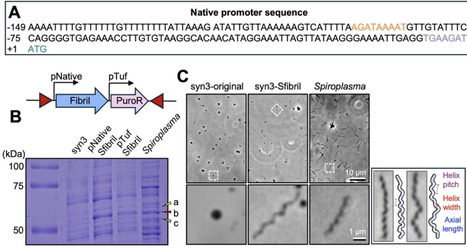
Spiroplasma, wall-less helical bacteria of the class Mollicutes, swim without flagella by shifting the handedness of their helical body. This motility is driven by an internal ribbon composed of actin-superfamily MreB proteins (SMreB) and the Spiroplasma-specific Fibril protein (Sfibril), which accounts for nearly half of the ribbon mass. However, because helical shape and swimming have been reconstituted with SMreBs alone, the role of Sfibril has remained unclear. Here, we expressed Fibril from Spiroplasma eriocheiris under its native promoter in the minimal synthetic bacterium JCVI-syn3B (syn3), in which swimming had been reconstituted with SMreB proteins, and analyzed cell morphology and swimming. Sfibril formed filaments with chained ring units in syn3 cells and, by itself, induced cell elongation and left-handed helical shape. Elongated cells expressing Sfibril recovered their length after hypo-osmotic shock, indicating that Sfibril confers morphological robustness. In cells expressing SMreB4 and SMreB5 from Spiroplasma, Sfibril increased the fraction of helical and motile cells, extended the distance of continuous kink propagation, reduced cell bending, and increased traveling distance. In addition, Sfibril altered the handedness of SMreB5-driven helices from exclusively right-handed to a mixture of right- and left-handed. These results suggest that Sfibril is not essential for helicity shift but stabilizes the cell body and supports efficient, processive helicity shifts.
|
|
Scooped by
mhryu@live.com
November 18, 1:21 AM
|
Native nucleic acids and proteins are homochiral biopolymers: the sugar moieties in nucleic acids are D-configured, whereas the amino acids in proteins are predominantly L-configured. By contrast, mirror-image nucleic acids are built from L-ribose (in L-RNA) or L-2-deoxyribose (in L-DNA), rather than from their D-configured counterparts. Although the mirror-image central dogma exhibits perfect theoretical symmetry, its experimental reconstruction remains challenging, particularly with respect to the efficient synthesis of system components and their precise assembly and regulation to achieve functional integration. Recent technological breakthroughs have rendered this goal increasingly feasible. The accumulated technical capabilities have brought about a novel cross-chiral paradigm that fundamentally extends beyond single-chiral replication, enabling mutual replication and synergistic interactions between left- and right-handed biomolecules. This review systematically surveys recent technological advances, covering macromolecular synthesis, the development and validation of tools for system operation, and conceptual breakthroughs in cross-chirality. It further examines how these developments collectively propel the field from theoretical frameworks toward practical applications, while also raising profound safety and ethical concerns.
|
|
Scooped by
mhryu@live.com
November 18, 1:15 AM
|
Symbiotic relationships between endophytes and plants have emerged as a dynamic field of study with far-reaching implications for crop production and ecosystem management. They enhance plant tolerance to a range of biotic and abiotic stresses, offering sustainable solutions for agriculture and ecosystem sustainability. This review examines their multifaceted roles, particularly as natural biocontrol agents that reduce dependence on chemical pesticides and promote sustainable development. At the same time, they mitigate abiotic stressors, such as drought, salinity, temperature extremes, and biotic stress, by modulating plant physiological and biochemical responses, including antioxidant activity, osmolyte accumulation, and nutrient acquisition. These interactions support the development of climate-resilient crop varieties and their integration into precision and sustainable agricultural practices in changing climate scenarios. Beyond agriculture, they support ecosystem restoration and phytoremediation by removing heavy metals and helping recover degraded habitats. Biotechnological applications of endophytes include producing bioactive compounds, eco-friendly biopesticides, and effective bioremediation agents. Challenges remain in fully characterising these communities because of their diversity, complex interactions, limited databases, and ethical considerations for their biotechnological deployment. Emerging directions include designer synthetic communities (SynComs), multi-omics dissection of host-endophyte interactions, seed-borne transmission, data-driven strain discovery, and resilience to compound stresses. Endophyte research thus advances the scientific basis for sustainable agriculture, environmental restoration, and biotechnological application. Fully exploiting endophytes' potential will require further mechanistic research, standardised methods, and coordinated cross-disciplinary effort to address present and future global challenges.
|









thermo, 1str, directed evolution, The solvent accessibility profiles for all residues in WT baLAC were calculated with Dezyme (http://www.dezyme.com/). Residues labeled in red are designated as those with solvent accessibility over 70%, thereby serving as candidate mutation sites for protein engineering.