Your new post is loading...

|
Scooped by
Robin Landis
April 20, 2013 7:16 AM
|
The Kenyan government said Sunday it will soon establish a Disaster Management Authority that will be charged with disaster mitigation and management in the country... ... The heavy rains have been experienced in the area for the past one week as experts warned that if no measures are taken to curb the floods, they fear facing the wrath of hunger next year due to lack of food..
...The country’s food security experts last Friday warned of a looming food shortage amid heavy rains that have disrupted transport and farming activities across the East Africa.
|
|
Scooped by
Robin Landis
April 18, 2013 4:56 AM
|
VIDEO : The number of street children in Kampala has risen to 10,000 in the past few years, marking a 70% increase.
|
|
Scooped by
Robin Landis
April 17, 2013 11:59 AM
|
The Hunger and Nutrition Commitment Index (HANCI) ranks governments on their political commitment to tackling hunger and undernutrition. The index was created to provide greater transparency and public accountability by measuring what actions governments take, and what they fail to do, in addressing hunger and undernutrition.
|
|
Scooped by
Robin Landis
April 17, 2013 4:02 AM
|
NAIROBI, Kenya, Apr 16 – President Uhuru Kenyatta pledged his government’s support to the National Land Commission saying that resolving land ownership disputes Also in a bid to improve overall security, especially in drought prone areas such as North Eastern Kenya, the Head of State promised to build more dams and therefore negate the need to fight over water. “Kenya has been the victim of perennial droughts and floods, every other year we have a drought or floods. This cycle has an adverse effect on not only our food production but on our infrastructure and our economy as a whole. We have commissioned the relevant ministries to work out a framework for building dams and pans for water retention on a massive scale.”
|
|
Scooped by
Robin Landis
April 17, 2013 3:33 AM
|
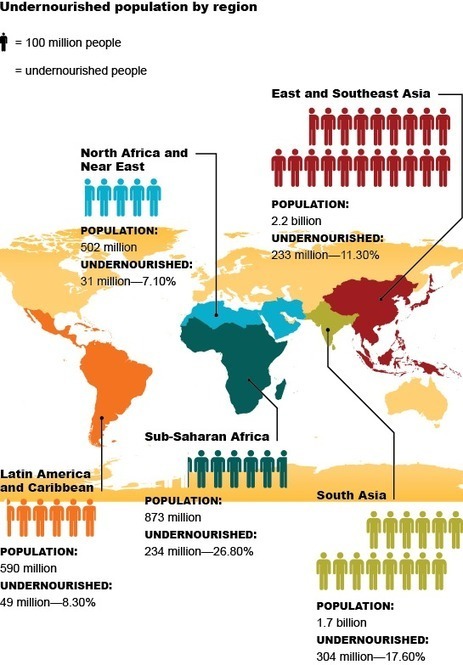
Check out this and other infographics on the CGIAR portal, "Big Facts". The CGIAR Research Program on Climate Change, Agriculture and Food Security’s (CCAFS) �“Big Facts” site represents the latest and most authoritative research on topics at the intersection �of climate change, agriculture and food security. Explore and share the data and graphics on topics ranging from undernourishment and population to fisheries and forestry. Find out why it’s impossible to address climate issues without including agriculture—and vice versa.
|
|
Scooped by
Robin Landis
April 16, 2013 11:28 AM
|
Democratic, stable, fertile Senegal used to be a rare success story in Africa. It could feed its people and even export surplus food. But last year, almost one million people needed emergency food aid as the harvest failed across much of west Africa. “When the help came, we had reached the point where we had nothing. We were waking up to the sound of children crying and there was nothing we could do,” Deoude recalls. Only rapid intervention by international agencies averted a crisis. The EU stumped up more than €100 million for the UN’s World Food Programme (WFP), which distributed aid and cash vouchers to the worst-affected communities across west Africa.... ...People everywhere are noticing changed weather patterns, but in these parts climate change is pushing entire communities over the edge. “The rains have become extremely erratic. They start early, finish late, and there are long spells without any rain,” explains Inge Breuer, country representative of the WFP.... ...Conscious of the challenge, agencies such as the WFP are adopting new approaches to tackle the effects of climate change. A new government has acknowledged the scale of the problem but needs external help. Yet the question of who ultimately bears responsibility for the problem – and who will pay to clear up the mess – remains unanswered.
|
|
Scooped by
Robin Landis
April 16, 2013 6:14 AM
|
Improvements in nutrition and stronger government policies have led to a decline in childhood stunting, according to a new report on child nutrition. However, the condition continues to affect some 165 million children under the age of five globally. Stunting can lead to irreversible brain and body damage in children, making them more susceptible to illness and more likely to fall behind in school. Based on UNICEF’s report, IRIN has put together a round-up of the nutrition situations in six East and Central African countries -- BURUNDI, CAR, DRC, ETHIOPIA, RWAND and TANZANIA -- that are among 24 countries with the largest burden and highest prevalence of stunting.
|
|
Scooped by
Robin Landis
April 13, 2013 4:24 PM
|
A report, “Managing famine risk: Linking early warning to early action,” released by the think-tank Chatham House, found that despite warnings of looming drought from organisations such as Fews Net, international humanitarian agencies only chose to get involved at the emergency level. For example, in 2010 and 2011, FEWS NET and FSNAU increasingly issued urgent early warnings of a looming crisis in Somalia for up to 11 months before a famine was eventually declared in July 2011. Humanitarian organisations and systems only began to mobilise after this declaration. The irony is that it is actually more cost efficient for the international humanitarian aid agencies and home governments to mitigate a looming famine before it becomes a disaster.
|
|
Scooped by
Robin Landis
April 7, 2013 6:37 AM
|
INTERVIEW Online, 22 Mar 2013. Shenggen Fan, IFPRI Director General, highlights possible ways to overcome constraints to implementation of global food policies, stressing the importance of coordination between donors of the South and North countries.
|
|
Scooped by
Robin Landis
April 7, 2013 6:20 AM
|
The Food and Agriculture Organization (FAO) of the United Nations is working to develop institutional and professional capacities in nutrition education in Africa through the Education for Effective Nutrition in Action (ENACT) project, funded by the German Ministry of Food, Agriculture and Consumer Protection (BMELV). The ENACT project was implemented in 2012 as a tailored response to this needs assessment. In collaboration with partners from national universities in several African countries, the ENACT project will produce, pre-test and disseminate a basic module at undergraduate level which will apply the best practices of professional training in dietary promotion, and will also be adaptable to local demand. he materials will be available for online, face-to-face or blended use, and will be piloted in all these formats in Africa. The module will be piloted face-to-face by the University of Botswana, Hawassa University in Ethiopia, University of Ghana, Michael Okpara University of Agriculture in Nigeria, Sokoine University of Agriculture in Tanzania and Makerere University Kampala in Uganda. Discussions are underway with the University of South Africa (UNISA), Kenyatta University in Kenya and the People’s Open Access Educational Initiative (People’s University) regarding the piloting of the online/blended versions of the course.
|
|
Scooped by
Robin Landis
April 5, 2013 4:33 AM
|
Information Communication Technology (ICT) was identified as a means of improving research, accessing and sharing knowledge, and delivering services through a shared platform. The shared ICT platform shall consist of infrastructure for data and voice, a service centre as well as a joint management and planning system. This setup will support the plan to re-engineer business processes at both institutions for efficiency in and effective service delivery. In addition, the shared ICT platform will support the handling of grievances and complaints. Besides linking farmers to potential markets and increasing their bargaining power, it also provides information on weather, land management and availability of inputs. There are also community knowledge workers equipped with smartphones, who are providing up-to-date information on market prices, weather, pests and diseases and best farming practices directly to farmers.
|
|
Scooped by
Robin Landis
April 4, 2013 7:33 AM
|
The Seminar entitled “Pushing the Limits: Lessons from CARE on Market Systems Approaches, Food Security, and Resilience” featured Christian Pennotti, Senior Technical Advisor for Learning and Impact with CARE’s Economic Development Unit, in a discussion on lessons learned from two USAID-sponsored programs – one in Bangladesh and one in Ethiopia – as well as five key considerations that inform CARE’s practice. ...In Ethiopia, where CARE has been working with USAID on a push-pull model targeting ultra-poor smallholder farmer households to help them move up to positions of food security. This model builds in financial inclusion and resilience by attempting to make the households market-ready as well as make the market ready for these households, and by improving the adaptive capacity of the households and the system they are trying to engage with. The lessons learned from this were that the push-pull model contributes to graduation and improved resilience (households in the program were better equipped to stabilize after the drought), households engaged in multiple value chains are more likely to graduate (particularly for female-headed households), and that Village Savings & Loans Associations (VSLA) are a promising foundation on which to build (although the relationship between VSLAs and producer groups needs to be improved and more needs to be done to address women’s mobility and domestic violence).
|
|
Scooped by
Robin Landis
April 3, 2013 10:06 AM
|
Blog written by Marshall Matz, former Counsel to the Senate Agriculture Committee and founder of Friends of the World Food Program. Later this month, on April 29 and 30th, the G-8 will host an important meeting on Open Data for Agriculture. The Department of Agriculture is organizing the meeting on behalf of the United States for members of the G-8 and interested parties...This meeting can have a major impact on global food security. The meeting grows directly out of the G-8 Summit hosted by President Obama last year at Camp David and the commitment they made to a new Alliance for Food Security and Nutrition. As a part of the Camp David Declaration, the G-8 agreed to “take to scale new technologies and other innovations that can increase sustainable agricultural productivity, and reduce the risk borne by vulnerable economies and communities” in Africa. A fact sheet was issued by White House at the time of the Declaration. In an effort to scale up new technologies, the G-8 agreed to: http://blogs.usda.gov/2013/04/02/open-data-for-agriculture-meeting-focuses-on-global-food-security/
|
|
|
Scooped by
Robin Landis
April 18, 2013 10:25 AM
|
In Summary:
--In Uganda, about 110,220 children have died in the last five years due to malnutrition. --An estimated 1.9 million people in Uganda are food insecure, while about 6.0 million are moderately food secure. Uganda loses up to $899 million due to malnutrition every year, a new report shows. Over 975,000 children under the age of five are experiencing cases of anaemia, acute diarrhoea syndrome (ADH), acute respiratory infection (ARI) and in some cases fever due to poor nutrition, says a Cost of Hunger in Africa (COHA) report, adding that malnutrition in children under five is one of the top 10 causes of morbidity and mortality after malaria, respiratory tract infections and diarrhoeal diseases in the country. The study conducted in four countries that included UGANDA, Egypt, ETHIOPIA and Swaziland found that underweight children are more likely to die from nutrition related illnesses and in Uganda, about 110,220 children have died in the last five years due to malnutrition. The COHA study estimated the additional cases of morbidities, mortalities that can be associated with under-nutrition before the age of five.
|
|
Scooped by
Robin Landis
April 18, 2013 4:53 AM
|
Unlike their rural counterparts, women in urban areas are thought to enjoy greater social, economic, political opportunities and freedoms. In an editorial, the International Institute for Environment and Development (IIED) said that urban women are able to “engage in paid employment outside the family, better access to services, lower fertility rates, and some relaxation of the rigid social values and norms that define women as subordinated to their husbands and fathers and to men generally” Even so, these women are likely to continue experiencing forms of gender discrimination. According to UN-HABITAT, “notable gender gaps in labour and employment, decent work, pay, tenure rights, access to and accumulation of assets, personal security and safety, and representation in formal structures of urban governance show that women are often the last to benefit from the prosperity of cities.”
|
|
Scooped by
Robin Landis
April 17, 2013 6:55 AM
|
One in four of all children less than five years of age is stunted because of chronic under-nutrition in crucial periods of growth. The damage done to a child’s body and brain by stunting is irreversible. It drags down performance at school and later at work, and puts children at a higher risk of dying from infectious diseases. An estimated 80 per cent of the world’s stunted children live in just 14 countries. The report highlights successes in scaling up nutrition and improving policies in 11 countries including DRC, ETHIOPIA, RWANDA and TANZANIA.
|
|
Scooped by
Robin Landis
April 13, 2013 4:25 PM
|
Tanzania has topped the list of East African countries for showing commitment in fighting hunger and malnutrition in the recently published Hunger and Nutrition Commitment Index (Hanci). In the index, produced by the Institute of Development Studies (IDS) – a UK-based global charity for international development research and communications, TANZANIA has scored 201 points compared to KENYA’s 34 and UGANDA’s 20. According to the report, Tanzania is rated among countries with moderate commitment in improving nutrition.
|
|
Scooped by
Robin Landis
April 17, 2013 3:14 AM
|
Author: Rob Bailey This document reports on the project Translating famine early warning into early action, which defines famine as a process beginning with a particular shock or stress such as drought, precipitating a livelihood crisis that may eventually lead to a humanitarian emergency. It explores the barriers that hinder appropriate response to early warning of slow-onset food crises. Its purpose is to identify problems and consider opportunities to address the challenges of preventing and responding to humanitarian crises with scarce resources.
Among its key findings, the report asserts that risk reduction efforts are not commensurate with the scale of risk and that famine early warning systems have a good track record of predicting food crises but a poor track record of triggering early action. Its recommendations include: (i) improvement of the official early warning capacity and effectiveness, including a review of existing capabilities and needs in at-risk areas, capacity building and scientific approaches; (ii) enabling vulnerable communities to take early action themselves; (iii) operational reform; (iv) funding reform; and (v) institutional reform. Also available at: http://www.preventionweb.net/english/professional/publications/v.php?id=32182&a=email&utm_source=pw_email
|
|
Scooped by
Robin Landis
April 16, 2013 10:17 AM
|
Drought, rocketing bread prices, food and water shortages have all blighted parts of the Middle East. Analysts at the Centre for American Progress in Washington say a combination of food shortages and other environmental factors exacerbated the already tense politics of the region. As the Observer reports today, an as-yet unpublished US government study indicates that the world needs to prepare for much more of the same, as food prices spiral and longstanding agricultural practices are disrupted by climate change. We should expect much more political destabilisation of countries as it bites," says Richard Choularton, a policy officer in the UN's World Food Programme climate change office. "What is different now from 20 years ago is that far more people are living in places with a higher climatic risk; 650 million people now live in arid or semi-arid areas where floods and droughts and price shocks are expected to have the most impact. "The recent crises in the Horn of Africa and Sahel may be becoming the new normal. Droughts are expected to become more frequent. Studies suggest anything up to 200 million more food-insecure people by 2050 or an additional 24 million malnourished children. In parts of Africa we already have a protracted and growing humanitarian disaster. Climate change is a creeping disaster," he said.
|
|
Scooped by
Robin Landis
April 16, 2013 2:17 AM
|
Malnutrition could be greatly reduced and food security improved by ensuring improved access to nutrient-rich forest-derived foods like berries, bushmeat, roots, insects and nuts for the world’s poorest populations, experts say... In its 2011 Forests for Improved Food Security and Nutrition report, the UN Food and Agricultural Organization (FAO) noted that households living on the margins of poverty could, during the “lean season” or in times of famine or food shortage, rely on forests to provide “an important safety net.... ...A lack of national policies to guide the use of wild foods, lack of knowledge about the benefits of such foods, and deforestation and land use changes continue to hamper access to these resources...
...Increased investment in forest development by governments and organizations, increased local control over forest management and use, pro-poor forestry measures, and the integration of forests into national food security strategies are some of the ways to boost access to forest-derived foods.
|
|
Scooped by
Robin Landis
April 7, 2013 6:42 AM
|
...Indeed, according to one recent study, growth in agriculture is five times more effective in low income countries – and eleven times more effective in sub-Saharan Africa – in reducing poverty... ... Yet there seems to be little appetite for investment in agriculture. The share of the agriculture budget in relation to total government spending has declined in all regions of the world, and in many countries it is less than 10 per cent of total expenditure... And despite renewed concern about food security, ODA to agriculture is only about 6 per cent today, compared with a high of about 20 per cent in the early 1980s....For agriculture to have the greatest impact on poverty reduction and food security, it must be more productive, sustainable, and climate-sensitive... ...In China, Gambia, KENYA, Pakistan, RWANDA and Viet Nam, IFAD-supported projects are helping farmers generate energy for their homes from the methane produced by human and animal waste. They are reducing greenhouse gas emissions, reducing their dependence on fuel wood for cooking, and benefitting themselves and their families in the process.
|
|
Scooped by
Robin Landis
April 7, 2013 6:27 AM
|
During the month of March, in North Kivu Province, the Logistics Cluster facilitated, via WFP Service Provision, the road transportation of 101.7 mt of food on behalf of Mercy Corps as well as 45.2 mt of NFIs on behalf of UNOPS and FAO. The WFP fleet of off-road (tous terrain) vehicles can access isolated areas that commercial carriers cannot reach; these trucks are the only means that the humanitarian community possess of accessing these remote communities, as there are no commercial operators with trucks of this kind which can endure the gruelling journeys on these roads.
|
|
Scooped by
Robin Landis
April 5, 2013 5:50 AM
|
On 5 April, the UN and partners worldwide will observe the 1,000-day mark to the 2015 target date for the Millennium Development Goals (MDGs). The MDGs are the most successful global anti-poverty push in history. Governments, international organizations and civil society groups around the world have helped to cut in half the world’s extreme poverty rate. More girls are in school. Fewer children are dying. The world continues to fight killer diseases, such as malaria, tuberculosis and AIDS. There are 1,000 days to accelerate action on issues such as hunger, access to education, improved sanitation, maternal health and gender equality. Get involved and help build more #MDGmomentum! From Friday 5 April, 8:00am EDT to Saturday 6 April, 1:00am EDT, UN staff and partners are tweeting photos that illustrate the local impacts that MDGs have for communities around the world. Join the Rally! Beginning 5 April, UN agencies, partners, and individuals will come together in 1,000 minutes of online programming about building #MDGmomentum. Participate in Google hang-outs, Facebook chats and Twitter dialogues about the MDGs from across the world. Organized in partnership with the UN Foundation. www.momentum1000.org
|
|
Scooped by
Robin Landis
April 5, 2013 4:02 AM
|
Catherine Bertini served as executive director of the U.N. World Food Program 1992-2002. Dan Glickman served as U.S. agriculture secretary 1995-2001. They are co-chairs of The Chicago Council on Global Affairs’ Global Agricultural Development Initiative. ...The U.S. Agency for International Development estimates that up to half of its spending on food aid now goes to ocean transportation costs. ...[US] agricultural, foreign policy and national security objectives would be better served by focusing our efforts more precisely toward getting food aid as quickly as possible to the people who desperately need it. The United States is the only food aid donor that still gives food in-kind rather than cash. Now is the time for flexible food aid program that uses our foreign assistance monies more efficiently and ensures America’s leadership in the fight against global hunger. ...A cash-based food aid system would support the wider goal of helping farmers in poor countries get access to markets for their produce, get higher prices for their crops and become more productive and sustainable... ...Experts predict that farmers in developing countries will have to double their output over the next several decades in order to avoid global food insecurity on a massive scale. Meanwhile, growth in agriculture has been shown to be at least twice as effective in reducing poverty as growth in other sectors, as more than half of the 870 million people who are chronically hungry rely on agriculture for their livelihoods. Read more: http://www.politico.com/story/2013/04/food-aid-for-the-21st-century-89545_Page2.html#ixzz2PZcjI1HW
|
|
Scooped by
Robin Landis
April 4, 2013 3:23 AM
|
Better data on the extent of the problem and likely outcomes of continued climate change is needed. Building on the wealth of information generated by a number of EU-funded projects and other initiatives, the AfriCAN Climate project, supported by the 7th Framework Programme of the European Union, is filling this knowledge gap through its network of research partners in Europe and Africa, using web and communication tools, technical exchanges and its growing database. Our vision is it to be “the gateway to climate change knowledge with relevance for Africa”. The AfriCAN Climate portal is now online and ready for you to search for the content you are interested in, to sign up and share your own content and meet the other AfriCAN members. You can comment to this Blog, create or join a Group for discussing the topics of your interest.
|