


Emotional literacy at an early age can make a big difference in a person's life. Here are some steps for helping adults and young children understand a child's big emotions.


 Your new post is loading...
 Your new post is loading...
Your new post is loading...
 Scoop.it!
Emotional literacy at an early age can make a big difference in a person's life. Here are some steps for helping adults and young children understand a child's big emotions.

No comment yet.
Sign up to comment
Scoop.it!

THE MOST IMPORTANT EMOTIONAL SKILL IN RELATIONSHIP-BUILDING IS ALSO ONE THAT MOST OF US NEED TO WORK ON.
While psychologists believe that infancy is a critical time for us to learn empathy, we also know that we can increase it throughout our lifetime. There is perhaps no other attribute that is more vital to develop relationships with others than empathy. Empathy requires that we cultivate the trait of active listening. Most people are thinking how they are going to respond while the other person is still speaking. Active listening means being totally focused on what the other person is saying.
2. CHALLENGE PREJUDICES AND STEREOTYPES..
3. DEVELOP A CURIOSITY ABOUT OTHERS...
4. SPEND SOME TIME IN ANOTHER’S SHOES..
5. SHARE YOURSELF WITH OTHERS.. HARVEY DEUTSCHENDORF
Via Edwin Rutsch, Nancy J. Herr
Scoop.it!
"We spend so much time listening to the things people are saying that we rarely pay attention to the things they don't," says slam poet and teacher Clint Smith."
Scoop.it!

Resources for teaching about topics related to Health http://bit.ly/youth_health
Scoop.it!

Lady Gaga's Born This Way Foundation and the Yale Center for Emotional Intelligence have teamed up to launch an initiative called the Emotion Revolution.
Scoop.it!

When students are motivated by star charts and glitter pencils instead of a love of knowledge, writes Justin Minkel, they stop paying attention to what they're supposed to be learning.
http://www.edweek.org/tm/articles/2015/03/23/distracted-by-rewards-moving-beyond-carrots-and.html
Scoop.it!
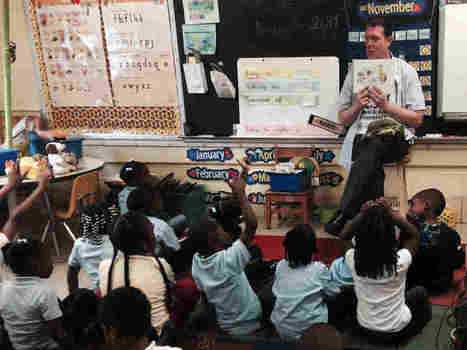
By Maanvi Singh (Image credit: Elissa Nadworny/NPR)
"Thomas O'Donnell's kindergarten kids are all hopped up to read about Twiggle the anthropomorphic Turtle.
"Who can tell me why Twiggle here is sad," O'Donnell asks his class at Matthew Henson Elementary School in Baltimore.
"Because he doesn't have no friends," a student pipes up. And how do people look when they're sad? "They look down!" the whole class screams out.
Yeah, Twiggle is lonely. But, eventually, he befriends a hedgehog, a duck and a dog. And along the way, he learns how to play, help and share. These are crucial skills we all need to learn, even in preschool and kindergarten. And common sense — along with a growing body of research — shows that mastering social skills early on can help people stay out of trouble all the way into their adult lives. So shouldn't schools teach kids about emotions and conflict negotiation in the same way they teach math and reading? The creators of Twiggle the Turtle say the answer is yes.
Twiggle is part of a program called Promoting Alternative Thinking Strategies, or PATHS. It's designed to help young kids recognize and express emotions."...
For full post, click on title above or here:
Scoop.it!

"This article provides a description of a clinical project that used combined Tai Chi and mindfulness-based stress reduction as an educational program. The 5-week program demonstrated that sustained interest in this material in middle school–aged boys and girls is possible. Statements the boys and girls made in the process suggested that they experienced well-being, calmness, relaxation, improved sleep, less reactivity, increased self-care, self-awareness, and a sense of interconnection or interdependence with nature. The curriculum is described in detail for nurses, teachers, and counselors who want to replicate this type of instruction for adolescent children. This project infers that Tai Chi and mindfulness-based stress reduction may be transformational tools that can be used in educational programs appropriate for middle school–aged children. Recommendations are made for further study in schools and other pediatric settings."... For full article: http://www.sciencedirect.com/science/article/pii/S0891524505001094
Scoop.it!

"Studies show children whose parents are involved in their education do better in school, and our hope is to provide you with useful tips and tools to support your growing child at all ages. The Parent Toolkit is a one-stop shop resource that was produced and developed with parents in mind.
For full page and related resources, click on title above or here:
Scoop.it!
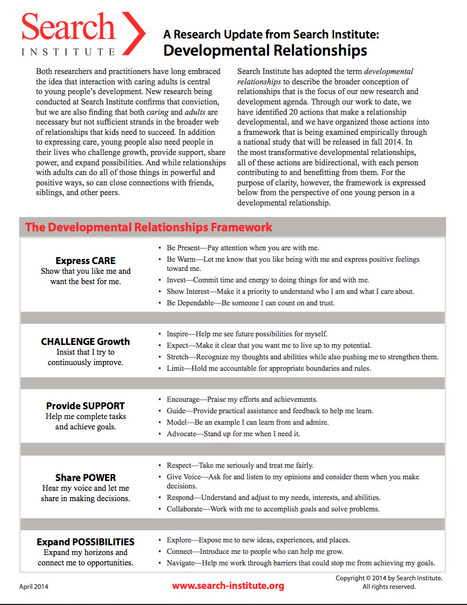
"Relationships are too important to leave to chance. Search Institute’s newest research-to-practice initiative focuses on studying and strengthening the developmental relationships that help young people succeed. A developmental relationship is a close connection between a young person and an adult or between a young person and a peer that positively shapes the young person’s identity and sense of a thriving mindset.
Search Institute is now testing and refining the Developmental Relationships Framework which includes the following strategies to build positive relationships with young people"...
For full post and Search Institute Website, please visit: http://www.search-institute.org/blog/research-update-developmental-relationships
Scoop.it!
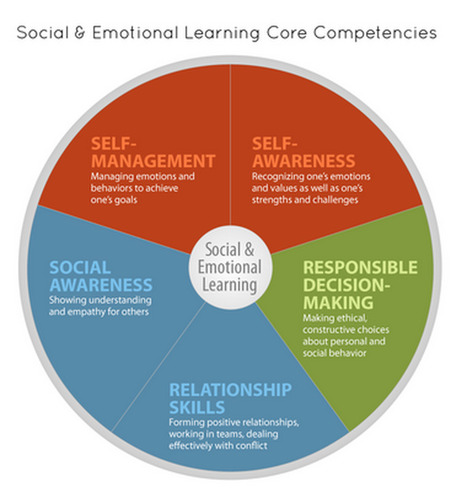
"The Massachusetts Consortium for Social-Emotional Learning in Teacher Education (SEL-TEd) was created in the spring of 2011, as a branch of the Social-Emotional Learning Alliance of Massachusetts (SAM). This consortium includes teacher educators from a range of programs in Massachusetts. The overarching goal of this group is to advocate for systematic integration of SEL research & practice in the state's teacher education programs -- primarily in terms of PreK-12 teacher preparation, but also including the preparation and initiation of principals, school psychologists & social workers."
Scoop.it!

Eric Westervelt, NPR
Educator Ashanti Branch doesn't much care or, more accurately, doesn't have time to care.
He's too busy trying to make a difference in boys' lives. Boys in American public schools are suspended from and drop out of school at higher rates than girls. Black and Latino boys are suspended the most. Boys make up half of the student population in American public schools. But among those who are suspended multiple times and expelled, 75 percent are boys.
Branch, now an assistant principal at Montera Middle School in Oakland, Calif., is working to change that. When he first became a teacher about a decade ago at a high school in the San Francisco Bay Area, Branch soon realized he had a problem with the boys: Nearly half of all black and Latino boys were failing his math class, and almost half were failing all their classes.
"That was not OK for me," he says. "I was not willing to sit back and watch that happen."
So in 2004, at San Lorenzo High School on the east side of San Francisco Bay, he founded the Ever Forward Club for boys. "When I started it I told these young men, 'I'm gonna bribe you. I'm gonna buy you lunch once a week and you're basically gonna teach me how to be a better teacher.' "
He came to school early and stayed late. And he always tried to have something in his room for kids to snack on. He created a safe place where boys can talk with him and each other, play, hang out and do their homework without fear of being seen as weak or uncool. This year Branch started a new boys Ever Forward Club at Montera Middle School in Oakland.
A Bigger Tool Box Branch tries to foster emotional maturity through conversation, play and community. The big goal is to help give boys a bigger emotional tool box to better handle the challenges of school and life now and into the future.
"The pain that they're holding on to that they don't really have a space to [let] go, the anger, the sadness — all those things. How can I help them tap into that in ways that they can let it go and not walk around angry all the time? I told one young man the other day: 'You walk around with a tool box full of hammers. You hammer everything. All you needed was a little screwdriver.' "...
For full post, click on title above or here: http://www.npr.org/blogs/ed/2014/06/25/325464770/giving-boys-a-bigger-emotional-tool-box
Click here to view EverForward IndieGoGo Video
Scoop.it!
Studies show that sustained and well-integrated social and emotional learning (SEL) programs can help schools engage their students and improve achievement. ... Via Roxana Marachi, PhD
|
Scoop.it!
"Where Are You?" Created by Mark C. Eshleman featuring Tyler Joseph for Trend Micro's What's Your Story Contest." http://www.youtube.com/watch?v=SdC7iBpD8Sk 
Scoop.it!
From
www

An excellent TED talk that draws attention to the importance of conscious listening... perhaps among the most important and under-activated aspects of our cognition.
http://www.ted.com/talks/julian_treasure_5_ways_to_listen_better
Scoop.it!
"As kids, we all get advice from parents and teachers that seems strange, even confusing. This was crystallized one night for a young Clint Smith,"...
Scoop.it!

"Teaching Adolescents To Become Learners summarizes the research on five categories of non-cognitive factors that are related to academic performance: academic behaviors, academic perseverance, academic mindsets, learning strategies and social skills, and proposes a framework for thinking about how these factors interact to affect academic performance, and what the relationship is between non-cognitive factors and classroom/school context, as well as the larger socio-cultural context.
It examines whether there is substantial evidence that non-cognitive factors matter for students' long‐term success, clarifying how and why these factors matter, determining if these factors are malleable and responsive to context, determining if they play a role in persistent racial/ethnic or gender gaps in academic achievement, and illuminating how educators might best support the development of important non-cognitive factors within their schools and classrooms.
The review suggests some promising levers for change at the classroom level, and challenges the notion that hard work and effort are character traits of individual students, instead suggesting that the amount of effort a student puts in to academic work can depend, in large part, on instructional and contextual factors in the classroom."...
For main page, click on title, image above, or here:
Scoop.it!
Thanks to Johanna Nilsson for contributions of the following resources for addressing issues of diversity, oppression and privilege in the classroom:
http://www.trainingforchange.org/tools
http://www.paulkivel.com/resources/exercises
http://www.docstoc.com/docs/95316315/connectingtooppressionandprivilege
http://www.whiteprivilegeconference.com/pdf/framework_for_teaching.pdf
https://mazzonicenter.org/sites/default/files/High%20School%20Lesson%20Plans.pdf
http://www.framingham.k12.ma.us/equity/Guideforteachers.pdf
http://www.tolerance.org/classroom-resources
Scoop.it!

by Pam Belluck (Pictured are Emanuele Castano, left, and David Comer Kidd, researchers in the New School for Social Research’s psychology department. Credit Casey Kelbaugh for The New York Times)
"Say you are getting ready for a blind date or a job interview. What should you do? Besides shower and shave, of course, it turns out you should read — but not just anything. Something by Chekhov or Alice Munro will help you navigate new social territory better than a potboiler by Danielle Steel. That is the conclusion of a study published Thursday in the journal Science. It found that after reading literary fiction, as opposed to popular fiction or serious nonfiction, people performed better on tests measuring empathy, social perception and emotional intelligence — skills that come in especially handy when you are trying to read someone’s body language or gauge what they might be thinking.
For full post, click on title above or here:
Scoop.it!

"This project was piloted in four communities across the United States: Durham, Nashville, rural Pennsylvania and Seattle. Fast Track is based on the hypothesis that improving child competencies, parenting effectiveness, school context, and school-home communications will, over time, contribute to preventing certain behaviors across the period from early childhood through adolescence."...
For more, click on title above or here:
Scoop.it!
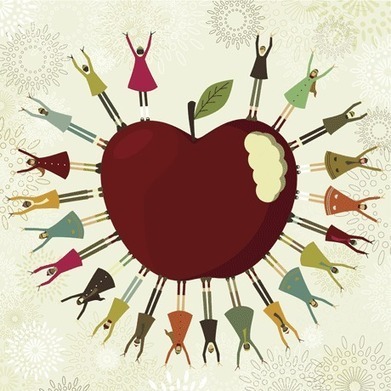
By Homa Tavangar: "My most important back-to-school supply doesn't fit in a backpack, and it can't be ordered online. It's as essential as a pencil, but unlike a pencil, no technology can replace it. In a sense, like a fresh box of crayons, it can come in many colors. Better than the latest gadget, it's possible to equip every student with it, and even better, when we do, it can transform our world. It's actually a "muscle" I've been working on all summer. It's empathy." Via Roxana Marachi, PhD
Scoop.it!

By Jessica Lahey
While social emotional learning programs may look different from school to school, most are designed to support and enhance five areas of social and emotional development:
For full post, click on title above or here:
Scoop.it!

"Through a powerful curriculum, the 180º Program provides the opportunity and educational framework for elementary school, middle school, high school and college youth to fully develop their internal compass so they can develop healthy goals based upon a foundation of strong personal values, reflective and critical thinking skills, and social awareness and responsibility.
The world that youth will inherit in the 21st century is filled with opportunity and hope. It is a world of global economies, rich diversity and ethnicity, advanced technological achievement, and rewarding career opportunities. The world also presents significant challenges and new issues that today’s youth will confront as adults. The American society of the 21st century will require youth to achieve specialized credentials and skills to be most successful in life. Specifically, youth will be required to successfully obtain post secondary education degrees or other specialized credentials to qualify for a secure family wage career in the 21st century global workplace and economy. The importance of successfully completing a quality educational experience is higher today than at any other time so that youth can go on to complete additional specialized education.
In addition to high academic standards, youth will also require full development of character and life skills to more effectively navigate as highly productive and fulfilled individuals in our communities. And to ensure that youth stay the course while in school, opportunities for character and social emotional learning is essential in addition to high academic standards."
For main webpage:
Scoop.it!
To view video on Youtube, https://www.youtube.com/watch?t=167&v=RVA2N6tX2cg
For related blogpost, please visit: http://www.mindful.org/news/kindergarteners-talk-about-mindfulness-in-just-breathe-short-film
Scoop.it!
Mission:
|





