


For months this fall, protesters occupied public spaces in cities across Canada, the U.S. and around the world to object to corporate greed and social and economic inequality - but did the movement garner much sympathy?

 Your new post is loading...
 Scoop.it! For months this fall, protesters occupied public spaces in cities across Canada, the U.S. and around the world to object to corporate greed and social and economic inequality - but did the movement garner much sympathy? 
No comment yet.
Sign up to comment
Scoop.it!

The sort of oxen you expect to see in Chinese villages tend to be pulling carts or tilling fields, not a beasts made of a ton of gold.
Scoop.it!

A crowd of anti-military activists suddenly converged on a bustling Cairo boulevard, erecting screens and showing videos of soldiers beating protesters, dragging women on the ground, partially stripping one and stomping on her chest. Their flash mob's message for the passers-by who stopped to watch: The generals ruling Egypt have to go.
Scoop.it!

I am reading Daniel Dorling's marvelous book 'Injustice: Why Social Inequality Persists'. He lists five ... While this is not Dorling's argument, I would suggest that this helps prop up the whole hierarchical structure of society.
Scoop.it!

The renowned scholar and political activist has shown his support for the workers in their fifth week of a sit-in at their former employers in Cork.
Scoop.it!

The time for businesses to get social is now, according to Gartner analysts. (The Social Business Revolution: Are you on the bandwagon?
Scoop.it!
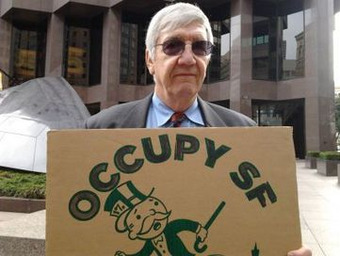
Warren Langley ran the Pacific Exchange through 1999. On Friday, he'll be marching on the banks.
Scoop.it!

A special report from the Brookings-Rockefeller Project on State and Metropolitan Innovation looks at local solutions to our national woes...
Scoop.it!

She was nominated for a Nobel peace prize, but threats against her life had her praying she would not win, writes Ruth Pollard. The blogger and human rights activist known as the Tunisian Girl cuts a diminutive figure amid the chaos of demonstrations outside the parliament in Tunis.
Scoop.it!

However these debates play out, the capitalism that emerges from the Great Recession will be a different capitalism. The groundswell of public discontent that has exploded on the streets from Los Angeles to London to Athens simply cannot be ignored. Yet however loud the calls for change, capitalism is here to stay. While many in the West sour on the system that made them rich, China, India and much of the rest of the rapidly advancing emerging world are slowly, inexorably turning toward freer trade, deregulation and more-open capital flows in their drive for riches. The challenge facing the world’s politicians, economists, bankers and corporate leaders is to reform capitalism in ways that enhance its power to grow and uplift the downtrodden while mitigating the ill effects of globalization and greed. The outcome will shape the fortunes of capitalism—and the world economy—for the next generation.
Scoop.it!

"It’s easy to feel unsettled by the European debt crisis as policymakers inch toward a solution. There are plenty of good reasons to fear a financial catastrophe, given the scale of the euro zone’s troubles. But there are also reasons to see a path out, given the political and economic costs of failure."
Scoop.it!

“It’s time to stand up to the powerful people and say we’re not going to put up with it anymore,” said Back, who said she did not vote for Obama in 2008 but supported him now."
Scoop.it!

"Whipped by the recession and financial crisis, U.S. cities are looking far beyond their borders to grow their local economies. At a meeting this week in the U.S. capital, mayors from across the country have focused intently on the promise of exports for generating jobs and economic activity."
Scoop.it!
"I am what I create" says John Seely Brown addressing the Carnegie Foundation for the Advancement of Teaching - Stanford, CA, Oct. 23-...
Scoop.it!
What does change for good really take? What three words say it best for you? Deborah Frieze is an author, entrepreneur and social activist. As former co-pres...
Scoop.it!

What makes for a good life? In The Best Things in Life, distinguished philosopher Thomas Hurka takes a fresh look at these perennial questions as they arise for us now in the 21st century. Should we value family over career?
Scoop.it!

The hope for Bolivia’s future remains with the overwhelmingly indigenous rural and urban popular classes, organising and struggling independently for themselves, against combined capitalist exploitation and racial oppression, with visions of simultaneous indigenous liberation and socialist emancipation, as we witnessed on a grand scale between 2000 and 2005.
Scoop.it!
At TED@MotorCity, Lisa Gansky, author of “The Mesh,” talks about a future of business that's about sharing all kinds of stuff, either via smart and tech-enabled rental or, more boldly, peer-to-peer. Examples across industries ...
Scoop.it!
From
rt

“We’ve got to realize, all the changes that have ever been made — the civil rights movement, the unions — they all broke the law to make those changes,” said Monson. “At the time, they were demonized and seen as criminals . . . But not we look back and go, ‘Wow, we’re so glad they stood up to the way the system was.’”
Scoop.it!
"China's economic and social development now requires a social transformation and reforms targeted at equality and sustainable development. To facilitate this, the country should embrace a consumption-driven, green and market-regulated development model, prioritize increasing people's wealth and push for government transformation. To this end, China should push forward overall reforms of its economic and social institutions as well as governance changes during the 12th Five-Year Plan (2011-15) period. While giving the market a full role in the distribution of resources, the country should step up the establishment of a public service system and a service-oriented government. A systematic foundation should also be laid for the expansion of domestic demand and the establishment of social justice and sustainable development."
Scoop.it!
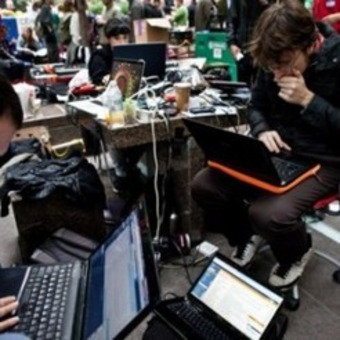
"The first App for the Occupation has been made! Wired broke the news on the In-human Microphone App for iPhone used to circumvent the Megaphone Ban at OccupyNYC."
Scoop.it!

"Being raised in the middle class is not a guarantee that you'll have that same status as an adult," Erin Currier, project manager at Pew's Economic Mobility Project, told CNNMoney. "With all the economic turmoil in the past four years, there's good reason to think that downward mobility is more severe."
Scoop.it!

"Unfortunately, an ability to recognize systems, connections, and patterns is not a skill our culture at large values quite yet. We like quick fixes and immediately visible gains and lean away from ideas that raise more questions for us than answers. This kind of linear, concrete thinking has served us well for a long time and will continue to serve us in some ways, but I believe that systems thinking and systems-related skills is where we’ll find much-needed inspiration and new possibilities."
Scoop.it!

"In the New York Times this past Sunday, Sam Tanenhaus, senior editor of the New York Times Book Review and a student of conservatism, pronounced the impending death of the Tea Party. He noted that “even in South Carolina, a seat of conservative activism, the opposition to Mr. Romney appears to be fragmented and diffuse, as Matt Bai reports this weekend in The Times Magazine. Others have put the case more bluntly. ‘Where’s the Tea Party?’ a headline in Politico asked last week.”
Scoop.it!
Complete video at: http://fora.tv/2008/02/05/Joseph_Stiglitz_Economics_of_Information Nobel Prize-winning economist Joseph Stiglitz proposes alternatives to ...
|

Curated by jean lievens
Economist, specialized in political economy and peer-to-peer dynamics; core member of the P2P Foundation
Other Topics

Anders en beter
Met P2P voorbij markt en staat: voor een progressieve coalitie rond de commons. Met nieuws over op p2p gebaseerde praktijken en hoe de overheid, de politiek en de zakenwereld ermee (kunnen) omgaan...

money money money
on money and what it is

music-all
From the Great White Way to the West-End and beyond

Peer2Politics
on peer-to-peer dynamics in politics, the economy and organizations

real utopias
Not TINA (There Is No Alternative) but TAPAS: THERE ARE PLENTY OF ALTERNATIVES
|




