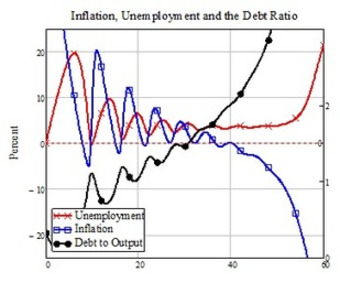
No, I didn’t spell the title wrong – not Keynes. If you haven’t heard of Steve Keen, that’s not too much of a surprise because I hadn’t either, although I regularly visit sites in the economics blogosphere. Steve has an important message, but it’s unlikely you will hear much about it any time soon because it is just too radical for most orthodox economists, and many ordinary people who have drunk the mainstream economic Kool Aid, to wrap their minds around it.
Steve Keen, Google Talk. A video here of Steve Keen, which appears to be a Google talk. The quality is not the best, but still worth watching. Posted by Lord Keynes at 9:27 PM. Labels: Google Talk, Steve Keen.
The ‘4th element’, technology, has transformed the marketing industry. It has given us another dimension to play with. But, putting digital aside (as that’s now old news) technology is now the key element we need to understand in 2012.
My first association with money was watching family members trade wornout velvety bills for the things I knew we desired or needed. I was hypnotized. What was this magical tailsman that made everybody seem so pleased or frustrated? Of course we are not born knowing the answeres to these questions, instead our playful child-selves pick up on these cues and we learn how to associate of what is perceived as an adult play-thing. My child-self was trying to find meaning and discovered a bit of truth: money is magic. Not in the way we believe it can satisfy all our needs–we know this isn’t true–but more in how it functions, because it doesn’t inherently have great power, we imbue it with meaning that gives it power.
Parag Khanna - Parag Khanna is a geographic strategist and writer. He is a senior research fellow at the New America Foundation and Director of the Hybrid Reality...
Civilizations have clashed in an unexpected way this year, as ordinary people using Facebook and Twitter knocked down dictators in Tunisia, Egypt and Libya—and are threatening absolute rule in Syria. A so-called Arab spring brought waves of liberation to a long-oppressed region. Something similar is happening in more democratic countries. In Spain throngs of young people, known as “the indignant ones,” occupied public plazas nationwide, protesting unemployment and exclusionary politics. In Israel ordinary citizens from both right and left united in massive demonstrations against high housing prices. And in India one man’s campaign against corruption went viral, bringing thousands to the streets in support.
As the EU and IMF demands for cuts and austerity continue, Newsnight's economics editor Paul Mason reports that struggling Greeks are turning their backs on the state and the political class.
"Back in the days when we all knew our neighbors, borrowing from them was a common occurrence. Lawn mowers, hand tools, and that insane “cup of sugar” that appeared on nearly every TV show in the 50′s and 60′s."
Egyptian revolution inspires French writersAhram OnlineThe Egyptian revolution has inspired many French writers eager to analyse the social, economic and political motivation behind it and monitoring its events day by day in addition to prosucing...
Today was supposed to be a meeting of EU Finance ministers to push through the bailout of Papademos' technocrat led government in Greece. This decision cam a...
Inequality did not increase during the early stages of economic development in Japan and the East Asian Tigers. But in India and China it did. Why is that? Vamsi Vakulabharanam suggests that the explanation lies not with the particularities of the countries themselves, but rather with the shift in the "regime of global capitalism" around 1980. Testing whether a global regime shift drives inequality dynamics in national development -- this is new economic thinking.
This year’s Black Friday raised commercialism to the next level with nationwide reports of shootings, stabbings fights, assaults with pepper spray and trampled customers.
It is just over two weeks since London's top prosecutor, Alison Saunders, gave a chilling warning that the 'almost demonisation' of women by the media was having a negative impact on the British justice system and leading to acquittals in rape cases. This echoed evidence given by End Violence Against Women to the Leveson inquiry that prejudicial and inaccurate media reporting of rape sends a strong and consistent message to the justice system – and the public more broadly – that women routinely "cry rape"; to rape survivors that they will not be believed; and to potential perpetrators that they will get away with it.
You saw the video of his mad rant against Occupy, then you saw the "list" cobbled together in far too much of a hurry to rationalize the rant, then the ...
One factor that is increasingly being cited as an important economic indicator is happiness. After all, what good is increased production and consumption if the result isn’t increased human satisfaction?
Women’s subordination is not only due to male domination but also due to the basic economic and political structures of society which again are reinforced by the same male domination. The essentially patriarchal state structure in the Indian context and in fact in most Third world countries was to some extent influenced by their colonial past which shaped the nature of the independent states they eventually culminated into.
I’m not sure to what extent the emergence of commercialized “social” consumption is changing the premises of Williamson’s analysis, making identity feel more collective in our consciousness and upending the necessary fiction of our total personal autonomy over our own identity. For the time being, though, capitalism still relies on consumers who believe against the evidence that they are in control.
On Wednesday, January 24, the Occupy movement joined the National Prison Divestment Campaign in 13 cities across the country for a nationwide day of action that gave a voice to an invisible segment of the 99 percent exploited by the private prison industry.
Technology extends human reach but participation requires engaged participants who feel welcome, comfortable and valued. Serhan Ada, head of the Cultural Management Program of Istanbul Biligi University, summed it up well in a final comment: “Participation occurs when someone welcomed as a guest feels as though they have become a host.”
The literary critic and Marxist political theorist, Fredric Jameson, has written Representing Capital: A Reading of Volume One, a book that revisits Karl Marx's most important work, Capital.
At a time when it’s become a cliché to say that Occupy Wall Street has changed the nation’s political conversation—drawing long overdue attention to the struggles of the 99 percent—electoral politics and the 2012 presidential election have become almost exclusively defined by the 1 percent. Or, to be more precise, the .0000063 percent. Those are the 196 individual donors who have provided nearly 80 percent of the money raised by super PACs in 2011 by giving $100,000 or more each.
On September 17, 2011, a group of young people occupied Zuccotti Park in New York City’s financial district. Shortly thereafter, their oft-repeated slogan of being the “99%” started to ricochet in the news media. The heavy news coverage has allowed their slogan to seep into the public consciousness.
This is just one tiny example of the challenges of ethical consumerism. Any given product can embody any number of incommensurable values — values that can't just be added up to arrive at a total “ethics quotient.
To get content containing either thought or leadership enter:
To get content containing both thought and leadership enter:
To get content containing the expression thought leadership enter:
You can enter several keywords and you can refine them whenever you want. Our suggestion engine uses more signals but entering a few keywords here will rapidly give you great content to curate.


 Your new post is loading...