


Selon une nouvelle étude de la Silicon Valley Bank, l'IA, le Big Data et l'IoT sont susceptibles d'avoir un impact majeur su
Via Coralie Bouillot

Données de santé, études et rapports : qualité, interopérabilité, recherche, IA, cybersécurité et gouvernance. Une veille sélectionnée par Lionel Reichardt, Pharmageek, pour comprendre les chiffres, examiner les méthodes et relier les données à leur utilité pour le soin et les décisions.
 Your new post is loading...
 Scoop.it! Selon une nouvelle étude de la Silicon Valley Bank, l'IA, le Big Data et l'IoT sont susceptibles d'avoir un impact majeur su Via Coralie Bouillot 
No comment yet.
Sign up to comment
Scoop.it!

Le futur Dr. House, champion des diagnostics les plus complexes, sera une IA, nul doute à cela. Les logiciels ont déjà atteint le niveau des meilleurs spécialistes et leur pertinence ne fera que croître. Pour autant, devons nous leur livrer toute notre vie numérique ? Via Jerome Leleu
Scoop.it!
Executives want strategic and operational decisions to be more data-driven. They say their own organizations and cultures are likely to hold them back. In a new survey, executives say their companies need to be faster and more sophisticated when it comes to decision-making capabilities. They’re seeking the right mix of mind and machine to leverage data, understand risk, and gain a competitive edge.
Scoop.it!

Découvrez comment le Big Data impacte le secteur de la santé en 7 étapes, de la source des données jusqu'à leur exploitation.
Via Festival Communication Santé
Scoop.it!
Les applications de santé et de bien-être répondent aux mêmes lois que toutes applications mobiles : très renseignées en matière de données personnelles sensibles, elles sont aussi très vulnérables, pouvant générer des discriminations à l’embauche, à l’assurance... Car ces data de santé représentent des milliards au plan commercial. En tant qu’utilisateurs, comment parer à une récupération de ses données personnelles de santé ? Et, à partir de quel cadre juridique ? Via Rémy TESTON
Scoop.it!
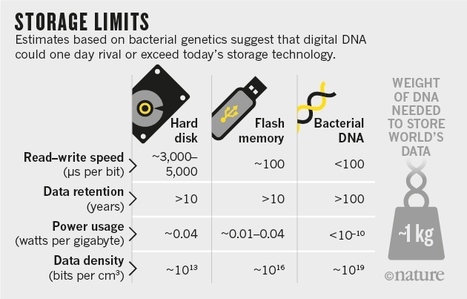
Modern archiving technology cannot keep up with the growing tsunami of bits. But nature may hold an answer to that problem already.
For Nick Goldman, the idea of encoding data in DNA started out as a joke. It was Wednesday 16 February 2011, and Goldman was at a hotel in Hamburg, Germany, talking with some of his fellow bioinformaticians about how they could afford to store the reams of genome sequences and other data the world was throwing at them. He remembers the scientists getting so frustrated by the expense and limitations of conventional computing technology that they started kidding about sci-fi alternatives. “We thought, 'What's to stop us using DNA to store information?'”
Then the laughter stopped. “It was a lightbulb moment,” says Goldman, a group leader at the European Bioinformatics Institute (EBI) in Hinxton, UK. True, DNA storage would be pathetically slow compared with the microsecond timescales for reading or writing bits in a silicon memory chip. It would take hours to encode data by synthesizing DNA strings with a specific pattern of bases, and still more hours to recover that information using a sequencing machine. But with DNA, a whole human genome fits into a cell that is invisible to the naked eye. For sheer density of information storage, DNA could be orders of magnitude beyond silicon — perfect for long-term archiving.
“We sat down in the bar with napkins and biros,” says Goldman, and started scribbling ideas: “What would you have to do to make that work?” The researchers' biggest worry was that DNA synthesis and sequencing made mistakes as often as 1 in every 100 nucleotides. This would render large-scale data storage hopelessly unreliable — unless they could find a workable error-correction scheme. Could they encode bits into base pairs in a way that would allow them to detect and undo the mistakes? “Within the course of an evening,” says Goldman, “we knew that you could.”
He and his EBI colleague Ewan Birney took the idea back to their labs, and two years later announced that they had successfully used DNA to encode five files, including Shakespeare's sonnets and a snippet of Martin Luther King's 'I have a dream' speech1. By then, biologist George Church and his team at Harvard University in Cambridge, Massachusetts, had unveiled an independent demonstration of DNA encoding2. But at 739 kilobytes (kB), the EBI files comprised the largest DNA archive ever produced — until July 2016, when researchers from Microsoft and the University of Washington claimed a leap to 200 megabytes (MB).
The latest experiment signals that interest in using DNA as a storage medium is surging far beyond genomics: the whole world is facing a data crunch. Counting everything from astronomical images and journal articles to YouTube videos, the global digital archive will hit an estimated 44 trillion gigabytes (GB) by 2020, a tenfold increase over 2013. By 2040, if everything were stored for instant access in, say, the flash memory chips used in memory sticks, the archive would consume 10–100 times the expected supply of microchip-grade silicon3. Via Dr. Stefan Gruenwald
Scoop.it!

MyHealth.US CEO CJ Wilson pitches his start-up to panel of experts on CNBC's "Power Pitch."
Scoop.it!

Premier site français d’information en continu sur les technologies de l’information et de la communication (TIC, NTIC) dans la santé Via Jerome Leleu
Scoop.it!

IBM is reorganizing its internal blockchain team into a business unit that encompasses its artificial intelligence and cloud computing efforts.
Scoop.it!

Hospitals looking to reduce overcrowding in the emergency department should use current ED demand data to predict future trends, a study finds.
Scoop.it!

Dans la course à la transformation numérique les DSI doivent se repositionner et faire valoir leurs compétences vis à vis de la collecte e Via Bruno Demay
Scoop.it!

More than half a billion dollars. That’s the recently released total for readmission penaltiesthe federal government will be withholding in Medicare payments from over half the nation’s hospitals in the coming year. In this type of environment, healthcare systems are scrambling to find new solutions to address post-discharge patient needs—both to proactively improve the quality of care and to decrease the financial ramifications of negative outcomes. The good news is that with continued advances in the sophistication and adoption of technology, connected health solutions that integrates patient-generated health data (PGHD) can help address these needs and lower readmission rates. Driving the need for change As a component of the Affordable Care Act (ACA), the Hospital Readmissions Reduction Program went into effect in October 2012. The provision requires the Centers for Medicare & Medicaid Services (CMS) to reduce payments to hospitals that see an excessive number of readmissions from patients with specific conditions within 30 days after discharge. Although the number of hospitals penalized this year is about the same as last year, the penalty amount is a record. There are many concerns about these penalties, especially for hospitals that care for large populations of low-income and vulnerable patients—who often don’t have access to needed resources to follow recommended post-discharge regimens. Factors such as these and others impact a patient’s recovery and are largely beyond the hospital’s control after a patient is discharged. In addition, many patients who are readmitted suffer from one or more chronic diseases that contribute to the need to return to the hospital. According to the U.S. Centers for Disease Control and Prevention (CDC), chronic diseases are responsible for seven of every 10 deaths per year, and treating them accounts for 86 percent of our nation’s total healthcare costs. here to edit the content Via Giuseppe Fattori
Scoop.it!
|
Scoop.it!
Scoop.it!

Le rôle positif des big data ne doit pas faire oublier la protection de la vie privée.
Scoop.it!

Si le rôle positif du numérique dans le domaine de la santé est reconnu, le big data doit prévenir les risques sanitaires et non en développer de nouveaux, tout en préservant la vie privée. Via Bruno Demay
Scoop.it!

Une équipe américaine a identifié 44 nouveaux gènes impliqués dans l’hypertension. L’analyse de plusieurs centaines de milliers de personnes a été nécessaire pour cela.
Scoop.it!

Si le rôle positif du numérique dans le domaine de la santé est reconnu, le big data doit prévenir les risques sanitaires et non en développer de nouveaux, tout en préservant la vie privée.
Scoop.it!
“La directive européenne "Network and Information Security" (NIS) publiée au Journal officiel européen cet été s'appliquera après sa transposition dans le droit national aux établissements de santé définis comme des "opérateurs de services essentiels".Les Etats membres de l'Union européenne (UE) ont jusqu'au 9 mai 2018 afin de transposer cette directive.En France, cette transposition sera assurée par l'Agence nationale de la sécurité des systèmes d'information (Anssi), "en lien avec l'ensemble des acteurs concernés", a précisé l'agence sur son site internet.”
Via sylvie Royant-Parola, Alain Codaccioni

sylvie Royant-Parola's curator insight,
August 23, 2016 9:27 AM
Des directives européennes de sécurité pour les systèmes d'information des établissements de santé. Tout un programme!
Scoop.it!

Les assureurs commencent tout juste à entrevoir les possibilités qu'ouvre l'analyse de masses de données pour leur métier, notamment pour définir les profils de risque et accélérer sur la prévention. Via assurancedufutur.fr
Scoop.it!

Stanford Medicine will use the power, security and scale of Google Cloud Platform to support precision health and more efficient patient care.
Scoop.it!

Via Rémy TESTON
Scoop.it!

A group of clinical trials doctors announce, in a position paper in the New England Journal of Medicine, that they should have complete ownership of patients' data, basically forever, so that they can publish as many papers as they like. They even demand that other scientists pay them some undetermined amount of money in order to get access to the data, and even then they want a delay of up to five years. Nowhere do they mention any concern for the patients.
Scoop.it!

La santé va être bouleversée par le Big Data, estime le professeur Nicolas Glady (Essec), parce qu’il permet d’avoir des résultats en temps réel et a
Via Emmanuel Capitaine
Scoop.it!

Le nouveau règlement européen 2016/679 sur la protection des données personnelles vient d’être adopté. Sa mise en application directe et de manière harmonisée dans l’ensemble des Etats membres sera obligatoire dès mai 2018 et remplacera la Directive 95/46/CE. Voici les atouts de Via Bruno Demay

Bruno Demay's curator insight,
August 26, 2016 11:34 AM
Renforcement du respect des droits des personnes et de la protection des données personnelles |






