


Microsoft obtient la certification d'hébergeur de données de santé. Un sésame qui permet au géant du numérique américain de... - L'Usine Santé

Données de santé, études et rapports : qualité, interopérabilité, recherche, IA, cybersécurité et gouvernance. Une veille sélectionnée par Lionel Reichardt, Pharmageek, pour comprendre les chiffres, examiner les méthodes et relier les données à leur utilité pour le soin et les décisions.
 Your new post is loading...
 Scoop.it! Microsoft obtient la certification d'hébergeur de données de santé. Un sésame qui permet au géant du numérique américain de... - L'Usine Santé 
No comment yet.
Sign up to comment
Scoop.it!
Les pouvoirs publics relancent le DMP avec pour ambition d'ouvrir 40 millions de dossiers d'ici 2022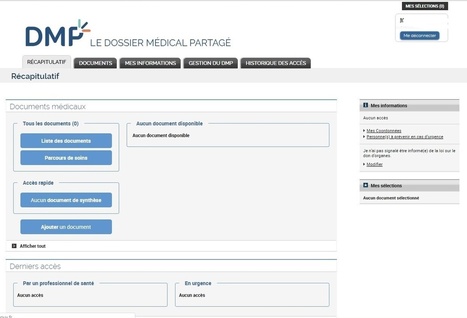

Jean-Christophe Lévêque's curator insight,
November 8, 2018 5:34 AM
Après 2 ans d'expérimentation dans 9 départements, le DMP (Dossier Médical Partagé) est dorénavant disponible sur tout le territoire. Il faut espérer que cette 3eme tentative sera la bonne et facilitera les échanges entre praticiens.#mbamci #hcsmeufr
Scoop.it!

Le géant américain de l'informatique est l'une des premières entreprises à obtenir la nouvelle certification d'hébergeur de données de santé, qui va lui permettre de travailler étroitement avec des hôpitaux et des start-up spécialisées.
Scoop.it!

Le dossier médical partagé est officiellement « disponible pour tous » depuis mardi. Les médecins expriment leurs doutes sur sa mise en œuvre. Via Suzana Biseul PRo

Suzana Biseul PRo's curator insight,
November 6, 2018 2:05 PM
Sur le papier, l’outil présente beaucoup de vertus. Il doit renforcer la collaboration entre les professionnels de santé, permettre un accès immédiat aux informations médicales d’un patient lors d’une première consultation ou en cas d’urgence, éviter les risques liés aux interactions médicamenteuses ou la réalisation d’actes médicaux redondants. En 2004, lors de la présentation du projet, M. Douste-Blazy estimait que le DMP pourrait permettre d’économiser 3,5 milliards d’euros par an, un montant jamais réévoqué depuis.
Scoop.it!
Lionel Reichardt / le Pharmageek's insight:
la vision est la bonne..la question c'est Comment fait on pour que cela soit opérationnel ? #interopérabilité #gouvernance
Scoop.it!
Scoop.it!

Almost every industry is looking at the impact artificial intelligence (AI) will have on it, but healthcare has been one of the most forward-looking because it has the potential of providing better patient care and can save lives.
Scoop.it!

Les données de santé ouvrent de nouveaux gisements de valeur tout au long du parcours de soin. Aux côtés des acteurs traditionnels, des géants du numérique, américains et chinois, et des biotechs entrent sur le marché de la santé. Ces bouleversements s’accompagnent déjà de règles juridiques et de réflexions éthiques, mais les cadres restent encore largement à construire.
Scoop.it!
Turn health data into actionable, cost-saving strategiesoday’s healthcare challenges are no mystery. Hospitals and health systems are navigating the transition to value-based care while continuing to rely on traditional fee-for-service reimbursement models. Uncertainty about the future of health care in the United States is making this shift even more complex as organizations seek a path forward that conquers both known (and unknown) challenges ahead.
The standard advice heard across the industry is to “leverage data,” but how does a health system do this? Every healthcare delivery network in the country is rich with data, but how can this resource be applied for each of your care settings, clinicians and provider groups, payers and reimbursement models, and shifting populations?
Ensuring high quality patient care and outcomes while balancing financial realities in an evolving market requires a robust data analytics solution—one that can handle the breadth and complexity of health care today without an army of data analysts to make it work.
With Verily’s big data computing power, the Performance Matrix platform applies 3M’s risk adjustment methodologies and performance measures to all available data. It then mines this enriched data to identify and prioritize key problem areas. Rather than deploying teams of data analysts, the technology does the work for you.
Using Verily’s analytics engine and 3M’s real-world, proven methodologies, the platform helps improve performance by focusing on areas and interdependencies of preventable clinical and financial issues that stem from:
3M Performance Matrix analyzes aggregated data against dozens of performance measures to identify and describe the most impactful problem areas. This combination of problem prioritization and analysis helps you focus on what can be fixed, and done differently, going forward. 3M Health Information Systems Hyland Healthcare’s enterprise imagingHyland Healthcare’s suite of enterprise imaging solutions allow healthcare providers to control all clinical image content—including images from specialty departments. When integrated with a clinical imaging system or EHR, clinicians and staff can view medical images in the context of the patient record from within those familiar systems.
Eliminating departmental imaging silos improves clinical workflows, strengthens security of protected health information (PHI), enhances disaster recovery, and eases the burden of building and supporting multiple clinical imaging interfaces to the EHR. The following are core components of Hyland Healthcare’s enterprise imaging portfolio. Acuo VNAThe Acuo Vendor Neutral Archive (VNA) provides standards-based enterprise access to medical images regardless of viewing application, offering independence from proprietary archives, and streamlining clinical workflows.
The solution leverages technologies to support the management and sharing of medical images across the enterprise and beyond, allowing providers to assemble a comprehensive image-enabled patient record.
With on-site, cloud, and hybrid deployment options, Acuo VNA supports business continuity and disaster recovery strategies while providing a platform for clinical content integration, interoperability, and exchange. NilReadNilRead, a multi-specialty, zero-footprint enterprise viewer, provides a universal vendor-independent platform for accessing a full range of DICOM and non-DICOM image data. Integrating seamlessly with most EHR, PACS, or VNA, NilRead identifies and ingests images from virtually any departmental archiving solution—whether dermatology JPEGs, data-intensive virtual pathology slides, or radiology DICOM files.
This scalable solution is based on a zero footprint, web-based architecture, meaning only a browser is needed to launch the application. There is no software or plug-ins and images never reside on the workstation. NilRead runs on any web-enabled mobile device, tablet, or PC, providing clinicians with constant access to medical images and remarkable tools to enable collaboration across the enterprise. PACSgearPACSgear solutions complete the enterprise imaging framework by allowing providers to capture a variety of documents, film, photos, video, and other media and integrate them with any EHR, VNA, or PACS. Hyland Healthcare’s ModLink software uses DICOM Structured Report or HL7 measurement data from ultrasound, DEXA, and CT devices to auto-populate reports in voice recognition systems. Meanwhile, ImageLink worklist solution manages HL7 to DICOM MWL mappings, facilitating Integrating the Healthcare Enterprise (IHE) workflow for interoperability with existing PACS. PACSgear connectivity offerings:PACS Scan, PACS Scan Mobile, PACS Scan Film, PACS Scan Web, EHR Gateway, ModLink, Media Writer, Gear View QC, MDR Video – Touch, ScopeCap, DICOM Box, and Image Link. Alliance Community Hospital first MEDITECH customer to deploy CommonWell ServicesMEDITECH, an Enterprise Health Record (EHR) vendor and Contributor Member of CommonWell Health Alliance, has deployed CommonWell interoperability services at Alliance Community Hospital (ACH). The capabilities will enable ACH, a non-profit hospital serving the residents of Alliance, OH, to exchange patient information seamlessly for improved patient care and quality outcomes.
MEDITECH is the first EHR vendor in CommonWell to deploy the Argonaut Project’s FHIR specifications to customers for the purpose of document exchange, providing near real-time access to a participating patient’s data. Embedded directly into the MEDITECH EHR, these CommonWell services include patient enrollment capabilities and C-CDA exchange, opening the door for more comprehensive sharing of discrete segments of data in the future, such as medication and allergy data.
Today, more than 9,300 provider sites are Live on CommonWell services across the nation, and more than 30 million individuals are enrolled..
Accelerate and improve patient care anytime, anywhere with secure mobile app AlertViewAlertView, the mobile application developed by Novarad Healthcare Enterprise Imaging, was created to accelerate healthcare by notifying physicians via text message that reports and findings are ready for review.
AlertView makes healthcare more efficient by eliminating unnecessary delays in the review of imaging reports. The AlertView app instantly sends a text message to referring physicians, radiologists, or cardiologists alerting them that a report is ready for review. No matter where they are, they can review with one click on the text message, and have this instantly shared with other medical care professionals. This type of mobile communication and collaboration improves patient outcomes while minimizing disruptions for primary care physicians and hospital staff.
The app’s features include secure login with TouchID, a dynamic patient list to enable quick searches, extensive filtering including modality and time filters, a convenient basic report view along with an in-depth full report view, display of all key images in the study, and enhanced data security through deep linking
Scoop.it!
Persuasive EHR Workflow Design Increased Same-Day Data Entry by 10% #esante #hcsmeufr #digitalhealth
Incorporating persuasive design concepts into primary care electronic health records (EHRs) increased same-day data entry by 10 percent per physician, demonstrating the potential for persuasive design to change data entry behavior, a study published in JMIR Human Factors revealed.
Persuasive design is a way of developing technology to influence behavior by leveraging social processes. Healthcare stakeholders have primarily focused on using persuasive design in consumer-facing mobile apps to improve outcomes, but there are few examples of using persuasive design to influence clinician behavior.
In primary care settings, providers often face barriers to entering data into EHRs in a timely manner. Data entry tasks often take a long time, and users may feel as if completing documentation is a lower priority than seeing patients or finishing other tasks.
“Persuasive design is a viable approach for designing and encouraging behavior change and could support effective data capture in the field of medical informatics. There may be opportunities to continue improving this approach, and further work is required to perfect and test additional designs,” the team concluded.
read the original unedited article at https://healthitanalytics.com/news/persuasive-ehr-workflow-design-increased-same-day-data-entry-by-10
Via nrip
Scoop.it!

Le 12 septembre lors de la remise des conclusions du rapport de préfiguration du Health Data Hub, la ministre des solidarités et de la santé, Agnès Buzyn, a confié à Jean-Marc Aubert, directeur de la recherche, des études, de l’évaluation et des statistiques (Drees), le pilotage de ce projet de "laboratoire d'Etat au service des données de santé", dont la première version est attendue pour juin 2019.
Scoop.it!
The MITRE Corporation's Kristina Sheridan shares how her life experience inspired the Patient Toolkit, which lets patients digitally record symptoms and treatment
Scoop.it!

MIT researchers have developed a cryptographic system that could help neural networks identify promising drug candidates in massive pharmacological datasets, while keeping the data private. Secure computation done at such a massive scale could enable broad pooling of sensitive pharmacological data for predictive drug discovery.
Datasets of drug-target interactions (DTI), which show whether candidate compounds act on target proteins, are critical in helping researchers develop new medications. Models can be trained to crunch datasets of known DTIs and then, using that information, find novel drug candidates.
In recent years, pharmaceutical firms, universities, and other entities have become open to pooling pharmacological data into larger databases that can greatly improve training of these models. Due to intellectual property matters and other privacy concerns, however, these datasets remain limited in scope. Cryptography methods to secure the data are so computationally intensive they don't scale well to datasets beyond, say, tens of thousands of DTIs, which is relatively small.
In a paper published in Science, researchers from MIT's Computer Science and Artificial Intelligence Laboratory (CSAIL) describe a neural network securely trained and tested on a dataset of more than a million DTIs. The network leverages modern cryptographic tools and optimization techniques to keep the input data private, while running quickly and efficiently at scale.
The team's experiments show the network performs faster and more accurately than existing approaches; it can process massive datasets in days, whereas other cryptographic frameworks would take months. Moreover, the network identified several novel interactions, including one between the leukemia drug imatinib and an enzyme ErbB4—mutations of which have been associated with cancer—which could have clinical significance.
"People realize they need to pool their data to greatly accelerate the drug discovery process and enable us, together, to make scientific advances in solving important human diseases, such as cancer or diabetes. But they don't have good ways of doing it," says corresponding author Bonnie Berger, the Simons Professor of Mathematics and a principal investigator at CSAIL. "With this work, we provide a way for these entities to efficiently pool and analyze their data at a very large scale." Via Dr. Stefan Gruenwald
|
Scoop.it!

Pour atteindre l'objectif de 3,5 millions de dossiers ouverts à la fin de l'année, l'Assurance-maladie mobilise les pharmaciens.
Scoop.it!

L’AP-HP est le CHU d’Ile-de-France. Ses 39 hôpitaux accueillent chaque année 8,3 millions de patients.
Scoop.it!

Les points de vue d’Olivier Clatz, cofondateur de la société Therapixel, à l’origine d’un algorithme dépistant les cancers du sein lors de mammographies, et d’Alexis Vervialle, chargé de mission pour l’Union nationale des associations agréées d’usagers du système de santé.
Scoop.it!

Saviez-vous qu’une des premières causes d’erreur médicamenteuse en France est l’absence de dossier médical unifié ? Les erreurs médicamenteuses coûtent la vie à des centaines de patients chaque année. Comment se fait-il qu’un pays aussi développé et industrialisé que la France n’est pas de solution pour enrayer un circuit patient aussi complexe et vulnérable ? Intéressons-nous plus précisément au milieu hospitalier. Où en sommes-nous en termes d’optimisation des parcours patient ? Quel est l’état de la dématérialisation dans le milieu hospitalier actuel en France ?
Scoop.it!

New US analysis suggests the country is approaching a “turning point” in the implementation of interoperability standards for health IT.
Scoop.it!

Journal of Medical Internet Research - International Scientific Journal for Medical Research, Information and Communication on the Internet
Scoop.it!

Téléchargez le dernier Livre Blanc e-santé "Le patient et ses données au coeur du parcours de soin". A l’heure où l’on évoque le chiffre de 25 à 30 % d'examens ou d'actes de soins non pertinents, l’essoufflement de notre système de santé (et de ses personnels) et une restructuration des organisations..
Scoop.it!

Of all the big data use cases, healthcare has the potential to realize the greatest returns.
Scoop.it!

WASHINGTON (AP) — A government computer system that interacts with HealthCare.gov was hacked earlier this month, compromising the sensitive personal data of some 75,000 people, officials said Friday. The Centers for Medicare and Medicaid Services made the announcement late in the afternoon ahead of a weekend, a time slot agencies often use to release unfavorable developments. Officials said the hacked system was shut down and technicians are working to restore it before sign-up season starts Nov. 1 for health care coverage under the Affordable Care Act.
Scoop.it!

In a study published in the AMA Journal of Ethics, researchers explored the role of social and behavioral data in precision medicine research.
Electronic health records (EHRs) can offer information on social and behavioral data, which can aid research investigating genetic and social factors across health disparities; for example, factors such as substance use and eating habits inform some of the risk associated with preventable premature deaths in the United States. Brittany Hollister, PhD, and Vence L. Bonham, JD, from the National Human Genome Research Institute at the National Institutes of Health, discussed potential biases in collecting, using, and interpreting EHR-based data in precision medicine research.
Current collection of behavioral and social data by precision medicine researchers is increasingly done using EHR data, as opposed to self-report methods such as surveys. However, extraction and use of EHR data poses challenges of inconsistencies or inaccuracies. Another challenge is determining what data are included or excluded from EHRs, and the consequences of using data collected through biased methodologies. The National Academy of Medicine addressed some of this in recommendations for the systematic capture of behavioral and social measures.2 They recommended intentional collection of structured social environment data, as well as the development of a plan by the National Institutes of Health to include social and behavioral data in EHRs. The current inconsistencies in collecting social and behavioral data pose difficulties to use in precision medicine research, but with improved collection methods these difficulties could be amended.
more at https://www.medicalbag.com/ethics/precision-medicine-research-ehr-data/article/808747/
Via nrip
Scoop.it!

Une chercheuse du MIT affirme que la cryptographie permettrait aux sites de séquençage génétique individuel de partager leurs données avec la recherche.
Scoop.it!

For many reasons, several of which we’ll discuss here, a patient’s full understanding of, and engagement with,their health care experiences are vital for a positive outcome. And today, we have more options than ever for achieving higher levels of interest, patient engagement, and “buy-in” from health care customers. These include data-rich wearables, telemedicine for housebound patients and electronic health records that follow us around as we switch providers or seek treatment from specialists. We’re positively swimming in data. But all that noise stands a good chance of confusing or distracting patients from their ultimate goal of ongoing good health if doctors and patients don’t come to the table together with a plan and a common understanding of which data points are meaningful in context and which are not. There’s no doubt anymore: Big data is going to revolutionize the way we administer health care throughout the world and help us achieve financial savings. But as doctors look to leverage modern tools for interacting with and sharing patient health data, there are several factors to remember and several key advantages worth checking out. Here’s a rundown. Data in Long-Term Treatment for Chronic DiseasesRegrettably, we still lack a cure for many chronic diseases. Therefore, doctors and their patients must instead “manage” these conditions. It’s possible to live a full and active life while undergoing treatment for severe diseases and conditions, but only with the right levels of vigilance and engagement. Patients with chronic illnesses must maintain their motivation, their attention to treatment and medication schedules and their general knowledgeability about their condition. Chronic diseases are particularly well-suited to data-driven treatment because they come with unique challenges:
Working together, doctors and patients can use real-time and historical health data to better understand the individual’s holistic health and draw up bespoke treatment plans for their unique circumstances. One part of the equation involves applying predictive models to anticipate future changes or unexpected turns their health condition might take. READ How Big Data Can Play An Essential Role In Fintech Evolution For instance, gathering and organizing data from a large number of insured people lets data-driven health care systems and insurers more accurately take into account social and geographical “determinants” for future patient health. This process can help break down a health care system’s roster of patients by risk type — such as proximity to environmental conditions with known connections to patient health. Plus, not everybody has a history of responding the same way to known pharmaceutical treatments. And not every patient is equally likely to make the lifestyle changes recommended by their doctors. We’ve entered an era in health care where insurers and doctors will eventually begin requiring patients to wear health and fitness monitors as a matter of course. Doing so ensures everybody remains on the same page and that doctors can draw the most personalized conclusions possible from the reams of data such devices collectively produce. Natural Language Processing, or “Once More in Plain English”Health care is a product, like it or not. And whether we’re purchasing that product on some convoluted health care exchange, or we live someplace where health care is an understood right of being a citizen, we all buy into this product one way or another. But even in countries where a single-payer system spreads out the liabilities and costs among patients and consumers and helps drive down prices for everybody, health “literacy” is still a real problem almost across the board. We all know the jokes about doctors’ handwriting. But that’s not the kind of literacy we’re talking about. Often, the valued customers of the world’s health care systems lack even basic knowledge about human health or turn to poor sources of information, such as doctors who skate by on name recognition alone. The situation only becomes worse when you consider the chorus of medical jargon patients must digest as they visit physicians and specialists for what ails them. Here’s why poor health literacy is detrimental to health outcomes:
READ How Data Monetization Can Add Value To Your Analytics Natural language processing has had a long road to relevance as the technology has slowly come of age. But in 2017, researchers from Yale, the University of Massachusetts and the Veterans Administration applied natural language processing algorithms to the task of demystifying electronic health records, or EHRs, to make them more easily digestible for laypeople. They wanted to see whether a computer algorithm could promote better communication about health. It did. Indeed, it worked so well it outperformed the researchers’ expectations, even with unsorted and unlabeled data from patient evaluations. Another 2018 study, now made public by e-health publisher JMIR, confirmed the original findings: When patients and health care providers use natural language algorithms, themselves powered by big data and machine learning, patients have a far and away more complete understanding of their health. After a few tweaks to the systems, researchers even found patients’ ability to recall complex medical definitions later had improved further. Lower Costs Are Just the BeginningIt’s true we frequently measure the quality of health care in dollars and cents. It’s also true that when deployed sensibly, emerging technologies can help bring down costs for everybody. But that’s just the start. Here are some of the other advantages of applying data to solving lackluster patient engagement:
When we empower people with knowledge about the condition of their bodies, they make better lifestyle choices. And when that happens, we enjoy a healthier population overall. It shouldn’t come as a surprise, but the effectiveness of our communication and the quality of our information are two of the keys we need in hand to build a health care system that works the way it’s supposed to. Via Plus91

nani pepsi's curator insight,
November 3, 2022 10:14 AM
Acquista Online La Prescrizione Di Perdita Di Peso https://farmaciadimagrante.com/
https://farmaciadimagrante.com/blog/
Quando si tratta di questioni di salute, è fondamentale sapere quali sono le farmacie buone e cattive. https://profarmaceutico.com/
Quando si tratta di questioni di salute, è fondamentale sapere quali sono le farmacie buone e cattive. https://profarmaceutico.org/ |






