Scientist and entrepreneur turn to Brazil nuts to protect Peru's threatened forests. Sofía Rubio was eight years old when she decided she wanted to be a biologist. 'I would skip school to go to the woods with my father or mother,' who did research in what is now the Tambopata National Reserve in the southeastern Peruvian Amazon, she says.
Hungry for oil revenue, governments and fossil fuel companies are moving even further into one of the world's last great wildernesses, according to a new study in the journal Environmental Research Letters.
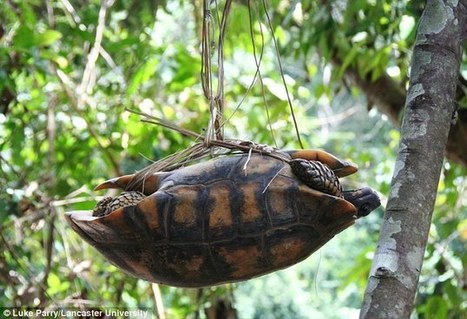
EXCLUSIVE: Experts from Lancaster University and Brazil surveyed households in he cities of Borba and Novo Aripuanã to find out which animals they hunt and eat from the rainforest.
This article was written by James Cook , a Professor at the University of Reading in the UK and the Hawkesbury Institute for Environment at the University of Western Sydney, where he leads the Plants, Animals and Interactions research theme. The...
Long ago, about 36 million years before today, a raft of monkeys found themselves adrift in the Atlantic. They'd been blown out to sea by an intense storm that had ripped up the African coast, and ...
While hordes of tourists with cameras swarming through rainforests is also obviously not what we want, the more people understand these incredible ecosystems, whether through actually visiting themselves or learning proactively, the better. Only increased awareness of the power and possibility that rainforests create for us can inspire the conviction needed to actually do something - before it's too late.
Unlike their parents, when cinereous mourner chicks hatch they usually grow bright orange feathers making themselves look like toxic hairy caterpillars — and it’s not because they were adopted.
In a dog-eat-dog world like the Amazon rainforest, these tiny little creatures are basically easy picking for predators. They can’t run, they can’t hide, and they can’t fly.
Pregnant bats and the world's largest spider; your average evening in the Amazon. Studying bats allows biologists to make valuable connections between the an...
Carbon mapping by the Carnegie Institute for Science reveals nearly seven billion tonnes of carbon stored in Peru’s rainforests, in a technique that could help preserve such stores to reduce carbon emissions
Regional conservation area safeguards subsistence and spirituality in the Peruvian Amazon. For Alfredo Rojas, the history of the remote villages along the Ampiyacu River is one of enslavement.
As scientists and many others have emphasised, building roads into fragile environments such as tropical forests, like the Amazon, can have particularly devastating impacts. These include physical disturbances to the soil, vegetation and water-flows, pollution, and opening up previously inaccessible areas to hunting, colonisation and natural resource exploitation.
Jaguars are strong swimmers and climbers and require large areas of tropical rain forest and stretches of riverbank to survive. A model for conservation, the...
Tropical forests provide countless goods and services that help sustain human life. Given the rapid conversion of forests to agricultural lands, scientists say it is critical that we prioritize conservation of forest ecosystems. While economists have attempted to quantify the economic value of tropical forests, these estimates may overlook the intricacies of the landscape. According to a recent study in Biological Conservation, economic analyses of forests tend to neglect areas containing
Scientists have long known that forests play a significant role in global climate dynamics, but now they are increasingly concerned about the way they transport water on a regional scale.
Footage from the Amazon accompanied by a haunting Wayne Shorter composition shows the beauty of the rainforest side by side with the effects of deforestation...
It’s World Philosophy Day! Here at the Rainforest Alliance, we tend to spend this day pondering the age-old conundrum: “If a tree falls in the forest and no one is there to hear it, does it make a ...
A new study predicts that the effects of deforestation on the global climate will be much stronger than expected. Study author Deborah Lawrence tells DW more.
I don't want to write about leaving — I miss the Amazon so much it's almost crippling. I find myself smelling the laundry I brought back, being weirdly comforted by heady smells of river and decay still in them. It makes me happy that there are still traces of mud on my boots. When I can't sleep, I try to imagine a floor of green stars.
I'm never, ever going to shake this place — that's just the way it is. And as fragile as the Amazon is today, it needs more people who can't forget it — more people who won't ever let go.
Wow - such a great blog post from Laurel Allen at the California Academy of Sciences - reflecting on her time in the Amazon with Dr. Meg Lowman. So glad that Amazon Rainforest Workshops get to help make programs like this happen!
“What we see in the natural world is far more complex than what we can create in the lab,” says Yang. “Dan is helping us to understand the ecological benefits of the many structures found in nature. Then we ask how we can re-engineer that structure efficiently with enhanced functions.”
To get content containing either thought or leadership enter:
To get content containing both thought and leadership enter:
To get content containing the expression thought leadership enter:
You can enter several keywords and you can refine them whenever you want. Our suggestion engine uses more signals but entering a few keywords here will rapidly give you great content to curate.


 Your new post is loading...
 Scoop.it!