

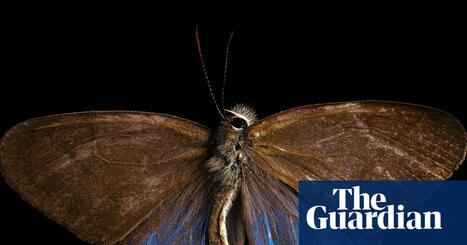
The insects’ brilliant hues evolved in lush ecosystems to help them survive. Now they are becoming more muted to adapt to degraded landscapes – and they are not the only things dulling down
Get Started for FREE
Sign up with Facebook Sign up with X
I don't have a Facebook or a X account


 Your new post is loading... Your new post is loading...
 Scoop.it!
The insects’ brilliant hues evolved in lush ecosystems to help them survive. Now they are becoming more muted to adapt to degraded landscapes – and they are not the only things dulling down

No comment yet.
Sign up to comment
Scoop.it!

New research shows that dozens of Neotropical birds lineages have independently evolved to follow army ants - and almost never turn back.
Scoop.it!
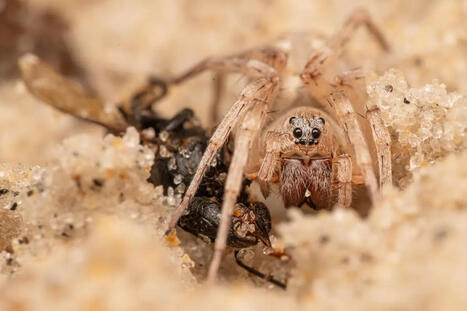
Deep in northern Brazil, a group of scientists from the Clemente Estable Institute (Uruguay), the National University of Córdoba (Argentina), and the
Scoop.it!
Vampire bats are the only mammals to subsist on blood alone. Their ancient ancestors might have eaten parasites and insects off larger animals until vampire bats began feeding directly from those animals themselves. So, how do these nocturnal creatures find their sustenance? And what animals do they most commonly target? Imran Razik follows the nighttime routine of a vampire bat as she hunts. Via Andrew van Zyl
Scoop.it!
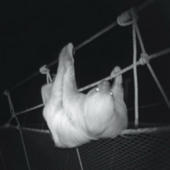
The Amazon Basin is a biodiversity hotspot, with vertically stratified forests fostering complex habitats and high mammal diversity. Although mammals play a critical role in maintaining ecosystem structure, less is known about arboreal mammal activity and habitat use across forest canopy layers. As forest fragmentation increases, understanding how these changes impact arboreal species is essential for effective conservation efforts. Here, we provide a snapshot of canopy walkway use by arboreal mammals in an Amazonian forest with unfragmented canopy cover, providing insight into their spatial and temporal movement patterns across different canopy layers. This study was conducted at the Amazon Conservatory for Tropical Studies, in the Napo-Sucusari Biological Reserve outside Iquitos, Perú. During a three-week survey, we deployed camera traps at multiple heights along a canopy walkway system to monitor arboreal mammal activity. A total of seven mammal species used this canopy walkway system during our study period. Linnaeus’s two-toed sloth (Choloepus didactylus) and the long-tailed porcupine (Coendou longicaudatus longicaudatus) were the most commonly observed species, with several observations of the more reclusive and data-deficient C. ichillus also recorded, among other species. Peak activity occurred between 1900 and 2100 h, coinciding with higher temperature and humidity than nighttime averages. Mid-canopy layers (ca. 21 to 27 m above ground) were most frequently used, with decline in use at higher and lower canopy layers. Our findings provide baseline data on arboreal mammal use of canopy walkways in a tropical forest, which may help inform the design of human-created arboreal corridors to connect forest fragments.
Scoop.it!

As Cop30 approaches, a new report makes it clear the survival of isolated tribes is under threat as protections are eroded. It’s time our countries fulfilled their obligations to defend Indigenous people
Scoop.it!
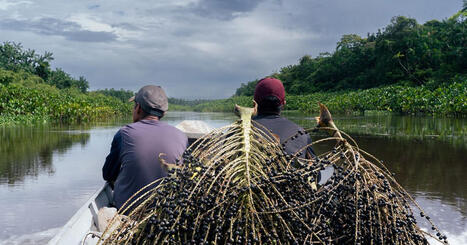
Across the Amazon, The Nature Conservancy is working with partners and communities to create conditions for a thriving, forest-based economy that benefits people and nature. These collective efforts have the power to reshape the future of the Amazon.
Scoop.it!

The American Geographical Society's Weekly Newsletter for Tuesday, October 21, 2025
Scoop.it!

From
apnews

Scientists warn that “flying rivers” — invisible streams of moisture that carry rain from the Atlantic Ocean westward across the Amazon — are weakening as deforestation and climate change advance.
Scoop.it!

The Rio Conventions is a collaborative platform for raising awareness and identifying co-benefits for the implementation of the 3 Rio Conventions
The Morpho Institute's insight:
Glad to see this new synergy!
Scoop.it!

The Amazon biome, stretching over a vast area across nine countries in northern South America, is renowned for its extreme diversity (biological and cultural) and its abundant water resources. Indeed, the major features of the Amazon are linked by interconnected water flows, both on land and in the air (Beveridge et al. 2024). The natural […]
Scoop.it!

From
www
Happy Holidays Friends! Wishing you the best for the end of 2025 and a bright start to 2026!
|
Scoop.it!
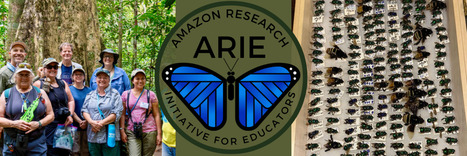
[ARIE 2025] This summer, teachers became researchers at the ACTS Field Station, continuing a long-term inventory of orchid bee diversity. By documenting species richness and distribution from the forest floor to the canopy, they gathered data that will support future monitoring of environmental change.
Scoop.it!

Giving season is here! Your gift to the Morpho Institute empowers K-12 educators to take an active role in realizing the vision of a sustainable Amazon – with its forests, rivers, biodiversity, and people treasured and protected as a vital global resource now and for generations to come. Donate Today!
Scoop.it!

Scientists have detected microplastics in the digestive systems of red howler monkeys living in protected areas in the Brazilian Amazon, marking the first evidence of plastic ingestion by a tree-dwelling primate, according to a recent study. The researchers evaluated 47 Juruá red howler monkeys (Alouatta juara) and found green-colored microplastic filaments, smaller than 5 millimeters […]
Scoop.it!

From
www
George Mason researcher David Luther is leading a project that is using AI models to help identify species and track biodiversity in Brazilian rainforests.
Scoop.it!

Inspired by naturalist Alfred Russel Wallace’s visit nearly two centuries ago, an isolated Indigenous community in Brazil worked with scientists to survey local birds and documendocument cultural traditions. In doing so, they flipped the script of how research gets done.
Scoop.it!

From
apnews
A report says at least 196 uncontacted Indigenous groups remain worldwide and face growing threats from logging, mining, missionaries and organized crime.
Scoop.it!
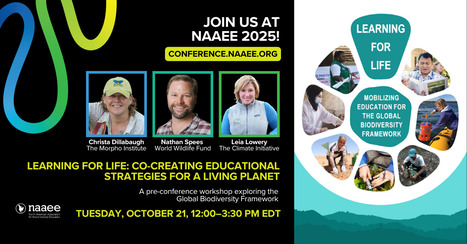
So excited to be on this team to share new guidance on harnessing education to meet the Global Biodiversity Framework Targets! Hope you'll join us!
Scoop.it!

Plastic pollution is widespread across the Amazon Rainforest’s rivers, plants and animals, according to a recent study. Previous research suggests up to 10% of total plastics in the ocean arrive there via the vast network of waterways that’s the Amazon Basin. To understand how and where plastic pollution is present within the basin itself, researchers […]
Scoop.it!

A new Morpho impact survey coordinated by alumn Jordan Wolf has the answers! Check it out on our Blog!
Scoop.it!

Grâce à la connexion satellitaire, cette communauté indigène du nord-est péruvien peut désormais alerter en direct, surveiller son territoire et raconter sa culture au monde. Un outil qui change leur quotidien et pourrait peser dans la protection de l’Amazonie.
Scoop.it!
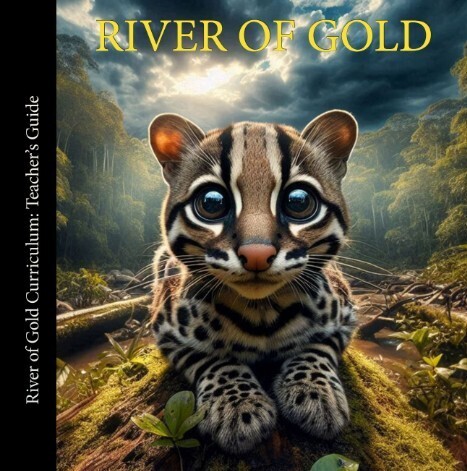
From
amazonaid
A new teaching resource from Amazon Aid to accompany thier film River of Gold. Check it out and let us know if we should post it on our website!
Scoop.it!

A great collection of teaching resources and articles from the American Musuem of Natural History!
|





