 Your new post is loading...

|
Scooped by
Jeff Domansky
February 2, 2015 8:36 PM
|
Big Data holds the potentially to describe target customers with an accuracy and level of detail unfathomable only a decade ago. While old-school marketing efforts were limited to things like tracking returns on direct mail campaigns, or number of subscribers to newsletters, modern marketers can have data on people’s exercise habits, digital clicking behavior, time spent on various sites, purchasing history, personal preferences based on social media postings, time awake, time spent in the car, caloric intake, and almost anything else you can imagine.
So it makes sense that marketers would be chomping at the Big Data bit.
But how should marketers leverage this new quantified customer landscape in the best way?
|
|
Scooped by
Jeff Domansky
February 2, 2015 8:19 PM
|
You can certainly create a killer blog post or an amazing article as the cornerstone of your content. But it’s more efficient and effective in the long term (and often times required for larger organizations) to take a broader view – to create content that can come to life in various formats, across many different platforms, and that can address multiple audiences.
Consider the following types of content that you probably aren’t creating, but should be...
|
|
Scooped by
Jeff Domansky
February 2, 2015 8:01 PM
|
To social selling expert Jill Rowley, ABC doesn't mean "always be closing." It means "always be connecting." She believes that because a sales rep's network is their net worth, salespeople should live on LinkedIn, researching and requesting thought leaders, industry influencers, and potential prospects.
The upshot of this mantra is that sales reps should be connecting with people they know online, but have never met in person. And the difference between being perceived as a valuable contact rather than a stalking stranger in these situations comes down to your LinkedIn request. "I'd like to add you to my professional network" just isn't going to cut it.
LinkedIn allows you to write personalized invitations that contain up to 300 characters -- take advantage of this real estate to make a strong first impression. Confused about what to write? Let the following template be your guide....
|
|
Scooped by
Jeff Domansky
February 2, 2015 9:47 AM
|
Across the six-month period of this analysis, we found that some post types did perform better than others. - Lists and why-posts proved to have the most reliable social traction, averaging around 21,000 shares per month with a variance of less than 2.5%. - What-posts were the riskiest format, showing a high variance of 13.45% - Further analysis of the six-month period revealed:Lists narrowly claimed the most social traction at 22.45% - Why-posts earned 22.32% of social traction. - Videos drew 18.94% of total shares and performed well in Q4. - How-to articles earned 18.42% of shares. - What-posts had the lowest social traction, earning 17.88% of total shares....
|
|
Scooped by
Jeff Domansky
February 2, 2015 2:24 AM
|
Time spent on mobile is skyrocketing. Since about 80% of that time is spent on apps, many marketing leaders have quickly jumped to the conclusion that the only way to reach and engage their customers is through their own branded apps. Wrong! Here are five — often ignored — good reasons for marketing leaders to broaden their mobile approach beyond their own apps...
|
|
Scooped by
Jeff Domansky
February 1, 2015 5:29 PM
|
Content marketing is more important to B2B businesses. Who is succeeding and why? Below is a infographic that details B2B Content Marketing Trends for 2015.
Here are 15 B2B case studies. They show how content marketing drives ROI with B2B businesses who: - Know their audience
- Don’t create content for the sake of creating content
- Use specific content solutions to impact different stages of the buying cycle
- Integrate internally with their teams...
|
|
Scooped by
Jeff Domansky
February 1, 2015 5:13 PM
|
I’ve been building SEO-driven, Adsense/Affiliate monetized sites for 4 years now. I’ve been through every Panda update and Penguin update. I've survived a lot of them, but I've been absolutely crushed by some of them as well. If getting crushed is how you learn, then I've learned a lot.
I started out building hundreds of microniche sites with content as cheap as $3/500 word article, to creating sites that received thousands of FB, Twitter, Reddit, and Stumble upon shares - even though my goal was solely to drive organic search traffic.
One article got over 100,000 likes on Facebook and millions of visitors. It cost me $30 to outsource and I made no effort to optimize it for social.
I don’t claim to be a content creation expert, but I’ve picked up a thing or two over the years, and this is the guide to SEO content creation I wish I had when I started....
|
|
Scooped by
Jeff Domansky
February 1, 2015 4:40 PM
|
You could argue that it doesn’t matter. That these journalists are well established and don’t need online audiences. Perhaps. But I think they’re missing out on the medium that allows you to broaden your scope of thinking, test ideas in an online marketplace and allow fans to have a small sliver of unfiltered access to you. It’s a two-way world. Too many NY Times oldline journos are one-way. Shame. And when you look at the 43 people Brooks follows it’s probably about 35 of his fellow NY Times colleagues. And Marc Andreessen. At least there’s that. Marc, maybe you can break through?...
|
|
Scooped by
Jeff Domansky
February 1, 2015 4:15 PM
|
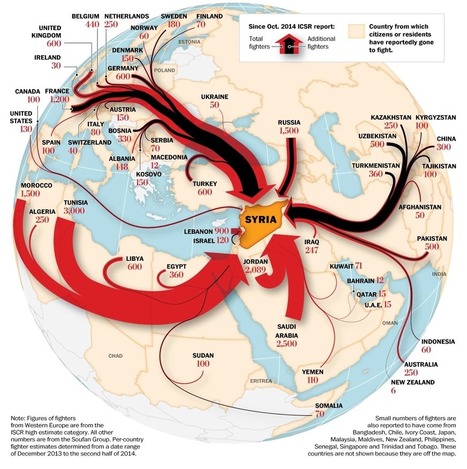
This fascinating data visualisation by @washingtonpost.shows the origin of where fighters have come from and raises some intriguing questions.
|
|
Scooped by
Jeff Domansky
February 1, 2015 3:52 PM
|
It’s interesting to see that content curation is evolving from an opportunity to a necessity as Julia McCoy from ExpressWriters recently noted in the Search Engine Journal explaining how we must curate content in 2015.
Why is that happening? Why is this accelerating?
As communication shifts from traditional methods (PR, advertising, old-style SEO…) to new ones (content marketing, inbound marketing, social media…), professionals and businesses can not only become their own media: they have to. This is something Brian Solis noted about brands a few years ago, as social networks started to become significant for content distribution, when he said they needed to become media to earn relevance. But today, this is not about brands anymore: social networks are not just significant, they are dominant. They became social media and they’re just the main way we receive and consume content. Even search evolved to reflect that and Google changed their algorithms in a defensive way. Today, this about every company, big or small and whether you think of your business as a brand. Not just businesses but professionals too have to build their personal brands and show thought leadership through the content they publish. At Scoop.it, we like to summarize that by saying that:
You are the content you publish.
But another thing changed as well: after an initial period where we learned how to like, follow, subscribe or mark as spam, we, as content consumers, are regaining control. We have tools to filter the noise, we learn how to manage information overload. So in this new world of communication, professionals or companies who want to get heard need to consider this question:
Do people listen to you because they have to or because they want to?...
|
|
Scooped by
Jeff Domansky
February 1, 2015 3:03 PM
|
Why should we care about social selling? Isn't it just another one of those buzzwords used to describe something we already know about? Isn't it just sales under a different name? If that's true then why are we seeing organisations increasingly using new digital channels as part of their sales strategy?
Maybe it's because engaging with our audiences in new ways is just more exciting than traditional sales channels as it provides a way of interacting with our potential buyers. It's also because it's a lot cheaper, digital channels allow us to reach a wider audience, with the same resources. We're having a look at who is the most influential in this up and coming topic, and figure out what brands are driving most engagement on social media....
|
|
Scooped by
Jeff Domansky
February 1, 2015 11:01 AM
|
Have you ever experienced that sinking feeling when a slide pops up on the screen, and it’s just crammed with tiny text? (Or, even worse, when the presenter starts reading it to you, word for word?)
Slides like that are hard to understand and remember. (They're great at boring your audience to death, though.)
It’s pretty common for people to pack slides full of text and content, but most presentation experts recommend avoiding that....
|
|
Scooped by
Jeff Domansky
February 1, 2015 10:20 AM
|
Hey there, marketer. I’m curious … what’s really going on in that day-to-day work life of yours?
When you say you’re working from home, are you actually being productive? When you have a deadline, do you wait until the last minute? What are you actually doing on LinkedIn? It's time to speak the truth.
Below are 15 graphs and charts showing how we really spend our days....
|
|
|
Scooped by
Jeff Domansky
February 2, 2015 8:28 PM
|
If you want to separate your content from your competitors, storytelling is a great tactic to add to your content marketing strategy. Several interesting case studies have shown how the implementation of storytelling can triple sales within one year. The best part is that any business can use storytelling in their content marketing strategy by following these five best practices....
|
|
Scooped by
Jeff Domansky
February 2, 2015 8:11 PM
|
“The essence of strategy is choosing what not to do.” – Michael Porter
More than anything else, this quote has been in my mind lately. I think all of us content marketers need to be mindful of this.
As many of you know, I’ve been working with the team on my latest book Content Inc., which will be released at Content Marketing World 2015 in September. In the book, I’m working on dissecting the business models of enormously successful entrepreneurs who grew an audience through content before launching a product (my initial Content Inc. podcast is now available).
At this point, I’m not going to get specific about the individual companies (I’ll leave that for the book and podcast), but we’ve discovered something interesting. In almost all cases, these successful content marketing-driven companies put all their energy into one channel. It was just a blog, just a series of videos, or just a podcast. Then, after many months and years of success, they began to diversify the content offerings. There’s something about building a loyal audience on one channel before giving them additional options....
|
|
Scooped by
Jeff Domansky
February 2, 2015 7:51 PM
|
Now I don’t know about you, but the words ‘visual storytelling’ really inspire me to answer. In fact, visuals have a better chance of catching users’ attention than any other form of content, and they can tell your brand’s story in a much more dynamic way than a block of text could.
Here are some eye-opening statistics: - Posts with visuals result in 180 percent greater engagement (source)
- 93 percent of the most engaging Facebook posts are image posts (source)
- Half of the human brain is involved in processing visuals. A visual can be interpreted in less than 1/10th of a second (take that goldfish) (source)
As a result, draping content with strong visuals and a story will allow for quick comprehension, even if your fans don’t actually read the copy.
Visual storytelling tactics for Facebook engagement
You may already have an established Facebook presence, but do your posts effectively engage your audiences? Here are some ways to engage them with visual storytelling...
|
|
Scooped by
Jeff Domansky
February 2, 2015 2:35 AM
|
So how does all of this fit into online marketing? If you can convince your potential customers that plenty of other people are using your product – service or software – and are happy with it, then you stand a much better chance of persuading them to get onboard. The message that we are trying to transmit is: a lot of people are wearing our shoes so it´s about time you were wearing them too. The shoes being our respective products, of course.
The folks over at Power Reviews tell us that more than 70 percent of Americans claim to look at online reviews before making a purchase decision and, reporting similar numbers, Search Engine Journal found that around 63 percent of consumers are “more likely to purchase from a site if it has product ratings and reviews”. To put it another way: if your product doesn’t have any online reviews, you could be sending away 60-70 percent of your potential market....
|
|
Scooped by
Jeff Domansky
February 1, 2015 5:43 PM
|
In recent years, psychologists and behavioral economists have shown that our emotional decisions are neither irrational nor irresponsible. In fact, we now understand that our unconscious decisions follow a logic of their own.
They are based on a deeply empirical mental processing system that is capable of effortlessly processing millions of bits of data without getting overwhelmed. Our conscious mind, on the other hand, has a strict bottleneck, because it can only process three or four new pieces of information at a time due to the limitations of our working memory.
|
|
Scooped by
Jeff Domansky
February 1, 2015 5:18 PM
|
What is the difference between content marketing and social media? And, with the burgeoning interest in the former, will the latter wane as a tactic or as a marketing term?
These were the questions posed to me by my very wise friend Jeff Cohen of the SocialMediaB2B blog. Jeff asked several other content/social thinkers and consultant-types to weigh in as well.
Here’s what I said:
Content marketing is a device used by companies to educate, inform or entertain customers or prospects by creating attention or causing behavior that results in leads, sales or advocacy. Social media is used by customers and prospects to communicate among themselves, and occasionally with companies. This communication can result in leads, sales or advocacy, but is often less structured and conversational, and can be reactive too, as social media is increasingly used as a customer support channel.
|
|
Scooped by
Jeff Domansky
February 1, 2015 5:01 PM
|
Google is widely expected to soon rollout a major update to its ranking algorithm that will impact results for searches carried out on mobile devices.
This guide will take you step by step, through all of the actions necessary to become fully compliant with all of Google’s Mobile SEO and Mobile Usability requirements.
According to Stat Counter, in December 2014, mobile searches accounted for 32% of all searches made globally.
This update is therefore likely to have a major impact on most websites and on the search engine landscape....
|
|
Scooped by
Jeff Domansky
February 1, 2015 4:28 PM
|
Content marketing was voted the top marketing activity to drive commercial results in 2015, according to Smart Insights, so competition will be tough and the need to create a focused plan is paramount.
Even though content looks set to take over the digital marketing landscape in 2015, brands still need to get the fundamentals right. This means coming up with a clear strategy, researching consumer data, distributing content in the right places and measuring campaign effectiveness.
By doing so, B2C companies can overcome challenges such as creating engaging content that resonates and appeals to customers, on a regular and consistent basis.
Take a look at the infographic below for an overview of, the most commercially important digital marketing trends for 2015, marketers' top goals for 2015, most popular B2C content marketing tactics, 7 content marketing planning techniques, and more.
|
|
Scooped by
Jeff Domansky
February 1, 2015 3:56 PM
|
Some have deep pockets to solve this. RedBull for instance became a media company with its own record labels, studios and a content pool of 50,000 videos.
Do you?
As an SMB, chances are… no.
So how does a content strategy for the rest of us look like?
Answer: Low cost / fast / high impact.
Easier said than done of course but here in Silicon Valley we have examples every day of companies with limited budget changing the world in a radical way. So we got inspired by the Lean Startup movement and together with other marketers decided to apply that to marketing: speed and agility can make up for lack of budget.
Here’s a framework on how to do this. L.E.A.N means:...
|
|
Scooped by
Jeff Domansky
February 1, 2015 3:38 PM
|
So how are we to respond? I believe that no matter what your business is, you need to become the CEO of a software company. Software must be your differentiator. Software must be your competitive advantage. Software must be integrated, ingested, and ingrained in every aspect of your offering. Software must become your foundation so that you’re freed to build the rest of your offering, rather than constantly defending against new challenges posed by voracious software.
|
|
Scooped by
Jeff Domansky
February 1, 2015 2:29 PM
|
There are literally hundreds of social networks to choose from. We all know the big players: Twitter, Facebook, LinkedIn, Pinterest, Instagram, Google+, Snapchat... oh, well, that list can go on for awhile, too. How can anyone actively engage in all of the social networks, even just sticking to the main players? The truth is, you can't.
Every business has to determine which social networks are most valuable to them. Where is your target audience engaging? Which network is most friendly to your type of business? Which offers you the best reach? Not all social networks are equal, and a network that does great for one business might be a bust for another.
I usually tell businesses that are just starting out in social media to choose one network at a time. Build that up sufficiently before jumping into another network. By focusing on one network initially, your efforts will be far more effective (we only have so many hours in the day!) and you'll more quickly be able to determine if your efforts there are producing fruit....
|
|
Scooped by
Jeff Domansky
February 1, 2015 10:45 AM
|
Ideas that spread, win. ~Seth Godin
A few years ago, blogging and social media were separate. Blogging was long-form, serious, and crafted. Social media was short-form, personal, and spontaneous. Some people predicted that social media would replace blogging because of declining attention spans.
Now blogging and social media not only amicably coexist; they complement each other. The trick is to use a blog to enrich your social media with long-form posts and to use social media to promote your blog.I recently did a live webinar event with Marketo about The Art of Social Media, and we’d like to share the takeaways from the presentation and a few of the follow-up questions that we answered....
|












Big data could be a big deal in your marketing strategy.