 Your new post is loading...

|
Scooped by
Jeff Domansky
August 18, 2015 12:47 AM
|
India is a market obsessed with discounts, coupons and any deal that can help them spend less and save more. This trend was fairly offline until the e-marketplace boom came into place.
The e-commerce boom quickly transferred the euphoria of bustling bazaars online and tech-savvy people were more than happy to shop with a click of a button. With a large number of people from tier 1 and tier 2 cities buying online, it was not far before discounts industry made an online surge.
We observed similar behaviour in global markets as well. Reading on the lines of this buying habit, we conducted an elaborate research on the coupon usage behaviour of the online shoppers. We have come up with an interesting infographic on how people shop and use online coupons globally....
|
|
Scooped by
Jeff Domansky
August 17, 2015 11:58 PM
|
Publish or perish" is an adage often used in the context of academia.
For would-be professors to be considered for tenured positions, they must regularly showcase their brilliance through publishing relevant scholarly works.
I would argue that CEOs should follow the same advice, but the output shouldn't be doctoral-thesis-worthy communications. Rather, they should be writing compelling blog content to advance their business and personal interests.
Below are five reasons why organizations should embrace the CEO blog....
|
|
Scooped by
Jeff Domansky
August 17, 2015 7:26 PM
|
Andreessen Horowitz appears to be one of the winners in the $2.4 billion acquisition of online retailer Zulily by the owner of home shopping network QVC that was announced on Monday.
The Menlo Park-based venture firm was the Seattle company's (Nasdaq: ZU) biggest shareholder as recently as April, with about 13 percent of its stock at that time. But its hard to know exactly how well it did as Term Sheet reported on Monday that A16Z had "quietly distributed" most of its shares within the past few months.
Zulily's example may not be terribly comforting, either, to other so-called unicorns — as venture-backed companies that hit $1 billion in valuation are known. It is one of a growing group of VC-backed companies that have strong IPOs and first-day stock gains, only to lose value after their quarterly financials are subjected to Wall Street scrutiny....
|
|
Scooped by
Jeff Domansky
August 17, 2015 6:26 PM
|
With online and mobile media set to transform primary and secondary education, professional development won’t be far behind. That’s the bet Inc. magazine is making with the launch of a new online education program, bringing in experts and top execs from across the business world to teach courses -- and, yes, assign and grade homework (but no tests!).
The new online education program is kicking off with a five-week course on entrepreneurship, called “The Inc. Startup Accelerator,” which according to Inc. president and editor-in-chief Eric Schurenberg, will “help you with everything you need to know about creating a business -- starting it, protecting it, and marketing it.”
Schurenberg will host the course; individual classes will be taught by a series of guest lecturers, including Eric Ryan, the founder and CEO of Method, Susan Lyne, CEO of BBG Ventures, Sabrina Parsons, the CEO of Palo Alto Software, and Ben Huh, founder of I Can Has Cheezburger, among others....
|
|
Scooped by
Jeff Domansky
August 17, 2015 4:48 PM
|
Ever since the commercial Internet emerged, content has been at the center. Bill Gates, quite famously, declared that content is king and called it the “killer app” of the Internet age. Inspired, media executives and internet entrepreneurs alike sought to marry content and distribution to create the perfect business model.
The problem is, as I’ve noted before, that content is crap. Nobody walks out of a great movie and says, “Wow! That was some great content.” Nobody listens to content on their way to work in the morning. We never call anything we like “content,” the term is a mere fantasy in the minds of business planners.
That, in essence, is why despite the predictions of digital pundits, the TV industry has continued to prosper. Through a series of disruptions—cable, DVD and now streaming video—programing has continued to evolve. Now, with the cable business model starting to unravel, we can expect an explosion of creative energy that will usher in a new golden age of TV....
Kohl’s is bullish on mobile’s role for the upcoming holiday season, with 30 percent of its mobile traffic being driven by a new wallet feature in its application and plans to bring a new click-and-collect service to mobile.
During a conference call with analysts last week to discuss the retailer’s second quarter results, Kohl’s executives talked up the success of its new app, which has had more than 2 million downloads this year for a total of more than 8 million users. The wallet feature in the app is focused on offers and promotions, enabling users able to scan and save Kohl’s Cash and offers to the wallet and then redeem them at checkout.
Via Douglas G Hall
|
|
Scooped by
Jeff Domansky
August 17, 2015 9:58 AM
|
While at Google’s offices recently, I had the pleasure to hear a Google Product Manager present the company’s view of how information retrieval has changed with the rise of mobile and smartphone adoption.
They are calling it “micro-moments,” the premise being that as smartphone adoption and use continues to skyrocket, consumers increasingly have small bursts of interaction with their phones across search, social, video and email, as opposed to prolonged periods in front of a desktop.
This viewpoint represents a shift from the linear “sit, search and act” desktop mentality that characterized the early days of the internet, in which research and action were typically performed in one sitting while in front of a connected internet device.
These days, according to Google, more searches are done on mobile than on desktop in many countries, including the United States, Japan and United Kingdom.
Google’s micro-moment perspective posits that discovery and action are decoupled as discovery comes in multi-session bursts, across channels, on a mobile device, while action (conversion/purchase) often takes place later on a larger screen, a laptop or tablet device....
|
|
Scooped by
Jeff Domansky
August 16, 2015 4:06 PM
|
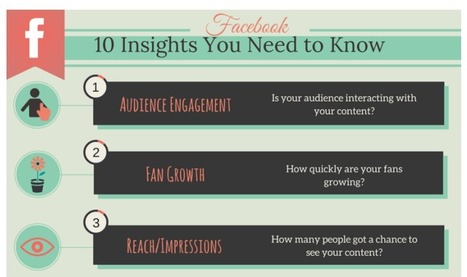
What social media analytics do you use to verify that your Facebook Page is working well?
What do you monitor and improve on, on a weekly or monthly basis?
We have all heard about organic reach declining on Facebook and
… of course, that is true.
It’s harder to get reach. But you can increase your reach and engagement if you monitor your analytics....
|
|
Scooped by
Jeff Domansky
August 16, 2015 3:23 PM
|
Share Tally is the result of a desire to know more. There are more than a few sites that will tell you how many Tweets your blog post received, or how many Likes on Facebook your landing page got - but what about the other social networks? What about the smaller niche voting sites that drive so much targeted traffic? What about the rest?
I got fed up with having to check multiple places to see how my content was fairing in the social world. I decided to build something better, something more robust. Share Tally was born.
|
|
Scooped by
Jeff Domansky
August 16, 2015 2:52 AM
|
If you’ve checked your Direct Messages today, you may have noticed that something’s missing: the limitation of 140 characters. You can now chat on (and on) in a single Direct Message, and likely still have some characters left over.
|
|
Scooped by
Jeff Domansky
August 16, 2015 2:26 AM
|
Think about a big purchase you made recently. Perhaps you bought a new phone, laptop, or television set. Chances are that you did not make that purchase on an impulse. As a buyer, you probably, either consciously or subconsciously, went through a process of discovery, also known as the “buyer’s journey.”
The “buyer’s journey” is the active research process that a customer goes through leading up to a final purchase decision. The first step of the “buyer’s journey” is awareness; you took this step when you became aware of the existence of the product that you purchased. The second step is consideration; you took this step as you weighed the pros and cons of purchasing the product and did a subjective cost-benefit analysis. The third and last step is the decision; you took this step when you finally bought the product....
|
|
Scooped by
Jeff Domansky
August 16, 2015 2:06 AM
|
There are two ways in which you can come up with new content: you either create it or you curate it (ideally, you do both). The content that you create, curate and share with your audience should be relevant to your business.
You should identify topics that resonate with your followers and share content that will help your audience relate to your business. While content creation is a more time-intensive process, content curation need not be so.
There are several content curation tools that help you discover interesting and unique content that can help keep your social media pages buzzing with activity. Here are four such tools that you can use to share engaging content on social media....
|
|
Scooped by
Jeff Domansky
August 16, 2015 1:09 AM
|
The good news is that the keyword planner only shows a very small portion of keywords you can target.
If you can find “hidden” keywords that have a decent search volume, but less competition, your organic search traffic will grow rapidly.
I’m going to walk you through 5 modern keyword research methods that you can use to uncover keywords that haven’t been targeted by hundreds or thousands of your competitors. ...
|
|
|
Scooped by
Jeff Domansky
August 18, 2015 12:04 AM
|
Today I’m trying something different.
A brave person from our {grow} community has volunteered to let me tear apart his blog … in the most gracious way possible, of course! G. David Dodd is permitting me to dissect his blog B2B Marketing Directions and provide recommendations that I think will probably help a lot of people and dramatically improve David’s content marketing opportunities.
Here we go. This is the top of Mr. Dodd’s blog with numbers that correspond to my comments....
|
|
Scooped by
Jeff Domansky
August 17, 2015 11:51 PM
|
Big Data is that buzzword that describes the increasing volume of data surrounding every aspect of human life. It refers to the idea that nearly every human action can be quantified and logged in a bank of data that is growing at an unprecedented rate. In fact, there are nearly as many pieces of digital information as there are stars in the universe.
Marketers look into this vat of data bug-eyed and frothing at the mouth.
Why? Because Big Data holds the potentially to describe target customers with an accuracy and level of detail unfathomable only a decade ago. While old-school marketing efforts were limited to things like tracking returns on direct mail campaigns, or number of subscribers to newsletters, modern marketers can have data on people’s exercise habits, digital clicking behavior, time spent on various sites, purchasing history, personal preferences based on social media postings, time awake, time spent in the car, caloric intake, and almost anything else you can imagine....
|
|
Scooped by
Jeff Domansky
August 17, 2015 6:48 PM
|
Internet comments are awful. Recently sites [like Popular Science, Bloomberg Business, Reuters, Mic, The Week, re/code, The Verge, and now The Daily Dot] have been giving up on hosting local comments altogether. Blaming trolls and spambots and the shift in engagement to platforms like Facebook, Twitter and Reddit, you can almost hear the sighs of relief in their articles discussing these decisions.
This “What can you do? People are awful amirite!” attitude towards comment sections is fatalistic and misguided. If you don’t want comments on your website, that’s fine, don’t have them. But don’t act like comments are some sort of intractable problem that can’t be realistically addressed by mortals. They’re not. There are only a few reasons why most internet comments sections are terrible and real-world solutions to those problems. Be honest: you could fix this, but your priorities are elsewhere....
|
|
Scooped by
Jeff Domansky
August 17, 2015 5:03 PM
|
No survivorship bias here. A compilation of startup failure post-mortems by founders and investors.
On his many failed experiments, Thomas Edison once said,
"I have learned fifty thousand ways it cannot be done and therefore I am fifty thousand times nearer the final successful experiment."
And so while we have dug into the data behind startups that have died (as well as those acqui-hired) and found they usually die 20 months after raising financing and after having raised about $1.3 million, we thought it would be useful to see how startup founders and investors describe their failures.
While not 50,000 ways it cannot be done, below is a compilation of startup post-mortems that describe the factors that drove a startup’s demise. Most of the failures have been told by the company’s founders, but in a few cases, we did find a couple from investors including Roger Ehrenberg (now of IA Ventures) and Bruce Booth (Atlas Venture). They are in no particular order, and there is something to learn from each and every one of them....
|
|
Scooped by
Jeff Domansky
August 17, 2015 4:36 PM
|
When you’re desperate to spread the word about your ecommerce site and get visitors clicking on products, your first thought may be to blast out a coupon to everyone on your contact list. While coupons definitely work, they’re not the only marketing tools you have in your toolbox. Several other techniques exist and have been proven to work. Try some of the following tactics and watch your conversions grow.,,,
|
|
Scooped by
Jeff Domansky
August 17, 2015 4:28 PM
|
Right off the bat, Instagram makes itself more difficult than other social media networks. Instead of posting anything you please, you’re forced to use a picture or video with every post – and that picture or video is the main focus of your post.
That means you’re constantly creating new visual content – if you’re not, others who are creating new eye-catching Instagram content will pull right ahead. Especially in the jewelry and fashion industries, Instagram has fierce competition for viewers’ attention.
The best way to get ahead is to do something truly unique and creative that your competitors aren’t doing. But everyone needs to start somewhere.
We’ll go over three general Instagram marketing strategies and give you real examples of brands using each one so you have the resources to get started right away....
|
|
Scooped by
Jeff Domansky
August 17, 2015 9:55 AM
|
What CEOs and the CMOs have come to realize is insights can play a pivotal role in enabling organizations to shift their organization towards customer centricity. Enabling understanding of what customer strategies to implement and how to design marketing effective at connecting with prospective buyers and existing customers.
With the overwhelming amount of data available to corporations, as well as, what can be called the “marketing of insights” by analytics, SaaS, and consulting firms, CEOs, and their teams can get caught in the midst of confusion about what really is a good insight. Confusing it is. We are witnessing top-down big data along with readily available public data broadly categorized as insights. When, in fact, they represent customer information and intelligence gathering organizations have to be good at just to compete....
|
|
Scooped by
Jeff Domansky
August 16, 2015 3:54 PM
|
This Data Visualisation by @iantsommers. should be required reading for all US voters. As should is data source Politifact.
|
|
Scooped by
Jeff Domansky
August 16, 2015 3:15 PM
|
Using analytics to come up with a directed strategy for developing content has become second nature. Did you know that you also can use analytics for your content auditing? Let’s take an inside look at content audits and how analytics figure into them.
Content auditing involves a detailed analysis of a website’s content to weed out poorly performing pages, identify outdated pages or wrong information, and learn which pages have poor SEO built into them. The aim is to fix these problems to streamline the operation of the site and to keep visitors (both new and returning) happy. Content auditing also allows you to revamp existing content to increase its search ranking or to develop content similar to previously successful pages. It’s one of the best ways to maintain the ongoing quality of your content....
|
|
Scooped by
Jeff Domansky
August 16, 2015 2:40 AM
|
Do you know what is the fastest way to grow your blog audience?
Model the successful bloggers that have already achieved success!
We’ll go through 18 of the most effective strategies to build your blog audience.
And I’ll show you examples of bloggers who used those strategies to build a large following....
|
|
Scooped by
Jeff Domansky
August 16, 2015 2:16 AM
|
As the co-founder of the Social Tools Summit, the first social media conference devoted entirely to social media tools, how they can benefit your social media program, and best practices in utilizing them, it is my job to audit the entire social media for business universe and create sessions based on the types of social media tools that are becoming mainstream in the corporate world.
This is the background to the 10 sessions revolving around social media tools that were just announced for the upcoming Social Tools Summit taking place in San Francisco, CA on October 27 and 28, 2015....
|
|
Scooped by
Jeff Domansky
August 16, 2015 1:54 AM
|
Because they’ve become so essential, there are actually quite a few social media management tools on the market. Some are well known, and some aren’t.
But what’s interesting is the fact that some of the lesser known tools are starting to catch up (or have already caught up) with their more popular competitors. In fact, some of these tools offer completely unique functionalities which may really benefit your Social Media game.
With this is mind, here’s my list of the five best social media tools to try in 2015....
|




















A CupoNation research study looks at how coupons are used around the globe.