Your new post is loading...

|
Scooped by
Jean-Michel Ané
January 23, 2024 4:50 PM
|
Common bean (Phaseolus vulgaris) can efficiently fix atmospheric nitrogen when associated with Rhizobia. However, drought stress impairs plant metabolic processes, especially the biological nitrogen fixation (BNF). Here, we assessed transcriptional responses in nodules of two common bean genotypes to drought stress under BNF reliance. The RNA-Seq analysis yielded a total of 81,489,262 and 72,497,478 high quality reads for Negro Argel and BAT 477 genotypes, respectively. The reads were mapped to the Phaseolus vulgaris reference genome and expression analysis identified 145 and 1451 differentially expressed genes (DEGs) for Negro Argel and BAT 477 genotypes, respectively. Although BAT 477 had more DEGs, both genotypes shared certain drought-responsive genes, including an up-regulated heat shock protein (HSP) and a down-regulated peroxidase, indicating shared pathways activated during drought in nodule tissue. Functional analysis using MapMan software highlighted the up-regulation of genes involved in abiotic stress responses, such as HSPs and specific transcription factors (TFs), in both genotypes. There was a significant down-regulation in metabolic pathways related to antioxidant protection, hormone signaling, metabolism, and transcriptional regulation. To validate these findings, we conducted RT-qPCR experiments for ten DEGs in nodules from both genotypes, for which the expression profile was confirmed, thus reinforcing their functional relevance in the nodule responses to drought stress during BNF. BAT 477 genotype exhibited more pronounced response to drought, characterized by a high number of DEGs. The strong down-regulation of DEGs leads to transcriptional disturbances in several pathways related to stress acclimation such as hormone and antioxidant metabolism. Additionally, we identified several genes that are known to play key roles in enhancing drought tolerance, such as HSPs and crucial TFs. Our results provide new insights into the transcriptional responses in root-nodules, an underexplored tissue of plants mainly under drought conditions. This research paves the way for potential improvements in plant-bacteria interactions, contributing to common bean adaptations in the face of challenging environmental conditions.
|
|
Scooped by
Jean-Michel Ané
January 23, 2024 4:46 PM
|
CRISPR/Cas9 systems are commonly used for plant genome editing; however, the generation of homozygous mutant lines in Medicago truncatula remains challenging. Here, we present a CRISPR/Cas9-based protocol that allows the efficient generation of M. truncatula mutants. Gene editing was performed for the LysM receptor kinase gene MtLYK10 and two major facilitator superfamily transporter genes. The functionality of CRISPR/Cas9 vectors was tested in Nicotiana benthamiana leaves by editing a co-transformed GUSPlus gene. Transformed M. truncatula leaf explants were regenerated to whole plants at high efficiency (80%). An editing efficiency (frequency of mutations at a given target site) of up to 70% was reached in the regenerated plants. Plants with MtLYK10 knockout mutations were propagated, and three independent homozygous mutant lines were further characterized. No off-target mutations were identified in these lyk10 mutants. Finally, the lyk10 mutants and wild-type plants were compared with respect to the formation of root nodules induced by nitrogen-fixing Sinorhizobium meliloti bacteria. Nodule formation was considerably delayed in the three lyk10 mutant lines. Surprisingly, the size of the rare nodules in mutant plants was higher than in wild-type plants. In conclusion, the symbiotic characterization of lyk10 mutants generated with the developed CRISPR/Cas9 protocol indicated a role of MtLYK10 in nodule formation.
|
|
Scooped by
Jean-Michel Ané
January 15, 2024 7:18 PM
|
Plant breeding and genetics play a major role in the adaptation of plants to meet human needs. The current requirement to make agriculture more sustainable can be partly met by a greater reliance on biological nitrogen fixation by symbiotic diazotrophic microorganisms that provide crop plants with ammonium. Select accessions of the cereal crop sorghum (Sorghum bicolor (L.) Moench) form mucilage-producing aerial roots that harbor nitrogen-fixing bacteria. Breeding programs aimed at developing sorghum varieties that support diazotrophs will benefit from a detailed understanding of the genetic and environmental factors contributing to aerial root formation. A genome-wide association study of the sorghum minicore, a collection of 242 landraces, and 30 accessions from the sorghum association panel was conducted in Florida and Wisconsin and under 2 fertilizer treatments to identify loci associated with the number of nodes with aerial roots and aerial root diameter. Sequence variation in genes encoding transcription factors that control phytohormone signaling and root system architecture showed significant associations with these traits. In addition, the location had a significant effect on the phenotypes. Concurrently, we developed F2 populations from crosses between bioenergy sorghums and a landrace that produced extensive aerial roots to evaluate the mode of inheritance of the loci identified by the genome-wide association study. Furthermore, the mucilage collected from aerial roots contained polysaccharides rich in galactose, arabinose, and fucose, whose composition displayed minimal variation among 10 genotypes and 2 fertilizer treatments. These combined results support the development of sorghums with the ability to acquire nitrogen via biological nitrogen fixation.
|
|
Scooped by
Jean-Michel Ané
January 10, 2024 12:43 PM
|
Nitrogen is an essential element for all plants, animals, and microorganisms in the Earth’s biosphere. For millions of years, nitrogen was available through soil minerals; dead organisms; and biological nitrogen fixation by microorganisms, with symbiotic nitrogen fixation in particular being the most efficient source. Humans have used legumes and symbiotic nitrogen fixation in all continents for thousands of years without knowing anything about symbiosis. Back in Roman times, in the literature on soil improvement, the positive impact on yields and soil quality after planting legumes was already noted. The 20th century industrial technology of chemical synthesis increased the availability of nitrogenous fertilizers. Thanks to this, crop yields improved significantly, and the human mortality rate from starvation reduced. Nitrogen fertilizers are expensive and not quite ecologically friendly, but, considering the size and growth of the human population, they are strictly necessary. A trend in technology of recent times has been the search for environmentally friendly methods to replace the “dirty” technologies used since the beginning of the technological era. This has led to the development of research in biological nitrogen fixation [1]. Over the past 30–40 years, studies on legume–rhizobium symbiosis have obtained a vast amount of information regarding the structure of root nodules and the dynamics of symbiosis formation. The scientific community working in this area of research was fascinated by the logic of the successive steps in the establishment of symbiosis and by the cytological beauty of root nodules, as it was almost like Newton’s celestial mechanics. The advent of new methods of genetics and molecular biology revealed complexity in seemingly simple processes such as inoculation, plant selection of microsymbionts, and nodule formation. In return, researchers gained the ability to manipulate both plant and bacterial genes instead of being passive spectators [1,2]. Major efforts have been made to decipher Nod factor (NF) signaling pathways and the mechanisms of the perception of NF in susceptible regions of young roots, as well as the regulation of nodule formation [2,3,4].
|
|
Scooped by
Jean-Michel Ané
January 10, 2024 12:34 PM
|
Arbuscular mycorrhizal fungi (AMF) play an indispensable role in terrestrial ecosystem soil organic carbon (SOC) dynamics. Over the past 22 years, numerous researchers have studied the role of AMF on soil the carbon cycle, thereby producing a wealth of knowledge. However, a comprehensive summary and analysis of the basic characteristics, research outputs, and knowledge base is still lacking. To explore the authors, countries, institutions, and keywords involved in the study of AMF effects on the soil carbon cycle, publications between 2001 and 2022 were identified and extracted from the Web of Science Core Collection databases using specific keywords, and a bibliometric analysis conducted on this data using CiteSpace. The number of publications has gradually increased over time, with a notable acceleration from 2017 onward. Most of the authors did not cooperate on a regular basis, and a stable cooperative group had not yet been formed among the core authors. The Chinese Academy of Sciences produced the largest number of publications among research institutions. Specifically, China published the largest number of articles in terms of national contributions, but had less influence in collaborative networks. The most desirable research topics mainly included nitrogen and phosphorus nutrients, root colonization, diversity, organic matter and organic carbon, plant growth, and microbial community. In more recent years, research seemed to focus more on AMF-mediated carbon, nitrogen, phosphorus, nutrient exchange, alterations in microbial community structure, advancements in research techniques and methods, and in-depth studies into related mechanisms. This study serves as a valuable reference for future researchers interested in the effects of AMF on the soil carbon cycle, and provides guidelines for future innovative research.
|
|
Scooped by
Jean-Michel Ané
January 4, 2024 4:57 PM
|
Soybeans [Glycine max L. (Merr.)] serve as a primary source of food, fuel, and commercial products around the world. As a legume they serve a critical role in crop production cycles where they are capable of fixing the majority of their required nitrogen endogenously. This nitrogen production occurs through the symbiotic relationship between soybeans and a soil born bacteria, most often Bradyrhizobium japonicum, in specialized root structures known as nodules. Within these nodules, diatomic atmospheric nitrogen (N2) is fixed into a plant bioavailable form of ammonia (NH3) which is used for vegetative growth, protein production, and seed fill. The roots these nodules grow on are also diverse and adaptive to their environments with variations in their physical structure known as root system architecture (RSA). The value of understanding the variation and adaptability of nodulation, RSA traits, and their interactions serves as a critical turning point to breeding and optimizing soybeans for specific environments and output traits. With recent developments in machine learning and computer vision this work presents the development of Soybean Nodule Acquisition Pipeline (SNAP), a novel tool, for evaluating nodulation which we re-define as the total nodule area on a root or root growth zone as a function of nodule count and individual nodule area. SNAP combines RetinaNet and Unet deep learning architectures to dramatically reduce the human labor needed to quantify nodule size and locations on roots. With the deployment of SNAP in early growth stages we show that nodule count does not statistically differ from V1 to V5 in the taproot growth zone, but nodulation continues to increase in every growth zone at each growth stage. We also found that in the panel assessed, the percent of nitrogen in end season seed has a moderate (r2 = 0.5) and significant (p = 0.04) correlation specifically to tap root nodulation. We also deployed SNAP on a large diversity panel (n=300) of soybeans in three field environments to conduct genome-wide association studies. As a result, we report three quantitative trait loci (QTL) across four traits and explore a putative gene for that may impact the Nodulation Carbon to Nitrogen Production Efficiency (NCNPE). Additionally, we explored the same diversity panel in controlled growth environments across the first 12 days of growth using the Advanced Root Image Analysis (ARIA) system for the underlying genetics of RSA and report 19 QTL across 21 traits in addition to finding five overlapping QTL with previously reported RSA traits. In these studies, we found no overlapping QTL between RSA and nodulation traits.
|
|
Scooped by
Jean-Michel Ané
January 4, 2024 4:44 PM
|
The whole field of synthetic biology (SynBio) is only about 20 years old, and plant SynBio is younger still. Nevertheless, within that short time, SynBio in general has drawn more scientific, philosophical, government, and private-sector interest than anything in biology since the recombinant DNA revolution. Plant SynBio, in particular, is now drawing more and more interest in relation to plants’ potential to help solve planetary problems such as carbon capture and storage and replacing fossil fuels and feedstocks. As plant SynBio is so young and so fast-developing, we felt it was too soon to try to analyze its history. Instead, we set out to capture the essence of plant SynBio's origins and early development through interviews with 8 of the field's founders, representing 5 countries and 3 continents. We then distilled these founders’ personal recollections and reflections into this review, centering the narrative on timelines for pivotal events, articles, funding programs, and quoting from interviews. We have archived the interview recordings and documented timeline entries. This work provides a resource for future historical scholarship.
|
|
Scooped by
Jean-Michel Ané
January 3, 2024 2:54 PM
|
Phosphorus is a vital nutrient for plant growth, as it is an essential component of diverse biomolecules (i.e., nucleic acids). Plants primarily uptake phosphorus as Pi, but Pi rapidly forms cation complexes, making it impossible to take up [1.].
Pi deficiency reduces plant growth and development. Therefore, plants have evolved sophisticated mechanisms to sustain Pi uptake, translocation, and homeostasis under scarcity conditions. Genes participating in these responses are part of the phosphate starvation response (PSR) [2.]. Phosphate Starvation Response (PHR), a transcription factor (TF) conserved from algae to land plants, tightly controls the activation of the PSR [3.]. It also regulates the expression of plant genes required to engage in symbiosis with arbuscular mycorrhizal (AM) fungi, which provide Pi to the plant host in exchange for sources of carbon [4.]. For instance, PHR activates the expression of genes participating in the biosynthesis of the phytohormone SLs, which are essential to initiate symbiosis with AM fungi [5.].
Plants also deal with Pi deficiency by modifying their root and shoot architecture. For instance, Pi deficiency reduces tiller number and panicle length in Oryza sativa (rice) [6.]. SLs are highly produced under Pi deficiency and control root and shoot architecture [7.]. However, the molecular mechanism underlying the role of SLs in shaping the root and shoot architecture remains elusive.
Recently, Yuan et al. [8.] showed that the TFs Nodulation Signaling Pathway (NSP)-1 and NSP2, in coordination with PHR, regulate tiller number and root architecture by promoting the biosynthesis of SLs in rice. This study provides insights for understanding the regulatory mechanisms of SL biosynthesis and signaling in response to Pi deficiency.
|
|
Scooped by
Jean-Michel Ané
January 2, 2024 12:03 PM
|
Biological nitrogen fixation, the conversion of inert N2 to metabolically tractable NH3, is only performed by certain microorganisms called diazotrophs and is catalyzed by the nitrogenases. A [7Fe-9S-C-Mo-R-homocitrate]-cofactor, designated FeMo-co, provides the catalytic site for N2 reduction in the Mo-dependent nitrogenase. Thus, achieving FeMo-co formation in model eukaryotic organisms, such as Saccharomyces cerevisiae, represents an important milestone toward endowing them with a capacity for Mo-dependent biological nitrogen fixation. A central player in FeMo-co assembly is the scaffold protein NifEN upon which processing of NifB-co, an [8Fe-9S-C] precursor produced by NifB, occurs. Prior work established that NifB-co can be produced in S. cerevisiae mitochondria. In the present work, a library of nifEN genes from diverse diazotrophs was expressed in S. cerevisiae, targeted to mitochondria, and surveyed for their ability to produce soluble NifEN protein complexes. Many such NifEN variants supported FeMo-co formation when heterologously produced in the diazotroph A. vinelandii. However, only three of them accumulated in soluble forms in mitochondria of aerobically cultured S. cerevisiae. Of these, two variants were active in the in vitro FeMo-co synthesis assay. NifEN, NifB, and NifH proteins from different species, all of them produced in and purified from S. cerevisiae mitochondria, were combined to establish successful FeMo-co biosynthetic pathways. These findings demonstrate that combining diverse interspecies nitrogenase FeMo-co assembly components could be an effective and, perhaps, the only approach to achieve and optimize nitrogen fixation in a eukaryotic organism.
|
|
Scooped by
Jean-Michel Ané
January 2, 2024 11:56 AM
|
•Sustainable Agriculture Importance: Emphasizes the need for practices that ensure long-term food production with minimal environmental impact.
•AM Fungi and PSMs' Roles: Highlights the complex interactions between plants and soil microbiome, focusing on AM fungi and PSMs in enhancing plant health and resilience.
•AM Fungi Symbiosis: Describes how AM fungi form symbiotic relationships with plant roots, improving phosphorus absorption and plant growth, and stress resistance.
•PSMs in Nutrient Solubilization: Discusses PSMs' role in making soil phosphorus available to plants, crucial for plant physiology.
•Wider Impact of AM Fungi and PSMs: Points out the broader benefits of these microorganisms on soil quality, water retention, and ecosystem health.
•Alternatives to Chemical Fertilizers: Explores the potential of AM fungi and PSMs as sustainable substitutes for chemical fertilizers.
•Addressing Food Security and Climate Change: Connects the use of these microorganisms in agriculture to global challenges like food security and climate change.
•Research and Implementation Needs: Identifies the necessity for more research on soil microorganisms' synergistic interactions and highlights challenges in education, expertise, regulation, cost, and scalability.
|
|
Scooped by
Jean-Michel Ané
December 24, 2023 5:37 PM
|
The unique evolutionary adaptation of legumes for nitrogen-fixing symbiosis leading to nodulation is tightly regulated by the host plant. The autoregulation of nodulation (AON) pathway negatively regulates the number of nodules formed in response to the carbon/nitrogen metabolic status of the shoot and root by long distance signaling to and from the shoot and root. Central to AON signaling in the shoots of Medicago truncatula is SUNN, a leucine-rich-repeat receptor-like kinase with high sequence similarity with CLAVATA1 (CLV1), part of a class of receptors in Arabidopsis involved in regulating stem cell populations in the root and shoot. This class of receptors in Arabidopsis includes the BARELY ANY MERISTEM family which like CLV1 bind to CLE peptides and interact with CLV1 to regulate meristem development. M. truncatula contains five members of the BAM family, but only MtBAM1 and MtBAM2 are highly expressed in the nodules 48 hours after inoculation. Plants carry mutations in individual MtBAMs and several double BAM mutant combinations all displayed wild type nodule number phenotypes. However, Mtbam2 suppressed the sunn-5 hypernodulation phenotype and partially rescued the short root length phenotype of sunn-5 when present in a sunn-5 background. Grafting determined bam2 suppresses supernodulation from the roots, regardless of SUNN status of the root. Overexpression of MtBAM2 in wild type plants increases nodule numbers while overexpression of MtBAM2 in some sunn mutants rescues the hypernodulation phenotype, but not the hypernodulation phenotypes of AON mutants rdn1-2 or crn. Relative expression measurements of the nodule transcription factor MtWOX5 downstream of the putative bam2 sunn-5 complex revealed disruption of meristem signaling; while both bam2 and bam2 sunn-5 influence MtWOX5 expression, the expression changes are in different directions. We propose a genetic model, wherein the specific root interactions of BAM2/SUNN are critical for signaling in nodule meristem cell homeostasis in M. truncatula.
|
|
Scooped by
Jean-Michel Ané
December 18, 2023 5:45 PM
|
Plant colonization of land has been intimately associated with mycorrhizae or mycorrhizae-like fungi. Despite the pivotal role of fungi in plant adaptation, it remains unclear whether and how gene acquisition following fungal interaction might have affected the development of land plants. Here we report a macro2 domain gene in bryophytes that is likely derived from Mucoromycota, a group that includes some mycorrhizae-like fungi found in the earliest land plants. Experimental and transcriptomic evidence suggests that this macro2 domain gene in the moss Physcomitrella patens, PpMACRO2, is important in epigenetic modification, stem cell function, cell reprogramming and other processes. Gene knockout and over-expression of PpMACRO2 significantly change the number and size of gametophores. These findings provide insights into the role of fungal association and the ancestral gene repertoire in the early evolution of land plants.
|
|
Scooped by
Jean-Michel Ané
December 18, 2023 11:38 AM
|
Drought and heat stress are important abiotic stresses restricting plant growth, while the two stresses often occur at the same time in nature, little is known about when these stresses occur in combination. Therefore, attempts were made to understand the impact of water stress imposed under different temperature conditions on various physiological parameters such as nitrogen fixation, photosynthesis, chlorophyll fluorescence, seed yield and quality. Cultivar JS 97–52 was grown in pots under polyhouses maintained at day/night temperatures of 30/22, 34/24, 38/26 and 42/28 °C. At each temperature, pots were divided into two sets, one set was unstressed while second was subjected to water stress at reproductive stage (beginning of seed fill). An increase in temperature and water stress caused the reduction in CO2 exchange, which ultimately affected the nitrogen fixation. Nitrogenase activity was significantly declined in the nodules with an increase in temperature. There was a concomitant decline in leghemoglobin, heme-chrome and ureids content in the nodules which ultimately resulted in the reduction of nitrate reductase activity, chlorophyll content and total free amino acid under high temperatures. A decline in nitrogen and carbon fixation ultimately caused a reduction in seed yield and quality. Water stress when imposed at different temperature further aggravated the effects of temperature, and the combination of water stress and high temperature had more detrimental effect. Thus, understanding the mechanisms by which plants acclimate to water deficit combined with high temperature is crucial for identifying stress tolerant soybean cultivars and to pave the way for obtaining cultivars with higher productivity under combined stress conditions.
|
|
|
Scooped by
Jean-Michel Ané
January 23, 2024 4:47 PM
|
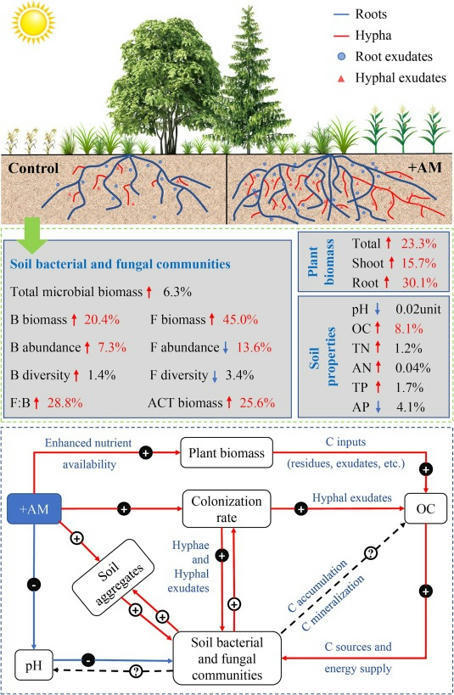
Arbuscular mycorrhizal (AM) fungi exist naturally in most ecosystems and have significant effects on other soil microbes, but how these effects vary across ecosystem types and experimental conditions remains unclear. We compiled a global dataset to identify the responses of soil bacteria and fungi to AM fungal inoculation, and whether these responses vary or are consistent across ecosystem types (cropland, grassland, and forest) and experimental conditions (sterilized vs. non-sterilized soils; mixed vs. single AM fungal inoculation; and field studies vs. greenhouse experiments). Our analysis of the global data showed that AM fungal inoculation increased almost all soil bacterial and fungal parameters examined (1.4–45.0 %), except for fungal abundance which decreased significantly (−13.6 %). Plant, shoot, and root biomass were also increased by 23.3 %, 15.7 %, and 30.1 % after AM fungal inoculation, respectively. Additionally, the effects of AM fungi on most soil bacterial and fungal metrics did not differ significantly among ecosystem types and experimental conditions applied. Changes in pH and soil organic carbon were key factors contributing to the responses of bacteria and fungi. These findings highlight the consistent positive effects of AM fungal inoculation on soil bacteria and fungi across various ecosystem types, which may simplify the prediction of AM fungal functionality and related important ecological processes at large spatial scales. Moreover, the roles of bacteria and fungi in supporting ecosystem functionality may be overestimated without considering the effects of AM fungi. Therefore, the effects of AM fungi on soil bacteria and fungi should be explicitly disentangled when evaluating the roles that bacteria and fungi play in terrestrial ecosystems.
|
|
Scooped by
Jean-Michel Ané
January 18, 2024 4:02 PM
|
In this article, we discuss the Nagoya Protocol and its implications for access and benefit-sharing (ABS) agreements related to genetic resources and biodiversity. We analyze a case study of the appropriation of olotón, a maize variety with an unusual nitrogen-fixing trait grown in many communities throughout Oaxaca and probably beyond that region. Samples of olotón were acquired by scientists affiliated with Mars, Inc., the University of California-Davis, and the University of Wisconsin-Madison. The article unpacks how the olotón ABS agreement with the single Oaxacan community of Totontepec became a topic of controversy despite its approval by the Mexican government under the auspices of the Nagoya Protocol. We pose the question: Is the olotón ABS agreement to be considered “fair and equitable” or could it be an example of the unjust appropriation of genetic resources known as “biopiracy”? To answer that question, we proceed to analyze the “procedural,” “distributive,” “commutative,” and “representational” forms of justice as they apply to the acquisition of olotón. The Nagoya Protocol was created in part to impede biopiracy by providing a framework for acquiring and using biodiversity in a “fair and equitable” way, but the Nagoya Protocol’s provisions are ambiguous and allow for confidentiality clauses that favor the acquisition of genetic materials in ways that we do not consider fair and equitable. We join other researchers and academics who cite the need for an improved approach for ethically accessing, using, and sharing genetic resources and knowledge.
|
|
Scooped by
Jean-Michel Ané
January 10, 2024 12:43 PM
|
Phosphorus (P) for carbon (C) exchange is the pivotal function of arbuscular mycorrhiza (AM), but how this exchange varies with soil P availability and among co-occurring plants in complex communities is still largely unknown.
We collected intact plant communities in two regions differing c. 10-fold in labile inorganic P. After a 2-month glasshouse incubation, we measured 32P transfer from AM fungi (AMF) to shoots and 13C transfer from shoots to AMF using an AMF-specific fatty acid. AMF communities were assessed using molecular methods.
AMF delivered a larger proportion of total shoot P in communities from high-P soils despite similar 13C allocation to AMF in roots and soil. Within communities, 13C concentration in AMF was consistently higher in grass than in blanketflower (Gaillardia aristata Pursh) roots, that is P appeared more costly for grasses. This coincided with differences in AMF taxa composition and a trend of more vesicles (storage structures) but fewer arbuscules (exchange structures) in grass roots. Additionally, 32P-for-13C exchange ratios increased with soil P for blanketflower but not grasses.
Contrary to predictions, AMF transferred proportionally more P to plants in communities from high-P soils. However, the 32P-for-13C exchange differed among co-occurring plants, suggesting differential regulation of the AM symbiosis.
|
|
Scooped by
Jean-Michel Ané
January 10, 2024 12:36 PM
|
During drought, plants allocate resources to aboveground biomass production and belowground carbohydrate reserves, often at the expense of production of defence traits. Additionally, drought has been shown to alter floral resources, with potential implications for plant–pollinator interactions. Although soil symbionts, such as arbuscular mycorrhizal (AM) fungi, can alleviate drought stress in plants, certain levels of drought may negatively impact this relationship, with potential cascading effects.
Because of their importance to plant and animal community diversity, we examined effects of drought on biomass production, physical defence properties, nectar production, and associated AM fungal abundance of five common prairie forb species in a greenhouse study.
Reduced soil moisture decreased vegetative biomass production. Production of trichomes and latex decreased under drought, relative to well-watered conditions. Ruellia humilis flowers produced less nectar under drought, relative to well-watered conditions. Intra-radical AM fungal colonization was not significantly affected by drought, although extra-radical AM fungal biomass associated with S. azurea decreased following drought.
Overall, grassland forb productivity, defence, and nectar production were negatively impacted by moderate drought, with possible negative implications for biotic interactions. Reduced flower and nectar production may lead to fewer pollinator visitors, which may contribute to seed limitation in forb species. Reduced physical defences increase the likelihood of herbivory, further decreasing the ability to store energy for essential functions, such as reproduction. Together, these results suggest drought can potentially impact biotic interactions between plants and herbivores, pollinators, and soil symbionts, and highlights the need for direct assessments of these relationships under climate change scenarios.
|
|
Scooped by
Jean-Michel Ané
January 10, 2024 12:31 PM
|
The use of plant-associated microorganisms is increasingly being investigated as a key tool for mitigating the impact of biotic and abiotic threats to crops and facilitating migration to sustainable agricultural practices. The microbiome is responsible for several functions in agroecosystems, such as the transformation of organic matter, nutrient cycling, and plant/pathogen growth regulation. As climate change and global warming are altering the dynamics of plant-microbial interactions in the ecosystem, it has become essential to perform comprehensive studies to decipher current and future microbial interactions, as their useful symbiotic mechanisms could be better exploited to achieve sustainable agriculture. This will allow for the development of effective microbial inoculants that facilitate nutrient supply for the plant at its minimal energy expense, thus increasing its resilience to biotic and abiotic stresses. This article collection aims to compile state-of-the-art research focused on the elucidation and optimization of symbiotic relationships between crops and their associated microbes. The information presented here will contribute to the development of next-generation microbial inoculants for achieving a more sustainable agriculture.
|
|
Scooped by
Jean-Michel Ané
January 4, 2024 4:52 PM
|
The phoD-harboring bacterial community is responsible for organic phosphorus (P) mineralization in soil and is important for understanding the interactions between arbuscular mycorrhizal (AM) fungi and phosphate-solubilizing bacteria (PSB) at the community level for organic P turnover. However, current understanding of the phoD-harboring bacterial community associated with AM fungal hyphae responses to organic P levels remains incomplete. Here, two-compartment microcosms were used to explore the response of the phoD-harboring bacterial community in the hyphosphere to organic P levels by high-throughput sequencing. Extraradical hyphae of Funneliformis mosseae enriched the phoD-harboring bacterial community and organic P levels significantly altered the composition of the phoD-harboring bacterial community in the Funneliformis mosseae hyphosphere. The relative abundance of dominant families Pseudomonadaceae and Burkholderiaceae was significantly different among organic P treatments and were positively correlated with alkaline phosphatase activity and available P concentration in the hyphosphere. Furthermore, phytin addition significantly decreased the abundance of the phoD gene, and the latter was significantly and negatively correlated with available P concentration. These findings not only improve the understanding of how organic P influences the phoD-harboring bacterial community but also provide a new insight into AM fungus-PSB interactions at the community level to drive organic P turnover in soil.
|
|
Scooped by
Jean-Michel Ané
January 3, 2024 3:04 PM
|
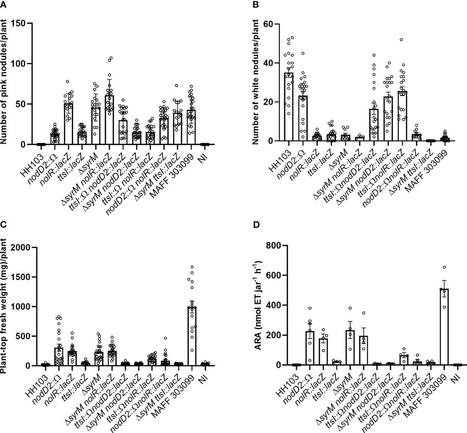
Introduction: The establishment of the rhizobium-legume nitrogen-fixing symbiosis relies on the interchange of molecular signals between the two symbionts. We have previously studied by RNA-seq the effect of the symbiotic regulators NodD1, SyrM, and TtsI on the expression of the symbiotic genes (the nod regulon) of Sinorhizobium fredii HH103 upon treatment with the isoflavone genistein. In this work we have further investigated this regulatory network by incorporating new RNA-seq data of HH103 mutants in two other regulatory genes, nodD2 and nolR. Both genes code for global regulators with a predominant repressor effect on the nod regulon, although NodD2 acts as an activator of a small number of HH103 symbiotic genes.
Methods: By combining RNA-seq data, qPCR experiments, and b-galactosidase assays of HH103 mutants harbouring a lacZ gene inserted into a regulatory gene, we have analysed the regulatory relations between the nodD1, nodD2, nolR, syrM, and ttsI genes, confirming previous data and discovering previously unknown relations.
Results and discussion: Previously we showed that HH103 mutants in the nodD2, nolR, syrM, or ttsI genes gain effective nodulation with Lotus japonicus, a model legume, although with different symbiotic performances. Here we show that the combinations of mutations in these genes led, in most cases, to a decrease in symbiotic effectiveness, although all of them retained the ability to induce the formation of nitrogen-fixing nodules. In fact, the nodD2, nolR, and syrM single and double mutants share a set of Nod factors, either overproduced by them or not generated by the wild-type strain, that might be responsible for gaining effective nodulation with L. japonicus.
|
|
Scooped by
Jean-Michel Ané
January 2, 2024 12:07 PM
|
It is well understood that agricultural management influences arbuscular mycorrhizal (AM) fungi, but there is controversy about whether farmers should manage for AM symbiosis.
We assessed AM fungal communities colonizing wheat roots for three consecutive years in a long-term (> 14 yr) tillage and fertilization experiment. Relationships among mycorrhizas, crop performance, and soil ecosystem functions were quantified.
Tillage, fertilizers and continuous monoculture all reduced AM fungal richness and shifted community composition toward dominance of a few ruderal taxa. Rhizophagus and Dominikia were depressed by tillage and/or fertilization, and their abundances as well as AM fungal richness correlated positively with soil aggregate stability and nutrient cycling functions across all or no-tilled samples. In the field, wheat yield was unrelated to AM fungal abundance and correlated negatively with AM fungal richness. In a complementary glasshouse study, wheat biomass was enhanced by soil inoculum from unfertilized, no-till plots while neutral to depressed growth was observed in wheat inoculated with soils from fertilized and conventionally tilled plots.
This study demonstrates contrasting impacts of low-input and conventional agricultural practices on AM symbiosis and highlights the importance of considering both crop yield and soil ecosystem functions when managing mycorrhizas for more sustainable agroecosystems.
|
|
Scooped by
Jean-Michel Ané
January 2, 2024 11:58 AM
|
WOX family transcription factors are well-known regulators of plant development, controlling cell proliferation and differentiation in diverse organs and tissues. Several WOX genes have been shown to participate in regeneration processes which take place in plant cell cultures in vitro, but the effects of most of them on tissue culture development have not been discovered yet. In this study, we evaluated the effects of MtWOX2 gene overexpression on the embryogenic callus development and transcriptomic state in Medicago truncatula. According to our results, overexpression of MtWOX2 leads to an increase in callus weight. Furthermore, transcriptomic changes in MtWOX2 overexpressing calli are, to a large extent, opposite to the changes caused by overexpression of MtWOX9-1, a somatic embryogenesis stimulator. These results add new information about the mechanisms of interaction between different WOX genes and can be useful for the search of new regeneration regulators.
|
|
Scooped by
Jean-Michel Ané
December 24, 2023 7:16 PM
|
Cross-kingdom RNA interference (ckRNAi), the bidirectional communication between microbes and their host counterparts, is a key element in the outcome of host colonization. Whether mutualistic fungi of the Serendipitaceae family with their broad host range use small RNA effectors (sRNAs) to colonize plant roots is still under debate. To investigate if ckRNAi is a factor in the symbiosis of Serendipita indica (Si) with Arabidopsis thaliana (Ath), we established a pipeline to validate expression, translocation and post-transcriptional gene silencing of host genes by Si-derived sRNAs (SisRNAs). First, we confirmed the expression of SisRNAs both in axenic fungal culture and during Ath root colonization using stem-loop PCR. Then, to verify the translocation of putative SisRNA effectors, an ARGONAUTE 1 immuno-purification assay (AtAGO1-IP) was employed, detecting fungal SisRNAs being loaded into the plant RNAi machinery in Si-colonised roots. Subsequently, SisRNAs and artificial sRNAs (amiRNAs), were transiently expressed in Ath protoplasts to test their gene silencing activity. Stem-loop PCR confirmed expression of sRNA effectors and qPCR validated post-transcriptional gene silencing of their predicted target genes involved in cell wall organization, hormonal signalling regulation, plant immunity and gene expression. Moreover, 5’-RLM-RACE analysis revealed amiRNA-mediated canonical cleavage in Arabidopsis targets. In conclusion, this study provides a blueprint for rapid selection and analysis of sRNA effectors in plant-microbe interactions in general and suggests cross-kingdom communication in the Sebacinoid symbiosis.
|
|
Scooped by
Jean-Michel Ané
December 23, 2023 6:22 PM
|
Arbuscular mycorrhizal (AM) symbiosis is a mutualistic interaction between fungi and most land plants that is underpinned by a bidirectional exchange of nutrients. AM development is a tightly regulated process that encompasses molecular communication for reciprocal recognition, fungal accommodation in root tissues and activation of symbiotic function. As such, a complex network of transcriptional regulation and molecular signaling underlies the cellular and metabolic reprogramming of host cells upon AM fungal colonization. In addition to transcription factors, small RNAs (sRNAs) are emerging as important regulators embedded in the gene network that orchestrates AM development. In addition to controlling cell-autonomous processes, plant sRNAs also function as mobile signals capable of moving to different organs and even to different plants or organisms that interact with plants. AM fungi also produce sRNAs; however, their function in the AM symbiosis remains largely unknown. Here, we discuss the contribution of host sRNAs in the development of AM symbiosis by considering their role in the transcriptional reprogramming of AM fungal colonized cells. We also describe the characteristics of AM fungal-derived sRNAs and emerging evidence for the bidirectional transfer of functional sRNAs between the two partners to mutually modulate gene expression and control the symbiosis.
|
|
Scooped by
Jean-Michel Ané
December 18, 2023 12:55 PM
|
Latest paper from our lab on nitrogen fixation in #sorghum in collaboration with Wilfred Vermerris @UF and funded by @ENERGY Plant breeding and genetics play a major role in the adaptation of plants to meet human needs. The current requirement to make agriculture more sustainable can be partly met by a greater reliance on biological nitrogen fixation (BNF) by symbiotic diazotrophic microorganisms that provide crop plants with ammonium. Select accessions of the cereal crop sorghum (Sorghum bicolor (L.) Moench) form mucilage-producing aerial roots that harbor nitrogen-fixing bacteria. Breeding programs aimed at developing sorghum varieties that support diazotrophs will benefit from a detailed understanding of the genetic and environmental factors contributing to aerial root formation. A genome-wide association study (GWAS) of the sorghum minicore, a collection of 242 landraces, and 30 accessions from the sorghum association panel (SAP) was conducted in Florida and Wisconsin and under two fertilizer treatments to identify loci associated with the number of nodes with aerial roots and aerial root diameter. Sequence variation in genes encoding transcription factors that control phytohormone signaling and root system architecture showed significant associations with these traits. In addition, the location had a significant effect on the phenotypes. Concurrently, we developed F2 populations from crosses between bioenergy sorghums and a landrace that produced extensive aerial roots to evaluate the mode of inheritance of the loci identified by the GWAS. Furthermore, the mucilage collected from aerial roots contained polysaccharides rich in galactose, arabinose, and fucose, whose composition displayed minimal variation among 10 genotypes and two fertilizer treatments. These combined results support the development of sorghums with the ability to acquire nitrogen via BNF.
|


 Scoop.it!