The ability of As-resistant endophytic bacteria in As transformation and plant growth promotion was determined. The endophytes were isolated from As-hyperaccumulator Pteris vittata (PV) after growing for 60 d in a soil containing 200 mg kg−1 arsenate (AsV). They were isolated in presence of 10 mM AsV from PV roots, stems, and leaflets, representing 4 phyla and 17 genera. All endophytes showed at least one plant growth promoting characteristics including IAA synthesis, siderophore production and P solubilization. The root endophytes had higher P solubilization ability than the leaflet (60.0 vs. 18.3 mg L−1). In presence of 10 mM AsV, 6 endophytes had greater growth than the control, suggesting As-stimulated growth. Furthermore, root endophytes were more resistant to AsV while the leaflet endophytes were more tolerant to arsenite (AsIII), which corresponded to the dominant As species in PV tissues. Bacterial As resistance was positively correlated to their ability in AsV reduction but not AsIII oxidation. The roles of those endophytes in promoting plant growth and As resistance in P. vittata warrant further investigation.
The ecological and physiological significances of orchid mycorrhizae (OM) are well documented. However, very little is known about the molecular regulation of these associations, especially for adult green orchids. The equilibrative nucleoside transporters (ENTs) contains a group of newly characterized active proteins which may involve in nucleoside and nucleoside-type cytokinin transport, and H+-ATPases are considered to be essential to sustain arbuscular mycorrhizal colonization. In this paper, we studied the expression profiles of three OM-associated candidate genes, one equilibrative nucleoside transporter 3-like gene (CyENT3) and two H+-ATPase-like genes (CyHA1 and CyHA2). The transcript levels for CyENT3 increased gradually after 6 dpi and reached a significant peak at 15 dpi when treated with mycorrhizal fungi compared to that of mock-inoculated control and non-mycorrhizal fungi (NMF) treatment. The expression of CyHA1 and CyHA2 was also significantly up-regulated in Cymbidium roots in response to mycorrhizal fungi at 15 and 20 dpi. The highest transcript levels of these three genes were synchronized with the time point of active peloton formation in orchid mycorrhizae. The full length cDNA of CyENT3 is 1642 bp long with an ORF of 1254 bp encoding a 418 amino acid polypeptide which shows the highest similarity (70%) to AtENT3 from Arabidopsis. The CyENT3 protein is further localized at plasma membrane. Our results revealed that the CyENT3 was membrane bound protein and probably a proton-coupled transporter. The data also suggest a potential role of the CyENT3 in meeting the drastically increased demands for nucleosides in OM formation.
The goal of this work is to study the evolution and the degree of horizontal gene transfer (HGT) within rhizobial genera of both Alphaproteobacteria (Mesorhizobium, Rhizobium) and Betaproteobacteria (Burkholderia), originating from South African Fynbos legumes. By using a phylogenetic approach and comparing multiple chromosomal and symbiosis genes, we revealed conclusive evidence of high degrees of horizontal transfer of nodulation genes among closely related species of both groups of rhizobia, but also among species with distant genetic backgrounds (Rhizobium and Mesorhizobium), underscoring the importance of lateral transfer of symbiosis traits as an important evolutionary force among rhizobia of the Cape Fynbos biome. The extensive exchange of symbiosis genes in the Fynbos is in contrast with a lack of significant events of HGT among Burkholderia symbionts from the South American Cerrado and Caatinga biome. Furthermore, homologous recombination among selected housekeeping genes had a substantial impact on sequence evolution within Burkholderia and Mesorhizobium. Finally, phylogenetic analyses of the non-symbiosis acdS gene in Mesorhizobium, a gene often located on symbiosis islands, revealed distinct relationships compared to the chromosomal and symbiosis genes, suggesting a different evolutionary history and independent events of gene transfer. The observed events of HGT and incongruence between different genes necessitate caution in interpreting topologies from individual data types.
Step-by-step walk through of planting inoculated soybean seeds with the purpose of initiating a symbiotic relationship between the soybean and Bradyrhizobium...
Experimental studies show that plant root morphologies can vary widely from straight gravity-aligned primary roots to fractal-like root architectures. However, the opaqueness of soil makes it difficult to observe how environmental factors modulate these patterns. Here, we combine a transparent hydrogel growth medium with a custom built 3D laser scanner to directly image the morphology of Medicago truncatula primary roots. In our experiments, root growth is obstructed by an inclined plane in the growth medium. As the tilt of this rigid barrier is varied, we find Medicago transitions between randomly directed root coiling, sinusoidal root waving, and normal gravity-aligned morphologies. Although these root phenotypes appear morphologically distinct, our analysis demonstrates the divisions are less well defined, and instead, can be viewed as a 2D biased random walk that seeks the path of steepest decent along the inclined plane. Features of this growth response are remarkably similar to the widely known run-and-tumble chemotactic behavior of Escherichia coli bacteria, where biased random walks are used as optimal strategies for nutrient uptake.
The phylogeny of symbiotic genes of Astragalus glycyphyllos L. (liquorice milkvetch) nodule isolates was studied by comparative sequence analysis of nodA, nodC, nodH and nifH loci. In all these genes phylograms, liquorice milkvetch rhizobia (closely related to bacteria of three species, i.e. Mesorhizobium amorphae, Mesorhizobium septentrionale and Mesorhizobium ciceri) formed one clearly separate cluster suggesting the horizontal transfer of symbiotic genes from a single ancestor to the bacteria being studied. The high sequence similarity of the symbiotic genes of A. glycyphyllos rhizobia (99–100% in the case of nodAC and nifH genes, and 98–99% in the case of nodH one) points to the relatively recent (in evolutionary scale) lateral transfer of these genes. In the nodACH and nifH phylograms, A. glycyphyllos nodule isolates were grouped together with the genus Mesorhizobium species in one monophyletic clade, close to M. ciceri, Mesorhizobium opportunistum and Mesorhizobium australicum symbiovar biserrulae bacteria, which correlates with the close relationship of these rhizobia host plants. Plant tests revealed the narrow host range of A. glycyphyllos rhizobia. They formed effective symbiotic interactions with their native host (A. glycyphyllos) and Amorpha fruticosa but not with 11 other fabacean species. The nodules induced on A. glycyphyllos roots were indeterminate with apical, persistent meristem, an age gradient of nodule tissues and cortical vascular bundles. To reflect the symbiosis-adaptive phenotype of rhizobia, specific for A. glycyphyllos, we propose for these bacteria the new symbiovar “glycyphyllae”, based on nodA and nodC genes sequences.
Signaling pathways mediated by heterotrimeric G-protein complexes comprising Gα, Gβ, and Gγ subunits and their regulatory RGS (Regulator of G-protein Signaling) protein are conserved in all eukaryotes. We have shown that the specific Gβ and Gγ proteins of a soybean (Glycine max) heterotrimeric G-protein complex are involved in regulation of nodulation. We now demonstrate the role of Nod factor receptor 1 (NFR1)-mediated phosphorylation in regulation of the G-protein cycle during nodulation in soybean. We also show that during nodulation, the G-protein cycle is regulated by the activity of RGS proteins. Lower or higher expression of RGS proteins results in fewer or more nodules, respectively. NFR1 interacts with RGS proteins and phosphorylates them. Analysis of phosphorylated RGS protein identifies specific amino acids that, when phosphorylated, result in significantly higher GTPase accelerating activity. These data point to phosphorylation-based regulation of G-protein signaling during nodule development. We propose that active NFR1 receptors phosphorylate and activate RGS proteins, which help maintain the Gα proteins in their inactive, trimeric conformation, resulting in successful nodule development. Alternatively, RGS proteins might also have a direct role in regulating nodulation because overexpression of their phospho-mimic version leads to partial restoration of nodule formation in nod49 mutants.
In disease-suppressive soils, plants are protected from infections by specific root pathogens due to the antagonistic activities of soil and rhizosphere microorganisms. For most disease-suppressive soils, however, the microorganisms and mechanisms involved in pathogen control are largely unknown. Our recent studies identified Actinobacteria as the most dynamic phylum in a soil suppressive to the fungal root pathogen Rhizoctonia solani. Here we isolated and characterized 300 isolates of rhizospheric Actinobacteria from the Rhizoctonia-suppressive soil. Streptomyces species were the most abundant, representing approximately 70% of the isolates. Streptomyces are renowned for the production of an exceptionally large number of secondary metabolites, including volatile organic compounds (VOCs). VOC profiling of 12 representative Streptomyces isolates by SPME-GC-MS allowed a more refined phylogenetic delineation of the Streptomyces isolates than the sequencing of 16S rRNA and the house-keeping genes atpD and recA only. VOCs of several Streptomyces isolates inhibited hyphal growth of R. solani and significantly enhanced plant shoot and root biomass. Coupling of Streptomyces VOC profiles with their effects on fungal growth, pointed to VOCs potentially involved in antifungal activity. Subsequent assays with five synthetic analogs of the identified VOCs showed that methyl 2-methylpentanoate, 1,3,5-trichloro-2-methoxy benzene and the VOCs mixture have antifungal activity. In conclusion, our results point to a potential role of VOC-producing Streptomyces in disease suppressive soils and show that VOC profiling of rhizospheric Streptomyces can be used as a complementary identification tool to construct strain-specific metabolic signatures.
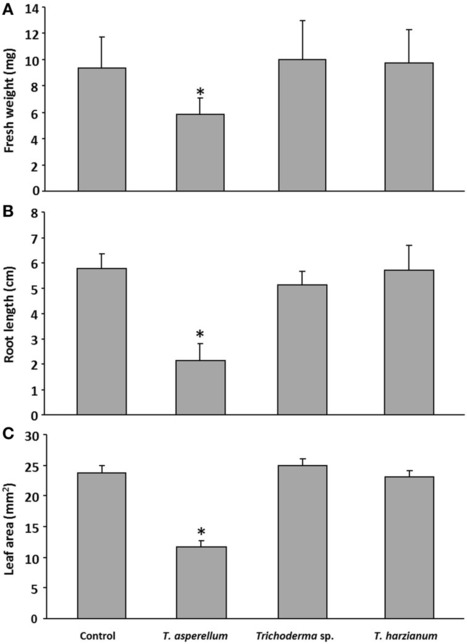
Trichoderma species are present in many ecosystems and some strains have the ability to reduce the severity of plant diseases by activating various defense pathways via specific biologically active signaling molecules. Hence we investigated the effects of low molecular weight volatile compounds of Trichoderma asperellum IsmT5 on Arabidopsis thaliana. During co-cultivation of T. asperellum IsmT5 without physical contact to A. thaliana we observed smaller but vital and robust plants. The exposed plants exhibit increased trichome numbers, accumulation of defense-related compounds such as H2O2, anthocyanin, camalexin, and increased expression of defense-related genes. We conclude that A. thaliana perceives the Trichoderma volatiles as stress compounds and subsequently initiates multilayered adaptations including activation of signaling cascades to withstand this environmental influence. The prominent headspace volatile of T. asperellum IsmT5 was identified to be 6-pentyl-α-pyrone (6PP), which was solely applied to A. thaliana to verify the growth and defense reactions. Most noticeable is that A. thaliana preexposed to 6PP showed significantly reduced symptoms when challenged with Botrytis cinerea and Alternaria brassicicola, indicating that defense-activated plants subsequently became more resistant to pathogen attack. Together, these results support that products that are based on Trichoderma volatiles have the potential being a useful biocontrol agent in agriculture.
The bacterial microbiota of plants is diverse, with 1000s of operational taxonomic units (OTUs) associated with any individual plant. In this work, we used phenotypic analysis, comparative genomics, and metabolic models to investigate the differences between 19 sequenced Pseudomonas fluorescens strains. These isolates represent a single OTU and were collected from the rhizosphere and endosphere of Populus deltoides. While no traits were exclusive to either endosphere or rhizosphere P. fluorescens isolates, multiple pathways relevant for plant-bacterial interactions are enriched in endosphere isolate genomes. Further, growth phenotypes such as phosphate solubilization, protease activity, denitrification and root growth promotion are biased toward endosphere isolates. Endosphere isolates have significantly more metabolic pathways for plant signaling compounds and an increased metabolic range that includes utilization of energy rich nucleotides and sugars, consistent with endosphere colonization. Rhizosphere P. fluorescens have fewer pathways representative of plant-bacterial interactions but show metabolic bias toward chemical substrates often found in root exudates. This work reveals the diverse functions that may contribute to colonization of the endosphere by bacteria and are enriched among closely related isolates.
A recent perspective article ably argued that fully sequencing more algal genomes would enable progress in diverse areas of fundamental and applied studies. More algal genomes would add resources needed to build well-supported phylogenies, improve our understanding of how horizontal gene transfer has influenced the evolution of algal genomes, provide useful ecological insights, and generate information essential to manipulating the genomes of industrially useful algae (J. Phycol. 51:1). We agree that more algal genomes would be quite beneficial, and also propose that more algal metagenomes would enable progress in both predictable and unforeseen directions.
Do you need the inoculants and if so, what kind should you use? How do you know if there is a shortage of these microorganisms that get grab free nitrogen from the air and add it to your soils? Progressive retailers and growers are always trying to enhance their yields and profitability. Here are six key considerations for helping them decide on whether soybean inoculants make sense.
The aim of present study was to examine the effect of arbuscular mycorrhizal fungi (AMF) on the growth, lipid peroxidation, antioxidant enzyme activity and some key physio-biochemical attributes in cowpea (Vigna unguiculata [L.] Walp.) subjected to salt stress. Salt stress (200 mM NaCl) reduced growth, biomass, relative water content and chlorophyll pigment content in cowpea leaves. AMF ameliorated the negative impact of salinity on the growth parameters studied. The activity of antioxidant enzymes such as superoxide dismutase (SOD), catalase (CAT), ascorbate peroxidase (APX), peroxidase (POD) and glutathione reductase (GR) enhanced under salt stress and AMF inoculation further enhanced their activity, thus strengthening the plant’s defense system. Proline content increased in salt stressed plants as well as AMF-inoculated plants providing efficient protection against salt stress. Besides this AMF also increased uptake of mineral elements which have direct impact on the osmoregulation of the plants. The present study shows that AMF possesses the potential to enhance salt tolerance of cowpea.
A better understanding of how bacteria resist stresses encountered during the progression of plant-microbe symbioses will advance our ability to stimulate plant growth. Here, we show that the symbiotic system comprising the nitrogen-fixing bacterium Bradyrhizobium diazoefficiens and the legume Aeschynomene afraspera requires hopanoid production for optimal fitness. While methylated (2Me) hopanoids contribute to growth under plant-cell-like microaerobic and acidic conditions in the free-living state, they are dispensable during symbiosis. In contrast, synthesis of extended (C35) hopanoids is required for growth microaerobically and under various stress conditions (high temperature, low pH, high osmolarity, bile salts, oxidative stress, and antimicrobial peptides) in the free-living state and also during symbiosis. These defects might be due to a less rigid membrane resulting from the absence of free or lipidA-bound C35 hopanoids or the accumulation of the C30 hopanoid diploptene. Our results also show that C35 hopanoids are necessary for symbiosis only with the host Aeschynomene afraspera but not with soybean. This difference is likely related to the presence of cysteine-rich antimicrobial peptides in Aeschynomene nodules that induce drastic modification in bacterial morphology and physiology. The study of hopanoid mutants in plant symbionts thus provides an opportunity to gain insight into host-microbe interactions during later stages of symbiotic progression, as well as the microenvironmental conditions for which hopanoids provide a fitness advantage.
In recent years, the term plant microbiome inhabiting the root interior of healthy plants, as well as the rhizosphere, has received substantial attention, since it influences nutrient availability, plant growth promotion and disease suppression. The community structure and diversity of plant-associated microbiome is well characterized in modern systems such as Arabidopsis, maize and rice using deep rRNA gene sequencing techniques. Increasing evidence indicates that composition of root exudates secreted by host plants can shape the soil microbiome. The molecular communication fluctuates according to the plant genotype, plant development stage, biotic/abiotic stress, proximity to neighbouring species, management techniques and many other factors which may shape the rhizospheric microbiome. Plants secretes blends of organic compounds that are differentially produced at distinct stages of development to help orchestrate rhizosphere microbiome assemblage. A comprehensive understanding of the mechanisms that govern selection and activity of microbial communities by plant roots will provide new opportunities to increase crop production. Hence, this chapter focuses mainly on existing knowledge based on the root microbiome, its functional importance and potential influence of host plant to the establishment of its rhizospheric associates.
Most eukaryotic organisms produce different classes of endogenous small RNA (esRNA) molecules that suppress gene expression through RNA interference (RNAi) pathways. These pathways, which may differ among organisms, are normally involved in genome defense, heterochromatin formation and regulation of genes involved in multiple cellular functions. In the basal fungus Mucor circinelloides, an opportunistic human pathogen, we previously demonstrated that biogenesis of a large group of esRNA molecules requires a basic RNAi machinery consisting of a Dicer-like protein, an Argonaute nuclease and two RNA-dependent RNA polymerases. This canonical dicer-dependent pathway regulates different cellular processes, such as vegetative sporulation. Besides those esRNAs generated by this canonical RNAi pathway, we have identified a new rdrp-dependent dicer-independent esRNA class. These esRNAs are produced by a degradation pathway in which the RdRP proteins signal specific transcripts that will be degraded by a newly identified RNase. This RNase, named R3B2, presents unique domain architecture, can only be found in basal fungi and it is also involved in the canonical dicer-dependent RNAi pathway. Our results expand the role of RdRPs in gene silencing and reveal the involvement of these proteins in a new RNA degradation process that could represent the first step in the evolution of RNAi.
A better understanding of how bacteria resist stresses encountered during the progression of plant-microbe symbioses will advance our ability to stimulate plant growth. Here, we show that the symbiotic system comprising the nitrogen-fixing bacterium Bradyrhizobium diazoefficiens and the legume Aeschynomene afraspera requires hopanoid production for optimal fitness. While methylated (2Me) hopanoids contribute to growth under plant-cell-like microaerobic and acidic conditions in the free-living state, they are dispensable during symbiosis. In contrast, synthesis of extended (C35) hopanoids is required for growth microaerobically and under various stress conditions (high temperature, low pH, high osmolarity, bile salts, oxidative stress, and antimicrobial peptides) in the free-living state and also during symbiosis. These defects might be due to a less rigid membrane resulting from the absence of free or lipidA-bound C35 hopanoids or the accumulation of the C30 hopanoid diploptene. Our results also show that C35 hopanoids are necessary for symbiosis only with the host Aeschynomene afraspera but not with soybean. This difference is likely related to the presence of cysteine-rich antimicrobial peptides in Aeschynomene nodules that induce drastic modification in bacterial morphology and physiology. The study of hopanoid mutants in plant symbionts thus provides an opportunity to gain insight into host-microbe interactions during later stages of symbiotic progression, as well as the microenvironmental conditions for which hopanoids provide a fitness advantage.
IMPORTANCE Because bradyrhizobia provide fixed nitrogen to plants, this work has potential agronomical implications. An understanding of how hopanoids facilitate bacterial survival in soils and plant hosts may aid the engineering of more robust agronomic strains, especially relevant in regions that are becoming warmer and saline due to climate change. Moreover, this work has geobiological relevance: hopanes, molecular fossils of hopanoids, are enriched in ancient sedimentary rocks at discrete intervals in Earth history. This is the first study to uncover roles for 2Me- and C35 hopanoids in the context of an ecological niche that captures many of the stressful environmental conditions thought to be important during (2Me)-hopane deposition. Though much remains to be done to determine whether the conditions present within the plant host are shared with niches of relevance to the rock record, our findings represent an important step toward identifying conserved mechanisms whereby hopanoids contribute to fitness.
In plants and fungi, energetics at the plasma membrane is provided by a large protonmotive force (PMF) generated by the family of P-type ATPases specialized for proton transport (commonly called PM H+-ATPases or, in Arabidopsis, AHAs for Arabidopsis H+-ATPases). Studies have demonstrated that this 100-kDa protein is essential for plant growth and development. Posttranslational modifications of the H+-ATPase play crucial roles in its regulation. Phosphorylation of several Thr and Ser residues within the carboxy terminal regulatory domain composed of ∼100 amino acids change in response to environmental stimuli, endogenous hormones, and nutrient conditions. Recently developed mass spectrometric technologies provide a means to carefully quantify these changes in H+-ATPase phosphorylation at the different sites. These chemical modifications can then be genetically tested in planta by complementing the loss-of-function aha mutants with phosphomimetic mutations. Interestingly, recent data suggest that phosphatase-mediated changes in PM H+-ATPase phosphorylation are important in mediating auxin-regulated growth. Thus, as with another hormone (abscisic acid), dephosphorylation by phosphatases, rather than kinase mediated phosphorylation, may be an important focal point for regulation during plant signal transduction. Although interactions with other proteins have also been implicated in ATPase regulation, the very hydrophobic nature and high concentration of this polytopic protein presents special challenges in evaluating the biological significance of these interactions. Only by combining biochemical and genetic experiments can we attempt to meet these challenges to understand the essential molecular details by which this protein functions in planta.
The Alphaproteobacterium Rhizobium radiobacter F4 (RrF4) was originally characterized as an endofungal bacterium in the beneficial endophytic Sebacinalean fungus Piriformospora indica. Although attempts to cure P. indica from RrF4 repeatedly failed, the bacterium can easily be grown in pure culture. Here, we report on RrF4’s genome and the beneficial impact the free-living bacterium has on plants. In contrast to other endofungal bacteria, the genome size of RrF4 is not reduced. Instead, it shows a high degree of similarity to the plant pathogenic R. radiobacter (formerly: Agrobacterium tumefaciens) C58, except vibrant differences in both the tumor-inducing (pTi) and the accessor (pAt) plasmids, which can explain the loss of RrF4’s pathogenicity. Similar to its fungal host, RrF4 colonizes plant roots without host preference and forms aggregates of attached cells and dense biofilms at the root surface of maturation zones. RrF4-colonized plants show increased biomass and enhanced resistance against bacterial leaf pathogens. Mutational analysis showed that, similar to P. indica, resistance mediated by RrF4 was dependent on the plant’s jasmonate-based induced systemic resistance (ISR) pathway. Consistent with this, RrF4- and P. indica-induced pattern of defense gene expression were similar. In clear contrast to P. indica, but similar to plant growth-promoting rhizobacteria, RrF4 colonized not only the root outer cortex but also spread beyond the endodermis into the stele. On the basis of our findings, RrF4 is an efficient plant growth-promoting bacterium.
As is the case with other multicellular eukaryotes, plants are colonized by large numbers of unicellular microorganisms. They may be free-living commensals, epiphytes, symbionts (endophytes), or obligate parasites. The plant holobiont is in effect an ecosystem, and it is of interest to know how this assemblage is established and maintained, and reacts to both biotic and abiotic cues. The current view, initially elaborated in the context of coral-dwelling microbial communites, is that the multicellular organism is more inclusively described by the term “holobiont” that includes associated microbiota, and is a valid unit of natural selection (Rosenberg et al., 2007). The holobiont then, is often dependent on its microbiota for crucial functions, drastic imbalances in which, termed dysbiosis, are thought to lead to compromised or deficient functioning.
The association of plants with microbes is phylogenetically ancient, going back to the macroalgae (Marshall et al., 2006). The role of the microbiota of plants, collectively termed the “phytomicrobiome,” in their overall life cycle is now under investigation, close on the heels of more extensive studies on animal, especially human, microbiota. The development of Arabidopsis thaliana (thale cress) and Brachypodium distachyon (purple false brome) as model systems for dicotyledonous and monocotyledonous plants respectively, and the availability of genome databases for Pseudomonads (Winsor et al., 2011) and plants (Duvick et al., 2008) indicate that the potential for both hypothesis-based and discovery science are indeed great.
The assembly, development and maintenance of the plant holobiont is not possible without an exchange and sensing of, and responses to, biomolecular cues between its constituents. Within this overall theme, we focus on a few recently discovered, novel inter- and intra-species interactions of some Pseudomonas spp., indicating their utility as model systems, and highlighting some previously unforeseen mechanisms that could have a bearing on plant-phytomicrobiome interactions. Note that, for purposes of this article, we use the word “signaling” to refer generically to the sensing and response of organisms to environmental cues of both biotic and abiotic origins.
Several plant growth-promoting rhizobacteria (PGPR) are known to improve plant tolerance to multiple stresses, including low temperatures. However, mechanisms underlying this protection are still poorly understood. The aim of this study was to evaluate the role of the endophytic PGPR, Burkholderia phytofirmans strain PsJN (Bp PsJN), on Arabidopsis thaliana cold tolerance using photosynthesis parameters as physiological markers. Under standard conditions, our results indicated that Bp PsJN inoculation led to growth promotion of Arabidopsis plants without significant modification on photosynthesis parameters and chloroplast organization. However, bacterial colonization induced a cell wall strengthening in the mesophyll. Impact of inoculation modes (either on seeds or by soil irrigation) and their effects overnight at 0, -1, or -3°C, were investigated by following photosystem II (PSII) activity and gas exchanges. Following low temperatures stress, a decrease of photosynthesis parameters was observed. In addition, during three consecutive nights or days at -1°C, PSII activity was monitored. Pigment contents, RuBisCO protein abundance, expression of several genes including RbcS, RbcL, CBF1, CBF2, CBF3, ICE1, COR15a, and COR78 were evaluated at the end of exposure. To assess the impact of the bacteria on cell ultrastructure under low temperatures, microscopic observations were achieved. Results indicated that freezing treatment induced significant changes in PSII activity as early as the first cold day, whereas the same impact on PSII activity was observed only during the third cold night. The significant effects conferred by PsJN were differential accumulation of pigments, and reduced expression of RbcL and COR78. Microscopical observations showed an alteration/disorganization in A. thaliana leaf mesophyll cells independently of the freezing treatments. The presence of bacteria during the three successive nights or days did not significantly improved A. thaliana responses but prevented the plasmalemma disruption under freezing stress.
Plant roots, their associated microbial community and free-living soil microbes interact to regulate the movement of carbon from the soil to the atmosphere, one of the most important and least understood fluxes of terrestrial carbon. Our inadequate understanding of how plant–microbial interactions alter soil carbon decomposition may lead to poor model predictions of terrestrial carbon feedbacks to the atmosphere. Roots, mycorrhizal fungi and free-living soil microbes can alter soil carbon decomposition through exudation of carbon into soil. Exudates of simple carbon compounds can increase microbial activity because microbes are typically carbon limited. When both roots and mycorrhizal fungi are present in the soil, they may additively increase carbon decomposition. However, when mycorrhizas are isolated from roots, they may limit soil carbon decomposition by competing with free-living decomposers for resources. We manipulated the access of roots and mycorrhizal fungi to soil in situ in a temperate mixed deciduous forest. We added 13C-labelled substrate to trace metabolized carbon in respiration and measured carbon-degrading microbial extracellular enzyme activity and soil carbon pools. We used our data in a mechanistic soil carbon decomposition model to simulate and compare the effects of root and mycorrhizal fungal presence on soil carbon dynamics over longer time periods. Contrary to what we predicted, root and mycorrhizal biomass did not interact to additively increase microbial activity and soil carbon degradation. The metabolism of 13C-labelled starch was highest when root biomass was high and mycorrhizal biomass was low. These results suggest that mycorrhizas may negatively interact with the free-living microbial community to influence soil carbon dynamics, a hypothesis supported by our enzyme results. Our steady-state model simulations suggested that root presence increased mineral-associated and particulate organic carbon pools, while mycorrhizal fungal presence had a greater influence on particulate than mineral-associated organic carbon pools. Synthesis. Our results suggest that the activity of enzymes involved in organic matter decomposition was contingent upon root–mycorrhizal–microbial interactions. Using our experimental data in a decomposition simulation model, we show that root–mycorrhizal–microbial interactions may have longer-term legacy effects on soil carbon sequestration. Overall, our study suggests that roots stimulate microbial activity in the short term, but contribute to soil carbon storage over longer periods of time.
While arbuscular mycorrhizal fungi improve plant performance they demand large shares of the plant's assimilated carbon, therefore resource allocation trade-offs may drive the commonly observed sexual dimorphism in mycorrhizal colonization in dioecious species. Here we looked for evidence of the evolutionary reduction of mycorrhizal colonization in males of 15 tropical rain forest plants including palms (Chamaedorea) and trees, light-demanding and shade-tolerant species. For none of the analyzed species there was evidence of spatial segregation of the sexes. Most of the tree species had no seasonal variability in mycorrhizal colonization and males had lower mycorrhizal colonization than females in over 70% of the tree species. In contrast, there were no differences between the sexes of the Chamaedorea species. Chamaedorea species had ticker roots and lower specific root length than trees, and seasonal patterns of mycorrhizal colonization correlated with the life-histories of the plants. Based on phylogenetically independent contrast, mycorrhizal colonization of male trees correlated negatively with a metric of sexual differentiation of mycorrhizal colonization between sexes. Our results suggest an evolutionary reduction in the intensity of mycorrhizal interactions in male plants, presumably driven by resource allocation trade-offs as the origen of sexual dimorphs in mycorrhizal colonization.
Although it is now well-established that decorated lipo-chitooligosaccharide Nod factors are the key rhizobial signals which initiate infection/nodulation in host legume species, the identity of the equivalent microbial signaling molecules in the Frankia/actinorhizal association remains elusive. With the objective of identifying Frankia symbiotic factors we present a novel approach based on both molecular and cellular pre-infection reporters expressed in the model actinorhizal species Casuarina glauca. By introducing the nuclear-localized cameleon Nup-YC2.1 into Casuarina glauca we show that cell-free culture supernatants of the compatible Frankia CcI3 strain are able to elicit sustained high frequency Ca2+ spiking in host root hairs. Furthermore, an excellent correlation exists between the triggering of nuclear Ca2+ spiking and the transcriptional activation of the ProCgNIN:GFP reporter as a function of the Frankia strain tested. These two pre-infection symbiotic responses have been used in combination to show that the signal molecules present in the Frankia CcI3 supernatant are hydrophilic, of low molecular weight and resistant to chitinase degradation. In conclusion, the biologically active symbiotic signals secreted by Frankia appear to be chemically distinct from the currently known chitin-based rhizobial/arbuscular mycorrhizal signaling molecules. Convenient bioassays in Casuarina glauca are now available for their full characterization.
To get content containing either thought or leadership enter:
To get content containing both thought and leadership enter:
To get content containing the expression thought leadership enter:
You can enter several keywords and you can refine them whenever you want. Our suggestion engine uses more signals but entering a few keywords here will rapidly give you great content to curate.


 Your new post is loading...