Your new post is loading...

|
Scooped by
Jean-Michel Ané
May 29, 2017 10:37 PM
|
The purpose of this study was to evaluate effects of arbuscular mycorrhizal fungi (AMF) on pacara earpod tree (Enterolobium contorstisiliquum) growth and phytoprotection in soil containing coal mining waste. A greenhouse experiment was carried out with three inoculation treatments groups (non-inoculated, inoculated with Rhizophagus clarus and inoculated with Acaulospora colombiana) in two substrates (0 or 30% tailings). After 90 days the seedlings were collected to quantify growth parameters, quality, mycorrhizal root colonization rate and leaf content of chlorophylls and carotenoids. Macronutrients were quantified in the shoots, Cu, Zn, and Mn were measured in the shoots and roots, and glomalin content was measured in the rhizosphere. Colonization by A. colombiana (40%) promoted phytoprotection and better growth in seedlings planted in partial tailing substrate, due to the lower Cu (1.04 mg kg−1) and Zn (13.4 mg kg−1) levels in shoot dry mass and reduced translocation of these elements to the shoots. A. colombiana increased soil glomalin (2.98 mg kg−1) and the accumulation of nutrients necessary for synthesizing chlorophylls and carotenoids in the leaves. Colonization by R. clarus (81%) produced no phytoprotective effects.
|
|
Scooped by
Jean-Michel Ané
May 29, 2017 10:34 PM
|
As a consequence of the importance of crop cultivation in Bioregenerative Life Support System (BLSS), there is a necessity of protecting the plants from pathogenic diseases. Cave soil bacteria can be utilized as a source for isolating biocontrol bacteria that are suitable for plant growth in BLSS. Pseudochrobactrum kiredjianiae strain A4 (GenBank accession KT203923) is a gram-positive, short-rod shaped and whitish bacterium isolated from cave soil, and is culturable at 13 °C. A species-level identification was conducted by 16S rRNA gene sequencing, which showed that this strain had a 98% similarity with sequences of P. kiredjianiae isolated from the public domain. The A4 strain was positive for siderophore, indole-3-acetic acid (IAA) production and 1-aminocyclopropane-1-carboxylate (ACC) deaminase activity. The results of in vitro experiments showed that A4 could inhibit the growth and development of Rhizoctonia cerealis, Fusarium graminearumt, Magnaporthe grisea, Fusarium oxysporum and Botrytis cinerea. Under greenhouse conditions, the bacterium A4 improved the physiological parameters and reduced the defense enzymes activities of wheat (Triticum aestivum L.) in the presence of R. cerealis. Statistical analysis of measured parameters revealed that A4-inoculated wheat plants were positively alleviating pathogenic stress. These results indicate that the isolate A4 provides a promising solution to control plant pathogenic fungi in BLSS.
|
|
Scooped by
Jean-Michel Ané
May 29, 2017 10:28 PM
|
The acquisition of reduced nitrogen (N) is essential for plant life, and plants have developed numerous strategies and symbioses with soil microorganisms to acquire this form of N. The evolutionary history of specific symbiotic relationships of plants with soil bacteria, however, lacks evidence from the fossil record confirming these mutualistic relationships. Here we use modern plants in the N-fixing clade of rosids to develop a geochemical method to assess the presence of symbiotic relationships with N-fixing soil bacteria via δ15N values of tree rings. Application of this method to Oligocene tree rings confirms the symbiosis of certain arborescent legumes with N-fixing soil bacteria. The results suggest actinorhizal symbiosis for some Oligocene non-leguminous trees. The specific age, genera, and presence or absence of bacterial symbiosis of these fossil trees provide new information on genera that have maintained or lost the ability to form symbioses in the N-fixing clade. We envision that this approach, as applied to paleoecology, can lead to greater understanding of the response of plant symbioses under variations in atmospheric chemistry for N-limited ecosystems.
|
|
Scooped by
Jean-Michel Ané
May 29, 2017 9:59 PM
|
The evolution of plastids has a complex and still unresolved history. These organelles originated from a cyanobacterium via primary endosymbiosis, resulting in three eukaryotic lineages: glaucophytes, red algae, and green plants. The red and green algal plastids then spread via eukaryote–eukaryote endosymbioses, known as secondary and tertiary symbioses, to numerous heterotrophic protist lineages. The number of these horizontal plastid transfers, especially in the case of red alga-derived plastids, remains controversial. Some authors argue that the number of plastid origins should be minimal due to perceived difficulties in the transformation of a eukaryotic algal endosymbiont into a multimembrane plastid, but increasingly the available data contradict this argument. I suggest that obstacles in solving this dilemma result from the acceptance of a single evolutionary scenario for the endosymbiont-to-plastid transformation formulated by Cavalier-Smith & Lee (1985). Herein I discuss data that challenge this evolutionary scenario. Moreover, I propose a new model for the origin of multimembrane plastids belonging to the red lineage and apply it to the dinoflagellate peridinin plastid. The new model has several general and practical implications, such as the requirement for a new definition of cell organelles and in the construction of chimeric organisms.
|
|
Scooped by
Jean-Michel Ané
May 29, 2017 9:55 PM
|
Multiple nutrient cycles regulate biological nitrogen (N) fixation in forests, yet long-term feedbacks between N-fixation and coupled element cycles remain largely unexplored. We examined soil nutrients and heterotrophic N-fixation across a gradient of 24 temperate conifer forests shaped by legacies of symbiotic N-fixing trees. We observed positive relationships among mineral soil pools of N, carbon (C), organic molybdenum (Mo), and organic phosphorus (P) across sites, evidence that legacies of symbiotic N-fixing trees can increase the abundance of multiple elements important to heterotrophic N-fixation. Soil N accumulation lowered rates of heterotrophic N-fixation in organic horizons due to both N inhibition of nitrogenase enzymes and declines in soil organic matter quality. Experimental fertilization of organic horizon soil revealed widespread Mo limitation of heterotrophic N-fixation, especially at sites where soil Mo was scarce relative to C. Fertilization also revealed widespread absence of P limitation, consistent with high soil P:Mo ratios. Responses of heterotrophic N-fixation to added Mo (positive) and N (negative) were correlated across sites, evidence that multiple nutrient controls of heterotrophic N-fixation were more common than single-nutrient effects. We propose a conceptual model where symbiotic N-fixation promotes coupled N, C, P, and Mo accumulation in soil, leading to positive feedback that relaxes nutrient limitation of overall N-fixation, though heterotrophic N-fixation is primarily suppressed by strong negative feedback from long-term soil N accumulation.
|
|
Scooped by
Jean-Michel Ané
May 27, 2017 11:16 AM
|
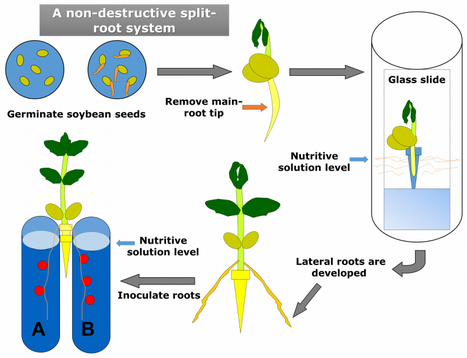
Split-root systems (SRS) constitute an appropriate methodology for studying the relevance of both local and systemic mechanisms that participate in the control of rhizobia-legume symbioses. In fact, this kind of approach allowed to demonstrate the autoregulation of nodulation (AON) systemic response in soybean in the 1980s. In SRS, the plant main root is cut and two lateral roots that emerge from the seedlings after root-tip removal are confined into separate compartments. After several days of growth, these plants have two separate roots that can be inoculated with the same or with different bacteria, at the same or at different times. In this work, we have used a non-destructive SRS to study two different competitiveness relations between rhizobial strains in soybean roots. One of them is the competition for nodulation between two soybean-nodulating rhizobia: the slow-grower Bradyrhizobium japonicum USDA110 and the fast-grower Sinorhizobium fredii HH103. The second is the competitive blocking of S. fredii 257DH4 nodulation in the American soybean Osumi by Sinorhizobium fredii USDA257, which is unable to nodulate American soybeans. Our results showed that the competitiveness relationships studied in this work are mitigated or even avoided when the competitive strains are spatially separated in different compartments containing half-roots from the same plant, suggesting that competitive relations are more related to local plant responses. In our opinion, split-root systems are an appropriate approach to further study competitive relations among rhizobial strains.
|
|
Scooped by
Jean-Michel Ané
May 27, 2017 10:51 AM
|
Little is known about the adaptive capacity of arbuscular mycorrhizal (AM) fungi to novel hosts. Here we assessed the possibility of two heterospecific AM fungal isolates to adaptively change, in terms of host biomass response, as a function of host plant identity, over the course of a growing season. First, we produced pure inocula of Rhizophagus clarus and Rhizophagus intraradices, each starting from a single spore. Second, we “trained” each isolate individually in a community with two plants, sudangrass (Sorgum bicolour subsp. drummondii) and leek (Aliium ampeloprasum var. porrum), using a dual-compartment system to allow the establishment of a common mycorrhizal network between the two hosts. Third, we conducted a greenhouse experiment to reciprocally test each “trained” clone, obtained from each compartment, either with the same (home), or the other host (away) under two contrasting phosphorus levels. Overall, results did not support adaptive responses of the AM fungi to their hosts (i.e., greater host biomass under “home” relative to “away” conditions), but the opposite (i.e., greater host biomass under “away” relative to “home” conditions) was more frequently observed. These changes in AM fungal symbiotic functioning open the possibility for relatively rapid genetic change of arbuscular mycorrhizal fungi in response to new hosts, which represents one step forward from in vitro experiments.
|
|
Scooped by
Jean-Michel Ané
May 27, 2017 9:43 AM
|
The microbial community that is systematically associated with a given host plant is called the core microbiota. The definition of the core microbiota was so far based on its taxonomic composition, but we argue that it should also be based on its functions. This so-called functional core microbiota encompasses microbial vehicles carrying replicators (genes) with essential functions for holobiont (i.e., plant plus microbiota) fitness. It builds up from enhanced horizontal transfers of replicators as well as from ecological enrichment of their vehicles. The transmission pathways of this functional core microbiota vary over plant generations according to environmental constraints and its added value for holobiont fitness.
|
|
Rescooped by
Jean-Michel Ané
from Plant pathogenic fungi
May 26, 2017 9:36 AM
|
BACKGROUND
Among the extensive cortège of plant-associated microorganisms (the so-called plant microbiota), mutualistic fungal and bacterial symbionts are striking examples of soil microorganisms that have successfully coevolved with their hosts since plants adapted to terrestrial ecosystems. They promote plant growth by facilitating the acquisition of scarce nutrients. In these associations, plant root colonization requires complex molecular cross-talk between symbiotic partners to activate a variety of host developmental pathways and specialized symbiotic tissues and organs. Despite the evolutionary distances that separate mycorrhizal and nitrogen-fixing symbioses, recent research has identified certain highly conserved features associated with early stages of root colonization. We focus on recent and emerging areas of investigation concerning these major mutualistic symbioses and discuss some of the molecular pathways and cellular mechanisms involved in their evolution and development.
ADVANCES
Phylogenomic analyses and divergence time estimates based on symbiotic plant fossils are shedding light on the evolution of mutualistic symbioses. The earliest land plants [~407 million years ago (Ma)] were associated with fungi producing mycorrhiza-like intracellular structures similar to extant symbioses involving Glomeromycotina and Mucoromycotina. Arbuscular mycorrhizal endosymbioses then diversified by the Late Carboniferous. Pinaceae species from the Late Jurassic and Early Cretaceous (~180 Ma) formed the first ectomycorrhizal associations involving Dikarya. More recently, certain angiosperms evolved a “predisposition” for the evolution of nitrogen-fixing root nodule symbioses (~100 Ma) with bacteria.
A conserved core module of the “common symbiotic signaling pathway” (CSSP) is shared by all host plants that establish endosymbioses, including arbuscular mycorrhizal, rhizobial, and actinorhizal associations. This striking conservation among widely divergent host species underlines the shared evolutionary origin for this ancient symbiotic signaling pathway. Furthermore, chitin-based signaling molecules secreted by both arbuscular mycorrhizal fungi and rhizobia activate the host CSSP after perception by related receptor-like kinases. Downstream signal transduction pathways then lead to the apoplastic intracellular infection modes that characterize the majority of these associations and, finally, to the coordinated development of sophisticated bidirectional symbiotic interfaces found in both arbuscules and nitrogen-fixing nodules. A common feature of all these mutualistic associations is phytohormone-associated modifications of root development, which lead to an increase in potential colonization sites as well as major structural and functional changes to the root during the establishment of symbiotic tissues.
OUTLOOK
Although we are at last beginning to understand how mutualistic microorganisms communicate with plants, how associated root developmental pathways are modulated, and how plant immune responses are successfully circumvented, many important questions remain. For example, little is currently known about more primitive modes of intercellular apoplastic colonization, whether for ectomycorrhizal fungi or for certain nitrogen-fixing symbioses. Neither do we know whether the CSSP has a key role in ectomycorrhizal associations, nor how host plants distinguish between structurally similar chitin-based “symbiotic” and “pathogenic” microbial signals. Answering these questions should contribute to our understanding of the underlying mechanisms that govern the relationships between plants and their entire microbiota. On a broader level, improved understanding of how environmental and genetic cues, together with plant metabolism, modulate microbial colonization will be crucial for the future exploitation of the microbiota for the benefit of sustainable plant growth.
Via Steve Marek
|
|
Scooped by
Jean-Michel Ané
May 21, 2017 1:22 AM
|
Wetlands are ecosystems where the water regime is the main factor that shapes the physical, chemical and biological characteristics. Wetland plants are rooted in water-saturated soils that are frequently anoxic. In spite of this, the rhizosphere can be oxygenated due to the aerenchyma of the wetland plants, which enable active ventilation of roots, rhizomes and the nearby rhizosphere. Some wetland species have an amphibious character, whereby they can thrive both in water and on dry land, with the development of structurally different aquatic and terrestrial forms. Studies of fungal colonisation in wetlands have revealed the presence of fungal endophytes and mycorrhizal fungi. These colonisers are affected by the hydrological regime of the specific wetland. The availability of oxygen also alters the morphology and density of the individual fungal structures. It has been shown that occurrence of arbuscular mycorrhiza is negatively correlated with water depth and duration of flooding. In wetlands, the availability of nutrients depends on a variety of factors, which can mask the role of these fungi. This is particularly the case for phosphorus, which is the main plant benefit from mycorrhizal symbiosis. The same holds true for the potentially positive role of aerenchyma, as the conditions that induce their development inhibit colonisation by arbuscular mycorrhiza. Studies carried out in an intermittent lake, Lake Cerknica, have revealed relatively high arbuscular mycorrhizal colonisation of amphibious species. This appears to be due to the low organic matter content and the low level of plant-available phosphorus in the rhizosphere. At the same time, the frequency of colonisation is lower in aquatic specimens. The impact of water level fluctuations and season on fungal root colonisation of the common reed Phragmites australis is reflected in an altered frequency and intensity of fungal colonisation. The structures of dark septate endophytes that might have a similar role in plants as arbuscular mycorrhiza under stress conditions are relatively frequent in this species.
|
|
Scooped by
Jean-Michel Ané
May 21, 2017 1:10 AM
|
The role of different forms of natural selection in the evolution of genomes in root nodule bacteria (rhizobia) is analyzed for the first time. In these nitrogen-fixing symbionts of leguminous plants, two types of genome organization are revealed: (i) unitary type, where over 95% of genetic information is encoded by chromosomes (5.3–5.5 Mb in Azorhizobium, 7.0–7.8 Mb in Mesorhizobium, 7.3–10.1 Mb in Bradyrhizobium); (ii) multipartite type, where up to 50% of genetic information is allocated to plasmids or chromids which may exceed 2 Mb in size and usually control the symbiotic properties (pSyms) in fast-growing rhizobia (Rhizobium, Sinorhizobium, Neorhizobium). Emergence of fast-growing species with narrow host ranges are correlated to the extension of extrachromosomal parts of genomes, including the increase in pSyms sizes (in Sinorhizobium). An important role in this evolution is implemented by diversifying selection since the genomic diversity evolved in rhizobia owing to symbiotic interactions with highly divergent legumes. However, analysis of polymorphism in nod genes (encoding synthesis of lipo-chitooligosaccharide signaling Nod factors) suggests that the impacts of diversifying selection are restricted to the bacterial divergence for host specificity and do not influence the overall genome organization. Since the extension of rhizobia genome diversity results from the horizontal sym gene transfer occurring with low frequencies, we suggest that this extension is due to the frequency-dependent selection anchoring the rare genotypes in bacterial populations. It is implemented during the rhizobia competition for nodulation encoded by the functionally diverse cmp genes. Their location in different parts of bacterial genomes may be considered as an important factor of their adaptive diversification implemented in the host-associated microbial communities.
|
|
Scooped by
Jean-Michel Ané
May 21, 2017 1:03 AM
|
The rarity of nitrogen (N)-fixing trees in frequently N-limited higher-latitude (here, > 35°) forests is a central biogeochemical paradox. One hypothesis for their rarity is that evolutionary constraints limit N-fixing tree diversity, preventing N-fixing species from filling available niches in higher-latitude forests. Here, we test this hypothesis using data from the USA and Mexico. N-fixing trees comprise only a slightly smaller fraction of taxa at higher vs. lower latitudes (8% vs. 11% of genera), despite 11-fold lower abundance (1.2% vs. 12.7% of basal area). Furthermore, N-fixing trees are abundant but belong to few species on tropical islands, suggesting that low absolute diversity does not limit their abundance. Rhizobial taxa dominate N-fixing tree richness at lower latitudes, whereas actinorhizal species do at higher latitudes. Our results suggest that low diversity does not explain N-fixing trees' rarity in higher-latitude forests. Therefore, N limitation in higher-latitude forests likely results from ecological constraints on N fixation.
|
|
Scooped by
Jean-Michel Ané
May 21, 2017 12:59 AM
|
Background and Aims The ability to fix atmospheric nitrogen is thought to play an important role in the invasion success of legumes. Interactions between legumes and nitrogen-fixing bacteria (rhizobia) span a continuum of specialization, and promiscuous legumes are thought to have higher chances of forming effective symbioses in novel ranges. Using Australian Acacia species in South Africa, it was hypothesized that widespread and highly invasive species will be more generalist in their rhizobial symbiotic requirements and more effective in fixing atmospheric nitrogen compared with localized and less invasive species.
Methods To test these hypotheses, eight localized and 11 widespread acacias were examined using next-generation sequencing data for the nodulation gene, nodC, to compare the identity, species richness, diversity and compositional similarity of rhizobia associated with these acacias. Stable isotope analysis was also used to determine levels of nitrogen obtained from the atmosphere via symbiotic nitrogen fixation.
Key Results No differences were found in richness, diversity and community composition between localized and widespread acacias. Similarly, widespread and localized acacias did not differ in their ability to fix atmospheric nitrogen. However, for some species by site comparisons, significant differences in δ15N isotopic signatures were found, indicating differential symbiotic effectiveness between these species at specific localities.
Conclusions Overall, the results support recent findings that root nodule rhizobial diversity and community composition do not differ between acacias that vary in their invasiveness. Differential invasiveness of acacias in South Africa is probably linked to attributes such as differences in propagule pressure, reasons for (e.g. forestry vs. ornamental) and extent of, plantings in the country.
|
|
|
Scooped by
Jean-Michel Ané
May 29, 2017 10:36 PM
|
Bread wheat (Triticum aestivum) is a major staple food and therefore of prime importance for feeding the Earth's growing population. Mycorrhiza is known to improve plant growth, but although extensive knowledge concerning the interaction between mycorrhizal fungi and plants is available, genotypic differences concerning the ability of wheat to form mycorrhizal symbiosis and quantitative trait loci (QTLs) involved in mycorrhization are largely unknown.
Therefore, a diverse set of 94 bread wheat genotypes was evaluated with regard to root colonization by arbuscular mycorrhizal fungi. In order to identify genomic regions involved in mycorrhization, these genotypes were analyzed using the wheat 90k iSelect chip, resulting in 17 823 polymorphic mapped markers, which were used in a genome-wide association study.
Significant genotypic differences (P < 0.0001) were detected in the ability to form symbiosis and 30 significant markers associated with root colonization, representing six QTL regions, were detected on chromosomes 3A, 4A and 7A, and candidate genes located in these QTL regions were proposed.
The results reported here provide key insights into the genetics of root colonization by mycorrhizal fungi in wheat.
|
|
Scooped by
Jean-Michel Ané
May 29, 2017 10:34 PM
|
Interactions between non-native plants and their mutualists are often disrupted upon introduction to new environments. Using legume–rhizobium mutualistic interactions as an example, we discuss two pathways that can influence symbiotic associations in such situations: co-introduction of coevolved rhizobia; and utilization of, and adaptation to, resident rhizobia, hereafter referred to as ‘ecological fitting’. Co-introduction and ecological fitting have distinct implications for successful legume invasions and their impacts. Under ecological fitting, initial impacts may be less severe and will accrue over longer periods as novel symbiotic associations and/or adaptations may require fine-tuning over time. Co-introduction will have more profound impacts that will accrue more rapidly as a result of positive feedbacks between densities of non-native rhizobia and their coevolved host plants, in turn enhancing competition between native and non-native rhizobia. Co-introduction can further impact invasion outcomes by the exchange of genetic material between native and non-native rhizobia, potentially resulting in decreased fitness of native legumes. A better understanding of the roles of these two pathways in the invasion dynamics of non-native legumes is much needed, and we highlight some of the exciting research avenues it presents.
|
|
Scooped by
Jean-Michel Ané
May 29, 2017 10:16 PM
|
Increased CO2 emissions and global warming may alter the composition of fungal communities through the removal of temperature limitation in the plant–soil system, faster nitrogen (N) cycling and changes in the carbon (C) allocation of host plants to the rhizosphere.
At a Swiss treeline featuring Larix decidua and Pinus uncinata, the effects of multiple years of CO2 enrichment and experimental soil warming on the fungal community composition in the organic horizons were analysed using 454-pyrosequencing of ITS2 amplicons. Sporocarp production and colonization of ectomycorrhizal root tips were investigated in parallel.
Fungal community composition was significantly altered by soil warming, whereas CO2 enrichment had little effect. Tree species influenced fungal community composition and the magnitude of the warming responses. The abundance of ectomycorrhizal fungal taxa was positively correlated with N availability, and ectomycorrhizal taxa specialized for conditions of high N availability proliferated with warming, corresponding to considerable increases in inorganic N in warmed soils.
Traits related to N utilization are important in determining the responses of ectomycorrhizal fungi to warming in N-poor cold ecosystems. Shifts in the overall fungal community composition in response to higher temperatures may alter fungal-driven processes with potential feedbacks on ecosystem N cycling and C storage at the alpine treeline.
|
|
Scooped by
Jean-Michel Ané
May 29, 2017 9:57 PM
|
Mycelium of ectomycorrhizal fungi colonizes soil that is extremely heterogeneous in terms of spatial arrangement as well as chemical and biological properties. Here we addressed which of the soil components would have the greatest influence on hyphal development of an ectomycorrhizal fungus, the summer truffle (Tuber aestivum). We tested a range of inorganic and organic compounds and bacterial strains isolated from truffle mycorrhizosphere, added to truffle grounds in small compartments accessible exclusively to the hyphae and not to host plant roots. Our results showed stimulation of truffle hyphal growth by high dosis of lime powder, whereas leaf litter had no effect. Further, we recorded significant stimulation of the hyphal growth by several organic compounds (gallic acid, cellulose and calcium formate), whereas no significant stimulation was observed by any of the inorganic compounds or bacterial cultures mixed with an inert carrier. None of the amendments, however, sustained the truffle growth rate recorded in unsterile field soil. These results indicate that the development of hyphae of T. aestivum in soil may well require complex and micro-heterogeneous environment, where specific organic compounds and calcium carbonate play particularly important roles.
Research on biodiversity and ecosystem functioning has demonstrated links between plant diversity and ecosystem functions such as productivity1, 2. At other trophic levels, the plant microbiome has been shown to influence host plant fitness and function3, 4, and host-associated microbes have been proposed to influence ecosystem function through their role in defining the extended phenotype of host organisms5, 6 However, the importance of the plant microbiome for ecosystem function has not been quantified in the context of the known importance of plant diversity and traits. Here, using a tree biodiversity–ecosystem functioning experiment, we provide strong support for the hypothesis that leaf bacterial diversity is positively linked to ecosystem productivity, even after accounting for the role of plant diversity. Our results also show that host species identity, functional identity and functional diversity are the main determinants of leaf bacterial community structure and diversity. Our study provides evidence of a positive correlation between plant-associated microbial diversity and terrestrial ecosystem productivity, and a new mechanism by which models of biodiversity–ecosystem functioning relationships can be improved.
Via Francis Martin
|
|
Scooped by
Jean-Michel Ané
May 27, 2017 11:08 AM
|
Antimicrobial peptides (AMPs) are massively produced by eukaryotic hosts during symbiotic interactions with bacteria. Among other roles, these symbiotic AMPs have the capacity to permeabilize symbiont membranes and facilitate metabolite flow across the host–symbiont interface. We propose that an ancestral role of these peptides is to facilitate metabolic exchange between the symbiotic partners through membrane permeabilization. This function may be particularly critical for integration of endosymbiont and host metabolism in interactions involving bacteria with strongly reduced genomes lacking most small metabolite transporters. Moreover, AMPs could have acted in a similar way at the onset of plastid and mitochondrion evolution, after a host cell took up a bacterium and needed to extract nutrients from it in the absence of dedicated solute transporters.
|
|
Rescooped by
Jean-Michel Ané
from Host Microbe Interactions
May 27, 2017 9:44 AM
|
Plants are colonized on their surfaces and in the rhizosphere and phyllosphere by a multitude of different microorganisms and are inhabited internally by endophytes. Most endophytes act as commensals without any known effect on their plant host, but multiple bacteria and fungi establish a mutualistic relationship with plants, and some act as pathogens. The outcome of these plant-microbe interactions depends on biotic and abiotic environmental factors and on the genotype of the host and the interacting microorganism. In addition, endophytic microbiota and the manifold interactions between members, including pathogens, have a profound influence on the function of the system plant and the development of pathobiomes. In this review, we elaborate on the differences and similarities between nonpathogenic and pathogenic endophytes in terms of host plant response, colonization strategy, and genome content. We furthermore discuss environmental effects and biotic interactions within plant microbiota that influence pathogenesis and the pathobiome.
Via Ryohei Thomas Nakano
|
|
Scooped by
Jean-Michel Ané
May 26, 2017 4:35 PM
|
Most terrestrial plants, including crops, engage in beneficial interactions with arbuscular mycorrhizal fungi. Vital to the association is mutual recognition involving the release of diffusible signals into the rhizosphere. Previously, we identified the maize no perception 1 (nope1) mutant to be defective in early signalling. Here, we report cloning of ZmNope1 on the basis of synteny with rice. NOPE1 encodes a functional homologue of the Candida albicans N-acetylglucosamine (GlcNAc) transporter NGT1, and represents the first plasma membrane GlcNAc transporter identified from plants. In C. albicans, exposure to GlcNAc activates cell signalling and virulence. Similarly, in Rhizophagus irregularis treatment with rice wild-type but not nope1 root exudates induced transcriptome changes associated with signalling function, suggesting a requirement of NOPE1 function for presymbiotic fungal reprogramming.
As decomposers or plant pathogens, fungi deploy invasive growth and powerful carbohydrate active enzymes to reduce multicellular plant tissues to humus and simple sugars. Fungi are perhaps also the most important mutualistic symbionts in modern ecosystems, transporting poorly soluble mineral nutrients to plants and thus enhancing the growth of vegetation. However, at their origin over a billion years ago, fungus-like plants and animals were unicellular marine microbes. Like the other multicellular kingdoms, Fungi evolved increased size, complexity, and metabolic functioning. Interactions of fungi with plants changed terrestrial ecology and geology and modified the Earth’s atmosphere. In this review, we discuss the diversification and ecological roles of the fungi over their first 600 million years, from their origin through their colonization of land, drawing on phylogenomic evidence for their relationships and metabolic capabilities and on molecular dating, fossils, and modeling of Earth’s paleoclimate.
Via Francis Martin
|
|
Scooped by
Jean-Michel Ané
May 21, 2017 1:21 AM
|
Plants belonging to family fabaceae play an imperative role in restoring soil fertility, with the remarkable ability to engage endosymbiotically with both rhizobia and arbuscular mycorrhiza (AM). Establishment of both symbioses is based on a finely regulated molecular dialogue between two partners. Plant roots secrete an assortment of flavonoids, competent to shape rhizosphere microflora by amplifying chemotactic surface motility of beneficial microorganisms while combating pathogenic ones. Flavonoids potentially regulate transcriptional activity of many microbial genes, e.g. nod genes, and fungal hyphal branching and initiate the production of microsymbiont signal molecules (Nod/Myc factor). The perception of these lipo-chito-oligosaccharides at epidermis stimulates partly analogous downstream signal transduction cascade to activate symbiosis-related genes and consequently enable successful penetration of both microsymbionts in the host. In response to host-specific microbe, selective accumulation of flavonoids drives suppression of plant innate immunity as well as cortical cell dedifferentiation into symbiosome. High degree of coordination between root cortical cell machinery and rhizobia/AM results in the formation of symbiotic interfaces—nodules/arbuscules respectively, where harboring bacteroids and arbuscules deliver macronutrients (nitrogen and phosphorus) to host in exchange for photosynthates. Flavonoids cross-link with plant proteins to form an O2− diffusion barrier in the symbiosome membrane and serve as a checkpoint for nitrogenase efficiency. Under nutrient-rich conditions, plants regulate flavonoid fluxes to prevent an excessive establishment of metabolically expensive symbioses. Therefore, understanding these selective forces that govern host selection of beneficial rhizomicrobiome, followed by underlying establishment and regulation of symbioses in legumes, is crucial for agrobiologists to achieve sustainable agriculture.
|
|
Scooped by
Jean-Michel Ané
May 21, 2017 1:07 AM
|
To detect potential pathogens, plants perceive the fungal polysaccharide chitin through receptor complexes containing lysin motif receptor-like kinases (LysM-RLKs). To investigate the ligand-induced spatial dynamics of chitin receptor components, we studied the subcellular behaviour of two Arabidopsis thaliana LysM-RLKs involved in chitin signalling, CHITIN ELICITOR RECEPTOR KINASE1 (CERK1) and LYSIN MOTIF-CONTAINING RECEPTOR-LIKE KINASE5.
We performed standard and quantitative confocal laser scanning microscopy on stably transformed A. thaliana plants expressing fluorescently tagged CERK1 and LYK5 from their native promoters. Microscopy approaches were complemented by biochemical analyses in plants and in vitro.
Both CERK1 and LYK5 localized to the plasma membrane and showed constitutive endomembrane trafficking. After chitin treatment, however, CERK1 remained at the plasma membrane while LYK5 relocalized into mobile intracellular vesicles. Detailed analyses revealed that chitin perception transiently induced the internalization of LYK5 into late endocytic compartments. Plants that lacked CERK1 or expressed an enzymatically inactive CERK1 variant did not exhibit chitin-induced endocytosis of LYK5. CERK1 could phosphorylate LYK5 in vitro and chitin treatment induced CERK1-dependent phosphorylation of LYK5 in planta.
Our results suggest that chitin-induced phosphorylation by CERK1 triggers LYK5 internalization. Thus, our work identifies phosphorylation as a key regulatory step in endocytosis of plant RLKs and also provides evidence for receptor complex dissociation after ligand perception.
|
|
Scooped by
Jean-Michel Ané
May 21, 2017 12:59 AM
|
A strain of Serratia sp. Ent16 isolated from internal tissues of pea nodule inhibited in vitro growth of the plant pathogens Fusarium oxysporum and Bipolaris sorokiniana and the model strain Rhizobium leguminosarum bv viceae 1078 but had a considerably weaker antagonistic effect on the Rhizobium strain Rh16 from its own nodule. Cells of the Ent16 strain tagged by the gfp gene (the Ent16-gfp strain) were not seen in the pea endorhizosphere when plants were grown in a rich culture medium. The development of symbiosis was favored by plant germination on filter paper. Confocal microscopy showed that individual cells of the Ent16-gfp strain were attached to the outer side of root hair cell walls, while agglomerations of fluorescent bacterial cells were detected in the zone of exoderm of lateral root formation and in root vessels. A series of scanned sections of pea root revealed the presence of the Ent16-gfp strain in lateral root primordia, through which the bacteria penetrated the endorhizosphere.
|


 Scoop.it!