Your new post is loading...

|
Scooped by
Jean-Michel Ané
November 24, 2018 12:17 PM
|
Citrus canker, caused by Xanthomonas axonopodis pv. citri (‘Xac’), is an important disease in citrus crops. Arbuscular mycorrhizal fungi (AMF) form symbiotic interactions with host plants and further affect their disease resistance, possibly by modulating the activity of salicylic acid (SA), a key phytohormone in disease resistance. Common mycorrhizal networks (CMNs) can interconnect plants, but it is not yet clear whether CMNs promote resistance to citrus canker and, if so, whether SA signaling is involved in this process. To test this possibility, we used a two‐chambered rootbox to establish CMNs between trifoliate orange (Poncirus trifoliata) seedlings in chambers inoculated (treated) or not (neighboring) with the AMF, Paraglomus occultum. A subset of the AMF‐inoculated seedlings were also inoculated with Xac (+AMF + Xac). At 2 days post‐inoculation (dpi), compared with the +AMF − Xac treatment, neighboring seedlings in +AMF + Xac treatment had lower expression levels of the SA biosynthetic genes, PtPAL, PtEPS1, and PtPBS3, but higher SA levels, which attributed to the up‐regulation of PtPAL and PtPBS3 in treated seedlings and the transfer of SA, via CMNs, to the neighboring seedlings. At 4 dpi, the pathogenesis‐related (PR) protein genes, PtPR1, PtPR4, and PtPR5, and the transcriptional regulatory factor gene, PtNPR1, were activated in neighboring seedlings of +AMF + Xac treatment. At 9 dpi, root phenylalanine ammonia‐lyase activity and total soluble phenol and lignin concentrations increased in neighboring seedlings of +AMF + Xac treatment, likely due to their linkage and signal transfer, via CMNs. These findings support the hypothesis that CMNs transfer the SA signal from infected to neighboring healthy seedlings, to activate defense responses and affording protection to neighboring plants against citrus canker infection.
|
|
Scooped by
Jean-Michel Ané
November 24, 2018 12:12 PM
|
Plant cell suspension cultures are used in basic research and applied biotechnology. In both cases, the transfer and stable integration of heterologous genes is a required technique. This report describes a rapid method for transformation of cell cultures of Medicago truncatula, the model species for the legume family. Accession A17 from the cultivar Jemalong is the reference genotype selected for the sequencing of the genome and therefore most studies on Medicago are carried out on this accession line. However, this line has a low embryogenic capacity and is poorly responsive to transformation protocols that rely on somatic embryogenesis. An alternative method for transformation of suspension cultures of this line, which does not depend on leaf transformation or somatic embryogenesis, was therefore needed. The method described herein uses Agrobacterium tumefaciens mediated gene transfer, allowing the transformation of Medicago callus tissue and the following establishment of liquid suspension cell cultures approximately 2 months after transformation. Kanamycin resistance was used to select for positive transformation events and the screening was facilitated by visualization of a fluorescent marker, which was fused to the gene of interest. This new protocol reduces the time between transformation and cell culture establishment, and allows the generation of transgenic suspension cultures of Medicago reference accession A17.
|
|
Scooped by
Jean-Michel Ané
November 24, 2018 12:08 PM
|
Signals and signaling pathways underlying the symbiosis between legumes and rhizobia have been studied extensively over the past decades. In a previous phosphoproteomic study on the Medicago truncatula - Sinorhizobium meliloti symbiosis, we identified plant proteins that are differentially phosphorylated upon the perception of rhizobial signals, called Nod factors. In this study, we provide experimental evidence that one of these proteins, Early Phosphorylated Protein 1 (EPP1), is required for the initiation of this symbiosis. Upon inoculation with rhizobia, MtEPP1 expression was induced in curled root hairs. Down-regulation of MtEPP1 in M. truncatula roots almost abolished calcium spiking, reduced the expression of essential symbiosis-related genes (MtNIN, MtNF-YB1, MtERN1, and MtENOD40), and strongly decreased nodule development. Phylogenetic analyses revealed that orthologs of MtEPP1 are present in legumes and specifically in plant species able to host arbuscular mycorrhizal fungi, suggesting a possible role in this association too. Short chitin oligomers induced the phosphorylation of MtEPP1 like Nod factors. However, the down-regulation of MtEPP1 affected the colonization of M. truncatula roots by arbuscular mycorrhizal fungi only moderately. Altogether, these findings indicate that MtEPP1 is essential for the establishment of the legume-rhizobia symbiosis but might plays a limited role in the arbuscular mycorrhizal symbiosis.
|
|
Scooped by
Jean-Michel Ané
November 23, 2018 11:05 AM
|
Arbuscular mycorrhizal fungi (AMF) colonisation of plant root facilitates the absorption of nutrients such as phosphorus (P) and enhances plant biotic and abiotic resistance generally. However, arbuscular mycorrhiza (AM) colonisation decreases with application of chemical fertiliser. Here, we investigated whether AMF inoculation in nurseries would facilitate AM colonisation and take physiological and ecological functions in watermelon (Citrullus lanatus) in the field. Pot experiments were carried out to study the change of AMF colonised seedling on physiology and gene expression in nursery site. Field experiments were performed to investigate the effect of nursery AMF inoculation on yield, quality and disease resistance of watermelon in the field. The results showed that nursery‐inoculated seedlings produced more dry matter and root surface area than non‐inoculated seedlings. Expression of the secretory purple acid phosphatase (PAP) genes ClaPAP10 and ClaPAP26 was up‐regulated following AMF colonisation. Accordingly, acid phosphatase activities at the root surface and P concentrations in seedling were enhanced. After transplantation to the field, the shoot dry matter and P concentration in old stem were higher in the nursery AMF inoculated seedlings than that in non‐AMF inoculated seedling. AMF inoculation also induced increase of yields and decrease of wilt disease indexes and soluble sugar content. In addition, acid phosphatase activities and AMF spore densities were increased by nursery‐inoculation in watermelon rhizosphere soil in the field. In conclusion, nursery colonisation AMF seedling enhanced watermelon growth and yield by improving the root growth and P acquisition in nursery cultivating stage, as well as optimised soil properties in the field. Nursery cultivation of watermelon seedling with AMF was an effective technique to reduce wilt disease in continuous cropped management in watermelon.
|
|
Scooped by
Jean-Michel Ané
November 23, 2018 10:58 AM
|
The complex and adaptable architecture of the plant root system in soil is of paramount importance for crop growth and performance. Root growth depends on the activity of the root apical meristem, an organised population of proliferating progenitor cells continuously replenished from a stem cell niche. Root branching, which greatly contributes to root system architecture in most dicot species, consists of de novo formation of new root meristems in existing root tissues. This phenomenon illustrates the ability of plants to repeatedly generate new tissues specialised in post‐embryonic continuous growth and greatly impacts the elaboration of the root system architecture and its adaptation to environmental constraints. Here, we review the recent findings and models related to lateral root organogenesis in the dicot species Arabidopsis thaliana, with emphasis on the mechanisms controlling de novo root meristem formation. Experimental evidence suggests that critical regulatory modules are common between embryonic and post‐embryonic root meristem organogenesis and that the lateral root formation molecular pathway is in part common with organ regeneration from callus.
|
|
Scooped by
Jean-Michel Ané
November 23, 2018 10:52 AM
|
Microbial inhabitants of the rhizosphere can have substantial impacts on the fitness of their associated host plants, in both beneficial and detrimental ways. Soil-borne pathogens can impose severe fitness costs that can be mitigated or eliminated in many cases by co-occurring beneficial bacteria that directly or indirectly temper pathogens’ antagonistic effects. Rhizobial bacteria are best known for their role as nitrogen fixing symbionts in the rhizobia-legume mutualism but there is growing evidence that they can also act as protective agents against microbial pathogens. This study examined the role of rhizobial bacterium Ensifer medicae in protecting the burclover, Medicago polymorpha, against antagonistic soil microbes in complex soil communities. Exposing plants to concentrated slurries of soil inoculum had an adverse effect on all aspects of plant fitness in M. polymorpha. However, inoculating plants with rhizobia increased plant survival in the presence of live soil inoculum from 18% to over 80%. In addition, the soil microbiome changed the symbiotic relationship between plants and rhizobia; plants that were co-inoculated with dilute soil inoculum and a beneficial rhizobium produced more nodules with a higher nodule biomass than plants inoculated with rhizobium alone. Finally, we found that the effects of soil microbes and rhizobia on root biomass, root:shoot ratio, and nodule number differed between host genotypes, indicating there is potential for complex plant-bacterial interactions to respond to selection and potentially contribute to the maintenance of both plant genetic variation and bacterial diversity.
|
|
Scooped by
Jean-Michel Ané
November 23, 2018 10:50 AM
|
Plants of the legume family host massive intracellular bacterial populations in the tissues of specialized organs, the nodules. In these organs, the bacteria, named rhizobia, can fix atmospheric nitrogen and transfer it to the plant. This special metabolic skill provides to the legumes an advantage when they grow on nitrogen-scarce substrates. While packed with rhizobia, the nodule cells remain alive, metabolically active, and do not develop defense reactions. Here, we review our knowledge on the control of plant immunity during the rhizobia-legume symbiosis. We present the results of an evolutionary process that selected both divergence of microbial-associated molecular motifs and active suppressors of immunity on the rhizobial side and, on the legume side, active mechanisms that contribute to suppression of immunity.
|
|
Scooped by
Jean-Michel Ané
November 22, 2018 4:14 PM
|
|
|
Scooped by
Jean-Michel Ané
November 18, 2018 10:44 PM
|
Members of plant specific families of receptor-like kinases (RLKs) and receptor-like proteins (RLPs), containing 3 extracellular LysMs have been shown to directly bind and/or to be involved in perception of lipo-chitooligosaccharides (LCO), chitooligosaccharides (CO), and peptidoglycan (PGN), three types of GlcNAc-containing molecules produced by microorganisms. These receptors are involved in microorganism perception by plants and can activate different plant responses leading either to symbiosis establishment or to defense responses against pathogens. LysM-RLK/Ps belong to multigenic families. Here, we provide a phylogeny of these families in eight plant species, including dicotyledons and monocotyledons, and we discuss known or putative biological roles of the members in each of the identified phylogenetic groups. We also report and discuss known biochemical properties of the LysM-RLK/Ps.
|
|
Scooped by
Jean-Michel Ané
November 18, 2018 10:22 PM
|
Plant growth promoting diazotrophs with the ability to associate with plant roots are in common use as inoculants to benefit crop yield and to mitigate chemical nitrogen fertilization. However, limited information is available in understanding to what extent the plant growth-promoting effect of the inoculum has on the plant’s nitrogen acquisition as well as on the impact of inoculation on the indigenous rhizosphere microbial population. Here we reported on experiments that assessed how endophytic P. stutzeri A1501 inoculated on maize improved plant growth and plant nitrogen content using a 15N dilution technique under two water regime conditions. The effects of inoculation and different water regimes were also assessed for the maize rhizospheric and surface soil communities by MiSeq community sequencing combined with qPCR of functional genes and transcripts (nifH and amoA) related to nitrogen cycling. Results support maize inoculated with P. stutzeri A1501 grew better and accumulated more nitrogen with a lower δ15N signature after 60 days than did plants inoculated with nifH-mutant and sterilized A1501 cells (non N2-fixing controls). Inoculant contribution to the plant was estimated to range from 0.30 to 0.82 g N/plant, depending on water conditions. Inoculation with P. stutzeri A1501 significantly altered the composition of the diazotrophic community that P. stutzeri became dominant in the rhizosphere, and also increased the population of indigenous diazotrophs and ammonia oxidizers and functional genes transcripts. Redundancy analysis revealed that soil compartment and A1501 inoculation treatments were the main factors affecting the distribution of the diazotrophic community.
|
|
Scooped by
Jean-Michel Ané
November 18, 2018 9:33 PM
|
Plants secrete a plethora of metabolites into the rhizosphere that allow them to obtain nutrients necessary for growth and modify microbial communities around the roots. Plants release considerable amounts of photosynthetically fixed carbon into the rhizosphere; hence, it is important to understand how carbon moves from the roots into the rhizosphere. Approaches used previously to address this question involved radioactive tracers, fluorescent probes, and biosensors to study sugar movement in the roots and into the rhizosphere. Although quite effective for studying sugar movement, it has been challenging to obtain data on spatial and temporal variability in sugar exudation using these techniques. In this study, we developed a gel-based enzyme-coupled colorimetric and fluorometric assay to image glucose (Glc) in vivo and used this assay to show that there is spatial variability in Glc release from plant roots. We found that the primary roots of maize (Zea mays) released more Glc from the base of the root than from the root tip and that the Glc release rate is reduced in response to water stress. These findings were confirmed independently by quantifying Glc release in well-watered and water-stressed maize primary roots using high-performance anion-exchange chromatography. Additionally, we demonstrated differential patterns of Glc exudation in different monocot and eudicot plant species. These findings and their implications on root-rhizosphere interactions are discussed.
|
|
Scooped by
Jean-Michel Ané
November 18, 2018 9:31 PM
|
Root exudates from Lotus japonicus were found to contain at least three different hyphal branching-inducing compounds for the arbuscular mycorrhizal (AM) fungus Gigaspora margarita, one of which had been previously identified as (+)-5-deoxystrigol (5DS), a canonical strigolactone (SL). One of the two remaining unknown hyphal branching inducers was purified and named lotuslactone. Its structure was determined as methyl (E)-2-(3-acetoxy-2-hydroxy-7-methyl-1-oxo-1,2,3,4,5,6-hexahydroazulen-2-yl)-3-(((R)-4-methyl-5-oxo-2,5-dihydrofuran-2-yl)oxy)acrylate, by 1D and 2D NMR spectroscopy, and HR-ESI- and EI-MS. Although lotuslactone, a non-canonical SL, contains the AB-ring and the enol ether-bridged D-ring, it lacks the C-ring and has a seven-membered cycloheptadiene in the A-ring part as in medicaol, a major SL of Medicago truncatula. Lotuslactone was much less active than 5DS, but showed comparable activity to methyl carlactonoate (MeCLA) in inducing hyphal branching of G. margarita. Other natural non-canonical SLs including avenaol, heliolactone, and zealactone (methyl zealactonoate) were also found to be moderate to weak inducers of hyphal branching in the AM fungus. Lotuslactone strongly elicited seed germination in Phelipanche ramosa and Orobanche minor, but Striga hermonthica seeds were 100-fold less sensitive to this stimulant.
|
|
Scooped by
Jean-Michel Ané
November 15, 2018 4:19 PM
|
DNA methylation is an important epigenetic mechanism regulating gene expression in plants. DNA methylation has been shown to vary among species and also among plant tissues. However, no study has evaluated whether arbuscular mycorrhizal (AM) fungi affect DNA methylation levels in a tissue‐specific manner.
We investigated whether symbiosis with AM fungi affects DNA methylation in the host, focusing on different plant tissues (roots versus leaves) and across time. We carried out a 6‐month pot experiment using Geranium robertianum in symbiosis with the AM fungus Funneliformis mosseae.
Our results show that the pattern of total DNA methylation differed between leaves and roots and was related to when plants were harvested, confirming that DNA methylation is a process that occurs dynamically throughout an organism's lifetime. More importantly, the presence of AM fungus in roots of our experimental plants had a positive effect on total DNA methylation in both tissues.
This study shows that colonisation by AM fungi can affect DNA methylation levels in their hosts and that plant DNA methylation varies in an age‐ and tissue‐specific manner.
|
|
|
Scooped by
Jean-Michel Ané
November 24, 2018 12:13 PM
|
Arbuscular mycorrhizal fungi (AMF) are commonly present in wetlands, but their functional role there is not well understood. We have quantified the carbon (C) allocation from rice to AMF under different flooding regimes, using stable isotope labeling (13CO2), and assessed the potential phosphorus (P) delivery from AMF to rice by profiling the expression of plant and fungal P transporter genes. The results showed that the plant-assimilated C was allocated to AMF under all flooding regimes, as evidenced by the significant enrichment of 13C in the AMF signature fatty acids. The plant C allocation to AMF declined at increased flooding intensity, and was strikingly greater at the growth stage when the rice plants had a higher nutrient requirement. The gene expression profiles and rice P levels strongly indicated that a considerable amount of P was transported to plants via the mycorrhizal pathway under wetland conditions, although AMF colonization did not improve rice growth. This work provides the first solid evidence of C‒P exchange in AM symbiosis under flooded conditions, although it is reduced compared to non-flooded conditions. Nonetheless, this means that AMF may have an important function in wetlands, which opens new perspectives on the application of symbiotic AMF in wetlands.
|
|
Scooped by
Jean-Michel Ané
November 24, 2018 12:11 PM
|
It has been 40 years since the first meeting dedicated to Frankia and actinorhizal plants, which was held at Petersham, Massachusetts (reported in Torrey and Tjepkema, 1979). Since then biennial meetings have been organised and held in different venues around the globe (Table 1). The most recent meeting, the “19th International Meeting on Frankia and Actinorhizal Plants”, organised in Hammamet, Tunisia from 17th to 19th of March, 2018, gathered scientists from Algeria, Argentina, Belgium, China, Egypt, France, India, Portugal, Senegal, Sweden, UK, USA and Tunisia. The event was a stimulating opportunity for active researchers to share many advances since the previous meeting held in Montpellier, France (Franche et al. 2016) and to discuss new perspectives in this research field.
|
|
Scooped by
Jean-Michel Ané
November 23, 2018 3:51 PM
|
Studies show that if we are happy, we work better and are both more creative and more productive1,2. Here are seven key principles that I follow as a PI to make the staff and researchers in my lab as happy as possible, and to maintain a nurturing and collaborative environment:
|
|
Scooped by
Jean-Michel Ané
November 23, 2018 10:59 AM
|
With the objective to examine maize plant response to whole rhizosphere microbial communities in terms of growth and nutrition, we performed a greenhouse pot experiment with full mineral fertilization except for N and P, which were applied in a fully factorial set-up (Without, with N, with P and with N+P). Rhizosphere microbial communities were measured in terms of mycorrhiza formation and biomarker fatty acids. Whole rhizosphere microbial communities promoted plant growth with single N fertilization (P limitation), whereas negative plant growth responses were observed without fertilization (N and P limitation), single P fertilization (N limitation) and dual N and P fertilization (no nutrient limitation). Whole rhizosphere microbial communities increased and decreased shoot N content without and with N fertilization, respectively. On the other hand whole rhizosphere microbial communities increased shoot P content both with and without P fertilization, though more without P. The observed plant growth and shoot nutrient response to whole rhizosphere microbial communities seems to be linked to the root association with arbuscular mycorrhizal fungi (AMF) and abundance of rhizosphere microorganisms. In conclusion, our results show that maize plant response to whole rhizosphere microbial communities in terms of growth and nutrition is strongly associated with N and P fertilization balance.
|
|
Scooped by
Jean-Michel Ané
November 23, 2018 10:55 AM
|
The mutualistic interaction between gram-negative soil bacteria and the roots of legumes leads to the establishment of nodules, where atmospheric nitrogen is fixed. Nodulation is a multistep process with numerous essential players. Among these are reactive oxygen species (ROS), which are mainly generated by Nicotinamide Adenine Dinucleotide Phosphate (NADPH) oxidases. In plants, these enzymes are known as respiratory burst oxidase homologs (RBOHs). In legumes, these proteins are encoded by a multigene family with members that are differentially expressed in various tissues and organs at distinct developmental stages. RBOHs have critical roles at several stages of nodulation: in the early signaling pathway triggered by nodulation factors in the root hairs, during both the progression of infection threads and nodule ontogeny, and in nitrogen fixation and senescence. Data from the literature along with the analysis conducted here imply that legumes use different RBOHs for different stages of nodulation; these RBOHs belong to the same phylogenetic subgroup, even though they are not strictly orthologous. Accordingly, the regulation of activity of a given RBOH during the nodulation process probably varies among legumes. View Full-Text
|
|
Scooped by
Jean-Michel Ané
November 23, 2018 10:50 AM
|
Many root‐colonizing microbes are multifaceted in traits that improve plant health. Although isolates designated as biological control agents directly reduce pathogen growth, many exert additional beneficial features that parallel changes induced in animal and other hosts by health‐promoting microbes termed probiotics. Both animal and plant probiotics cause direct antagonism of pathogens and induce systemic immunity in the host to pathogens and other stresses. They also alter host development and improve host nutrition. The probiotic root‐colonizing pseudomonads are generalists in terms of plant hosts, soil habitats and the array of stress responses that are ameliorated in the plant. This article illustrates how the probiotic pseudomonads, nurtured by the carbon (C) and nitrogen (N) sources released by the plant in root exudates, form protective biofilms on the root surface and produce the metabolites or enzymes to boost plant health. The findings reveal the multifunctional nature of many of the microbial metabolites in the plant–probiotic interplay. The beneficial effects of probiotics on plant function can contribute to sustainable yield and quality in agricultural production.
|
|
Scooped by
Jean-Michel Ané
November 22, 2018 4:23 PM
|
Diet affects multiple facets of human health and is inextricably linked to chronic metabolic conditions such as obesity, type 2 diabetes, and cardiovascular disease. Dietary nutrients are essential not only for human health but also for the health and survival of the trillions of microbes that reside within the human intestines. Diet is a key component of the relationship between humans and their microbial residents; gut microbes use ingested nutrients for fundamental biological processes, and the metabolic outputs of those processes may have important impacts on human physiology. Studies in humans and animal models are beginning to unravel the underpinnings of this relationship, and increasing evidence suggests that it may underlie some of the broader effects of diet on human health and disease.
|
|
Scooped by
Jean-Michel Ané
November 18, 2018 10:50 PM
|
Actinorhizal plants are able to establish a symbiotic relationship with Frankia bacteria leading to the formation of root nodules. The symbiotic interaction starts with the exchange of symbiotic signals in the soil between the plant and the bacteria. This molecular dialog involves signaling molecules that are responsible for the specific recognition of the plant host and its endosymbiont. Here we studied two factors potentially involved in signaling between Frankia casuarinae and its actinorhizal host Casuarina glauca: (1) the Root Hair Deforming Factor (CgRHDF) detected using a test based on the characteristic deformation of C. glauca root hairs inoculated with F. casuarinae and (2) a NIN activating factor (CgNINA) which is able to activate the expression of CgNIN, a symbiotic gene expressed during preinfection stages of root hair development. We showed that CgRHDF and CgNINA corresponded to small thermoresistant molecules. Both factors were also hydrophilic and resistant to a chitinase digestion indicating structural differences from rhizobial Nod factors (NFs) or mycorrhizal Myc-LCOs. We also investigated the presence of CgNINA and CgRHDF in 16 Frankia strains representative of Frankia diversity. High levels of root hair deformation (RHD) and activation of ProCgNIN were detected for Casuarina-infective strains from clade Ic and closely related strains from clade Ia unable to nodulate C. glauca. Lower levels were present for distantly related strains belonging to clade III. No CgRHDF or CgNINA could be detected for Frankia coriariae (Clade II) or for uninfective strains from clade IV.
|
|
Scooped by
Jean-Michel Ané
November 18, 2018 10:43 PM
|
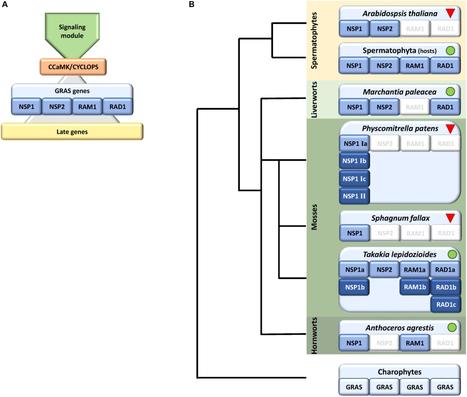
Arbuscular mycorrhiza is one of the most common plant symbiotic interactions observed today. Due to their nearly ubiquitous occurrence and their beneficial impact on both partners it was suggested that this mutualistic interaction was crucial for plants to colonize the terrestrial habitat approximately 500 Ma ago. On the plant side the association is established via the common symbiotic pathway (CSP). This pathway allows the recognition of the fungal symbiotic partner, subsequent signaling to the nucleus, and initiation of the symbiotic program with respect to specific gene expression and cellular re-organization. The downstream part of the CSP is a regulatory network that coordinates the transcription of genes necessary to establish the symbiosis, comprising multiple GRAS transcription factors (TFs). These regulate their own expression as an intricate transcriptional network. Deduced from non-host genome data the loss of genes encoding CSP components coincides with the loss of the interaction itself. Here, we analyzed bryophyte species with special emphasis on the moss Physcomitrella patens, supposed to be a non-host, for the composition of the GRAS regulatory network components. We show lineage specific losses and expansions of several of these factors in bryophytes, potentially coinciding with the proposed host/non-host status of the lineages. We evaluate losses and expansions and infer clade-specific evolution of GRAS TFs.
|
|
Scooped by
Jean-Michel Ané
November 18, 2018 9:38 PM
|
Tuberaceae is one of the most diverse lineages of symbiotic truffle-forming fungi. To understand the molecular underpinning of the ectomycorrhizal truffle lifestyle, we compared the genomes of Piedmont white truffle (Tuber magnatum), Périgord black truffle (Tuber melanosporum), Burgundy truffle (Tuber aestivum), pig truffle (Choiromyces venosus) and desert truffle (Terfezia boudieri) to saprotrophic Pezizomycetes. Reconstructed gene duplication/loss histories along a time-calibrated phylogeny of Ascomycetes revealed that Tuberaceae-specific traits may be related to a higher gene diversification rate. Genomic features in Tuber species appear to be very similar, with high transposon content, few genes coding lignocellulose-degrading enzymes, a substantial set of lineage-specific fruiting-body-upregulated genes and high expression of genes involved in volatile organic compound metabolism. Developmental and metabolic pathways expressed in ectomycorrhizae and fruiting bodies of T. magnatum and T. melanosporum are unexpectedly very similar, owing to the fact that they diverged ~100 Ma. Volatile organic compounds from pungent truffle odours are not the products of Tuber-specific gene innovations, but rely on the differential expression of an existing gene repertoire. These genomic resources will help to address fundamental questions in the evolution of the truffle lifestyle and the ecology of fungi that have been praised as food delicacies for centuries.
|
|
Scooped by
Jean-Michel Ané
November 18, 2018 9:31 PM
|
Soil biota can strongly influence plant performance with effects ranging from negative to positive. However, shifts in resource availability can influence plant responses, with soil pathogens having stronger negative effects in high-resource environments and soil mutualists, such as arbuscular mycorrhizal fungi (AMF), having stronger positive effects in low-resource environments. Yet the relative importance of long-term vs. short-term variation in resources on soil biota and plant responses is not well-known. To assess this, we grew the perennial herb Asclepias speciosa in a greenhouse experiment that crossed a watering treatment (wet vs. dry treatment) with a manipulation of soil biota (live vs. sterilized soil) collected from two geographic regions (Washington and Minnesota) that vary greatly in annual precipitation. Because soil biota can influence many plant functional traits, we measured biomass as well as resource acquisition (e.g., root:shoot, specific leaf area) and defense (e.g., trichome and latex production) traits. Due to their important role as mutualists and pathogens, we also characterized soil fungal communities in the field and greenhouse and used curated databases to assess fungal composition and potential function. We found that the experimental watering treatment had a greater effect than soil biota origin on plant responses; most plant traits were negatively affected by live soils under wet conditions, whereas responses were neutral or positive in live dry soil. These consistent differences in plant responses occurred despite clear differences in soil fungal community composition between inoculate origin and watering treatments, which indicates high functional redundancy among soil fungi. All plants grown in live soil were highly colonized by AMF and root colonization was higher in wet than dry soil; root colonization by other fungi was low in all treatments. The most parsimonious explanation for negative plant responses in wet soil is that AMF became parasitic under conditions that alleviated resource limitation. Thus, plant responses appeared driven by shifts within rather than between fungal guilds, which highlights the importance of coupling growth responses with characterizations of soil biota to fully understand underlying mechanisms. Collectively these results highlight how short-term changes in environmental conditions can mediate complex interactions between plants and soil biota.
|
|
Scooped by
Jean-Michel Ané
November 18, 2018 9:30 PM
|
Nodulation is crucial for biological nitrogen fixation (BNF) in legumes, but the molecular mechanisms underlying BNF have remained elusive. Here, we cloned a candidate gene underlying a major nodulation quantitative trait locus in soybean (Glycine max), INCREASING NODULE SIZE1 (GmINS1). GmINS1 encodes a cell wall β-expansin and is expressed primarily in vascular bundles, along with cortical and parenchyma cells of nodules. Four single-nucleotide polymorphisms distinguishing the two parents were found in the GmINS1 promoter region. Among them, single-nucleotide polymorphism A/C has a significant effect on GmINS1 expression in the parental genotype P2, based on β-glucuronidase activity and promoter deletion analysis. The expression of GmINS1 and the P2 genotype promoter was strongly associated with nodule development, not only in the parents but also in 40 progeny lines and 40 genotypes selected from a soybean core collection. Overexpression of GmINS1 resulted in increases in the number, biomass, infection cell abundance, and nitrogenase activity of large nodules and subsequently changed the nitrogen content and biomass of soybean plants. GmINS1 suppression via RNA interference had the opposite effect. Double suppression of GmEXPB2 and GmINS1 dramatically inhibited soybean nodulation. Our results reveal that GmINS1 is a critical gene in nodule development and that GmEXPB2 and GmINS1 synergistically control nodulation in soybean. Our findings shed light on the genetic basis of soybean nodulation and provide a candidate gene for optimizing BNF capacity through molecular breeding in soybean.
|


 Scoop.it!