Your new post is loading...

|
Scooped by
Jean-Michel Ané
November 4, 2020 11:41 PM
|
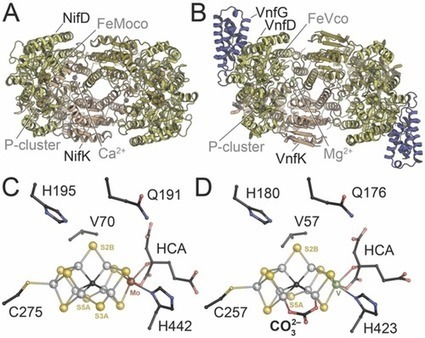
Nitrogenases reduce N2, the most abundant element in Earth's atmosphere that is otherwise resistant to chemical conversions due to its stable triple bond. Vanadium nitrogenase stands out in that it additionally processes carbon monoxide, a known inhibitor of the reduction of all substrates other than H+. The reduction of CO leads to the formation of hydrocarbon products, holding the potential for biotechnological applications in analogy to the industrial Fischer–Tropsch process. Here we report the most highly resolved structure of vanadium nitrogenase to date at 1.0 Å resolution, with CO bound to the active site cofactor after catalytic turnover. CO bridges iron ions Fe2 and Fe6, replacing sulfide S2B, in a binding mode that is in line with previous reports on the CO complex of molybdenum nitrogenase. We discuss the structural consequences of continued turnover when CO is removed, which involve the replacement of CO possibly by OH−, the movement of Q176D and K361D, the return of sulfide and the emergence of two additional water molecules that are absent in the CO‐bound state.
|
|
Scooped by
Jean-Michel Ané
November 4, 2020 11:36 PM
|
Smallholder farming systems form unique ecosystems that can protect beneficial soil biota and form an important source of useful genetic resources. They are characterized by high level of agricultural diversity mainly focused on meeting farmers’ needs. Unfortunately, these systems often experience poor crop production mainly associated with poor planning and resource scarcity. Soil fertility is among the primary challenges faced by smallholder farmers, which necessitate the need to come up with affordable and innovative ways of replenishing soils. One such way is the use of microbial symbionts such as arbuscular mycorrhizal fungi (AMF), a beneficial group of soil microbiota that form symbiotic associations with majority of cultivated crops and play a vital role in biological soil fertility, plant nutrition, and protection. AMF can be incorporated in smallholder farming systems to help better exploit chemical fertilizers inputs which are often unaffordable to many smallholder farmers. The present review highlights smallholder farming practices that could be innovatively redesigned to increase AMF symbiosis and related agroecosystem services. Indeed, the future of global food security depends on the success of smallholder farming systems, whose crop productivity depends on the services provided by well-functioning ecosystems, including soil fertility.
|
|
Scooped by
Jean-Michel Ané
November 4, 2020 11:33 PM
|
Arbuscular mycorrhizal fungi (AMF) colonization in roots of putative non-mycotrophic species has been known for decades, but our knowledge of AMF community structure in non-mycotrophic plants is limited. Here, we compared AMF species composition and diversity in roots of co-occurring mycotrophic and putative non-mycotrophic herbs in two wetlands. A SSU-ITS-LSU fragment in AMF rDNA was amplified, cloned and sequenced, and used to characterize the AMF community in the roots of 16 putative non-mycotrophic and 18 mycotrophic herbs. The results showed that AMF hyphae and vesicles, but not arbuscules, were commonly present in putative non-mycotrophic plants. A total of 971 AMF sequences were obtained, and these were finally assigned to 28 operational taxonomic units (OTUs). At both sites, AMF taxon richness and Hill number based on Shannon’s index in the putative non-mycotrophic herbs were similar to those for mycotrophic plants, but AMF community composition between mycotrophic and non-mycotrophic plants was significantly different. Ten AMF OTUs were uniquely detected in the putative non-mycotrophic species, and two were identified as the AMF indicators in non-mycotrophic plants. These results implied that non-mycotrophic plants may harbor a potential source of AMF diversity previously ignored which should be included in our understanding of diversity, distribution pattern, and ecological significance of root-colonizing AMF. As the first direct comparison of AMF diversity and species composition between mycotrophic and putative non-mycotrophic species in wetlands, our study has important implications for the understanding of AMF distribution patterns.
|
|
Scooped by
Jean-Michel Ané
November 4, 2020 9:24 PM
|
Golden Gate (GG) cloning assembles DNA fragments in a defined order to create a novel expression unit. The six entry modules contain a promoter, N-terminal tag, gene of interest, C-terminal tag, terminator, and a resistance marker. Expression units are assembled into one of three vectors that serve as both destination vectors for GG and entry vectors for Gateway (GW). The three GW entry vectors (pEN-L4-AG-R1, pEN-L1-AG-L2, and pEN-R2-AG-L3) are flanked by attR and attL sites for GW recombination. GW recombination with a destination vector results in an expression clone with three, ordered expression cassettes. The ccdB and chloramphenicol resistance ( CmR) genes between the cloning sites provide positive and negative selection, respectively.
|
|
Scooped by
Jean-Michel Ané
November 3, 2020 10:17 PM
|
Biological market theory provides a conceptual framework to analyze trade strategies in symbiotic partnerships. A key prediction of biological market theory is that individuals can influence resource value ‐ meaning the amount a partner is willing to pay for it ‐ by mediating where and when it is traded. The arbuscular mycorrhizal symbiosis, characterized by roots and fungi trading phosphorus and carbon, shows many features of a biological market. However, it is unknown if or how fungi can control phosphorus value when exposed to abrupt changes in their trade environment.
We mimicked an economic ‘crash’, manually severing part of the fungal network (Rhizophagus irregularis) to restrict resource access, and an economic ‘boom’ through phosphorus additions. We quantified trading strategies over a three‐week period using a recently developed technique by tagging rock phosphate with fluorescing quantum‐dots of three different colors.
We found that the fungus: (i) compensated for resource loss in the ‘crash’ treatment by transferring phosphorus from alternative pools closer to the host root (Daucus carota), (ii) stored the surplus nutrients in the ‘boom’ treatment until root demand increased.
By mediating from where, when and how much phosphorus was transferred to the host, the fungus successfully controlled resource value.
|
|
Scooped by
Jean-Michel Ané
November 3, 2020 6:00 PM
|
In Lotus japonicus, quantitative trait loci (QTLs) for nitrogen fixation activity (acetylene reduction activity, ARA) and seed weight are located in the same region on chromosome 4 as the gene responsible for the Fix− mutant sen1. The SEN1 gene of L. japonicus Gifu B129 has a deletion of three nucleotides in comparison with that of L. japonicus Miyakojima MG20, which results in a deletion of one amino acid. Here, we examined whether SEN1 is responsible for these QTLs. Because the MG20 allele of the QTL for ARA and seed weight has a positive effect, we generated a near-isogenic line (NIL) in which the SEN1 gene region of B129 was replaced with that of MG20. Growth parameters of this NIL (MG20-type) 21 days after inoculation with Mesorhizobium loti were significantly higher than those of B129-type, and ARA was also significantly higher. Nodules formed on hairy roots in which the sen1 mutant was complemented with the MG20 SEN1 gene had higher ARA than those of B129. The seeds of the MG20-type NIL were significantly heavier than those of B129-type. These results indicate that the SEN1 gene is a very likely candidate for the QTL for ARA and seed weight on chromosome 4.
|
|
Scooped by
Jean-Michel Ané
November 3, 2020 5:54 PM
|
Legume plants form nitrogen-fixing nodules in symbiosis with soil bacteria rhizobia. The number of symbiotic nodules is controlled at the whole-plant level with autoregulation of nodulation (AON), which includes a shoot-acting CLV1-like receptor kinase and mobile CLE (CLAVATA3/ENDOSPERM SURROUNDING REGION-related) peptides that are produced in the root in response to rhizobia inoculation. In addition to rhizobia-induced CLE peptides, nitrate-induced CLE genes have been identified in Lotus japonicus and Glycine max, which inhibited nodulation when overexpressed. However, nitrate-induced CLE genes that systemically suppress nodulation in AON-dependent manner have not been identified in Medicago truncatula. Here, we found that MtCLE35 expression is activated by both rhizobia inoculation and nitrate treatment in M. truncatula, similarly to L. japonicus CLE genes. Moreover, we found that MtCLE35 systemically suppresses nodulation in AON-dependent manner, suggesting that MtCLE35 may mediate nitrate-induced inhibition of nodulation in M. truncatula.
|
|
Scooped by
Jean-Michel Ané
November 3, 2020 9:44 AM
|
Stormwater biofilters rely on healthy plant communities to perform essential functions of stormwater management. Mycorrhizae are a class of fungi which may confer benefits to plants growing in green stormwater infrastructure, just as they do in natural ecosystems. Few studies have investigated the roles of mycorrhizae outside natural ecosystems or agricultural systems. This review describes three mechanisms of mycorrhizal symbiosis which could influence plant function in stormwater biofilters. The first mechanism is mycorrhizae acting as an extension of plant roots, providing water and nutrient for plant growth and resistance to stress. Through this mechanism metal removal could also be improved. The second mechanism, mycorrhizal interaction with the rhizosphere, can contribute to soil organic carbon and impact microbial community structures that ultimately affect the N cycle. A third mechanism is discussed in relation to the impact of mycorrhizae on the photosynthetic activity of plants and its subsequent effect on plant growth and resistance to environmental stress. These three mechanisms will be placed into the context of how mycorrhizae could play a crucial role on plant performance and nutrient and metal removal in stormwater biofilters.
|
|
Scooped by
Jean-Michel Ané
November 3, 2020 9:41 AM
|
Cynara cardunculus L. is a perennial species with high potential for bioenergy production. Arbuscular mycorrhizal symbiosis (AMF) is probably the terrestrial symbiosis most extended on earth. It presence in roots and soils improves plant nutrition and soil quality. Indigenous AMF have developed a variety of modifications to survive in their habitat and thus could serve as potential inoculants for the implantation of plant species in the respective AMF soil habitat. This work aimed to diagnose the status of the AMF symbiosis associated to two cardoon cultivars after a year of growth in a saline soil and in a conventional farming soil. For that purpose we determined AMF parameters in 4 rhizospheric soils and in roots of the cardoon varieties. We found that: (1) the rhizosphere of C. cardunculus var. altilis positively influenced the extraradical mycelium development in the saline soil, (2) the inorganic fertilization history of the conventional farming soil could have had a negative effect on the AMF community and, (3) the intraradical mycelium (IRM) development was extremely low. Our diagnosis suggests that, in order to improve the positive effects of AMF on cardoon growth and soil quality, efforts should be focused on the development of the IRM. In a boarder sense, the implementation of a diagnosis of indigenous AMF communities as a general agronomic practice could become an useful tool to farmers that are willing to potentiate the benefits of AMF on plant growth and soil quality.
|
|
Scooped by
Jean-Michel Ané
November 3, 2020 9:31 AM
|
Arbuscular mycorrhizas (AMs) are the most widespread symbioses between plants and soil fungi. They play such a critical role in the nutrition of both partners that AM fungi cannot complete their life cycle in the absence of a host plant, and the existence of non-mycorrhizal individuals of AM host species is virtually unknown in natural ecosystems.
Even if the genetics of AM fungi have long been difficult to approach, decades of studies on model host plants and recent achievements in fungal genomics and transcriptomics have shed light on the molecular bases of this fascinating and ecologically crucial interaction.
In this chapter we review the most influential literature on this topic, outlining the genetic and physiological bases of obligate biotrophism in AM fungi, their unique adaptation to symbiotic lifestyle, the emerging role of secreted effectors, and signaling molecules. Such insights complement our more advanced knowledge of the host plant response to AM fungi, from signal transduction to cell reorganization, metabolic and physiological reprogramming, and systemic responses. Lastly, we comment on our current understanding of natural variation in AM interactions, exploring the reciprocal advantages and disadvantages that emerge when coupling different fungal isolates and wild or domesticated plant varieties.
|
|
Scooped by
Jean-Michel Ané
November 3, 2020 9:29 AM
|
Desert truffles are edible hypogeous fungi forming ectendomycorrhizal symbiosis with plants of Cistaceae family. Knowledge about the reproductive modes of these fungi and the molecular mechanisms driving the ectendomycorrhizal interaction is lacking.
Genomes of the highly appreciated edible desert truffles, Terfezia claveryi Chatin and Tirmania nivea Trappe, have been sequenced and compared to other Pezizomycetes. Transcriptomes of T. claveryi x Heliantemum almeriense mycorrhiza from well‐watered and drought‐stressed plants, when intracellular colonizations is promoted, were investigated.
We have identified the fungal genes related to sexual reproduction in desert truffles and desert truffles specific genomic and secretomic features with respect to other Pezizomycetes, such as the expansion of a large set of gene families with unknown Pfam domains and a number of species or desert truffle – specific small secreted proteins differentially regulated in symbiosis. A core set of plant genes, including carbohydrate, lipid metabolism and defence related genes, differentially expressed in mycorrhiza under both conditions was found.
Our results highlight the singularities of desert truffles with respect to other mycorrhizal fungi while providing a first glimpse on plant and fungal determinants involved in ecto to endo symbiotic switch that occurs in desert truffle under dry conditions.
|
|
Scooped by
Jean-Michel Ané
October 31, 2020 6:42 PM
|
The abiotic environment can dictate the relative costs and benefits of plant-arbuscular mycorrhizal fungi (AMF) symbioses. While the effects of varying light or soil nutrient conditions are well studied, outcomes of plant-AMF interactions along soil moisture gradients are not fully understood. It is predicted that mycorrhizal associations may become parasitic in extreme soil moisture conditions. Under low soil moisture stress, costs of maintaining a mycorrhizal symbiont may outweigh benefits for the host plant, whereas under high soil moisture stress, the host plant may not need the symbiont. In a factorial growth chamber study, we investigated the effects of a plant-arbuscular mycorrhizal fungus symbiosis along a soil moisture gradient on growth, cell wall chemistry, and root architecture of a biofuel crop, Panicum virgatum (switchgrass). Regardless of soil moisture conditions, we found an increase in the number of tillers, number of leaves, root biomass, and amount of cellulose and hemicellulose in response to root colonization by the arbuscular mycorrhizal fungus. The fungus also increased aboveground biomass and changed several root architectural traits, but only under low soil moisture conditions, indicating a reduction in benefits of the mycorrhizal association under high soil moisture. Results from this study indicate that an arbuscular mycorrhizal fungus can increase some key measures of plant growth and cell wall chemistry regardless of soil moisture conditions but is most beneficial in low soil moisture conditions.
|
|
Scooped by
Jean-Michel Ané
October 31, 2020 5:57 PM
|
A completely randomized factorial experiment was conducted to evaluate the growth and biomass production of single- and mixed crop species inoculated with mycorrhizae. Radish, (R), safflower (SF), pearl-millet (PM), mustard (M), field peas ((FP), faba-bean (FB), common vetch (CV), and berseem clover (BC) and their blends as R-SF-PM-M, FP-FB-CV-BC, R-SF-PM-M-FP-FB-CV-BC, R-SF-M-FP-FB-CV-BC, and PM-FP-FB-CV-BC were planted in a pot culture. The mycorrhizal inoculum significantly influenced the cover crops growth and biomass production under sterilized soils than that of non-sterile soils. While the safflower produced the highest total biomass, the pearl millet and field peas produced the lowest total biomass. Generally, in sterile and mycorrhizal conditions plant grown better and have high total C fixation. Within non-sterile and mycorrhizal inoculation, Safflower (1383.1 g C m−2) and Berseem Clover (1235.5 g C m−2) as a single species have fixed highest amount of carbon as biomass. Mycorrhizae inoculated BC+CV+FB+FP+SF+PM blends had a return of 1365.0 g C m−2 in non-sterile soil. Our results suggested that cover crops in single or mixed stands with mycorrhizal inoculations are expected to provide a significantly greater amount of biomass, which would contribute to soil organic matter and nutrient recycling for crop production.
|
|
|
Scooped by
Jean-Michel Ané
November 4, 2020 11:37 PM
|
6S RNA, a conserved and abundant small non-coding RNA found in most bacteria, regulates gene expression by inhibiting RNA polymerase (RNAP) holoenzyme. 6S RNAs from α-proteobacteria have been studied poorly so far. Here, we present a first in-depth analysis of 6S RNAs from two α-proteobacteria species, Bradyrhizobium japonicum and Sinorhizobium meliloti. Although both belong to the order Rhizobiales and are typical nitrogen-fixing symbionts of legumes, their 6S RNA expression profiles were found to differ: B. japonicum 6S RNA accumulated in the stationary phase, thus being reminiscent of Escherichia coli 6S RNA, whereas S. meliloti 6S RNA level peaked at the transition to the stationary phase, similarly to Rhodobacter sphaeroides 6S RNA. We demonstrated in vitro that both RNAs have hallmarks of 6S RNAs: they bind to the σ70-type RNAP holoenzyme and serve as templates for de novo transcription of so-called product RNAs (pRNAs) ranging in length from ∼13 to 24 nucleotides, with further evidence of the synthesis of even longer pRNAs. Likewise, stably bound pRNAs were found to rearrange the 6S RNA structure to induce its dissociation from RNAP. Compared with B. japonicum 6S RNA, considerable conformational heterogeneity was observed for S. meliloti 6S RNA and its complexes with pRNAs, even though the two 6S RNAs share ∼75% sequence identity. Overall, our findings suggest that the two rhizobial 6S RNAs have diverged with respect to their regulatory impact on gene expression throughout the bacterial life cycle.
|
|
Scooped by
Jean-Michel Ané
November 4, 2020 11:36 PM
|
Demand for mycorrhizal fungi in gardening and landscaping tasks is steadily climbing, given its ability to boost growth and yield as a natural fertilizer. In a successful first, scientists from the Leibniz Institute of Plant Biochemistry (IPB), partnered the INOQ GmbH and the Leibniz Institute of Plant Genetics and Crop Plant Research (IPK) to develop a mycorrhiza substrate for commercial tomato production. Large-scale trials revealed that the fruit crop of mycorrhizal plants outperformed non-mycorrhizal control plants in terms of quality and richness of content. The findings pave the way to produce suitable mycorrhiza preparations for large-scale tomato cultivation for the first time.
|
|
Scooped by
Jean-Michel Ané
November 4, 2020 11:33 PM
|
The era of COVID-19 and the need to constantly wash one's hands and sanitize things have brought microbes to new levels of scrutiny, particularly for their impact on an individual's health.
While associations between microbes and their hosts, from the beneficial—think probiotics in yogurt—to the harmful—such as with viruses spread by touch—have long been known, little is known about how microbes evolve and how their evolution affects the health of their hosts.
|
|
Scooped by
Jean-Michel Ané
November 4, 2020 9:23 PM
|
Soil health and its pivotal role in growing food has recently met with the need to address another global challenge: climate change.
Providing food is a major source of greenhouse gases, emitting almost 40 percent as much as anthropogenic emissions from fossil fuels in areas not related to food production. Greenhouse gas emissions from agricultural soils are a major factor in this, accounting for 60 percent of agricultural emissions. Only a few years ago, at the UN climate convention in Paris, it dawned on the global community that soils not only harbor the opportunity to reduce emissions but also to sequester carbon. A fact well known among Earth scientists is that several times more carbon resides in soils on a global scale than in all vegetation and the atmosphere combined. Increasing organic carbon in soil by a relatively small proportion would thereby make a large difference to global climate. A much-needed global agenda was born that included not only scientists but particularly policy makers, industry and the farm and ranch community to promote carbon farming.
|
|
Scooped by
Jean-Michel Ané
November 3, 2020 6:02 PM
|
Adventitious root (AR) formation is a complex developmental process controlled by a plethora of endogenous and environmental factors. Based on fossil evidence and genomic phylogeny, AR formation might be considered the default state of plant roots, which likely evolved independently several times. The application of next-generation sequencing techniques and bioinformatics analyses to non-model plants provide novel approaches to identify genes putatively involved in AR formation in multiple species. Recent results uncovered that the regulation of shoot-borne AR formation in monocots is an adaptive response to nutrient and water deficiency that enhances topsoil foraging and improves plant performance. A hierarchy of transcription factors required for AR initiation has been identified from genetic studies, and recent results highlighted the key involvement of additional regulation through microRNAs. Here, we discuss our current understanding of AR formation in response to specific environmental stresses, such as nutrient deficiency, drought or waterlogging, aimed at providing evidence for the integration of the hormone crosstalk required for the activation of root competent cells within adult tissues from which the ARs develop.
|
|
Scooped by
Jean-Michel Ané
November 3, 2020 5:56 PM
|
SNAREs (soluble N-ethyl maleimide-sensitive factor attachment protein receptors) mediate membrane fusion of vesicle transport in eukaryotic cells. LjSYP132s are the members of Qa-SNAREs in Lotus japonicus. Two isoforms, LjSYP132a and LjSYP132b, are generated by alternative splicing. Immunoblot analysis detected strong expression of LjSYP132s in infected root nodules and seeds by posttranscriptional modification. In either LjSYP132a or LjSYP132b silenced roots (RNAi-LjSYP132a, RNAi-LjSYP132b), the infection thread (IT) was not elongated, suggesting that both LjSYP132a and LjSYP132b have a role in IT progression. The results were consistent with the data of qRT-PCR showing that both genes were expressed at the early stage of infection. However, during the nodulation, only LjSYP132a was induced. LjSYP132s protein was observed in the Mesorhizobium loti-inoculated roots of mutants, nfr1, castor and pollux, suggesting that LjSYP132s can be induced without Nod factor signaling. Accumulation of LjSYP132s in the peribacteroid membrane suggests the function of not only IT formation but also nutrient transport. In contrast, qRT-PCR showed that LjSYP132b was expressed in the seeds. A stable transgenic plant of LjSYP132b, R132b, was produced by RNAi silencing. In the R132b plants, small pods with a few seeds and abnormal tip growth of the pollen tubes were observed, suggesting that LjSYP132b has a role in pollen tube growth and nutrient transport in the plasma membrane of seeds.
|
|
Scooped by
Jean-Michel Ané
November 3, 2020 9:45 AM
|
This book explores microbial symbiosis, with a particular focus on soil microorganisms, highlighting their application in enhancing plant growth and yield. It addresses various types of bacterial and
|
|
Scooped by
Jean-Michel Ané
November 3, 2020 9:41 AM
|
Most land plants, from liverworts to angiosperms, form mutualistic mycorrhizal symbioses with fungal partners. However, several plants known as mycoheterotrophs exploit fungal partners by reversing the polarity of carbon movement, which usually moves from plant to fungus.
We investigated the physiological ecology of a photosynthetic orchid, Apostasia nipponica, which belongs to the first branching group within the Orchidaceae, to improve our understanding of mycoheterotrophic evolution in orchids. The fungal symbionts and nutrition modes of A. nipponica were investigated using molecular barcoding and 13C and 15N measurements, respectively.
Community profiling based on a metabarcoding technique revealed that A. nipponica associates with specific Ceratobasidium spp. within ectomycorrhizas‐forming clades, whereas isotope analysis revealed that A. nipponica was similar to fully mycoheterotrophic orchids in its 13C signature and was even more enriched in 15N than most of the fully mycoheterotrophic orchids that exploit ectomycorrhizal fungi.
Our molecular and mass‐spectrometric approaches demonstrated, for the first time, that a member of the Apostasioideae, the earliest‐diverging lineage of the Orchidaceae, gains carbon through both photosynthesis and fungal cheating (i.e., partial mycoheterotrophy) during the adult stage.
|
|
Scooped by
Jean-Michel Ané
November 3, 2020 9:35 AM
|
Feremycorrhiza (FM) is a newly discovered plant-fungus symbiosis that improves plant growth and nutrition without development of interface structures (i.e. no root colonization). The host plant range in the FM symbiosis is currently unknown. We report the results of controlled environment investigations characterizing the capability of crops to establish FM symbiosis with Austroboletus occidentalis, along with comprehensive in vitro studies to unravel the functional mechanisms underlying the phosphorus (P) nutritional benefits conferred to host plants. After 16 weeks of growth in a natural low-nutrient field soil (containing indigenous microbes), two mycorrhizal crops [wheat (Triticum aestivum) and barley (Hordeum vulgare)], and the non-mycorrhizal crop canola (Brassica napus) inoculated with A. occidentalis had significantly higher shoot biomass compared to the control (non-inoculated) plants. The FM symbiosis also led to significant grain yield increases in wheat (by 54%) and barley (by 37%) compared to the control plants, while canola was harvested before setting seeds due to slow growth under nutrient deficiency. In all crops, the FM symbiosis significantly improved the shoot nutrient content, including that of P, potassium and magnesium. Total nitrogen accumulation (shoot + grain content) was also significantly higher in all inoculated vs control crops. Inoculated treatments had reduced soil pH compared to the control, which was attributed to fungal activities in soil, leading to greater nutrient (P, in particular) availability to host plants. Presence of A. occidentalis in soil did not affect root colonization by indigenous arbuscular mycorrhizal fungi in wheat and barley, and no root colonization was detected in canola. Our in vitro studies demonstrated the solubilization, by A. occidentalis, of the water-insoluble P forms, including calcium phosphate (CaP, as hydroxyapatite), iron phosphate (FePO4), and aluminium phosphate (AlPO4) via exudation of organic acid anions (mainly oxalate, along with citrate and fumarate). The 31P nuclear magnetic resonance (NMR) spectroscopy revealed the presence of similar P species (dominated by orthophosphate and long-chain inorganic polyphosphates) in the agar-based media supplemented with different P forms (KH2PO4, CaP, FePO4 or AlPO4), indicating that all three water-insoluble P compounds were solubilized and transformed by the FM fungus. Furthermore, our in vitro studies revealed that the FM fungus converted a large proportion of the solubilized P (free orthophosphate) into long-chain inorganic polyphosphates (making up to 51% of total P in the media). The results demonstrated that the three important grain crops, regardless of their capacity to support arbuscular mycorrhizae, could get the growth and nutritional benefits from the FM symbiosis, emphasizing the potential of A. occidentalis as a novel fungal biofertilizer for agricultural crops.
|
|
Scooped by
Jean-Michel Ané
November 3, 2020 9:30 AM
|
Symbiotic association has been subject to great heed in part because of the prime of the disease to world agriculture, but also because both host and arbuscular mycorrhizal fungi are persuadable to proceed investigational approaches. The goal of the review is to furnish an overview of the microbial association system and designate concurrent remarkable studies that amend our comprehension of the biology and Omics of VAM fungi. The genomic studies have been organized to long-term well-established areas of investigation, including disease development and the characterization of proteins in relation to host. VAM fungi act as biological control in global sustainable development under varied agroecological regions. VAM fungi illustrate the plant–root/microbial interactions which serves gaining knowledge and a wide out-look of issues in crop production/protection.
|
|
Scooped by
Jean-Michel Ané
November 2, 2020 2:25 PM
|
Emerging experimental framework suggests that plants under biotic stress may actively seek help from soil microbes, but empirical evidence underlying such a ‘cry for help’ strategy is limited.
We used integrated microbial community profiling, pathogen and plant transcriptive gene quantification and culture‐based methods to systematically investigate a three‐way interaction between the wheat plant, wheat‐associated microbiomes and Fusarium pseudograminearum (Fp).
A clear enrichment of a dominant bacterium, Stenotrophomonas rhizophila (SR80), was observed in both the rhizosphere and root endosphere of Fp‐infected wheat. SR80 reached 3.7×10⁷ cells g‐1 in the rhizosphere and accounted for up to 11.4% of the microbes in the root endosphere. Its abundance had a positive linear correlation with the pathogen load at base stems and expression of multiple defense genes in top leaves. Upon re‐introduction in soils, SR80 enhanced plant growth, both the below‐ and above‐ground, and induced strong disease resistance by boosting plant defense in the aboveground plant parts, but only when the pathogen was present.
Together, the bacterium SR80 seems to have acted as an early warning system for plant defense. This work provides novel evidence for the potential protection of plants against pathogens by an enriched beneficial microbe via modulation of the plant immune system.
|
|
Scooped by
Jean-Michel Ané
October 31, 2020 6:01 PM
|
The past few decades have seen major discoveries in the field of molecular plant-microbe interactions. As the result of technological and intellectual advances, we are now able to answer questions at a level of mechanistic detail that we could not have imagined possible 20 years ago. The MPMI Editorial Board felt it was time to take stock and reassess. What big questions remain unanswered? We knew that to identify the fundamental, overarching questions that drive our research, we needed to do this as a community. To reach a diverse audience of people with different backgrounds and perspectives, working in different areas of plant-microbe interactions, we queried the more than 1,400 participants at the 2019 International Congress on Molecular Plant-Microbe Interactions meeting in Glasgow. This group effort resulted in a list of ten, broad-reaching, fundamental questions that influence and inform our research. Here, we introduce these Top 10 unanswered questions, giving context and a brief description of the issues. Each of these questions will be the subject of a detailed review in the coming months. We hope that this process of reflecting on what is known and unknown and identifying the themes that underlie our research will provide a framework to use going forward, giving newcomers a sense of the mystery of the big questions and inspiring new avenues and novel insights.
|