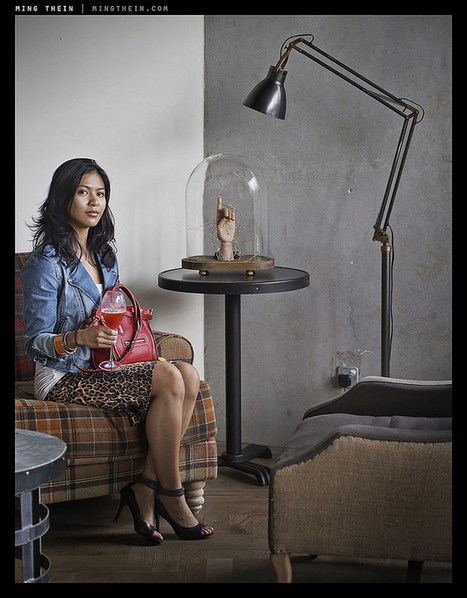
Cameron Van Loos: How do documentary ethics function within your photography?
Gregory Halpern: To ask what one’s ethics are when making photographs of other people is as complicated as asking what one’s ethics are in general.
I should start by explaining why I don’t call my work documentary. To begin with, the way the word “documentary” is understood by still photographers, particularly in the US, is extremely limited and strict. The second is that I am not primarily motivated by the desire to “document” things. I am motivated more by the desire to create things, to make photographs that rely on things/facts found “in the world” but that are then shaped and altered according to my vision of them.
Trent Parke is one of the most phenomenal contemporary photographers around. What I love about his work is the strong emotional and personal connection he has in his photographs, as well as his fanatical passion to street photography.
MyAngle's Photo Editor Levan Kherkheulidze speaks about Photo Journalism and Documentary Photography. What's the difference between a Single Photo and a Phot...
Adobe has announced new standalone and Creative Cloud versions of its image management and Raw conversion software, Lightroom. The latest versions gain simple HDR and Panorama merging tools that create 16-bit DNG files from the merged results. Also added is the ability to paint-out regions of gradient filters, to allow more flexible overlays. Face Recognition tools have also been added, to simplify the tagging and retrieval of images. The CC version of the software is also designed to tie-in with the iOS and Android versions of Lightroom, by allowing for collections you choose to be synced and available across multiple devices, as well as on a web platform. The CC version also works with Voice and Slate: two new programs for creating image-based animations and presentations.
’m Peter Kirkeskov Rasmussen, a mechanical engineer by profession, a self taught photographer with a passion for street photography by heart. I live in Copenhagen, Denmark, where I do most of my work.
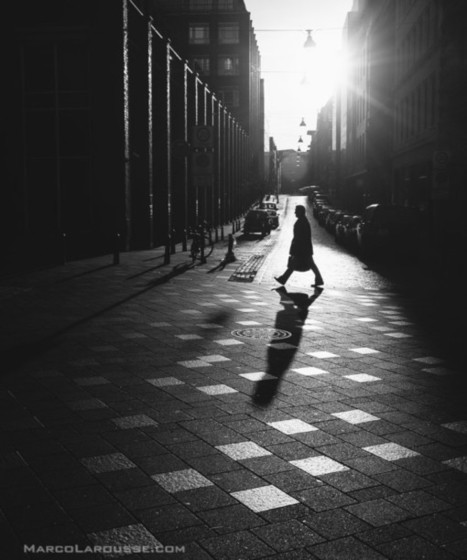
n part one we looked at why images of people fascinate us, and the nature of portraiture. However, this only covers half of the possibilities for ‘images of people': instances where the subject is a conscious and cooperative part of the process. What about the other possibility: where the subject is not aware the photographer, or only aware of them in the most fleeting of moments before any conscious self-image or rapport can be built?
Venice is a city of water. Perhaps the city of water. And in such a city, a boat is a necessity, not a luxury – today’s photoessay is a little celebration of the the Riva, a tribute to the workhorse vaporetto, a nod to the cruise liner that dwarfs the city it arrives at, and a grudging acknowledgement of the ubiquitous gondola.
When it comes to portraiture, photographer Malea Blackburn believes that film is the best medium you can work with–and she has quite the portfolio to back up that statement. Malea finds that digital is okay, but film brings forth even more raw emotion in the images. Additionally, one needs to be much more careful and exacting when they shoot a film portrait–which then translates into more interactivity between the photographer and the subject. Eventually this interpersonal relationship is conveyed through the images.
Today is the 75th birthday of Queen Margrethe II of Denmark. I thought I would share my view on her, so I searched my archive for Queen Margrethe and came up with 2,311 images, and then I searched my mind.
El pasado 21 de marzo se llevó a cabo el evento más grande de fotografía de calle: The 24 Hour Project. Una idea concebida por Renzo Grande y Sam Smotherman y que este año celebró su cuarta edición.
09h
La idea, en pocas palabras, consiste en extender la invitación a todo aquel que guste de la fotografía de calle (móvil o con cámaras regulares) y documentar su ciudad durante 24 horas continuas, subiendo a redes sociales (principalmente Instagram) una fotografía cada hora. El tema para este año fue: La Condición Humana. Es todo un reto físico e intelectual mantenerse creativo durante tanto tiempo.
Last March 21 was held the biggest event of street photography: The 24 Hour Project. An idea conceived by Renzo Large and Sam Smotherman and this year celebrated its fourth edition.
The idea, in short, is to extend an invitation to anyone who likes street photography (mobile or regular cameras) and document their city for 24 continuous hours, up to social networks (mainly Instagram) a picture every hour . The theme for this year was: The Human Condition.It's all physical and intellectual challenge creative maintained for so long.
I just gave a free street photography webinar, and here are some of the slides that I shared on practical tips, assignments, and "traits of great street photographers". The video recording of the event will be available in a week or so, will also make sure to share. In the meanwhile, enjoy this
Today’s article is the first of two parts focusing on portraiture and human subjects as the focus of an image. It is not something I’m normally associated with because I rarely choose to show my work here; it doesn’t mean I don’t engage in it for personal reasons (which are usually not shared, obviously) or professional ones (I do have clients whose mainstay subjects are primarily human). Whilst curating images for a recent assignment, I had a couple of little personal epiphanies which I’d like to share with you all.
Please note: this is not a list of influential street photographers by the moment just the masters can be labelled as most influential for historical reasons and for clear dissemination of their work in the world. This is not even a PR list, but I don’t deny there are friends here.
In this episode of ISO 400, we hear from Rinzi Ruiz, a street and wedding photographer based in Los Angeles. Towards the of 2011, Ruiz was laid off a job he ...
Welcome to our series of 100 interviews we will be holding with professional photographers who use mirrorless cameras for work! “Switching to a smaller and lighter system” has become somewhat of a buzz phrase as of late, but many working photographers take this philosophy seriously. From medical reasons such as resolving back and shoulder pain to the simple realisation that bigger does not mean better, photographers are turning to mirrorless systems now more than ever before.
Fille et petite fille de marin, j’ai passé mon enfance entourée par des objets exotiques. Mon grand-père a navigué aux quatre coins du globe et a rapporté dans son barda un tas de bibelots et de souvenirs tous aussi insolites les uns que les autres. Ne l’ayant jamais connu, toutes ces choses, ces bidules sont autant d’indices qui me renseignent sur son parcours géographique et donc son histoire. Il y a quelques temps, en farfouillant dans les affaires de famille, je suis tombée sur un ancien por
To get content containing either thought or leadership enter:
To get content containing both thought and leadership enter:
To get content containing the expression thought leadership enter:
You can enter several keywords and you can refine them whenever you want. Our suggestion engine uses more signals but entering a few keywords here will rapidly give you great content to curate.


 Your new post is loading...