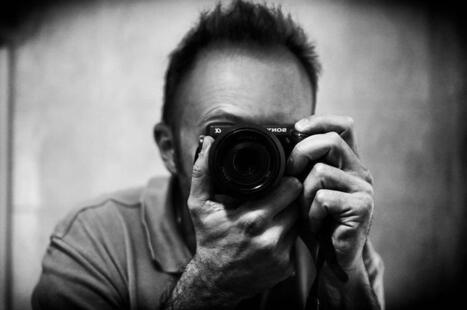
Sometimes I just want to make photos and not for any other reason then the enjoyment it gives me. Whenever I do tho’, I feel guilty. I feel like I’m not working which is bullcrap. I mean I still get my 5 miles walk in. I’m still carrying my camera. I’m still trying to find my photos and trying to allow my photos to find me.I would think it’s a matter of intent but I know that is wrong. My intent is to make photos. I feel that everytime I pick up the camera, Hmmmm. So what is happening when I feel that I’m somehow working different but I’m not.
This video is part of our Exposure series, in which National Geographic photographers share the stories behind their images. Listen to photographer Wayne Lawrence talk about his assignment photographing the people of Detroit.
...
When I look at Wayne Lawrence’s portraits from the Detroit story in the May issue of the magazine, I don’t need anyone to tell me that despite the city’s ups and downs Detroiters are tough and proud. I can see it for myself—because Wayne saw that so clearly.
This video is part of our Exposure series, in which National Geographic photographers share the stories behind their images. Listen to photographer Wayne Lawrence talk about his assignment photographing the people of Detroit.
When it comes to street photography, I am a huge believer that there is no “best” camera for street photography. Ever different camera has its own strengths and weaknesses, and are all used in different situations. I have shot with many types of cameras, including point and shoots, disposable film cameras, DSLR’s, and even rangefinders. …
Uh oh. Deep breath. I’m sticking my neck out and putting my head on the proverbial block as I’m going to attempt the impossible and try and define street photography. So strap yourselves in, this is sure to be a bumpy ride.
Born in 1984, Rudy Boyer lives in Nice, France. He has been engaged in street photography for over a few years. That time frame was enough to create the passion he now has for street photography.
In this episode of National Geographic’s fantastic series "Exposure," you go behind the scenes with street and portrait photographer Wayne Lawrence who describes photographing the “real Detroit.” Lawrence describes the challenge of shooting such a diverse city, one that includes familiar, comfortable suburbs and rundown, abandoned spaces.
The word “surveillance” is often loaded with heavy connotations that spark concerns about privacy lost to everything from government eavesdropping to video cameras on every street corner. But what if that word was paired with the story and photographs of the Hungarian photographer Andre Kertesz?
Photographer Marius Vieth has graced our site a couple of times, but one of our favorite projects by the award winning street photographer is called “Under My Umbrella.” It features many candid street photos taken in the rain–a time when the streets are crazier than normal and light shows of all sorts happen.
I use a Mirrorless camera 90% of the time for my Street Hunting. The other 10% is split into 35mm film Rangefinder cameras and my iPhone. This is not by chance.
In 1945, Alfred Hitchcock advised on a film that would catalogue the atrocities uncovered in concentration camps by Allied troops. Now the Imperial War Museum has completed the film with previously unseen footage
On a recent trip to Cuba in December 2014, Turkish photographer Ilknur Can created some seemingly timeless photographs using her iPhone. By using a digital black-and-white film filter, she further blurred the distinction between the past and future.
Photography books can be really expensive. I know, I've said this before. But seriously, some of us just don't want to fork over hundreds of dollars every time we buy a book. So what are the options? Well, there are a good number of great street photography books out there which are really quite budget friendly. Here are my own personal favorites. There is a mix of both books on technique and books showcasing talent. They are in no particular order.
London, 2014 I often have a hard time going out and making “street photos”— and I have a lot of other friends who face a similar difficulty. A lot of street photographers disdain their busy lives, and how they aren’t ever able to make time to go out and hit the streets and shoot “street
J’aime ce style de photo très instantanée, où l’humain est le point central, avec son habitat, ses habitudes, son formatage social, ses déformations, ses aspirations et inspirations. Ce genre de photo amène à rencontrer du monde, à nouer un contact, un dialogue, à apprendre et à découvrir au travers de ces gens que l’on a photographié. C’est ce que j’essaie de faire au travers de mes photos. Je parcours les rues de différentes villes très régulièrement, cherchant différentes situations, des personnes différentes, communes comme peu communes, faisant la diversité de notre société. Que ce soit seul ou avec des amis photographes
A really cool feature of mirrorless cameras is that the image you see in the electronic viewfinder is the same one that the sensor sees through the lens. (This is a step up from a DSLR, where you only see what the lens sees.) Moreover, camera settings that modify the captured image will likewise be shown in a mirrorless camera's EVF. This allows for fun things like making the X100s into a Monochrom, where you see an achromatic image while you're shooting.
Duane Michals had a major retrospective at the Carnegie Museum of Art that has moved to the Peabody Essex Museum in Massachusets, which is where I saw it (and where it will be until June 21). Shortly afterward I called Duane up and asked if we could talk. A month later we did, and here is the first part of that conversation.
Welcome to our series of 100 interviews we will be holding with professional photographers who use mirrorless cameras for work! “Switching to a smaller and lighter system” has become somewhat of a buzz phrase as of late, but many working photographers take this philosophy seriously. From medical reasons such as resolving back and shoulder pain to the simple realisation that bigger does not mean better, photographers are turning to mirrorless systems now more than ever before.
Since Adobe announced their movement to the Creative Cloud, many photographers were hoping that Adobe Lightroom didn’t make the move. Today, Adobe is giving consumers and professional photographers alike a new option. Photographers can either go for the new Adobe Lightroom 6 (most likely for the amateurs) or Adobe Lightroom CC (most likely for the working pros with a Creative Cloud account.) For the most part, they’re the same pieces of software.
Capturing the moment is a matter of seconds, even less. There are so many parameters and variables to take into consideration that it can sometimes feel impossible to achieve; and when we finally get that perfect shot, we may tend to believe that we’ve been lucky. Well, believing so is a mistake. Luck is important of course, but ultimately, it is your attitude to openness and possibilities that will determine your success. In other words, let’s give “chance” a chance to come upon us by choosing the right state of mind.
The photography staff of The St. Louis Post-Dispatch won the Pulitzer Prize for breaking news photography on Monday for its coverage of the aftermath of the police shooting of an unarmed black teenager, Michael Brown, in Ferguson, Mo., last summer.
To get content containing either thought or leadership enter:
To get content containing both thought and leadership enter:
To get content containing the expression thought leadership enter:
You can enter several keywords and you can refine them whenever you want. Our suggestion engine uses more signals but entering a few keywords here will rapidly give you great content to curate.


 Your new post is loading...