Your new post is loading...
When one thinks of receiving medical attention, they don’t think of iPads. The saying “technology is the wave of the future” is true, though, and mobile technology is beginning to work into how doctors diagnose illnesses and talk to their patients.
Via PEAS Healthcare, Giuseppe Fattori
How do you measure the success of a mobile app? At one time counting downloads was a sufficient way to evaluate the success of an app, but that's no longer the case.
Via Olivier Delannoy

|
Scooped by
Lionel Reichardt / le Pharmageek
November 21, 2012 9:43 AM
|
|
|
Scooped by
Lionel Reichardt / le Pharmageek
November 21, 2012 1:26 AM
|
The crowded mHealth apps market can make it hard to distinguish one from the other. Learn more about a few designed to bridge the patient-doctor gap.
|
|
Scooped by
Lionel Reichardt / le Pharmageek
November 21, 2012 1:20 AM
|
RT @PharmExecutive: "#Pharma will lose ~ $148bn in revenue due to the patent cliff and generics eroding branded medicine b/w 2012 and 2018" http://t.co/nkH0WURq...
A l’occasion du mois mondial de l’AVC, Tekneo a lancé une application iPhone baptisée AVC. Présentation. Mise à disposition dans l’AppStore depuis le 19 novembre, cette application est le pre...
Via fabrice gaullier
|
|
Scooped by
Lionel Reichardt / le Pharmageek
November 20, 2012 9:40 AM
|
|
|
Scooped by
Lionel Reichardt / le Pharmageek
November 20, 2012 9:27 AM
|
mobile health adoption among patients is booming, with 53% of US adults in possession of a smartphone, and just over half of those users accessing medical information from their devices. With ownership rates and device capabilities expanding every day, physicians, pharmacists, and other medical professionals are using apps to make an impact during clinical visits and behind the scenes.
There are between 20,000 and 30,000 healthcare related apps available for Apple and Android platforms, and 17,000 of those are geared towards purely medical use. Pharmacist Timothy August, for example, told the Las Vegas Review-Journal that he uses a pill identification app on a daily basis, inputting the shape, size, and color of a medication and receiving the name of the pill almost instantly. The technology has become invaluable to him during his community outreach work when a patient has her pills in hand, but hasn’t brought the prescription bottle.
Medical calculators and reference information are also popular among doctors and students who need to check symptoms or want a quick refresher on a procedure. Epocrates, one of the oldest companies developing mobile apps for medical professionals, has over one million users of their drug reference software, and is now branching out to educational apps, like Anatomy on the Go and an echocardiography atlas, for use on standard smartphone devices as well as the iPad.
Patient education is one reason some physicians use smartphones in the exam room. John Cox, CEO of Visible Health, notes that “somewhere around the order of 80 percent of all information communicated between a physician and a patient is lost when a patient walks out of the room.” With Visible Health’s drawMD software, physicians can create personalized diagrams to explain tumors and other injuries without needing to take out a sketch pad and pencil. The diagram can be printed or emailed afterward, or added to the patient’s medical record, ensuring that the patient can retain the information and its context.
|
|
Scooped by
Lionel Reichardt / le Pharmageek
November 20, 2012 9:25 AM
|
72 percent of European online consumers (ages 18 and older) are social health users*. According to the new Cybercitizen Health® Europe 2012 study from healthcare market research and advisory firm Manhattan Research, 44 percent of European online consumers used social networking websites for health, 33 percent read or posted patient testimonials and 34 percent used health ratings or reviews. The study surveyed 3,020 consumers (ages 18 and older) in France, Germany, Italy, Spain, and the United Kingdom online in October 2012, on their use of digital media and technology for health and its influence on treatment and product decisions. Additionally, the study found that adoption of social media for health varies by country. For example, compared with the other surveyed countries online consumers in Spain and Italy are most likely to use Facebook for health, while health ratings and reviews see strongest adoption in Germany. Social health users by country (percent is among those who are online in each country): * All EU: 72 percent
* Spain: 83 percent
* Italy: 82 percent
* Germany: 76 percent
* France: 71 percent
* United Kingdom: 56 percent “A large share of EU consumers is accessing health information from social feeds,” said Principal Analyst Christina Anthogalidis. “Although dedicated health communities have been struggling for consumer participation for years, health threads on general platforms are finally driving the adoption of social health feeds. We believe this finding is pointing at a significant shift in the EU online health content market.” *Social health users have conducted any of the following activities online for health within the past 12 months: used a community, group or social networking website, or conducted any social-related activity online such as reading or posting on health blogs, message boards or health ratings websites.
Big Data, smartphone, capteurs... Autant d'éléments qui modifient définitivement le secteur de la santé, en permettant aux individus de mieux se suivre, se connaître, prendre soin de soi. Mais aussi de vouloir se réapproprier cette partie d'eux pendant longtemps en grande partie déléguée aux professionnels du secteur. Le résultat ? Des patients qui voient de plus en plus la relation qu'ils peuvent avoir avec des entreprises liées à la santé comme identique à celle qu'ils ont avec une entreprise (ce qui sous entend la présence d'un service client). Et qui du coup deviennent friands d'applications qui leur permettent de mieux se connaître, de gérer leur santé, soit de manière très pratique, comme on gérerait son agenda, soit de manière ludique
Via L'Atelier, Antoine POIGNANT, MD, Pharmacomptoir / Corinne Thuderoz
Public ServiceGPs 'leading the way' for online services - surveyPharmaTimesThe survey shows that more than two-thirds of GPs in the UK said their practices had multi-functional capacity, such as being able to order prescriptions or diagnostic tests...
Via Denise Silber
|
|
Scooped by
Lionel Reichardt / le Pharmageek
November 20, 2012 9:11 AM
|
Health care is transforming quickly due to mobile and web technologies. The driving forces behind this development are not the traditional players, rather they are start-ups and software experts. To keep track of innovation, Health 2.0 held its annual European session in Berlin last week. Neil Bacon, founder of the rate and review platform iwantgreatcare.org, set the tone for the panels that followed: “Power, influence and money are still with the providers. It is crucial to unleash the power of the users.” More than 75 technology demos illustrated promising web and mobile solutions that live up to his claim: The highly acclaimed mobile phone app mySugr helps diabetics to manage their condition. It employs a gamified approach to monitor the disease and has many rewards in store to keep patients engaged. Nhumi.com‘s mission is to improve communication between doctors and patients by providing a 3D-model of the entire human body in which diseases can be localized and described. To overcome language barriers, universaldoctor.com helps translating between many different languages. Its crowd sourcing approach makes it easy for doctors to submit their own bilingual suggestions to facilitate medical consultation. Biovotion presented a sensor that monitors physiological functions non-invasively and thereby helps reducing hospital stays.
Social networks also apply more and more to professional interaction. In networks like BestDoctors.com, physicians can build communities where they can ask for second opinions from the best specialists from around the world. The Spanish Fundación Recover fosters cooperation between physicians in industrialized and third-world countries via the Internet. Khresmoi.com is a powerful search and access system for biomedical information that includes a multitude of text and image sources in combination with a semantic search engine.
|
Dans le cadre du programme de télémédecine Respir@dom, le site respiradom.fr a été lancé le 15 novembre dernier. Découverte. Respiradom.fr est un site communautaire autour du patient atteint d’un s...
Via Isabelle Delignière-Léglise
Détenir un smartphone pousse les gens à rechercher des informations et à télécharger des applications médicales. Des données démographiques clés augmentent l'engagement dans le domaine médical, tout comme certaines conditions et événements médicaux.
Via L'Atelier, umanlife
|
|
Scooped by
Lionel Reichardt / le Pharmageek
November 21, 2012 1:25 AM
|
Editor’s note: Tadhg Kelly is a game designer with 20 years experience.
There are plenty of people in and around games who make their living largely through behaving like wizards. Nowhere is this more true than in the field of gamification.
|
|
Rescooped by
Lionel Reichardt / le Pharmageek
from MedSM
November 21, 2012 1:08 AM
|
“The time has come to think seriously about enterprise social networking and consider its role within wider enterprise collaboration strategy", says Ovum, the global analyst firm. While 72 percent of companies use social technologies in some way, very few - according to the McKinsey Global Institute - have acheived the full potential benefit. In fact, McKinsey says the most powerful applications of social technologies in the global economy are largely untapped.
Based on estimates caclulated by the McKinsey Insitute, companies (particularly among healthcare providers, education and software) can raise the productivity of interaction workers—high-skill knowledge workers, by 20 to 25 percent if they fully implement social technologies across the enterprise. When we combine McKinsey's report with a recent study pubished in the Journal of Medical Internet Research (JMIR) and Accenture's 2012 Technology Vision, we can clearly see that medical providers and life science organizations are begining this transformation. If we accelerate the adoption of social tools across the healthcare industry, we can not only unlock much needed economic value but more importantly improve overall care and patient outcomes. The study published in JMIR shows that the use of social media applications may be seen as an efficient and effective method for physicians to keep up-to-date and to share newly acquired medical knowledge with other physicians within the medical community. In fact, the study revealed that 57% of surveyed oncologists and primary care physicians believe that existing social tools help them improve the quality of medical care they provide.
Via Joel Selzer, Best Doctors
|
|
Rescooped by
Lionel Reichardt / le Pharmageek
from New pharma
November 21, 2012 1:05 AM
|
The majority of online Europeans don’t want to learn more about prescription drugs directly from pharmaceutical companies, according to new research. But the study, from Manhattan Research, found that a sizable minority - 40 per cent - did want more drug information from pharma, as long as it doesn’t reach them via Facebook or Twitter. The Cybercitizen Health Europe found that among consumers already using, or interested in, online information and tools from pharmaceutical companies, only 13 per cent wanted to access this content on Facebook and 5 per cent on Twitter. In contrast, the study found 43 per cent of this audience would like to obtain pharma resources from websites about conditions and diseases... The report also outlined an area of opportunity for pharma to provide practical patient education, with online consumers indicating they are much more interested in accessing online resources such as disease and treatment information and condition management tools, than in online contests and games.
Via rob halkes
|
|
Scooped by
Lionel Reichardt / le Pharmageek
November 20, 2012 9:43 AM
|
Google et Android retirent de plus en plus le pain de la bouche d'Apple (#Geek Google et Android retirent de plus en plus le pain de la bouche d'Apple http://t.co/miBl8HSG...)...
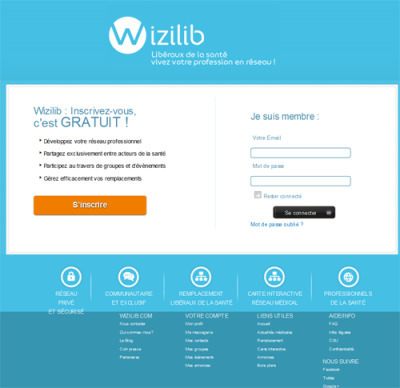
Un nouveau réseau social réservé aux professionnels de santé a vu le jour sur la toile : Wizilib. Présentation. Développé par une équipe de médecins, le site Wizilib.com est un réseau social, gratu...
Via Isabelle Delignière-Léglise
|
|
Scooped by
Lionel Reichardt / le Pharmageek
November 20, 2012 9:26 AM
|
Le groupe Sigma, expert en édition de logiciels, conseil, intégration, et infogérance, annonce l’obtention de l’agrément d’hébergeur de données de santé à caractère personnel pour son activité d’infogérance.
Restructuring healthcare delivery into an mHealth ecosystem November 05, 2012 | Rick Krohn, MA, MAS - President of HealthSense The Centers for Disease Control and National Institutes for Health report that more than 50 percent of the factors related to personal health can be traced to lifestyle choices, while only 10 percent are related to the medical care system. This finding illustrates a stark truth: The U.S. healthcare system in its current incarnation, a system of facility-based, episodic care, is insufficient to the task of improving population health. It's a growing crisis; an aging population, clinical staff shortages, cost inflation and uneven quality are heading us toward a potential healthcare tsunami. [See also: mHealth has 'implied, but vital' function in Stage 2 final rule] What is needed is a delivery system with a greater array of provider-patient touch points, with better care coordination and clinical collaboration, with diagnostic tools for self care, with aligned incentives and with the capability of achieving behavioral change across the spectrum of healthcare stakeholders. What is needed is a patient-centric healthcare ecosystem.
Via rob halkes
We've previously reported several times on the interaction between physicians and pharmaceutical companies.
Via Dan Baxter
|
|
Rescooped by
Lionel Reichardt / le Pharmageek
from Pharma Hub
November 20, 2012 9:15 AM
|
Asip Santé : Développer la e-santé sur le terrain, cela veut dire bénéficier d’instances régionales qui soient plus proches des professionnels de santé comme des patients.
Via Philippe Marchal
|