


Telcare (Bethesda, MD) has announced winning European clearance to begin marketing its smartphone-like blood glucose meter, a device already approved for


Une veille sur la santé numérique en France et à l’international : politiques publiques, données, infrastructures, IA, services et usages. Études, rapports et retours de terrain sélectionnés par Lionel Reichardt, Pharmageek, pour comprendre les transformations et éclairer les décisions.
 Your new post is loading...
 Scoop.it! Telcare (Bethesda, MD) has announced winning European clearance to begin marketing its smartphone-like blood glucose meter, a device already approved for 
No comment yet.
Sign up to comment
Scoop.it!
Scoop.it!

A great post from Mat Philips (@neovoca) detailing how to get started in social listening, and his favourite 15 pharma-related hashtags:
1. #Pharma General, worldwide industry. Often news on companies, academic studies, drug releases, corporate communications and regulatory articles 2. #DigitalHealth Covers innovative spectrum of technologies that achieve specific health outcomes, articles include medical devices, sensors & health data 3. #mHealth ‘Mobile health’, the practice of medicine and health initiatives supported by mobile devices inc. smartphones, tablets & computers 4. #PatientEngagement Patients invested in their own care. The valuable relationship patients have with health stakeholders, most commonly healthcare providers 5. #hcsm ‘Healthcare social media’ throughout the world, interactions that create & share valuable medical information that support patient care 6. #hcsmeu ‘Healthcare social media Europe’, the same as #hcsm but focused within Europe, this often reflected in the difference in regulation 7. #hcmktg ‘Healthcare marketing’, best practice including digital, multichannel and email marketing as well as ethical and regulatory considerations 8. #HIT/HealthIT ‘Healthcare information technology’, provides umbrella coverage of management of health information across computer systems 9. #HealthApps ‘Health applications’, computer software that performs a useful task relative to healthcare. Usually regarding smartphones & tablets 10. #ePatient ‘Electronic/internet patient’, health consumers who utilise the internet and electronic communication tools to gather medical information 11. #EHR/EMR* ‘Electronic health/medical records’, systematic collection, storage and utilisation of electronic health/medical data 12. #QuantifiedSelf Data acquisition of an individual’s daily life input, often covers individual’s health data via wearable technology 13. #BigData Large & complex data sets from which trends and meaningful insights can be found. Covering capture, storage, visualisation and analytics 14. #Gamification The integration of game mechanics in a non-game context in order to engage user, solve problems and derive specific outputs 15. #MedEd Comprehensive coverage of medical education including curriculum content, engagement, delivery and healthcare professional bodies

Tim Mustill's curator insight,
May 17, 2013 7:45 AM
Nice one Matt (and Andrew) - defo worth a reScoop 
Relatris's curator insight,
June 2, 2013 8:29 AM
If you like to start getting into the vast world of twitter and trying to understand how conversations about pharma topics work, this list is definitively a good starting point. Also check out Pharma Open Access Meducation (http://stwem.com/2013/05/08/phoam-is-the-concept-phoamed-is-the-hashtag-introducing-pharma-open-access-meducation/)
Scoop.it!

rob halkes's curator insight,
May 17, 2013 2:03 AM
It is from Kantar health - so expect some commercial promotion as well, but there are interesting findings and opinions to see.. ;-)
Scoop.it!
A new report shows that healthcare communications professionals prefer YouTube over Twitter, Facebook and LinkedIn.
According to the study, conducted by Ideahaus and published in the current issue of the Journal of Communication in Healthcare, professionals within the healthcare space are rapidly shaping best practices for marketing communications, despite the lack of FDA guidance in the use of social media in healthcare.
The study measured the attitude of 107 healthcare, pharmaceutical and life sciences executives on the use of social media, according to a May 15 news release. Survey respondents hold positions from CEO to CIO, from marketing director to brand manager, are active in their positions and serve primarily in the United States. “The results are surprising, especially given the historically conservative nature of the healthcare marketing community,” the news release said.
The survey focused on those who are tasked with the development, creation and delivery of brand and product information to target audiences. When asked about whether marketers should be permitted to use social media to promote their products and services to the public, most were positive. The mix of media (i.e. YouTube, Flickr, Twitter etc.) appears to be as important as the message.
The data indicates healthcare communications professionals are most reticent to adopt Twitter, a mainstream corporate communications tool. YouTube's acceptability was pervasive, in fact twice that of Flickr or Twitter. The study also flushed out a number of perceived risks of embracing social media marketing in healthcare communications.
Intuitively, Twitter would have seemed to be the most likely adopted marketing tool based on its 140-character limit: no photos, few words, simple messages and clean delivery. But this is not the case for surveyed healthcare communications professionals, researchers said. Via Parag Vora
Scoop.it!

Mayo Clinic-powered heart patient sensor commercially launches http://t.co/6u4vbgDhkc #hcsm
Scoop.it!

Pour permettre aux entrepreneurs et experts - français et américains - du secteur de se rencontrer, l'Atelier BNP Paribas a consacré l'une de ses récentes "Learning Expeditions" à la santé digital... Via Philippe Loizon
Scoop.it!

FirstWord Pharma - Gain Access to the Information You Need Track the Companies, Via Richard Meyer, eMedToday

eMedToday's curator insight,
May 14, 2013 9:12 PM
The question for a Pharma? How do you effectively market new products. The answer: Use e delailing which ideal platform to provide accurate, reliable information to doctors
Scoop.it!

Following up the presentation of our project with a pharma company in the Netherlands on how Pharma can enhance its impact and reduce costs of marketing, we present our chalkboard sketch to construe a new commercial model for a pharmaceutical market approach: An approach that would guide the decision makers in the company to construe the right set of activities to focus on accounts with the best chances of success, engage with its decision makers on drug prescription effectively and provide added value to their medicines so as to help care providers to help their patients better. The model starts with the acknowledgement that there is not one right way for approaching all different markets to pharma with a standard approach. Preference schemes for drug selection, local protocols, reimbursement schemes, actual health care systems’ conditions, drug prices, different stakeholders and the very portfolio of the company, can only lead to the conclusion that differentiation should be the name of the game. (see here). The model needs to accommodate for these different conditions. Via rob halkes

's comment July 3, 2013 10:46 AM
The stakeholder landscape is expanding, but still it´s physicians driving topline by prescription. Related complexity and required resources to serve physicians force companies to focus the development of new and efficient multichannel approaches.
However, it seems the pharmaceutical industry does not exploit the full potential of Multichannel Excellence. To find out where the industry expects chances and which hurdles keep them from reaching expectations, Camelot Management Consultants and TaylorWessing would be thrilled if you shared your opinion on our survey´s hypothesis. Of course, we are more than happy to share the consolidated results! https://de.surveymonkey.com/s/MultichannelExcellence
Scoop.it!

Accenture Eight-Country Survey of Doctors Shows Significant Increase in Healthcare IT Usage
eMedToday's curator insight,
May 15, 2013 9:37 PM
An Accenture survey among 3,700 doctors in eight countries reveals that today’s doctors are going digital—now more than ever before. In fact, the recent Accenture Doctors Survey showed a spike in healthcare IT usage across all countries surveyed (Australia, Canada, England, France, Germany, Singapore, Spain and the United States). A digital platform is the best way to reach doctors
rob halkes's curator insight,
May 16, 2013 1:54 AM
New proof of development into the desired direction..? ;-)
Scoop.it!
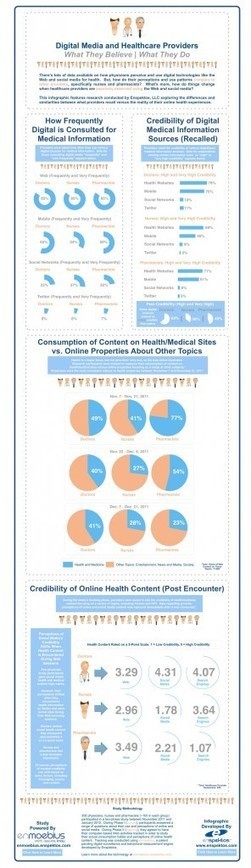
There is a lot of data available about how physicians perceive and use digital technologies. Yet, less is known about how their perceptions and use patterns compare to other health providers. In addition, there is very little research on how things change when providers are passively observed utilizing the Web to research and consume medical information.
This infographic features research from a stand-alone digiheatlh pulse study conducted between late 2011 and early 2012. It explores the differences and similarities between what providers recall versus the reality of their online experiences. This infographic was published in Summer 2012.
Scoop.it!
Les smartphones et les tablettes se font peu à peu une place dans la trousse à pharmacie.
|
Scoop.it!

APPEL A CANDIDATURE – 20 Minutes et IDS Santé recherchent 1000 volontaires qui porteront pendant six mois le Fitbit que nous leur offrirons.Objectif: faire avancer la science. Via Tiffany Jésus

Tiffany Jésus's curator insight,
May 18, 2013 3:12 AM
Participez à une étude unique sur le Quantified Self ! Un petit pas connecté, un grand pas pour votre santé
Participez à une expérience mondiale unique dans 4 grandes villes françaises !
Selon l’OMS, la sédentarité serait le 4ème facteur de risque de décès dans le monde et la cause principale de 21 à 25% des cancers du sein ou du côlon et de 27% des cas de diabète (1).
Aujourd’hui le développement des smartphones et la miniaturisation des capteurs permettent de mesurer un certain nombre de paramètres vitaux révélateurs de notre état global (poids, activité physique, nutrition, sommeil, etc).
En maîtrisant soi-même certaines mesures simples au quotidien (nombre de pas, nombre de calories brûlées, nombre de kilomètres parcourus) à l’aide d’outils accessibles, nous pouvons améliorer nos propres ressources et notre capital santé.
IDS Santé, société spécialisée depuis 20 ans dans les domaines de la prévention, de l’éducation santé et de la communication médecins-patients lance l’opérationwww.mysantemobile.fr sous le haut patronage du Ministère délégué chargé des PME, de l’Innovation et de l’Economie numérique dans 4 grandes villes françaises : Bordeaux, Lille, Lyon et Montpellier.
1000 volontaires seront équipés chacun d’un coach électronique intelligent qui mesurera et suivra leur activité physique pendant six mois.
JE M'INSCRIS !
• 15 mai 2013 : Lancement de www.mysantemobile.fr etrecrutement de 1000 candidats dans 4 villes (Bordeaux, Lille, Lyon et Montpellier),
L’agrégation des données « anonymisées » recueillies sur les 1000 volontaires permettra de suivre en direct et pour chaque ville le nombre de pas, le nombre de calories brûlées et le nombre de kilomètres effectués.
Il sera alors possible de savoir en un temps T, si l’on marche plus à Bordeaux qu’à Lille.
Les données recueillies feront l’objet d’un traitement statistique par l’institut MediQual Research, afin de tirer des enseignements pour les différents acteurs de l’opération :
Pour en savoir plus et vous inscrire dans votre ville (Bordeaux, Lille, Lyon et Montpellier) : www.mysantemobile.fr
www.mysantemobile.fr est une initiative unique réalisée par IDS Santé en partenariat avec fitbit.
(1)http://www.sante.gouv.fr/qu-est-ce-que-l-activite-physique.html
Source/Auteur : IDS Santé & My Santé Mobile
Date : 14/05/2013
Scoop.it!

From
frenchweb

En France, Google Chrome (27,2%) devance Mozilla Firefox (24,4%) mais reste de peu derrière Internet Explorer, en… Via Kevin Dangu
Scoop.it!
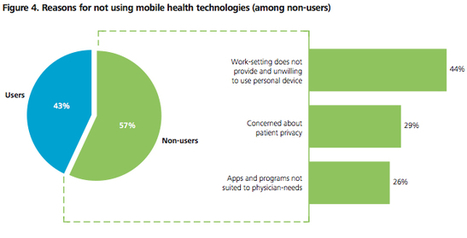
A recent survey by Deloitte found that 43 percent of doctors use smartphones or tablets for clinical purposes, which the firm suggested included EHR access, e-prescribing, and physician-to-physician communication. Via Olivier Delannoy

Antoine POIGNANT, MD's curator insight,
May 16, 2013 12:04 PM
Presque un médecin sur deux... Budget digital moyen < 10 % au maximum !!! Un bel avenir pour http://www.meditailing.com ;-)
eMedToday's curator insight,
May 16, 2013 8:54 PM
And 63% of doctor use mobile for medical reference. The conclusion is that Pharma's need to interact with doctor via mobile devices
Scoop.it!

Les Digital Mums* sont ces mamans ultra-connectées sur les réseaux sociaux, accros à leurs smartphones. Voici une Infographie de leurs comportements. Via sylvie Royant-Parola, Isabelle Delignière-Léglise

sylvie Royant-Parola's curator insight,
May 16, 2013 2:03 AM
Ces mamans digitales sont plus connectées au web et aux réseaux sociaux que la moyenne de la population. Signe d'unchangment de comportement.
Scoop.it!

Pharma Crisis? Improving Adherence Could Save You Billions! http://t.co/gQzIGKvBsY #Patient #Adherence #Pharma
Scoop.it!

Merck targets docs with revamped UK website and healthcare apps Via eMedToday
eMedToday's curator insight,
May 15, 2013 10:22 PM
Summary:
For the U.K. version of Univadis, physicians get free access to a library of medical apps for their work in 50 specialty areas. The company joins other global pharma companies such as Sanofi, Roche )/Genentech and others to offer apps with physicians in mind. The apps benefit from the wide use of Internet-connected devices in medicine. As MSD noted from a 2011 study, 87% of healthcare pros in the U.K. believe that the Internet serves an important role on a daily basis. There are about 400 mobile apps in the Pharma industry
Scoop.it!

How doctors prefer to engage with pharma part two - Articles In the second part of this new series, an oncologist, referred to as Doctor B, tells pharmaphorum's Rebecca Aris how he prefers to engage with the pharma industry and how this engagement... Via Ricard Robledo, Nikos Papaioannou
eMedToday's curator insight,
May 15, 2013 9:24 PM
The last Q&A:
RA: If you could completely redesign the way that doctors and the pharma industry interact what would this look like? DB: I think we should all be under one umbrella. Somehow there should be a gold umbrella covering industry, doctors and the users of pharmaceutical products.
The best one umbrella is one clincial platform, call e detailiing. One good defination
Use targeted self- guided e detailing, to quickly give technology smart doctors, at their convenience, creditable, accurate and value added drug, point of care and CME information and order sample opportunities with a strong focus on multi- media “ fully integrated solution
Scoop.it!

14 mai 2013: Conférence de presse à l'Université Pierre et Marie Curie (UPMC) pour la présentation des résultats de l'étude réalisée par les étudiants du Master Marketing de la Santé. ... Via catherine cerisey
Scoop.it!

For years, many mobile insiders proclaimed “201_” is the year of mobile. While I can’t say when/if it actually happened, 2013 is defin Via Philippe Marchal
Scoop.it!
To understand why parents balk at routine vaccinations for their kids, London-based drug giant GlaxoSmithKline undertook a project to mine parent websites with text analytics software from an MIT spinoff. As reported by the Wall Street Journal, the project has led the drugmaker to reconsider how it helps physicians communicate with parents about inoculating their children.
Scoop.it!
|





