


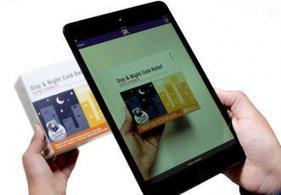
L'examen médical bientôt... sans médecin Le Quotidien du Médecin Peut-on confier un examen clinique à une machine ? Oui, répond Tytocare.


Une veille sur la santé numérique en France et à l’international : politiques publiques, données, infrastructures, IA, services et usages. Études, rapports et retours de terrain sélectionnés par Lionel Reichardt, Pharmageek, pour comprendre les transformations et éclairer les décisions.
 Your new post is loading...
 Scoop.it! L'examen médical bientôt... sans médecin Le Quotidien du Médecin Peut-on confier un examen clinique à une machine ? Oui, répond Tytocare. 
No comment yet.
Sign up to comment
Scoop.it!

Entretien avec Eric Phélippeau, Président élu de la FNIM. Un Prix Spécial FNIM au Festival de la Communication Santé 2013 Dans le cadre du Festival, la FNIM va solliciter ses 55 adhérents pour sélectionner leurs 3 projets préférés et décerner le Prix Spécial FNIM. L'ensemble des campagnes seront soumises à l'appréciation des adhérents avec comme ligne de conduite les 3 critères suivants : • L'originalité du concept • L'originalité créative • L'originalité du message Pour adhérer contactez : Via Festival Communication Santé
Scoop.it!

Les principaux enseignements du sondage : Via nathalie Bissot-Campos
Scoop.it!

The formula for disruption is not necessarily becoming smarter, but becoming more aware and creating organizations that can adapt to an ever changing context. Via Celine Schillinger

Anne Landreat's curator insight,
October 20, 2013 7:31 AM
- Focus On Passion - Build In And Then Build Out - It’s Not The Nodes, But The Network - Networks Trump Hierarchies - Stop Planning and Start Adapting
Scoop.it!
Your source for news, trends and analysis of pharmaceuticals, biologics, medical devices, and nutraceuticals. HCP Cover Image. Cover Gradient ...
Scoop.it!

If you're wondering what a pharmaceutical company is doing in social media, you're not alone. Regulation, corporate culture and touchy subject matters kept Via Nikos Papaioannou
Scoop.it!

Melissa Thompson takes an interesting look at mobile healthcare in her Huff Post article about Frictionless Health. First I love the concept of frictionless healthcare. There is almost nothing about healthcare today that’s frictionless. Via Emmanuel Capitaine

eMedToday's curator insight,
October 19, 2013 4:04 AM
The phone will become our healthcare brain. It will know everything about our healthcare.
Scoop.it!

Reporter John Gray attended the Interface 2013 healthcare conference. He concludes that no app will save us from ourselves. (Digital medicine is here. Via Emmanuel Capitaine
Scoop.it!

Alors que la santé se numérise pour faciliter les échanges entre médecins et malades, le cabinet PwC lance un signal d’alarme. Via Henri Lefèvre
Scoop.it!

Orca Health, a Sandy, UT-based mobile healthcare company has developed, with the help of Harvard Medical School, a suite of interactive mobile apps that us
Scoop.it!

The company will "fill the bag" of its sales reps, as part of a reorganization that also includes 8,500 job cuts and a more refined R&D focus. Via Thibaud Guymard
Scoop.it!

Hats off to Boehringer. Great presentation. These were just some of the Tweets from another digital pharma conference where "the industry circle" gets together to congratulate one another on the ... Via uri goren
Scoop.it!

Analysis of the influence of technology and smartphones in the field of medicine and how it they can be used to look after our health. @MWCBarcelona Via ET Russell
|
Scoop.it!

Xbox One, Kinect 2.0 and the future of health technology http://t.co/mOZK6WK6M2 Via Emmanuel Capitaine

Brandi Carney's curator insight,
January 29, 2014 2:51 PM
The future of health technology includes gaming in order to stay healthy and maintain your weight.
Scoop.it!

epgonline.org provides medical, disease and drug information for doctors. Search the drugs database, disease specific knowledge centres, guidelines, clinical trials, journal publications, conference diary, social media and apps directory.
Scoop.it!
Among different applications, cardiac monitoring and fitness tracking are the most prominent uses of mobile-enabled connected devices. With increasing awareness of the need for healthy lifestyles, patients prefer vital signs ... Via Emmanuel Capitaine
Scoop.it!
Scoop.it!

Reported in UK marketing and media magazine The Drum, he said, “We [Procter & Gamble] try and see it for what it is, which is a tool for engaging people with fresh, creative campaigns… the era of digital marketing is over. Via eMedToday
eMedToday's curator insight,
October 19, 2013 7:57 PM
Good advise for Pharmas
Digital is a delivery mechanism not a discreet channel; he wants marketers to see technology simply as a way to reach people.
Scoop.it!
Mediator, pilule de 4ème génération, sur-exposition radiologique, les erreurs et les accidents thérapeutiques sont inévitables.
Scoop.it!

SMS, Internet : les Français plébiscitent les échanges virtuels avec ...
Scoop.it!

1. What is the best way for doctors to gather information about which social media platforms their patients use regularly and consider influential? Should doctors inquire about social media use as part of intake questions with new patients? Should such questions be included as part of any follow-up visits? The best source for data on social media use is the Pew Internet & American Life Project. It regularly performs surveys that provide current demographic data on social media use. For instance, this past August it looked at Twitter, finding that 18% of Internet users are on Twitter, and that Internet users ages 18–29 are most likely to use Twitter. In 2012, it found that 67% of online Americans use Facebook. Some doctors should always inquire about social media use in their patients. Pediatricians, for instance. Guidelines from the American Academy of Pediatrics now recommend that questions regarding social media use should be routinely asked to child and adolescent patients. Phenomena such as cyberbullying, “Facebook depression,” sexting and exposure to inappropriate content are all issues about which pediatricians are uniquely positioned to educate patients and their families. To my knowledge, there are no guidelines for internal medicine physicians like me to include social media as part of intake questions. I do so if time allows, or if patients ask me directly. Rather than focus on social media specifically, a broader approach to how to search for reliable health information and interpret what patients read online is more helpful, and should be regularly included as more patients consult Google first before visiting their doctors. 2. Given that HIPAA prevents doctors from revealing identifiable personal details of their patients’ cases, what types of information can doctors communicate through social media that advance knowledge, provide guidance and broaden perspective—without any breaches in confidentiality? Social media are ideal to connect with patients collectively, but not individually. So, when educating patients on a social network, speak to them as a group. With health news stories breaking on a daily basis, there is ample opportunity for providers to get online and share their perspective. Consider cancer screening. Over the years, there have been continual changes in breast cancer and prostate cancer screening guidelines. And this confuses patients. I often have men in the exam room asking, “Should I be checking my PSA, or not?” I don’t blame them. The mixed messages that are often reported make cancer screening anything but black and white. I use KevinMD.com as a forum for cancer screening experts and other primary care doctors to share their expertise. They often talk about issues that aren’t often reported, such as the implications of a false positive cancer screening test. This is information that patients need in order to make an informed cancer screening decision. Speaking to patients as a collective on social media should steer providers away from any privacy risks. If an unknown patient reaches out and asks a personal health question to a doctor on social media, the physician should not answer. Instead, take that conversation offline with a standard response that asks the patient to call the office and make an appointment, or if an emergency, to call 911 or go to the emergency department. 3. For a doctor who wants to choose a single social media platform to focus on first—which do you recommend? Why might someone choose Twitter or Facebook over a blog, or vice versa? The first social media platform a doctor should choose is LinkedIn. Spend about 30 minutes or so and create a LinkedIn profile, which is a digital version of your CV. The benefit is that LinkedIn profiles get ranked high on a Google result page, so when patients Google you, a LinkedIn page tends to get seen first, above, say, a profile from a physician rating site. And if that’s all a doctor has time for, that’s fine. That simple act will already put him or her ahead of many of his or her peers. Twitter, Facebook and blogs all have different strengths, which a doctor can use depending on what his or her goals are. I use Twitter mainly to listen and curate information. I have a Twitter list of 40 or so healthcare personalities I follow several times daily, and it’s an invaluable resource for me to filter the hundreds of health stories that percolate up every day. Other doctors use Twitter to share interesting articles they have read, or participate with other individuals who share similar interests on Twitter chats. Facebook tends to have a younger demographic, so some practices, like MacArthur Obgyn, use Facebook to educate teenagers on issues such as STDs and teenage pregnancy. I consider the self-hosted blog to be the “hub” of a social media presence. The reason is that you own the content and have complete control of its presentation. Contrast that to Twitter or Facebook, where your content resides on their servers, and you are at the whim of their constantly changing privacy settings and terms of agreement. However, I appreciate that people may consume information only on specific social media platforms, so I engage users beyond my blog. My posts are syndicated on Facebook and Twitter, where people can read KevinMD.com and continue the conversation even if they don’t visit the site. 4. For many doctors and other busy healthcare professionals, the challenge isn’t so much “getting on social” but “staying active” on social. How can doctors find time in demanding schedules to grow and maintain their social media presence? I don’t have a problem with doctors not staying active. I disagree that the challenge of getting doctors on social media has been met. I speak to hundreds of doctors every year who don’t yet see the value of social media in the healthcare setting. Convincing them to spend 30 minutes to create an online presence with LinkedIn is a victory in itself. Staying active requires buy-in from healthcare leaders and administrators. The reason why the Mayo Clinic is so successful with physician social media engagement is that social media are part of its DNA, from the CEO on down. Unfortunately, the Mayo Clinic is more the exception than the rule. For doctors to stay active on social media, it needs to be part of the job description. Doctors need protected social media time, where they can write blog posts or create videos to be shared. Social media cannot be “one more thing to do,” added onto a physician’s plate. Replacing a half-day session a week of seeing patients with social media time to create content would be a reasonable goal. Healthcare leaders and administrators are the ones who can make that happen. In the current fee-for-service (FFS) payment system, this can be challenging, but health reform is promoting new models that are shifting away from FFS and better valuing communication with patients. Perhaps in the coming years, when payment isn’t tied to the number of patients seen, communicating with patients can be emphasized, whether it’s through a phone call, email, or social media. 5. What tools do you find most helpful in maintaining an active, engaged Twitter presence? An active, engaged Facebook presence? An active blog? The key to maintaining engagement is a regular posting schedule. I schedule posts on KevinMD.com up to two weeks in advance, and they’re published seven times throughout the day. As I continue to see patients full time in my primary care clinic, I acknowledge that I’m not utilizing Facebook and Twitter to their fullest potential by actively conversing on those platforms. That said, there is value to syndicating KevinMD.com posts on Twitter or Facebook. As I mentioned previously, some people consume content only on those specific sites or don’t read blogs. Buffer is an invaluable tool to schedule posts on the major social media platforms. Once a post is published on my blog, it can be syndicated on Twitter or Facebook according to a customized schedule. To manage Twitter, I use Hootsuite, where my mentions, Twitter lists and hashtags can be followed on a single screen. That window stays open throughout the day, and is checked regularly on my mobile devices. 6. It’s 2018. You’re a practicing physician. What is the “norm” for your relationship with your patients on social media? I see future trends as an evolution of something current, rather than a singular disruptive change that can transform healthcare overnight. Remember that Facebook didn’t invent the social network; it was an evolution of Friendster. And Apple’s iPad only refined the tablet, which was originally introduced by Microsoft in 2002. With that in mind, I see doctors and patients communicating on closed social networks that are an evolution of what patient portals are today. Healthcare is consolidating rapidly because of reform, and most patients eventually will be part of large, integrated healthcare systems. Picture Kaiser Permanente replicated nationwide. Those systems are, in essence, communities that can be united by a social network. Medical team members within that community would have access to patients’ charts and can interact with patients using social media concepts that are used today. Open social media platforms, of course, will evolve, and will continue to play a role in educating the public at large. But privacy and security are big concerns in healthcare, and I don’t envision a scenario anytime soon where a doctor can diagnose and treat individual patients over an open social network like Facebook or Twitter. - See more at: http://blogs.einstein.yu.edu/q-a-with-kevinmd-doctors-patients-and-social-media/#sthash.90CGoYeA.dpuf Via Plus91
Scoop.it!

Healthcare needs IT innovation. Yet, what does healthcare want from IT... and will you step up and deliver it?
Scoop.it!

Increased competition, health care reform, difficulty bringing new drugs to market and many other challenges face pharmaceutical companies. Technology is a fundamental component of meeting those challenges. Via Thibaud Guymard
Scoop.it!

What would happen if mobile health became addictive? This article by Joseph Kvedar, MD of the Center for Connected Health lays out how mobile devices have Via Sam Stern
Scoop.it!

Just as Big Data is transforming public health research, so too is it giving us new tools to explore the history of public health. One intriguing tool in this endeavor is of Google’s Ngram Viewer, ... Via Emmanuel Capitaine
|





