


“CDW Healthcare's healthcare mobility trends infographic explores the adoption of tablets by doctors, the impact on hospitals and potential savings.”
Via eMedToday


Une veille sur la santé numérique en France et à l’international : politiques publiques, données, infrastructures, IA, services et usages. Études, rapports et retours de terrain sélectionnés par Lionel Reichardt, Pharmageek, pour comprendre les transformations et éclairer les décisions.
 Your new post is loading...
 Scoop.it! “CDW Healthcare's healthcare mobility trends infographic explores the adoption of tablets by doctors, the impact on hospitals and potential savings.” Via eMedToday 
Scoop.it!

In 2014, pharma need to create dynamic content, created to deliver the right message, to the right person, at the right time. Via COUCH Medcomms, eMedToday

eMedToday's curator insight,
November 6, 2013 6:55 PM
“massively useful information, provided for free, that creates long term trust and kinship between your company and your customers.”
eMedToday's curator insight,
November 6, 2013 7:05 PM
This is exactly what Pharma need to do for e detailing in addition to product knowledge “massively useful information, provided for free, that creates long term trust and kinship between your company and your customers.”
Scoop.it!
Scoop.it!

Well-capitalized digital health entrepreneurs targeting surgeons seize the Google Glass opportunity. Via Sam Stern
Scoop.it!

Dans une étude sur la compétitivité de l'industrie française, le cabinet McKinsey estime que les entreprises...
Scoop.it!

Nouvelle web-série pour promouvoir le bon usage des médicaments
Scoop.it!

Mobile devices are uniquely positioned to make a significant contribution to medical imaging. Portability, computing power, accessibility and built in internet connectivity are well described advantages of mobile devices. There is a growing body of research which supports the use of mHealth technologies for imaging, and a number of novel uses are described in the literature. The role of mobile devices in medical imaging has broaden to encompass a broad range of functions including diagnostic purposes, facilitating triage of emergent conditions, improving communication between health care providers to expedite patient care, and providing a feasible system for patient follow-up and self monitoring. The ever increasing capabilities of mobile technologies have also enabled their purpose to expand beyond simply an image capturing tool. This has been reflected in a spectrum of basic sciences, medical and surgical specialties, and public health that are using the imaging capabilities of mHealth to improve access and delivery of patient care. One of the more novel fields of mHealth emergence is in its role as a diagnostic instrument in the laboratory. Traditionally, laboratory tasks such as microscopy, fluorescent imaging, and enzyme-linked immunosorbent assays (ELISA) require sophisticated and expensive equipment. In this context, the use of mobile technology has been explored as a viable adjunct for laboratory imaging to perform calorimetric analysis of fluid to detect biomarkers of ovarian cancer, microscopy to detect giardia lamblia,and optofluidic assessment for rapidly performing cell counts of body fluid samples. The use of mobile devices for medical imaging is rapidly growing, with many traditional imaging techniques being challenged. With increasing image quality, and software designed to take advantage of the computational power of smartphones, combined with rapidly declining costs, mHealth imaging has the potential to change the future of medical image capture. read more at the original source: http://www.journalmtm.com/2013/the-utility-of-mhealth-in-medical-imaging/
Via nrip
Scoop.it!
Scoop.it!

Saudi doctors are increasingly using their Twitter accounts to share with the public medical information, in a bid to publicize their services and help raise awareness about health issues.
“I have noticed that many people Google symptoms of a certain illness and what they find on the Web is usually not 100 percent accurate, which bothers us as doctors because it misleads patients,” said Dr. Nawal Andijani, a pediatrician.
“I have parents crying in my clinic thinking their children have a disease because the Internet told them so. This has prompted me to share information on my social media pages about different illnesses children might experience during each season just to relieve mothers,” she added.
“Beauty seekers follow me on Twitter and Facebook searching for new ideas and home remedies to have great skin. I always try to tweet new ways to help them protect their skin from the sun, cold weather and more,” she said. “Many of the people who follow me on my social media accounts actually come and visit me at the clinic for treatment, which is how I have come to realize the importance of this platform for my business and reputation as a doctor,” she added.
Social media is a powerful tool; doctors who use it are very smart as they are helping other people as well as themselves, according to Dr. Usama Darweesh, a cardiac surgeon.
“I share light tweets about various health issues such as obesity and smoking but not surgeries because I try to tweet beneficial information for the average individual, without going into great detail about complex medical procedures,” he said, adding, “I have people asking me for online consultations and I give them the right answer, which has helped me gain more followers and more patients in my clinic.”
Fitness instructors have also followed suit in subscribing to social media to share their experience and advice.
“I’m constantly trying to find ways to spread awareness against obesity and the benefit of sports and daily exercise. In my social media accounts, I share photos and studies about the harm of laziness,” said coach Mohammad Hasan. “You will be surprised how many people are waiting for someone to push them to go to the gym. I sometimes meet with my Twitter followers for free sessions just to help them get over their fear of sports,” he added.
Via Parag Vora
Scoop.it!
Via Philippe Marchal
Scoop.it!

Industrie pharmaceutique : le digital, c'est maintenant ! Les Échos LE CERCLE. En collaboration avec le MIT Center for Digital Business, nous avons mené un programme de recherche sur la Transformation Digitale des grandes entreprises dans le monde. Via Esposito Christelle
Scoop.it!

iMedicalApps had the opportunity to talk with leaders in mobile health Health 2.0's 7th Annual Convention. Via John Bennett MD
Scoop.it!
|
Scoop.it!

“Dr Russell Faust discusses the real role of a content marketing officer (CMO) in a hospital or large medical practice. He provides eight tips as to how physicians can be included in the marketing conversation, further building the relationship and...”
eMedToday's curator insight,
November 8, 2013 2:33 AM
Content Connecting is about providing useful, accurate, trustworthy healthcare information that your community is looking for...
Scoop.it!
iMedicalApps had the opportunity to talk with leaders in mobile health Health 2.0's 7th Annual Convention. Via John Bennett MD, Lionel Reichardt / le Pharmageek
Scoop.it!

A bias persists that doctors don’t use technology enough, particularly social media and apps. A Poll by Sermo however shows that while some doctors are reluctant to enter the digital pool, once they adopt, they adopt enthusiastically. Doctors are open to adopting more technology to manage their practices and they embrace medical reference apps. The most popular smart phone for physicians is the iPhone according to MedCrunch. A few top apps are listed below Medscape. Used by over 3 million doctors, nurses and medical students worldwide, Medscape is big. You can use it for medical news, clinical reference to things like drugs, diseases, conditions and procedures, and even provides medical education. EpocratesRx. This app is popular for drug interactions, research, Pill ID and medicine calculators. The lite version is free, but you can purchase the full version for $160. NeuroMind is a great app for neurologists, neurosurgeons and med students. It provides basic safety checklist requirements via the World Health Organization, and has “interactive clinical decision support.” It is the number one neuro app with over 140,000 downloads. Original: http://blog.sermo.com/2013/11/06/sermo-poll-mobile-technology-and-app-use-by-physicians/ Via nrip
Scoop.it!
Scoop.it!

AT Internet, spécialiste du web analytics, révèle dans une étude la progression constante du trafic des applications...
Scoop.it!
By Maneesh Juneja, Digital Health Futurist, MJ Analytics In 2 weeks’ time, at Health 2.0 Europe, I am moderating a pre-conference workshop ‘Health 2.0 Tool Via callooh

callooh's curator insight,
November 5, 2013 3:48 PM
How might we use tehnology to connect with seniors while being mindful that their technology needs and attitudes towards tech are different (in general) from other demographics
Scoop.it!
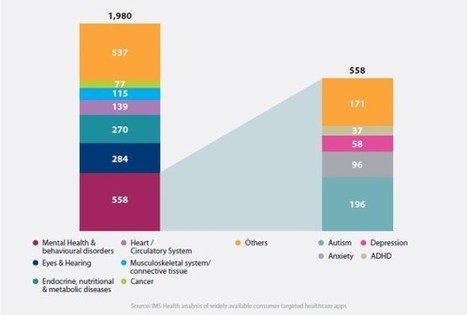
An IMS Health report on consumer facing mobile health apps offers an outlook on the future of mobile health technology and has a breakdown of mhealth apps. Via eMedToday, Giuseppe Fattori
eMedToday's curator insight,
November 5, 2013 7:56 PM
It reasons that apps for the most disabling chronic conditions such as cancer, stroke and arthritis could: Provide information for optimal condition management;Track patient health levels over time (and record improvements in well-being or condition);Help patients communicate with caregivers or other patients for motivation and the sharing of best condition management
Scoop.it!

Scoop.it!
Baromètre du Cessim : basculement vers le digital
C’est le 20 septembre dernier que le Cessim (Centre d’étude des supports d’information médicale), dont l’UDA est membre fondateur, présentait sonBaromètre numérique 2013 sur l’utilisation professionnelle de l'internet par les professionnels de santé. Dans un contexte marché 2013 chaotique, connaissant des bouleversements économiques et technologiques, il fait état d’un nouveau paradigme des systèmes d’information. Le désarmement commercial de l’industrie pharmaceutique et l’augmentation des contraintes du marché (pénétration croissante des génériques, chute des prix, déremboursement, diminution de la démographie en médecine générale, mises sur le marché plus rares, renforcement des règles de transparence) entraînent de fait une réduction significative des dépenses en matière de promotion, avec une visite médicale (VM) en chute libre et une baisse sensible des investissements presse. Via Isabelle Delignière-Léglise, Agathe Quignot
Scoop.it!

A study found just five apps account for 15 per cent of all downloads in the healthcare category, an example say the authors of a significant skew in how the market works. Via rob halkes

rob halkes's curator insight,
November 4, 2013 1:56 PM
Mhealth applications are lowering the threshold to people to be more active with their own health.
eMedToday's curator insight,
November 5, 2013 8:00 PM
Furthermore, the typical app profile does not address the major crisis in healthcare which is patients dealing with chronic diseases, who typically are aged over 65. They are the patients on which most resources are invested, but among whom smartphone penetration is lowest – only 18 per cent in the US against 55 per cent of those aged 45-54. There is a big opportunity for Pharma to develop mobile apps related to chronic diseasess
Scoop.it!

Depends what you want to achieve with your eDetailer: 1 – If you want to show only printed materials then you can use a static presentation app or pdf, such as Keynote, Adove Viewer, iViewer 2 – Going for some […]... Via eMedToday
Scoop.it!

Health workers in developing countries face challenges that are often taken for granted in the developed world, but new technologies have the potential to become leap frog solutions that address such barriers. Major obstacles exist today in the identification of patients, a fundamental issue at the very core of delivery of healthcare in resource poor settings. All too often patients have medical histories that doctors or community health workers (CHW) have no access to. Addressing this difficulty would potentially revolutionise prevention and treatment in a diverse array of public health areas ranging from vaccination campaigns, to prenatal care, to improving treatment adherence in diseases such as tuberculosis and HIV. SimPrints is in the process of developing a mobile-based fingerprint scanner that instantly connects an individual’s fingerprint to health records such as immunisation records and prenatal visits. This Bluetooth-enabled scanner, allows for real time access to health records, which enables CHWs to instantaneously access critical information necessary to provide care. In contrast to paper records sitting unhelpfully back in the clinic office, this technology would enable a CHW to swipe the mother’s fingerprint and receive an instantaneous update of what vaccines they have received and what needs to be administered that day. Via nrip
|







Mobile is the core of future health
mobility is the heart of new pharma marketing.
Do Pharma understand that: No
mobile devices are at the heart of e detailing