E-SANTÉ : COMPRENDRE. RELIER. TRANSFORMER.
315.6K views | +1 today
E-SANTÉ : COMPRENDRE. RELIER. TRANSFORMER.

Une veille sur la santé numérique en France et à l’international : politiques publiques, données, infrastructures, IA, services et usages. Études, rapports et retours de terrain sélectionnés par Lionel Reichardt, Pharmageek, pour comprendre les transformations et éclairer les décisions.

ESSAI
Your new post is loading...
Rescooped by Lionel Reichardt / le Pharmageek from Analytics & Social media impact on Healthcare
May 12, 2014 6:19 AM
Scoop.it!

Healthcare data analytics landscape changing rapidly

Healthcare data analytics landscape changing rapidly | E-SANTÉ : COMPRENDRE. RELIER. TRANSFORMER. | Scoop.it


Nearly half of healthcare organizations responding to a new survey say they  are experiencing a positive return on investment in data analytics and reporting  technology.

The survey, by TCS Healthcare Technologies in conjunction with the Case  Management Society of America and the American Board of Quality Assurance and  Utilization Review Physicians, found the landscape changing quickly from similar  measures taken in 2008 and 2010.

Forty-six percent reported positive ROI, compared with 14 percent who  reported a negative return, according to an announcement

Thirty percent of respondents reported stratifying healthcare information to  promote population-based screening, or to identify candidates for case  management. Meanwhile, just 25 percent reported using predictive modeling  applications, while 35 percent reported doing so two years ago.

Excel (39 percent), Crystal Reports (20 percent) and Access (17 percent)  remain the most widely used applications.

Users cited the importance of dashboard and visualization capabilities,  naming among their priorities the ability to manipulate reports and data  presented and to view trends for individual patients and for large sets of  data.

Applications for population health management that integrate claims and  clinical data are key to the success of accountable care organizations, an IDC Health  Insights report found recently, saying many organizations have found that  relying on EHR information alone isn't enough.

While tools that help organizations with case management have been  touted for their ability to improve care, as New Jersey-based primary-care  practice Vanguard Medical Group experienced, it's not all about the technology.  A Kaiser Permanente study found readmission-prediction software wasn't accurate enough for  it to replace manual review of cases.


Via Chatu Jayadewa
No comment yet.
Scooped by Lionel Reichardt / le Pharmageek
May 12, 2014 3:09 AM
Scoop.it!

San Francisco company aims to become the Wikipedia of medicine

San Francisco company aims to become the Wikipedia of medicine | E-SANTÉ : COMPRENDRE. RELIER. TRANSFORMER. | Scoop.it
What Wikipedia has done for knowledge, a San Francisco company called CrowdMed is betting it can do for medicine. Send your symptoms and a nominal fee to www.crowdmed.com and dozens of medical professionals, students and average Joes will 'crowdsource'' -- that is, share their knowledge and expertise -- to tell you what's wrong with you.
No comment yet.
Rescooped by Lionel Reichardt / le Pharmageek from Health Care Social Media And Digital Health
May 12, 2014 2:54 AM
Scoop.it!

Oh, the Pozibilities!

Oh, the Pozibilities! | E-SANTÉ : COMPRENDRE. RELIER. TRANSFORMER. | Scoop.it

Dr Jessica Browne is a Research Fellow at The Australian Centre for Behavioural Research in Diabetes, a partnership for better health between Diabetes Australia – Vic and Deakin University. Jessica, along with her colleague Adriana Ventura, is running the Diabetes Stigma Project campaign on Pozible until 10th June 2014.  In today’s guest post, Jessica provides some background to the project and ways in which you can help support it.


Via Marie Ennis-O'Connor
No comment yet.
Rescooped by Lionel Reichardt / le Pharmageek from Pharma Hub
May 6, 2014 12:58 AM
Scoop.it!

2 Français sur 3 considèrent que la e-santé peut limiter les coûts

2 Français sur 3 considèrent que la e-santé peut limiter les coûts | E-SANTÉ : COMPRENDRE. RELIER. TRANSFORMER. | Scoop.it
Une étude annuelle vient d'être réalisée par le cabinet Deloitte/IFOP sur la manière dont les Français perçoivent leur système de santé.

Via Philippe Marchal
No comment yet.
Rescooped by Lionel Reichardt / le Pharmageek from Buzz e-sante
May 3, 2014 2:51 AM
Scoop.it!

Prochaine rencontre IRL le 20 mai 2014 aux Salons de la Santé et de l'Autonomie

A l'occasion de la deuxième édition des Salons de la Santé et de l’Autonomie, le Club Digital Santé  organise une nouvelle rencontre IRL de la communauté le 20 mai prochain. Nous avons le plaisir d...

Via Rémy TESTON
No comment yet.
Rescooped by Lionel Reichardt / le Pharmageek from #eHealthPromotion, #SaluteSocial
April 28, 2014 1:16 PM
Scoop.it!

Green Paper on mobile health ("mHealth")

The objective of this Green Paper, announced in the eHealth Action Plan 2012-2020, is to launch a broad stakeholder consultation on existing barriers and issues related to mHealth deployment and help

Via Giuseppe Fattori
No comment yet.
Rescooped by Lionel Reichardt / le Pharmageek from Digital marketing pharma
April 28, 2014 12:24 PM
Scoop.it!

Infographic: Time for a digital health check-up

Infographic: Time for a digital health check-up | E-SANTÉ : COMPRENDRE. RELIER. TRANSFORMER. | Scoop.it

Find out how many Americans go online to search for health information.


Via Olivier Delannoy
No comment yet.
Scooped by Lionel Reichardt / le Pharmageek
April 28, 2014 7:49 AM
Scoop.it!

Reviewing the latest advances in Eric Topol's top ten digital health targets

Reviewing the latest advances in Eric Topol's top ten digital health targets | E-SANTÉ : COMPRENDRE. RELIER. TRANSFORMER. | Scoop.it

A nice review of digital health advances in Alzheimer’s, asthma, breast cancer, COPD, depression, diabetes, heart failure, hypertension, obesity, and sleep disorders.

No comment yet.
Rescooped by Lionel Reichardt / le Pharmageek from Digital marketing pharma
April 27, 2014 4:13 AM
Scoop.it!

PwC predicts disruptive entrants for healthcare industry

PwC predicts disruptive entrants for healthcare industry | E-SANTÉ : COMPRENDRE. RELIER. TRANSFORMER. | Scoop.it
The subtitle for this report is “Who will be the industry’s Amazon.com?” This sums up the report nicely as it is an analysis of healthcare looking for destabilizing elements and upstart newcomers that threaten the current balance.

Via Olivier Delannoy
No comment yet.
Rescooped by Lionel Reichardt / le Pharmageek from Ma santé et le digital francophone
April 24, 2014 11:36 AM
Scoop.it!

E-Santé : l'Ile de France enfin connectée? - Allo-Médecins.fr

E-Santé : l'Ile de France enfin connectée? - Allo-Médecins.fr | E-SANTÉ : COMPRENDRE. RELIER. TRANSFORMER. | Scoop.it
Allo-Médecins.fr
E-Santé : l'Ile de France enfin connectée?

Via Emmanuel Capitaine
No comment yet.
Rescooped by Lionel Reichardt / le Pharmageek from Healthy society
April 18, 2014 9:19 AM
Scoop.it!

A “design-pattern”-based approach for analyzing e-health business models

A “design-pattern”-based approach for analyzing e-health business models | E-SANTÉ : COMPRENDRE. RELIER. TRANSFORMER. | Scoop.it

Via Bernard Strée
No comment yet.
Rescooped by Lionel Reichardt / le Pharmageek from Pharmabook
April 16, 2014 11:49 AM
Scoop.it!

Des pistes pour développer l'e-santé - Avril 2014 - Pharmaceutiques

Des pistes pour développer l'e-santé - Avril 2014 - Pharmaceutiques | E-SANTÉ : COMPRENDRE. RELIER. TRANSFORMER. | Scoop.it
Dans un Livre blanc publié fin mars, le Catel (Club des acteurs de la télésanté) définit les enjeux du déploiement l'e-santé en France et émet 12 préconisations.

Via Philippe Loizon
Le Lab Marketing Digital's curator insight, April 23, 2014 4:12 AM


"L'innovation technologique [dans le domaine] des objets connectés" se développe en parallèle de l'"intérêt grandissant des citoyens à prendre en charge leur propre santé, qui selon certaines études, dépend pour 40% de leur mode de vie, pour 30% d'aspects environnementaux, pour 20% de la génétique et pour 10% seulement des soins.


Ces innovations facilitent les prises en charge médicales collaboratives entre tous les acteurs de santé et la participation active du patient", observe Pierre Traineau, directeur général du Catel, qui présente 12 propositions en faveur de l'essor de la e-santé.

Scooped by Lionel Reichardt / le Pharmageek
April 16, 2014 3:37 AM
Scoop.it!

2014-04-02 ASIP Santé WHOIT 2014 "Présentation de l'ASIP Santé"

“Coordination des professionnels de santé dans le parcours à l’échelon d’un territoire : intégrer des services et gérer les échanges d’informations.” Présent...
No comment yet.
Scooped by Lionel Reichardt / le Pharmageek
May 12, 2014 3:10 AM
Scoop.it!

How Technology Can Transform Our Healthcare Labyrinth - Techonomy

How Technology Can Transform Our Healthcare Labyrinth - Techonomy | E-SANTÉ : COMPRENDRE. RELIER. TRANSFORMER. | Scoop.it

According to the Institute of Medicine, the U.S. healthcare system wastes more than $765 billion each year—about 30 percent of our healthcare spending. If we eliminated this waste, over 10 years we could reduce nearly 50 percent of our national debt. The waste is that bad. It’s a huge handicap not only for the lives of every American, but for our overall economy.

No comment yet.
Rescooped by Lionel Reichardt / le Pharmageek from Qualité et sécurité des soins
May 12, 2014 2:57 AM
Scoop.it!

Le DPC décortiqué par l'IGAS : vers une simplification ?

Le DPC décortiqué par l'IGAS : vers une simplification ? | E-SANTÉ : COMPRENDRE. RELIER. TRANSFORMER. | Scoop.it

L’inspection générale des affaires sociales (IGAS) a publié en avril 2014 un rapport concernant le développement professionnel continu (DPC).
Premier constat, le titre de ce rapport est un peu confus : « Contrôle de l’Organisme gestionnaire du développement professionnel continu et évaluation du développement professionnel continu des professionnels de santé ». Contrôle ? Évaluation ? Organisme gestionnaire (OGDPC) ou dispositif complet ? Au final, un peu tout cela. Si la commande ministérielle (lettre de mission datée du 1er juillet 2014, page 61 du rapport) était de contrôler l’OGDPC, les inspecteurs ont rapidement constaté qu’ils ne pouvaient s’intéresser qu’au sommet de l’iceberg. Le champ de leur mission a donc été élargi.
Deuxième constat, le sujet est tellement complexe que la mission d’inspection propose 4 scenarii différents, allant du maintien du système actuel avec quelques retouches à sa suppression quasi-complète… Toutefois, les inspecteurs affichent leur préférence pour un scenario « intermédiaire ».


Via Florentin Clère
No comment yet.
Rescooped by Lionel Reichardt / le Pharmageek from e-patient et e-santé
May 6, 2014 1:15 AM
Scoop.it!

Vers un management éthique de l’e-communication médicale ? | Questionner le numérique

Vers un management éthique de l’e-communication médicale ? | Questionner le numérique | E-SANTÉ : COMPRENDRE. RELIER. TRANSFORMER. | Scoop.it
#e_santé, #éthique de l’information médicale au cœur de la relation asymétrique médecin-patient http://t.co/AbtCQiWtmJ @CIGREF

Via Marie Françoise de Roulhac
No comment yet.
Rescooped by Lionel Reichardt / le Pharmageek from Actu Pharmacovigilance
May 3, 2014 2:53 AM
Scoop.it!

European Medicines Agency - Monitoring the safety of medicines: European Medicines Agency presents first report on implementation of pharmacovigilance legislation to the European ...


Via EVELYNE PIERRON
No comment yet.
Rescooped by Lionel Reichardt / le Pharmageek from Hospitals: Trends in Branding and Marketing
May 1, 2014 1:25 AM
Scoop.it!

4 Encouraging Trends From The Future Of Health Care

4 Encouraging Trends From The Future Of Health Care | E-SANTÉ : COMPRENDRE. RELIER. TRANSFORMER. | Scoop.it
From self-tracking tools to printable prosthetics, a massive wave of innovation is just starting to change the health care field. As patients, here's what we can expect.
Health care is changing.

Via Sam Stern, eMedToday
No comment yet.
Rescooped by Lionel Reichardt / le Pharmageek from Health, Digital Health, mHealth, Digital Pharma, hcsm latest trends and news (in English)
April 28, 2014 12:25 PM
Scoop.it!

The Pros and Cons Of Electronic Prescriptions

The Pros and Cons Of Electronic Prescriptions | E-SANTÉ : COMPRENDRE. RELIER. TRANSFORMER. | Scoop.it
According to the latest industry data issued by Surescript, 44% of prescriptions are being routed electronically, and 69% of physicians have now issued some of

Via Celine Sportisse
No comment yet.
Rescooped by Lionel Reichardt / le Pharmageek from Social Media and Healthcare
April 28, 2014 11:04 AM
Scoop.it!

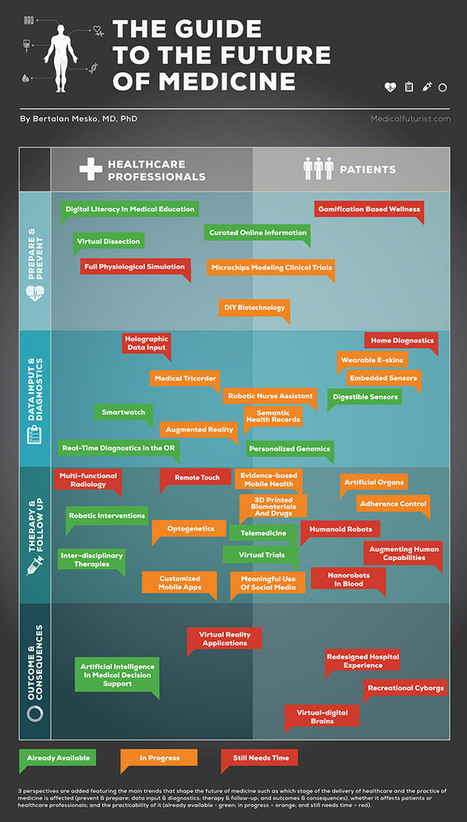
Interview with Berci Mesko on the Future of Medicine and the Doctors 2.0

Interview with Berci Mesko on the Future of Medicine and the Doctors 2.0 | E-SANTÉ : COMPRENDRE. RELIER. TRANSFORMER. | Scoop.it

Berci Mesko is a medical futurist, interested in bringing disruptive technologies to medicine & the wider spectrum healthcare. He is the managing director of Webicina.com which curates medical social media resources for patients and medical professionals. This interview was originally published on Medcrunch. 

MedCrunch: You are a speaker and advisor at Doctors 2.0 event. You obviously like the event. Why?

Berci: This is one of (if not) the best events where all the stakeholders of medicine can meet and interact about the implications of digital solutions in healthcare. It includes start-ups, policy makers, doctors, nurses, students and e-patients. The whole scale with a huge range of interesting topics to be covered.

MC: How can/do events like Doctors 2.0 disrupt the digital health ecosystem?

Berci: The stakeholders constantly interact every day but such real life events and interactions can generate amazing ideas which, later on, can be discussed and worked out through social media channels.

MC: You mentioned in your talk at Doctors 2.0 that rather than dealing with an information overload we are dealing with a filter failure. Please elaborate for our readers.

Berci: Without doubt, everyone must face a huge amount of information every day, therefore the question is not whether we should take part in such discussions, but about how to deal with the amount. I think finding the right filters is the solution, backed by skills acquired in digital literacy.

MC:  Is there danger of too much technological integration. Is it possible that through creating too many effective filters we end up in a world with no anonymity, randomness or ambiguity?

Berci: The danger is imminent. If we use technology too massively and without real backing then medicine loses its essence – the human interaction between doctor and patient. On the other hand, if we do not use technology, it’s impossible to give a good enough care to our patients. Therefore the ultimate goal is to find a balance between these.

MC: You have found a solution to the problem of filter failure with medicina.com  through digital curation. Can you tell us about another challenge that you face as a health professional and are still looking to find an ideal solution to?

Berci: A tsunami of technological changes and advances is coming to medicine and healthcare. I’m working on several solutions to prepare all stakeholders for what is coming next. This is why I published a white paper, The Guide to the Future of Medicine and this is why I’m working on my second book that will cover this huge topic.

MC: Why do you think digital literacy is so important to physicians?

Berci: As using digital channels and solutions become an integral part of our lives, they move toward medicine as well. Acquiring skills in digital literacy is the only way patients and their caregivers can properly and safely use new tools for practicing  medicine and health management.

MC:  In your TEDx talk you mention the 1925 prediction of remote medical services. We are getting closer to this. What is your opinion of telemedicine and where do we stand in this field?

Berci: The number of such devices has been rapidly increasing, but again, we must keep the human touch in the interaction between patients and doctors by implementing the right digital tools to strengthen the power and opportunities of practicing medicine.

MC: You hold a PHD in genomics. What are the most exciting trends/opportunities for genomics currently?

Berci: I cannot wait to reach a point where everyone can access the data of their own genome and use it accurately in their health management or when prescribing therapies. A few days ago, Illumina announced the $1,000 genome, now I’m waiting for the $100 genome.

MC: Your favourite book?

Berci: I read so many books that it’s hard to choose only one, but I recently finished Michio Kaku’s The Future of Physics and I loved that.

MC: What does your typical day look like?

Berci: I teach at medical schools, write my second book, give about 100 presentations a year worldwide, do consultant projects for large companies and constantly communicate with a lot of people in medicine globally.

MC: Berci you are a medical futurist. What is going to happen in the future?

Berci: The best thing I can do as a medical futurist is to extrapolate from today’s key trends and try to predict those trends, solutions and elements that can shape the future of medicine. I did this when published my white paper, but one thing is certain, patients will be in the center of the healthcare process.

Thank you we look forward to seeing you at Doctors 2.0 & You!

To hear more from Berci, join MedCrunch at Doctors 2.0™ & You on June 5-6th at the beautiful Cité Internationale Universitaire de Paris. With two days of 20 parallel sessions, ground-breaking speakers and the plenary, the conference will explore how physicians use new technologies, Web 2.0 tools, and social media to communicate with other health care professionals, patients, payers, pharmaceutical companies and public agencies. This is the best networking platform for digital physicians in Europe.


Via Plus91
No comment yet.
Rescooped by Lionel Reichardt / le Pharmageek from Buzz e-sante
April 28, 2014 4:02 AM
Scoop.it!

L’information santé sur Internet: comment la produire, l’évaluer, l’utiliser? | Portail Internet et santé

L’information santé sur Internet: comment la produire, l’évaluer, l’utiliser? | Portail Internet et santé | E-SANTÉ : COMPRENDRE. RELIER. TRANSFORMER. | Scoop.it
Cette table ronde a souligné le rôle que peuvent jouer les professionnels de la santé et les associations dans la production et la médiation vers une inf

Via Rémy TESTON
No comment yet.
Rescooped by Lionel Reichardt / le Pharmageek from E-Pochondriac
April 27, 2014 4:04 AM
Scoop.it!

The Environment and Health Atlas for England cc @Clem_biwan

The Environment and Health Atlas for England cc @Clem_biwan | E-SANTÉ : COMPRENDRE. RELIER. TRANSFORMER. | Scoop.it

Via uri goren
No comment yet.
Rescooped by Lionel Reichardt / le Pharmageek from Health, Digital Health, mHealth, Digital Pharma, hcsm latest trends and news (in English)
April 23, 2014 2:28 AM
Scoop.it!

IBM's Watson Supercomputer May Soon Be The Best Doctor In The World

IBM's Watson Supercomputer May Soon Be The Best Doctor In The World | E-SANTÉ : COMPRENDRE. RELIER. TRANSFORMER. | Scoop.it
Watson has analyzed 605,000 pieces of medical evidence, 2 million pages of text, and 25,000 training cases — far more than any med student could remember.

Via Benoit Lange, Celine Sportisse
Catherine Tonlorenzi's curator insight, April 26, 2014 9:51 AM

Une aide précieuse au diagnostic

Rescooped by Lionel Reichardt / le Pharmageek from eHealth
April 16, 2014 12:26 PM
Scoop.it!

Rx Disruption: Technology Trends in Medicine and Health Care | World Future Society

Rx Disruption: Technology Trends in Medicine and Health Care | World Future Society | E-SANTÉ : COMPRENDRE. RELIER. TRANSFORMER. | Scoop.it

Via Paul Epping
Paul Epping's curator insight, April 16, 2014 12:04 PM

A really good article that puts developments in perspective

Romain DEFOY's curator insight, April 22, 2014 5:44 AM
How to Prepare for the Future of Medicine

1. Whether you are a patient or a medical professional, follow the main trends and try to be up-to-date, using digital technologies ranging from message boards to mobile apps.

2. Constantly look for solutions to improve your practice as a medical professional or your health as a patient.

3. Embrace digital technologies in a comfortable way and use techniques that make your life easier and your work more efficient.

4. Look for examples and trends outside of medicine, as well.

5. Understand that evidence backed by massive data is needed for any uses of digital solutions in medicine.

6. Beware of hype in medicine. Strategically analyze trends and extrapolate to the future in a meaningful way.

7. Influence decision makers if your idea can make a change. Be bold and use social media channels to spread the word.

8. Remember that, no matter how important a role digital will play in our lives, the human touch is and will always be the key in the doctor–patient relationship.

Scooped by Lionel Reichardt / le Pharmageek
April 16, 2014 3:49 AM
Scoop.it!

EUROPA - COMMUNIQUES DE PRESSE - Communiqué de presse - La santé en ligne dans l'UE: quel est le diagnostic?

EUROPA - COMMUNIQUES DE PRESSE - Communiqué de presse - La santé en ligne dans l'UE: quel est le diagnostic? | E-SANTÉ : COMPRENDRE. RELIER. TRANSFORMER. | Scoop.it
No comment yet.