Papers
677.5K views | +39 today
Papers
Recent publications related to complex systems
Your new post is loading...
Scooped by Complexity Digest
March 16, 2012 6:13 PM
Scoop.it!

Learning, Social Intelligence and the Turing Test - why an "out-of-the-box" Turing Machine will not pass the Turing Test

The Turing Test (TT) checks for human intelligence, rather than any putative
general intelligence. It involves repeated interaction requiring learning in
the form of adaption to the human conversation partner. It is a macro-level
post-hoc test in contrast to the definition of a Turing Machine (TM), which is
a prior micro-level definition. This raises the question of whether learning is
just another computational process, i.e. can be implemented as a TM. Here we
argue that learning or adaption is fundamentally different from computation,
though it does involve processes that can be seen as computations. (…) We conclude three things, namely that: a
purely "designed" TM will never pass the TT; that there is no such thing as a
general intelligence since it necessary involves learning; and that
learning/adaption and computation should be clearly distinguished.

No comment yet.
Scooped by Complexity Digest
March 16, 2012 5:48 PM
Scoop.it!

The role of strong and weak ties in Facebook: a community structure perspective

In this paper we report our findings on the analysis of two large datasets representing the friendship structure of the well-known Facebook network. In particular, we discuss the quantitative assessment of the strength of weak ties Granovetter's theory, considering the problem from the perspective of the community structure of the network. We describe our findings providing some clues of the validity of this theory also for a large-scale online social network such as Facebook.

No comment yet.
Scooped by Complexity Digest
March 16, 2012 8:48 AM
Scoop.it!

The Future of Complexity Engineering

Complexity Engineering encompasses a set of approaches to engineering systems which are typically composed of various interacting entities often exhibiting self-* behaviours and emergence. The engineer or designer uses methods that benefit from the findings of complexity science and often considerably differ from the classical engineering approach of ‘divide and conquer’. This article provides an overview on some very interdisciplinary and innovative research areas and projects in the field of Complexity Engineering, including synthetic biology, chemistry, artificial life, self-healing materials and others. It then classifies the presented work according to five types of nature-inspired technology, namely: (1) using technology to understand nature, (2) nature- inspiration for technology, (3) using technology on natural systems, (4) using biotechnology methods in software engineering, and (5) using technology to model nature. Finally, future trends in Complexity Engineering are indicated and related risks are discussed.

No comment yet.
Rescooped by Complexity Digest from comple-X-city
March 15, 2012 2:59 PM
Scoop.it!

Megacities as sites of change

Megacities as sites of change | Papers | Scoop.it
Guest bloggers sound off on solutions for the future. Eight change accelerators in energy, mobility and design start the conversation, and you join in.

Via Alessio Erioli, proto-e-co-logics
luiy's curator insight, March 8, 2013 6:01 AM

Megacities are our future: There are more than 20 megacities in the world today and by 2025 there will be around 30 of them. They are home to more than 10 million people and sprawl for hundreds of kilometers. Their projected rapid expansion by the middle of this century will drive our economies and shape our lives. But they are not carefully designed superstructures; instead, they are aggregations of building developments that spread like weeds over already stressed infrastructures. Megacities offer the greatest opportunities and challenges for humankind in the 21st century as they exist at the interface where urban systems meet technology to support human development.


With the appropriate infrastructures supporting them, combined technologies can form qualitatively new kinds of engagement between buildings and the megacity environment. An exploratory project between Astudio architects and AVATAR examines the potential for upgrading the environmental performance of entire buildings in situ. The structural bones of buildings are kept in place and pruned as fit for purpose frameworks, without having to displace existing inhabitants, which are then re-wrapped with living facades. These are the next generation of functional vertical gardens that are colonized by microorganisms and life-like chemistries that assist with the lifecycles of buildings being able to process waste and make biofuels using local resources.

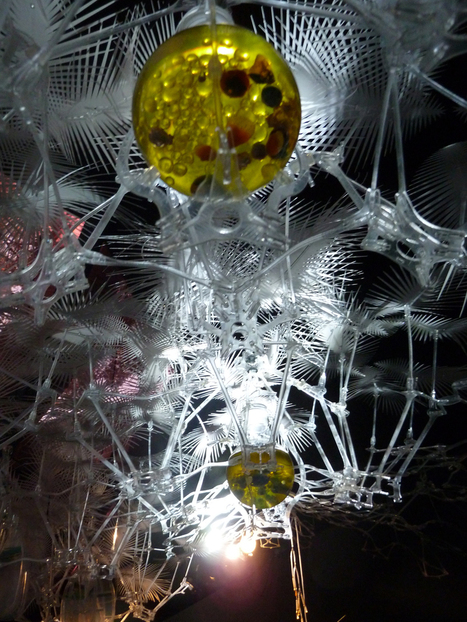
Architecture does not need to be limited by inert surfaces, which create a barrier between people and the environment but could directly engage the surroundings through active interfaces which act as vast synthetic soils. These might be maintained under surveillance by smart microfluidics monitoring systems and robotic gardeners. A taste of these dynamic geotextiles can be experienced in the architectural installation Hylozoic Ground, a finalist for the Katerva Award insustainability. This jungle-like technology is a prototype for living building surfaces that combine cybernetics with smart chemistry. The immersive, evolving technology offers a responsive framework for a new kind of architectural experience that senses people and the environment and whose principles may be applied in other contexts, such as gardens. Hylozoic Ground could even offer its inhabitants positive emotional experiences similar to being close to nature.

The grand vision of achieving positive human development in the 21st century will require effective coordination between disciplines, institutions, cultures, and geographical regions. The pressing concerns that affect us all are many and varied—and would require humanity to perform at its very best to secure a long-term partnership with this unstable earth that is our home.


Questions:

What are the challenges to developing and implementing a global vision of positive human development?

How can developed countries best transfer knowledge to the Global South?

How can combined technologies in cities help address significant social inequalities?

Scooped by Complexity Digest
March 15, 2012 2:16 PM
Scoop.it!

A measure of individual role in collective dynamics

Identifying key players in collective dynamics remains a challenge in several research fields, from the efficient dissemination of ideas to drug target discovery in biomedical problems.
No comment yet.
Scooped by Complexity Digest
March 15, 2012 2:11 PM
Scoop.it!

Alan Turing at 100

Alan Turing at 100 | Papers | Scoop.it

Alan Turing, born a century ago this year, is best known for his wartime code-breaking and for inventing the 'Turing machine' – the concept at the heart of every computer today. But his legacy extends much further: he founded the field of artificial intelligence, proposed a theory of biological pattern formation and speculated about the limits of computation in physics. In this collection of features and opinion pieces, Nature celebrates the mind that, in a handful of papers over a tragically short lifetime, shaped many of the hottest fields in science today.

No comment yet.
Scooped by Complexity Digest
March 16, 2012 6:05 PM
Scoop.it!

Self-Organization at the Nanoscale Scale in Far-From-Equilibrium Surface Reactions and Copolymerizations

An overview is given of theoretical progress on self-organization at the
nanoscale in reactive systems of heterogeneous catalysis observed by field
emission microscopy techniques and at the molecular scale in copolymerization
processes. The results are presented in the perspective of recent advances in
nonequilibrium thermodynamics and statistical mechanics, allowing us to
understand how nanosystems driven away from equilibrium can manifest
directionality and dynamical order.

No comment yet.
Scooped by Complexity Digest
March 16, 2012 5:43 PM
Scoop.it!

Identifying influential spreaders and efficiently estimating the number of infections in epidemic models: a path counting approach

We introduce a new method to efficiently approximate the number of infections resulting from a given initially-infected node in a network of susceptible individuals, based on counting the number of possible infection paths of various lengths to each other node in the network. We analytically study the properties of our method systematically, in particular demonstrating different forms for SIS and SIR disease spreading (e.g. under the SIR model our method counts self-avoiding walks). In comparison to existing methods to infer the spreading efficiency of different nodes in the network (based on degree, k-shell decomposition analysis and different centrality measures), our method directly considers the spreading process, and as such is unique in providing estimation of actual numbers of infections. Crucially, in simulating infections on various real-world networks with the SIR model, we show that our walks-based method improves the inference of effectiveness of nodes over a wide range of infection rates compared to existing methods. We also analyse the trade-off between estimate accuracy and computational cost of our method, showing that the better accuracy here can still be obtained at a comparable computational cost to other methods.

No comment yet.
Rescooped by Complexity Digest from Complex and cooperative systems
March 15, 2012 3:02 PM
Scoop.it!

Swarm Intelligence: Is the Group Really Smarter?

Swarm Intelligence: Is the Group Really Smarter? | Papers | Scoop.it
Decentralized problem solving works better on some problems than others. According to an article from SEO Theory, swarms work in situations that involve discovery, testing, and comparing results. For example, ants finding the most efficient route to food, or iPhone users who use their Yelp App to find the highest-rated restaurant close by. By leveraging the volume of agents involved, you can act upon complex and rapidly changing sets of data. This works in situations where you are looking for the most efficient method of execution, or the most optimal process. Shipping companies, for example, use Swarm Theory computer algorithms to reallocate trucking routes based on up-to-the-minute energy prices. Swarm Theory works less effectively for creative processes like innovation, except perhaps as a broad directional pointer. A Swarm cannot paint the next Mona Lisa.

Via Fabio Vanni
No comment yet.
Rescooped by Complexity Digest from Global Brain
March 15, 2012 2:27 PM
Scoop.it!

Google - a new paradigm to cultivate innovation & collective intelligence

Google - a new paradigm to cultivate innovation & collective intelligence | Papers | Scoop.it
Here are some brief notes about how Google fosters collective intelligence through the structure of the organisation, values and culture.

Via Spaceweaver
No comment yet.
Scooped by Complexity Digest
March 15, 2012 2:13 PM
Scoop.it!

Early Warning Signals for Critical Transitions: A Generalized Modeling Approach

Fisheries, coral reefs, productive farmland, planetary climate, neural activity in the brain, and financial markets are all complex systems that can be susceptible to sudden changes leading to drastic re-organization or collapse. A variety of signals based on analysis of time-series data have been proposed that would provide warning of these so-called critical transitions. We propose a new method for calculating early warning signals that is complementary to existing approaches. The key step is to incorporate other available information about the system through the framework of a so-called generalized model. Our new approach may help to anticipate future catastrophic regime shifts in nature and society, allowing humankind to avert or to mitigate the consequences of the impending change.

No comment yet.