Your new post is loading...

|
Suggested by
Segismundo
March 29, 2012 4:18 PM
|
Here we develop an approach and propose a quantity (measure) which is simple enough to be widely applicable, reveals a number of universal features of the organization of real-world networks and, as we demonstrate, is capable of capturing the essential features of the structure and the degree of hierarchy in a complex network.

|
Scooped by
Complexity Digest
March 26, 2012 4:47 PM
|
In the past decade, ecologists have increasingly applied complex network theory (1, 2) to ecological interactions, both in entire food webs (3) and in networks representing ecological interactions, especially those between plants and their animal pollinators or seed dispersers (4). How important are individual species to the maintenance of such ecological networks? On page 1489 of this issue, Stouffer et al. (5) analyze terrestrial, freshwater, and marine food webs to infer the contributions of individual species to network stability. In a related field study on page 1486 of this issue, Aizen et al. (6) explore plant and pollinator webs on a landscape scale. Using a different field study design, Pocock et al. (7) recently focused on a local community in which several webs of different kinds of interactions and organisms form a composite network.
|
|
Scooped by
Complexity Digest
March 26, 2012 4:36 PM
|
We investigate the motion of pedestrians through obscure corridors where the
lack of visibility (due to smoke, fog, darkness, etc.) hides the precise
position of the exits. We focus our attention on a set of basic mechanisms,
which we assume to be governing the dynamics at the individual level. Using a
lattice model, we explore the effects of non-exclusion on the overall exit flux
(evacuation rate). More precisely, we study the effect of the buddying
threshold (of no-exclusion per site) on the dynamics of the crowd and
investigate to which extent our model confirms the following pattern revealed
by investigations on real emergencies: If the evacuees tend to cooperate and
act altruistically, then their collective action tends to favor the occurrence
of disasters.

|
Suggested by
Joseph Lizier
March 23, 2012 7:17 PM
|
We study information processing in populations of Boolean networks with evolving connectivity and systematically explore the interplay between the learning capability, robustness, the network topology, and the task complexity. We solve a long-standing open question and find computationally that, for large system sizes N, adaptive information processing drives the networks to a critical connectivity Kc=2. For finite size networks, the connectivity approaches the critical value with a power law of the system size N. We show that network learning and generalization are optimized near criticality, given that the task complexity and the amount of information provided surpass threshold values. Both random and evolved networks exhibit maximal topological diversity near Kc. We hypothesize that this diversity supports efficient exploration and robustness of solutions. Also reflected in our observation is that the variance of the fitness values is maximal in critical network populations. Finally, we discuss implications of our results for determining the optimal topology of adaptive dynamical networks that solve computational tasks.
|
|
Scooped by
Complexity Digest
March 23, 2012 12:15 PM
|
We review the historic development of concept of information including the relationship of Shannon information and entropy and the criticism of Shannon information because of its lack of a connection to meaning. We review the work of Kauffman, Logan et al. that shows that Shannon information fails to describe biotic information. We introduce the notion of the relativity of information and show that the concept of information depends on the context of where and how it is being used. We examine the relationship of information to meaning and materiality within information theory, cybernetics and systems biology. We show there exists a link between information and organization in biotic systems and in the various aspects of human culture including language, technology, science, economics and governance.
|
|
Scooped by
Complexity Digest
March 23, 2012 11:50 AM
|
Studies of ecological networks (the web of interactions between species in a community) demonstrate an intricate link between a community’s structure and its long-term viability. It remains unclear, however, how much a community’s persistence depends on the identities of the species present, or how much the role played by each species varies as a function of the community in which it is found. We measured species’ roles by studying how species are embedded within the overall network and the subsequent dynamic implications. Using data from 32 empirical food webs, we find that species’ roles and dynamic importance are inherent species attributes and can be extrapolated across communities on the basis of taxonomic classification alone. Our results illustrate the variability of roles across species and communities and the relative importance of distinct species groups when attempting to conserve ecological communities.
|
|
Scooped by
Complexity Digest
March 21, 2012 5:56 PM
|
Reactions to textual content posted in an online social network show different dynamics depending on the linguistic style and readability of the submitted content. Do similar dynamics exist for responses to scientific articles? Our intuition, supported by previous research, suggests that the success of a scientific article depends on its content, rather than on its linguistic style. In this article, we examine a corpus of scientific abstracts and three forms of associated reactions: article downloads, citations, and bookmarks. Through a class-based psycholinguistic analysis and readability indices tests, we show that certain stylistic and readability features of abstracts clearly concur in determining the success and viral capability of a scientific article.
|
|
Rescooped by
Complexity Digest
from Global Brain
March 21, 2012 11:35 AM
|
By Steve Mills
Senior Vice President and Group Executive
IBM
Frustration with “information overload” is one of the facts of life these days.
Via Spaceweaver
|
|
Scooped by
Complexity Digest
March 20, 2012 7:00 PM
|
The very notion of social network implies that linked individuals interact repeatedly with each other. This notion allows them not only to learn successful strategies and adapt to them, but also to condition their own behavior on the behavior of others, in a strategic forward looking manner. Game theory of repeated games shows that these circumstances are conducive to the emergence of collaboration in simple games of two players. We investigate the extension of this concept to the case where players are engaged in a local contribution game and show that rationality and credibility of threats identify a class of Nash equilibria—that we call “collaborative equilibria”—that have a precise interpretation in terms of subgraphs of the social network. For large network games, the number of such equilibria is exponentially large in the number of players. When incentives to defect are small, equilibria are supported by local structures whereas when incentives exceed a threshold they acquire a nonlocal nature, which requires a “critical mass” of more than a given fraction of the players to collaborate. Therefore, when incentives are high, an individual deviation typically causes the collapse of collaboration across the whole system. At the same time, higher incentives to defect typically support equilibria with a higher density of collaborators. The resulting picture conforms with several results in sociology and in the experimental literature on game theory, such as the prevalence of collaboration in denser groups and in the structural hubs of sparse networks.

|
Suggested by
Hiroki Sayama
March 20, 2012 4:44 PM
|
Social contagion: What do we really know? by Duncan Watts
|
|
Suggested by
Hiroki Sayama
March 20, 2012 11:45 AM
|
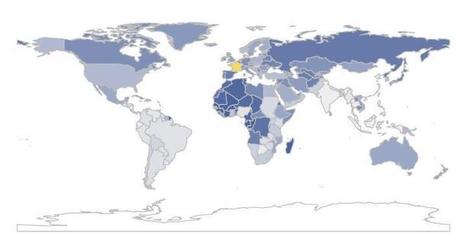
Facebook Data Team wrote a note titled Mapping Global Friendship Ties. Read the full text here.
|
|
Scooped by
Complexity Digest
March 16, 2012 7:18 PM
|
Science assessments indicate that human activities are moving several of Earth's sub-systems outside the range of natural variability typical for the previous 500,000 years. Human societies must now change course and steer away from critical tipping points in the Earth system that might lead to rapid and irreversible change. This requires fundamental reorientation and restructuring of national and international institutions toward more effective Earth system governance and planetary stewardship.
|
|
Scooped by
Complexity Digest
March 16, 2012 6:57 PM
|
Social networks affect in such a fundamental way the dynamics of the population they support that the global, population-wide behavior that one observes often bears no relation to the individual processes it stems from. Up to now, linking the global networked dynamics to such individual mechanisms has remained elusive.
|
|
|
Rescooped by
Complexity Digest
from Social Foraging
March 29, 2012 4:16 PM
|
We’ve recently seen Facebook go public with a $100 billion valuation and General Motors, formerly the world’s biggest company, go effectively bankrupt and need to be bailed out by the US government.Meanwhile, the new web darlings, Instagram andPinterest, have built communities of millions of people in a matter of months, not years and they have done it with a staff that can fit in my living room (which, I might add, is not that big). What’s amazing is that we have come to take things like these in stride. Such events have become not exactly the rule, but not the exception either. In short, we have witnessed the complete transformation of business as we knew it. The scale economy has become the semantic economy, where value chains have been subsumed by value networks.
Via Ashish Umre
|
|
Scooped by
Complexity Digest
March 26, 2012 4:42 PM
|
The spectacle of animals moving en masse is arguably one of the most fascinating phenomena in biology. For example, schools of fish can move in an orderly manner, and then change direction abruptly or, if under pressure from a nearby predator, swirl like a vigorously stirred fluid. The non-living world also has examples of collective motion, in systems that consist of units ranging from macromolecules to metallic rods, or even robots. On page 448 of this issue, Sumino et al. describe another, until now unobserved, example of such behaviour: the coordinated motion of hundreds of thousands of subcellular structures known as microtubules, which spontaneously self-organize into a lattice-like structure of vortices. When considered in the context of about half a dozen known universal classes of collective-motion pattern, this new structure poses challenges in terms of explaining how it can arise and its relevance to applications.
|
|
Scooped by
Complexity Digest
March 26, 2012 4:34 PM
|
Dynamical criticality has been shown to enhance information processing in dynamical systems, and there is evidence for self-organized criticality in neural networks. A plausible mechanism for such self-organization is activity dependent synaptic plasticity. Here, we model neurons as discrete-state nodes on an adaptive network following stochastic dynamics. At a threshold connectivity, this system undergoes a dynamical phase transition at which persistent activity sets in. In a low dimensional representation of the macroscopic dynamics, this corresponds to a transcritical bifurcation. We show analytically that adding activity dependent rewiring rules, inspired by homeostatic plasticity, leads to the emergence of an attractive steady state at criticality and present numerical evidence for the system's evolution to such a state.
|
|
Scooped by
Complexity Digest
March 23, 2012 12:17 PM
|
During the last two decades, a systematic re-examination of the whole information science field has taken place around the FIS—Foundations of Information Science—initiative. With the occasion of its Fourth Conference in Beijing 2010, a group of selected contributors and leading practitioners of those fields have been invited to contribute to this Special Issue. What is the status of information science today? What is the relationship between information and the laws of nature? Is information merely “physical”? What is the difference between information and computation? Has the genomic revolution changed the contemporary views on information and life? And what about the nature of social information? Cogent answers to these questions and to quite many others are attempted in the contributions that follow.
|
|
Scooped by
Complexity Digest
March 23, 2012 12:12 PM
|
We show novel techniques of analysing complex dynamics of cellular automata (CA) with chaotic behaviour. CA are well known computational substrates for studying emergent collective behaviour, complexity, randomness and interaction between order and disorder. A number of attempts have been made to classify CA functions on their spatio-temporal dynamics and to predict behavior of any given function. Examples include mechanical computation, lambda and Z-parameters, mean field theory, differential equations and number conserving features. We propose to classify CA based on their behaviour when they act in a historical mode, i.e. as CA with memory. We demonstrate that cell-state transition rules enriched with memory quickly transform a chaotic system converging to a complex global behaviour from almost any initial condition. Thus in just a few steps we can select chaotic rules without exhaustive computational experiments or recurring to additional parameters. We provide analysis of well-known chaotic functions in one-dimensional CA, and decompose dynamics of the automata using majority memory.
|
|
Suggested by
Joseph Lizier
March 22, 2012 1:57 PM
|
Biological systems often consist of multiple interacting subsystems, the brain being a prominent example. To understand the functions of such systems it is important to analyze if and how the subsystems interact and to describe the effect of these interactions. In this work we investigate the extent to which the cause-and-effect framework is applicable to such interacting subsystems. We base our work on a standard notion of causal effects and define a new concept called natural causal effect. This new concept takes into account that when studying interactions in biological systems, one is often not interested in the effect of perturbations that alter the dynamics. The interest is instead in how the causal connections participate in the generation of the observed natural dynamics. We identify the constraints on the structure of the causal connections that determine the existence of natural causal effects. In particular, we show that the influence of the causal connections on the natural dynamics of the system often cannot be analyzed in terms of the causal effect of one subsystem on another. Only when the causing subsystem is autonomous with respect to the rest can this interpretation be made. We note that subsystems in the brain are often bidirectionally connected, which means that interactions rarely should be quantified in terms of cause-and-effect. We furthermore introduce a framework for how natural causal effects can be characterized when they exist. Our work also has important consequences for the interpretation of other approaches commonly applied to study causality in the brain. Specifically, we discuss how the notion of natural causal effects can be combined with Granger causality and Dynamic Causal Modeling (DCM). Our results are generic and the concept of natural causal effects is relevant in all areas where the effects of interactions between subsystems are of interest.
|
|
Scooped by
Complexity Digest
March 21, 2012 5:55 PM
|
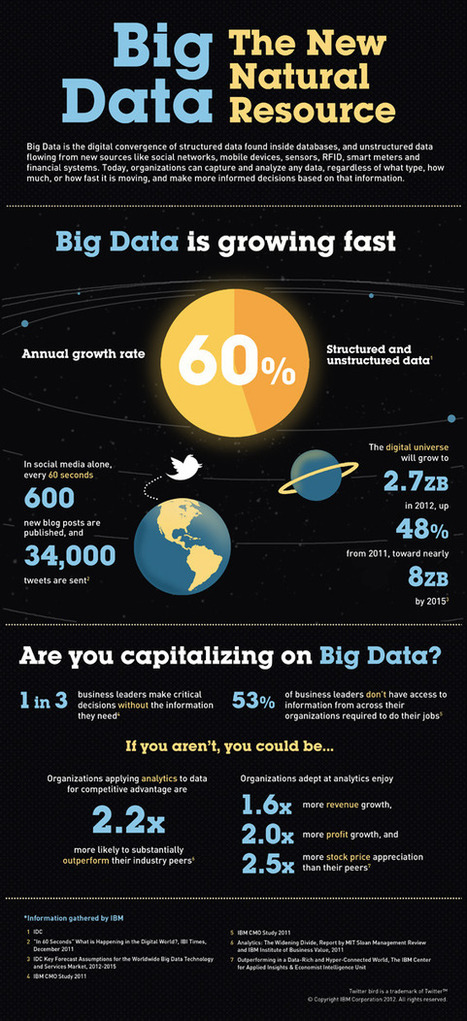
Does big data have the answers? Maybe some, but not all, says Mark Graham...

|
Suggested by
David Rodrigues
March 21, 2012 11:28 AM
|
Public opinion is often affected by the presence of committed groups of individuals dedicated to competing points of view. Using a model of pairwise social influence, we study how the presence of such groups within social networks affects the outcome and the speed of evolution of the overall opinion on the network.
|
|
Scooped by
Complexity Digest
March 20, 2012 6:57 PM
|
A universal map is derived for all deterministic 1D cellular automata (CA)
containing no freely adjustable parameters. The map can be extended to an
arbitrary number of dimensions and topologies and its invariances allow to
classify all CA rules into equivalence classes. Complexity in 1D systems is
then shown to emerge from the weak symmetry breaking of the addition modulo an
integer number p. The latter symmetry is possessed by certain rules that
produce Pascal simplices in their time evolution. These results elucidate
Wolfram's classification of CA dynamics.
|
|
Scooped by
Complexity Digest
March 20, 2012 12:30 PM
|
Various research initiatives try to utilize the operational principles of organisms and brains to develop alternative, biologically inspired computing paradigms and artificial cognitive systems. This article reviews key features of the standard method applied to complexity in the cognitive and brain sciences, i.e. decompositional analysis or reverse engineering. The indisputable complexity of brain and mind raise the issue of whether they can be understood by applying the standard method. Actually, recent findings in the experimental and theoretical fields, question central assumptions and hypotheses made for reverse engineering. Using the modeling relation as analyzed by Robert Rosen, the scientific analysis method itself is made a subject of discussion. It is concluded that the fundamental assumption of cognitive science, i.e. complex cognitive systems can be analyzed, understood and duplicated by reverse engineering, must be abandoned. Implications for investigations of organisms and behavior as well as for engineering artificial cognitive systems are discussed.
|
|
Suggested by
David Rodrigues
March 17, 2012 11:26 PM
|
Saint Matthew strikes again: An agent-based model of peer review and the scientific community structure
Flaminio Squazzoni, , Claudio Gandelli
|
|
Scooped by
Complexity Digest
March 16, 2012 7:08 PM
|
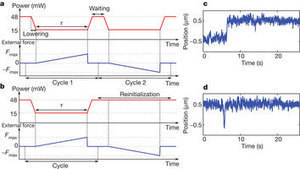
In 1961, Rolf Landauer argued that the erasure of information is a dissipative process. A minimal quantity of heat, proportional to the thermal energy and called the Landauer bound, is necessarily produced when a classical bit of information is deleted. A direct consequence of this logically irreversible transformation is that the entropy of the environment increases by a finite amount. Despite its fundamental importance for information theory and computer science, the erasure principle has not been verified experimentally so far (…) This result demonstrates the intimate link between information theory and thermodynamics. It further highlights the ultimate physical limit of irreversible computation.
|