Originals
805 views | +17 today
Your new post is loading...
Scooped by ulcriv
April 8, 2022 4:44 PM
Scoop.it!

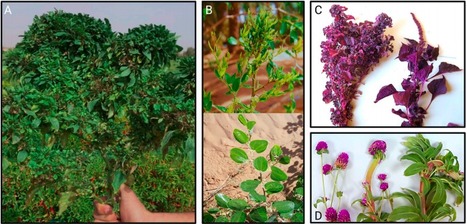
Original Paper in Plant Health Prog • Pérez-López Lab 2020 • The Host Range of Subgroup 16SrII-X Phytoplasma Extends to Globe Amaranth and Other Wild Plants in Saudi Arabia

Original Paper in Plant Health Prog • Pérez-López Lab 2020 • The Host Range of Subgroup 16SrII-X Phytoplasma Extends to Globe Amaranth and Other Wild Plants in Saudi Arabia | Originals | Scoop.it
In recent years, the number of plant hosts affected by peanut witches’-broom group (16SrII) phytoplasma in Saudi Arabia has increased at a concerning speed. Since 2015 symptoms resembling phytoplasma-related diseases have been reported in Al-Qassim region affecting the wild plants globe amaranth, amaranthus, black nightshade, and buckthorn. Except for globe amaranth, which showed flower deformations, the other plants showed witches’ broom and little leaves. All the symptomatic samples collected in this study were positive for phytoplasma using universal primers targeting the 16S rRNA-encoding gene. Sequence analysis identified the phytoplasma as a member of the 16SrII-X subgroup, originally described in Saudi Arabia by our group. This is the first report of globe amaranth, amaranthus, black nightshade, and buckthorn as phytoplasma hosts in Saudi Arabia, and the first report worldwide of globe amaranth as a phytoplasma host and buckthorn being affected by 16SrII phytoplasma group.
No comment yet.
Scooped by ulcriv
April 8, 2022 4:40 PM
Scoop.it!

Original Paper in RNA Biol • Bélanger Lab 2020 • Discovery of new group I-D introns leads to creation of subtypes and link to an adaptive response of the mitochondrial genome in fungi

Original Paper in RNA Biol • Bélanger Lab 2020 • Discovery of new group I-D introns leads to creation of subtypes and link to an adaptive response of the mitochondrial genome in fungi | Originals | Scoop.it
Group I catalytic introns are widespread in bacterial, archaeal, viral, organellar, and some eukaryotic genomes, where they are reported to provide regulatory functions. The group I introns are currently divided into five types (A-E), which are themselves distributed into several subtypes, with the exception of group I type D intron (GI-D). GI-D introns belong to the rarest group with only 17 described to date, including only one with a putative role reported in fungi, where it would interfere with an adaptive response in the cytochrome b (COB) gene to quinone outside inhibitor (QoI) fungicide resistance. Using homology search methods taking into account both conserved sequences and RNA secondary structures, we analysed the mitochondrial genomes or COB genes of 169 fungal species, including some frequently under QoI selection pressure. These analyses have led to the identification of 216 novel GI-D introns, and the definition of three distinct subtypes, one of which being linked with a functional activity. We have further uncovered a homing site for this GI-D intron type, which helps refine the accepted model of quinone outside inhibitor resistance, whereby mobility of the intron across fungal mitochondrial genomes, would influence a fungus ability to develop resistance to QoIs.
No comment yet.
Scooped by ulcriv
April 8, 2022 4:42 PM
Scoop.it!

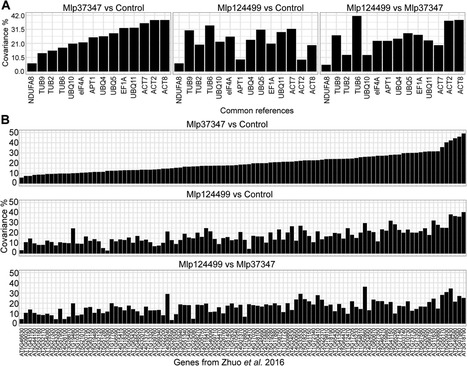
Original paper in BMC Genom • Desgagné-Penix/Germain Labs 2020 • Custom selected reference genes outperform pre-defined reference genes in transcriptomic analysis

Original paper in BMC Genom • Desgagné-Penix/Germain Labs 2020 • Custom selected reference genes outperform pre-defined reference genes in transcriptomic analysis | Originals | Scoop.it
RNA sequencing allows the measuring of gene expression at a resolution unmet by expression arrays or RT-qPCR. It is however necessary to normalize sequencing data by library size, transcript size and composition, among other factors, before comparing expression levels. The use of internal control genes or spike-ins is advocated in the literature for scaling read counts, but the methods for choosing reference genes are mostly targeted at RT-qPCR studies and require a set of pre-selected candidate controls or pre-selected target genes. Here, we report an R-based pipeline to select internal control genes based solely on read counts and gene sizes. This novel method first normalizes the read counts to Transcripts per Million (TPM) and then excludes weakly expressed genes using the DAFS script to calculate the cut-off. It then selects as references the genes with lowest TPM covariance. We used this method to pick custom reference genes for the differential expression analysis of three transcriptome sets from transgenic Arabidopsis plants expressing heterologous fungal effector proteins tagged with GFP (using GFP alone as the control). The custom reference genes showed lower covariance and fold change as well as a broader range of expression levels than commonly used reference genes. When analyzed with NormFinder, both typical and custom reference genes were considered suitable internal controls, but the custom selected genes were more stably expressed. geNorm produced a similar result in which most custom selected genes ranked higher (i.e. were more stably expressed) than commonly used reference genes. The proposed method is innovative, rapid and simple. Since it does not depend on genome annotation, it can be used with any organism, and does not require pre-selected reference candidates or target genes that are not always available.
No comment yet.
Scooped by ulcriv
April 8, 2022 4:34 PM
Scoop.it!

Original Paper in Can Entomol • Cloutier/Fournier Labs 2020 • Phenology and spatial distribution of spotted-wing drosophila (Diptera: Drosophilidae) in lowbush blueberry (Ericaceae) in Sag...

Original Paper in Can Entomol • Cloutier/Fournier Labs 2020 • Phenology and spatial distribution of spotted-wing drosophila (Diptera: Drosophilidae) in lowbush blueberry (Ericaceae) in Sag... | Originals | Scoop.it
Drosophila suzukii (Matsumura) (Diptera: Drosophilidae), the spotted-wing drosophila, is an invasive pest of fruit crops, which appeared in eastern Canada in 2010. It represents a major threat to lowbush blueberry (Vaccinium angustifolium Aiton; Ericaceae) in the Saguenay-Lac-Saint-Jean region, Québec, Canada, at the northern limits of its distribution. The dynamics, overwintering capacity, population fluctuations, and damage to lowbush blueberry of D. suzukii are unknown in Saguenay-Lac-Saint-Jean. We aimed to 1) document D. suzukii abundance and phenology in lowbush blueberry in separate localities; 2) evaluate the potential of D. suzukii to overwinter and examine population dynamics over three seasons; and 3) study the spatial distribution of D. suzukii in lowbush blueberry fields with respect to forested borders. Drosophila suzukii is abundant in lowbush blueberry fields of Saguenay-Lac-Saint-Jean. In spring, D. suzukii were absent until late June, when few summer-morph females appeared. Drosophila suzukii densities started to increase regularly in August, with increasing male proportions, to culminate in fall at high levels with balanced sex ratios. Overwintering remains uncertain, D. suzukii being undetectable in spring despite intensive trapping. Appearance of diapausing winter morphs at high densities indicates that D. suzukii responds appropriately to local conditions preceding cold winter. Models of variation of D. suzukii densities and lowbush blueberry fruit infestation with distance from borders indicate that forest borders are favoured habitats over lowbush blueberry fields and the source of D. suzukii moving to some extent into lowbush blueberry fields.
No comment yet.