Your new post is loading...
Electricity flows – but how? This question is crucial to the energy transition. After all, it is not just the production of electricity that must be sustainable, but also its transmission. As the national grid company, Swissgrid faces the challenge of expanding the extra-high-voltage grid while at the same time reconciling ecological, technical and economic aspects. A life cycle assessment study has shown that overhead lines are much more environmentally friendly than underground cables. This is a surprising finding that prompts a rethink.
In an increasingly complex energy landscape, where electrification, renewable energies and the need for continuous power supply coexist even in the event of grid failures, generator sets play a decisive role. Their evolution in terms of sustainability, efficiency and connectivity is redefining their presence in critical sectors and in environments where generating electricity in an environmentally responsible way has become an essential requirement. This article analyses how the sustainable generator set is evolving, its role in the energy transition and the technologies that will shape its future.
Surging electrification requires a doubling of global grid capacity within two decades. Slow investment, planning delays and connection queues threaten progress. Longer term planning, anticipatory investments, streamlined permitting and programmatic delivery are essential to unlock secure, affordable and sustainable energy.
El Consejo de Ministros, a propuesta del Ministerio para la Transición Ecológica y el Reto Demográfico, ha aprobado el Plan Estatal Marco de Gestión de Residuos 2025-2035, el instrumento para orientar la política de residuos en España, impulsar las medidas necesarias para mejorar las deficiencias detectadas y promover las actuaciones que proporcionen un mejor resultado ambiental y aseguren la consecución de los objetivos legales. Los objetivos planteados por el PEMAR son reflejo de los propósitos ya fijados en las normativas europeas y nacionales. Solo se proponen objetivos más ambiciosos para los residuos de aparatos eléctricos y electrónicos en materia de preparación para la reutilización y para la valorización de RCD.
ENTSO-E has launched the Grid Planning Hub, a new information platform designed to make grid planning processes more accessible and transparent. The Grid Planning Hub offers a comprehensive overview of how European climate ambitions influence the processes and tools used in electricity transmission system planning. It showcases the relationship between EU climate targets, National Development Plans (NDPs) and ENTSO-E’s Ten-Year Network Development Plan (TYNDP) — making it a go-to resource for stakeholders, researchers, and anyone interested in the future of European power planning. Additionally, the Grid Planning Hub showcases how national ambitions and strategies on infrastructure planning, climate resilience and stakeholder involvement interlink with wider European system planning, covering key information on domestic grid development and NDPs.
RGI has published the Terms of Reference to commission a new study on the future resource and material requirements for Europe’s electricity grids. The commissioned study is aimed at addressing these knowledge gaps by: (1) Forecasting material requirements for European transmission and distribution grids to 2050, with intermediate milestones for 2030 and 2040. (2) Evaluating strategic grid equipment, such as cable systems, substations, transformers, offshore infrastructure, converter stations and new grid digitalisation technologies. (3) Integrating circularity, efficiency and sufficiency measures into the analysis. (4) Assessing supply chain readiness and critical bottlenecks, including environmental and social impacts. They now invite qualified contractors to submit offers to carry out this important analysis.
Quantum computing just achieved a milestone that could fundamentally change how we keep the lights on. Engineers have recently demonstrated the quantum entanglement of two electrons on a single silicon chip, an unprecedented feat that signals quantum technology moving beyond the lab. We view breakthroughs like this as more than scientific curiosities; they are stepping stones toward solving the complexity and reliability challenges plaguing today’s electric grids. Pairing these advances with high-fidelity, real-time power system simulation allows the energy sector to unlock levels of stability and efficiency that conventional approaches alone could never achieve.
US quantum computing company IonQ and the Oak Ridge National Laboratory report having demonstrated how the power of quantum can support grid operators to meet emerging challenges.
Connections reform will open the way for clean power projects like new wind and solar farms to connect to the power grid, ending a growing gridlock. It is an instrumental step in achieving the government’s Clean Power 2030 ambition, which will help unlock up to £40 billion a year of private investment in clean homegrown power, bolstering economic growth.
ABB has partnered with E.ON, Germany’s largest distribution system operator (DSO), to supply its new sulfur hexafluoride (SF6)-free gas-insulated switchgear (GIS). As a DSO, E.ON is responsible for operating, maintaining, and developing the medium- and low-voltage electricity networks that deliver power to end users. The delivery includes ABB’s next-generation SafeRing and SafePlus Air 24kV secondary GIS, part of its expanding portfolio of SF6-free switchgear technologies.
Schneider Electric, compañía referente en la transformación digital de la gestión de la energía y la automatización, ha anunciado la firma de un acuerdo marco a largo plazo con E.ON, una de las mayores empresas de energía de Europa. Esta alianza estratégica supone un importante paso en el despliegue de infraestructuras energéticas sostenibles y preparadas para la digitalización en toda Europa. Se ha firmado un acuerdo marco a largo plazo para acelerar el despliegue de equipos de media tensión sin SF₆en toda la red de E.ON. Schneider Electric ha sido seleccionada para suministrar una parte sustancial de las necesidades de aparamenta de media tensión de E.ON, cubriendo tanto los sistemas primarios como secundarios. Esta alianza facilita el acceso temprano a tecnologías sostenibles, garantizando el cumplimiento del Reglamento europeo sobre gases fluorados de la UE, que entrará en vigor en enero de 2026.
Investigadores del Departamento de Física de la Universidad de Jaén (UJA) y del Departamento de Informática de la Universidad Carlos III de Madrid (UC3M) han desarrollado la primera base de datos sobre la generación de energía solar, eólica e hidráulica en España. La herramienta, denominada SHIRENDA, se ha creado mediante la combinación de datos meteorológicos de todas las provincias españolas desde 1990 a 2020 e inteligencia artificial, con técnicas de aprendizaje automático. De esta manera, permite estimar la producción de este tipo de energías renovables en España en esas tres décadas, con el objetivo de contribuir a la planificación de un sistema eléctrico a nivel nacional a partir de energías renovables.
The European Commission has adopted a new State aid framework supporting the Clean Industrial Deal (CISAF), to enable Member States to push forward the development of clean energy, industrial decarbonisation and clean technology. The CISAF sets out the conditions under which Member States can grant support for certain investments and objectives in line with EU State aid rules. Under the Framework, the Commission will authorise aid schemes introduced by Member States to boost clean industry, enabling the swift roll-out of individual aid. The CISAF will be in place until 31 December 2030, giving Member States and businesses long-term predictability. The framework allows for the following: (1) A ‘fast-track' for the rollout of clean energy: The CISAF introduces simplified procedures to enable the quick roll-out of renewable energy schemes, including low-carbon fuels, such as blue and green hydrogen. (2) New rules on flexibility measures and capacity mechanisms: The CISAF defines ‘target model' capacity mechanisms, where Member States pay electricity providers to maintain standby capacity, which can qualify for ‘fast-track' approval. (3) Support for electricity costs for energy-intensive users. The CISAF will allow Member States to reduce the electricity costs of energy-intensive users that face higher costs than competitors in regions with less ambitious climate policies. In return for receiving price support, companies will be required to invest in decarbonisation. (4) Flexible support for investments in all technologies leading to decarbonisation or increased energy efficiency.
|
The predictive capability of AI models is a game changer for the energy sector, from energy generation to consumption and energy markets. One major application has been to predict and optimise energy generation of solar and wind installations: e.g. AI models use weather data together with historical measurements to predict energy production and consumption required for grid planning. For example, transmission network operator in Belgium, Elia, has developed an AI-based tool that reduces the system imbalance forecast error by 41% in their effort to keep the grid frequency stable with increasing renewable energy integration. This predictive capacity of AI models has also been used for predictive maintenance of wind farms and power lines. Thus, AI-based algorithms facilitate real-time monitoring and control of electricity transmission and distribution, allowing for dynamic adjustments in response to fluctuating energy supply and demand.
Enedis, France’s largest distribution system operator (DSO), has renewed its framework agreement with ABB to continue modernizing the country’s electricity networks. The five-year deal, which can be extended to eight years, reflects the strength of the long-standing partnership between the two companies and Enedis’ ambition to reduce greenhouse gas emissions from its medium-voltage network infrastructure. The contract was signed and initiated in the third quarter of 2025. Financial terms were not disclosed.
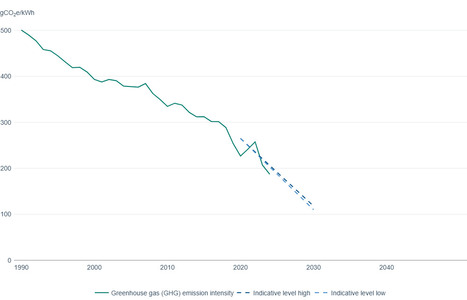
The greenhouse gas (GHG) emission intensity of power generation in the European Union has continued to fall, confirming the trend of recent decades. Generating one kilowatt hour is estimated to have emitted 9% lower emissions in 2024 on average than in 2023, and 40% less than a decade ago. Climate and energy policies have effectively lowered carbon-intensive electricity supply over time, resulting in less coal use, more renewables and a more efficient EU generation mix.
La Comisión Europea ha publicado el European Grids Package, una Comunicación dirigida al Parlamento Europeo, al Consejo y a otros órganos consultivos de la UE, cuyo objetivo es modernizar, ampliar y digitalizar la infraestructura energética de la Unión Europea. Esta propuesta busca: (1) Reforzar la planificación coordinada de infraestructuras transfronterizas, superando fragmentaciones entre niveles nacional, regional y europeo; (2) Optimizar el uso de las infraestructuras existentes antes de construir nuevas redes; (3) Acelerar los procesos de permisos y ejecución de proyectos, incluyendo renovables, almacenamiento y puntos de recarga; (4) Impulsar la participación pública y la aceptación social de los proyectos; (5) Abordar cuellos de botella en la cadena de suministro y escasez de capacidades industriales; (6) Asegurar la financiación de las necesidades futuras mediante mecanismos transparentes de reparto de costes y movilización de inversión privada; (7) Incorporar criterios de seguridad y resiliencia desde la fase de planificación; (8) Alinear la regulación con los objetivos de descarbonización, eficiencia y competitividad energética. Para ello, ha lanzado las siguientes medidas regulatorias y operativas clave: (i) Planificación energética integrada: En un plazo de dos años, la Comisión elaborará un escenario energético central europeo coherente con los objetivos climáticos y energéticos. Este escenario servirá de base para que ENTSO-E, ENTSOG y ENNOH identifiquen las necesidades de infraestructura. En caso de que existan necesidades detectadas sin proyectos presentados, la Comisión podrá activar un procedimiento de “gap filling” para convocar a operadores y promotores a presentar propuestas. (ii) Coordinación multiescala y multisectorial: Se reforzará la coordinación entre planificación nacional y europea, incluyendo elementos de red de distribución y transporte. La Comisión mantendrá el impulso del Plan de Acción sobre Redes (2023). (iii) Uso eficiente de la red existente: Se promoverá la aplicación del principio “energy efficiency first” mediante tecnologías digitales e innovadoras que aumenten la capacidad sin construir nuevas infraestructuras. Tecnologías como las grid-enhancing technologies (GETs) pueden incrementar la capacidad en un 20-40% y reducir costes en un 35% para 2040. La nueva plataforma Technopedia compartirá mejores prácticas en tecnologías de red. (iv) Mejora de los procesos de conexión: Se publica una Guía sobre conexiones eficientes con buenas prácticas para gestionar colas de conexión: Criterios de madurez transparentes, Hitos con sanciones por incumplimiento y Monitorización periódica de solicitudes. (v) Aceleración de permisos: Se establece un marco común para acelerar los permisos, limitando su duración máxima a 2 años estándar, 3 años en casos complejos. Las nuevas disposiciones se aplican a infraestructura de red, proyectos de renovables, almacenamiento y puntos de recarga. (vi) Participación pública y aceptación social: Obligación de redistribución de beneficios para proyectos renovables >10 MW. Facilitadores independientes para promover el diálogo temprano. En 2026, la Comisión lanzará un toolbox sobre inclusión ciudadana. (vii) Fortalecimiento de la cadena de suministro: Se crearán plataformas de planificación de redes de distribución para dar visibilidad a necesidades futuras. Se armonizarán las especificaciones técnicas y se promoverá la interoperabilidad, especialmente para sistemas HVDC. La revisión de las Directivas de Contratación Pública (2026) incluirá criterios para priorizar tecnologías “Made in Europe”. (viii) Financiación y reparto de costes: la inversión estimada hasta 2040 es de 1,2 billones de € en redes eléctricas. Incluye 730.000 millones de € en distribución y 240.000 millones de € en redes de hidrógeno. Se promoverá el uso de ingresos por congestión para financiar interconectores, mecanismos de agrupación (bundling) de proyectos PCI/PMI, vehículos de propósito específico (SPVs) para atraer inversión. Se abordará el reparto justo de costes y beneficios transfronterizos. (ix) Seguridad y resiliencia: Planificación con “resiliencia desde el diseño”. Mejora de la transparencia de propiedad de activos estratégicos. Infraestructuras existentes podrán acceder a financiación del Mecanismo Conectar Europa (CEF)para reforzar su seguridad.
Increase in electricity consumption through 2027 expected to average around 4% annually, driven by growing use for industry, air conditioning, electrification and data centres. The world’s electricity consumption is forecast to rise at its fastest pace in recent years, growing at close to 4% annually through 2027 as power use climbs in a range of sectors across the economy, according to a new IEA report.
Simulation software is useful in the analysis of new designs for improving power grid resilience, ensuring efficient and reliable power distribution, and developing components that integrate alternative energy sources, such as nuclear fusion and renewables. The ability to simulate multiple physical phenomena in a unified modeling environment gives engineers a deeper understanding of how different components of the grid interact with and affect each other.
Large-scale grid infrastructure projects are vital to the energy transition, as existing power grids are increasingly acting as a bottleneck for clean energy deployment. This report provides key recommendations for policy makers to deliver large-scale grid infrastructure projects on time and within budget, including case studies of projects around the world.
As regulatory pressures mount and environmental consciousness grows, engineers and designers reimagine how electronic products are built and managed throughout their life cycle. This shift toward sustainable electronics isn’t merely an environmental imperative. It’s also becoming a competitive advantage that drives innovation, reduces costs and opens new market opportunities. The transformation requires a fundamental rethinking of design methodologies, materials selection, and product architecture to prioritise repairability and recyclability from the earliest stages of development.
Per capita CO2 emissions from primary energy consumption decreased in every state from 2005 to 2023, according to recently released data in our State Energy Data System. Total energy-related CO2 emissions in the United States fell 20% over that time, and the population grew by 14%, leading to a 30% decrease in per capita CO2 emissions.
El Ministerio para la Transición Ecológica y el Reto Demográfico ha sometido a consulta pública el Proyecto de Real Decreto XXX, cuyo objetivo principal es adaptar el ordenamiento jurídico español al nuevo Reglamento (UE) 2024/573 del Parlamento Europeo y del Consejo, de 7 de febrero de 2024, sobre los gases fluorados de efecto invernadero. El nuevo marco europeo refuerza el control sobre el uso, comercialización e información relativa a gases fluorados y refrigerantes naturales. En particular, se endurece el sistema de cuotas para la producción e importación de hidrofluorocarbonos (HFC), se refuerzan las prohibiciones de puesta en mercado de equipos con gases de alto PCA (Potencial de Calentamiento Atmosférico) y se impulsa el uso de alternativas de bajo impacto climático. El reglamento prevé medidas específicas para el hexafluoruro de azufre (SF6) en aparamenta eléctrica, estableciendo una prohibición en cascada y mecanismos de justificación técnica, así como una potenciación del uso de gases reciclados y regenerados. Este proyecto se encuentra en fase de información pública. La consulta estará abierta hasta el próximo viernes 5 de septiembre de 2025.
The Commission adopted the first list of 13 Strategic Projects on strategic raw materials located outside of the EU, including in overseas countries or territories. The Strategic Projects will diversify the EU's sources of supply and increase economic security. At the same time, the projects are designed to boost local value creation in third countries. This initiative complements the list of 47 Strategic Projects in the EU, adopted on 25 March 2025. In total, all 60 Strategic Projects will contribute to the competitiveness of EU's industry and in particular sectors such as electro mobility, renewable energy, defence and aerospace. Those projects are the first results of the implementation of the Critical Raw Materials Act which entered into force in May 2024.
|