Your new post is loading...

|
Scooped by
Kim Flintoff
March 2, 2016 1:32 AM
|
Laster concludes his article by writing:
Learning technology has advanced more in the last five years than the last fifty, but a lack of openness is one of the key factors keeping it from having the massive effect on results that it should. By committing to a more open, collaborative future, we can accomplish our goals by putting students and educators in a better position to achieve theirs.
I couldn’t agree more with the notion that increased openness – free access to and 5R permissions in the platforms, tools, and resources they use – will put students and educators in an infinitely better position to achieve their goals.
Inasmuch as Laster is really arguing for interoperability in his article, I should make one final point. I wholeheartedly agree that companies, nonprofits, and other creators of educational platforms, tools, and resources should conform to standards that maximize their interoperability – standards like HTML5 for content, LTI for tools, and QTI for assessments. I hope that MH will become a role model worthy of emulating in this regard. Heaven knows the market would benefit from strong leadership by a major publisher. However, when platforms, tools, and resources are truly open, the community has the permissions necessary to fix any interoperability issues we discover in the platforms, tools, and resources we find otherwise valuable. That’s just one more benefit of being truly open.

|
Scooped by
Peter Mellow
February 25, 2016 4:38 PM
|
Do you remember how it felt when you first read what would eventually become your favorite book? For many students, that’s a feeling that’s hard to come by—books aren’t always cheap or easily accessible, especially when school budgets are stretched thin.
A shot from Anacostia Library, April 30, 2
|
|
Scooped by
Peter Mellow
February 25, 2016 2:39 AM
|
Join educational tech enthusiast Shannon Holden as he reveals several free tools to help teachers begin flipping classrooms.
|
|
Scooped by
Peter Mellow
February 24, 2016 11:06 PM
|
Even as the transition to digital course content "seems inevitable" on campus, not everybody is so sure. Nearly a fourth of faculty (24 percent) in a recent survey said that curricula they use in their classes will never be primarily digital.

|
Suggested by
Learning Futures
February 16, 2016 9:17 PM
|
Browsing?
Please use the search box at the top of this page or the links to the right. Feel free to subscribe to our syndicated feeds.
Using?
To fulfill the free license requirements, please read our Reuse guide. You can also request a picture.
Identifying?
Have a browse through Category:Unidentified subjects. If you find something you can identify, write a note on the item's talk page.
Creating?
Check out all you need to know at our Contributing your own work guide.
|
|
Scooped by
Peter Mellow
February 16, 2016 6:04 PM
|
So Amazon is working on a site that will curate Open Educational Resources. The initial market is K-12, though I have a hard time imagining higher ed will be far away. They’re calling it Amazon Inspire, and it’s supposed to launch in a few months.
|
|
Scooped by
Kim Flintoff
February 10, 2016 6:43 AM
|
In Washington state, pending legislation could promote the use of online textbooks and open-source materials
A student advocacy group, along with one of the University of Washington’s top librarians, is urging faculty members to take a good look at using more free online textbooks.
And two bills in the state Legislature would promote and facilitate the use of such open-source textbooks and course materials.
|
|
Scooped by
Kim Flintoff
January 28, 2016 3:08 AM
|
PanOpen is tackling the textbook affordability challenge with a new learning platform based exclusively on open educational resources (OER). The platform combines OER content with tools such as content customization, LMS integration, self-grading quizzes, note-taking, real-time chat and data analytics. While panOpen can be used for any subject, it offers enhanced, interactive "pillar" resources in the areas of history, chemistry, economics, physics, biology, psychology, business and finance. (Additional pillar courses are in development, according to the company.) All content can be freely downloaded, printed and shared.
|
|
Scooped by
Peter Mellow
January 26, 2016 5:43 PM
|
Publishing an open-access paper in a journal can be prohibitively expensive. Some researchers are drumming up support for a movement to change that.
|
|
Rescooped by
Peter Mellow
from Learning & Mind & Brain
January 1, 2016 7:06 AM
|
Anyone conducting advocacy and outreach work for Open Educational Resources naturally hears a lot of criticism of openness. While some of it is valid, much is based on lack of knowledge, unfounded fears and misconceptions or even misrepresentations of the issue. After hearing them one time too many, we decided to create an „OER mythbusting guide”, which collects the most popular myths, together with ways of „busting” them.
PDFWe are launching the Open Educational Resources mythbusting guide today, both as an online resource and a PDF guide (which can also be printed). The site is divided into two parts – a mythbusting guide and a quick introduction to OER. Both will help you find fast, simple and useful answers to myths, statements and unsupported claims about how Open Educational Resources (OER).
The guide has been written by Kamil Śliwowski (CC Poland) and Karolina Grodecka (Coalition for Open Education, Poland) and is based on results of a series of mythbusting workshops conducted over the course of the last year and a half, as well as a survey among OER advocates.
Via Miloš Bajčetić
|
|
Scooped by
Peter Mellow
December 20, 2015 6:45 PM
|
New technologies are often used to replicate current systems, without much thought given to how the affordances of the technology can help design a better system. Higher education has been particularly guilty of this lack of imagination. Since the days of "distance education" delivered over closed-circuit television, we have too often sought to use technology simply to replicate the traditional lecture-based classroom model. Technology has brought about significant change in many sectors of our economy, yet the primary delivery system for knowledge in our country has largely remained unchanged.
|
|
Scooped by
Peter Mellow
December 9, 2015 9:18 AM
|
If you don't already, get to know the sheer volume of free online resources out there available to teachers.
|
|
Scooped by
Kim Flintoff
December 9, 2015 8:18 AM
|
If you don't already, get to know the sheer volume of free online resources out there available to teachers.
|
|
|
Scooped by
Peter Mellow
February 25, 2016 4:41 PM
|
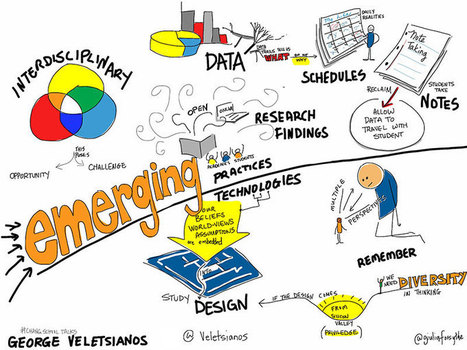
I joined Audrey Watters, Philipp Schmidt, Stephen Downes, and Jeremy Friedberg in Toronto last week, to give a talk at Digital Learning Reimagined, an event hosted and organized by Ryerson University's Chang School.
|
|
Scooped by
Peter Mellow
February 25, 2016 2:52 AM
|
By Bill Taylor - With the advantages of Open Educational Resources being so clear, why aren’t more educators utilizing them?
|
|
Scooped by
Peter Mellow
February 25, 2016 2:34 AM
|
Schools will be able to upload, manage, share, and discover open education resources on the plaftform when it is released in the next quarter.
Study shows faculty members remain skeptical of digital course materials and generally unfamiliar with open educational resources.
Via Chrissy UniMelb
Open Education Resources are online resources that are available for others to use to support learning. They are part of a worldwide movement to promote and support sustainable educational development – the use of the term ”OER” is attributed to a UNESCO workshop in 2002. The sharing of open educational materials is in line not only with University of Edinburgh’s mission but also with a global movement in which research-led institutions play a significant role.
Via ColinHickie
|
|
Scooped by
Peter Mellow
February 2, 2016 4:22 PM
|
panOpen has announced the official launch of its learning platform exclusively based on Open Educational Resources, with nearly 100 pilot programs in place at colleges and universities nationwide.
|
|
Scooped by
Peter Mellow
January 28, 2016 12:47 AM
|
PanOpen is tackling the textbook affordability challenge with a new learning platform based exclusively on open educational resources.
|
|
Scooped by
Peter Mellow
January 5, 2016 4:35 PM
|
Explore resources to help understand, implement, or refine Response to Intervention.
|
|
Scooped by
Peter Mellow
January 1, 2016 1:09 AM
|
The future of OER (Open Educational Resources) and OCW (Open CourseWare) in the developing world and how it will impact education in the future.
|
|
Scooped by
Peter Mellow
December 9, 2015 9:19 AM
|
Explore this educator's guide to open educational resources for information about online repositories, curriculum-sharing websites, sources for lesson plans and activities, and open alternatives to textbooks.
|
|
Scooped by
Kim Flintoff
December 9, 2015 8:18 AM
|
Explore this educator's guide to open educational resources for information about online repositories, curriculum-sharing websites, sources for lesson plans and activities, and open alternatives to textbooks.
|