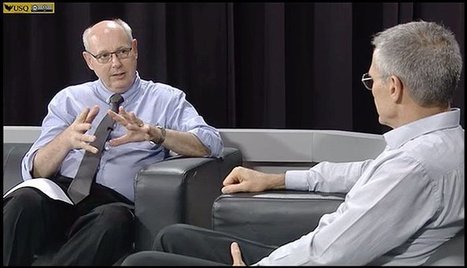
OSI's Patrick Masson interviews Dr. Harris and Dr. Zucker who will be panelists at the upcoming Open Summit on Monday, May 23, 2016 at NYU’s Kimmel Center for University Life.
Beware journalists, academicians, and book publishers: an intelligent Wikipedia is coming for you.
That might not be the exact warning Kyle Bowen, director of educational technology services at Penn State, would offer to the media. But it isn’t too far from the capabilities he’s been working on as part of a research team on machine learning and open educational resources (OER). Bowen is part of a team that has developed algorithms for computers to learn how to write textbooks by extracting factual information. He notes that in smaller ways, this technology is currently in play.
Kyle Bowen, director of educational technology services at Penn State, is part of a team researching machine learning and open educational resources (OER). They're developing algorithms to teach computers to write textbooks by extracting factual information, a technology already used in some areas like sports news. Bowen sees this as a game-changer for accessibility, especially for underserved populations in STEM fields where textbooks quickly become outdated. He's leading a webinar discussing an automated book creation platform they've developed at Penn State, using intelligent algorithms to search through OER repositories for relevant resources. Bowen acknowledges this as first-generation technology, expecting much progress in the future, and envisions even more transformative possibilities beyond machine-composed textbooks, particularly in assessment and adaptive learning spaces. Bowen's involvement with EDUCAUSE Learning Initiative (ELI) reflects his commitment to incorporating technology into teaching and learning. He values the diverse opportunities ELI offers for professional development and networking, describing it as a community of "learning activists" united to transform higher education. Bowen emphasizes the importance of continuing conversations beyond ELI events, fostering ongoing collaboration and learning within the broader educational technology community.
Claude Laflamme is not afraid to try out new ideas. Over the last 15 years, the professor in the Department of Mathematics and Statistics has been combining his passion for teaching with entrepreneurship. The result of his work is innovative teaching and learning tools now available to universities and colleges across Canada.
In 2000, Laflamme and fellow mathematics professor Keith Nicholson founded Lyryx Learning Inc., along with postdoctoral fellow Bruce Bauslaugh and undergraduate student Richard Cannings.
Lyryx works with authors to develop and adapt open texts, which are then provided to students at no cost. The open licences mean there are no copyright and cost issues, as material can be downloaded for free by anyone and posted on any website. The material can also be adapted as desired, as long as the material is attributed to the original creators.
After collaborating with a large publisher for several years, Lyryx is now its own publisher, and entirely committed to supporting Open Educational Resources (OER).
The UNESCO/COL OER Knowledge Cloud will greatly enhance research opportunities and access to knowledge and research on Open Educational Resources and related information by removing barriers, opening up scholarship and making research universally accessible.
The OER Knowledge Cloud has been established to identify, collect, preserve and disseminate available documents of enduring value to researchers, industry, government, scholars, writers, historians, journalists and informal learners.
“I don’t want to be part of a movement that is focused on replacing static, over-priced textbooks with static, free textbooks.” I hope Robin DeRosa’s thoughtful post about open textbooks provokes s…
The promise was of a future where Open Educational Resources would sweep the globe and those pesky publishers would be washed away by a tsunami of high quality, free stuff. It happened to a degree with Wikipedia, Khan, YouTube, MOOCs and Duolingo but almost in spite of the OER movement. In fact, there seems to have been a bifurcation in OER between lots of publically funded projects, that tended to atrophy even die, and a successful crop of global successes. I’d argue that this was due to several strains of scepticism, institutional attitudes and a lack of awareness around marketing and sustainability in the educational community. The successes have been those that weren't held back by these barriers.
The other day I had the pleasure of interviewing Dr Hennie Esterhuizen, the Manager of e-Learning Support at North-West University in South Africa. He and a colleague had come to USQ on a bit of a
There’s a troubling trend surfacing in the marketing world, one that’s riffing off a now-familiar strategy, “greenwashing”. We’ve all seen products coated in greensheen, the misleading marketing ploy that spins a product as environmentally-friendly in order to woo eco-cozy customers.
Now, there’s a whole new buzzword bingo game in town, and it’s all about transparency, access, and believe it or not, “openness”.That’s right. Companies are courting openness like it’s the new green.
Take, for example, the above (badly-photographed – sorry!) advertisement from the Berlin Partner GmbH, a promotional arm of Germany’s capital.
Their new slogan, “be open. be free. be Berlin,” is designed to evoke coolness and inspire acceptance with the young and wired generation. I think it’s pretty illustrative of what I’m calling openwashing. Reading through the campaign’s Terms of Use, for example, I’ve come across these gems:
UCI Open – formerly UCI OpenCourseWare - strives to bring UC Irvine to the world by making course materials, lectures, conferences, and other academic content available for free online.
The opposite of open is not closed; the opposite of open is broken. The more I think about it, the more this cogent observation, made by John Wilbanks, resonates with me. It is true for scholarly p…
MERLOT is a curated collection of free and open online teaching, learning, and faculty development services contributed and used by an international education community. Search peer reviewed open educational resources (OER), create Course ePortfolios, Bookmark Collections, and Learning Exercises, and build your own learning materials with our Content Builder.
Penn State's first Open Educational Resources Summit will be held March 23 in Foster Auditorium, 102 Paterno Library, University Park, and online via MediaSite Live in conjunction with simulcast events at more than a dozen Penn State campuses.
A video about how technology is transforming our system of education, generating equal opportunities for all. SCRIPT & DIRECTION: Daniel Sierra, Ricardo Haba...
Since 2000, walking on the wild side I do open classes and use digitised materials, because are free and open for students, self-learners and of course educators, to use and reuse it for teaching,
To get content containing either thought or leadership enter:
To get content containing both thought and leadership enter:
To get content containing the expression thought leadership enter:
You can enter several keywords and you can refine them whenever you want. Our suggestion engine uses more signals but entering a few keywords here will rapidly give you great content to curate.


 Your new post is loading...
 Scoop.it!