Your new post is loading...

|
Suggested by
Learning Futures
January 29, 2017 2:13 AM
|
"Students at Maricopa Community Colleges (MCC) in Arizona have done just as well academically with open educational resources (OER) as with traditional, high-priced textbooks. In addition, students and faculty are more engaged in teaching and learning in courses that use OER, which are free or low-cost teaching and learning materials, and students are more likely to complete degrees faster. Those benefits, as well as the cost savings, could be used in marketing efforts aimed at encouraging more students to enroll, according to OER advocates."

|
Scooped by
Peter Mellow
January 12, 2017 6:16 PM
|
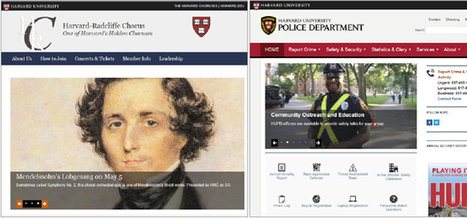
When Harvard kicked off OpenScholar six years ago, little did it realize the impact the website creation project would have on the university — and the academic world at large.

|
Scooped by
Kim Flintoff
November 28, 2016 7:02 PM
|
Open educational resources have grown over the last few years from one-off oddities in single courses to the basis of entire degree programs. Cutting out textbook costs for students tops the list of reasons administrators encourage faculty to develop and adopt these free—or very inexpensive—resources, also known as OER.
Other enticements include immediate access for students who sometimes wait or refuse to buy course materials, and instructors’ ability to customize and update OER, which range from digital textbooks to interactive tutorials to quizzes to YouTube videos.
|
|
Scooped by
Kim Flintoff
November 9, 2016 5:12 PM
|
Taking into account library articles, web links, videos, simulations and more, many courses are already using a number of open education resources — and the move to full OER doesn't necessarily mean a total revamp, according to research out of Excelsior College.
A recent survey of 3,000 faculty members by Babson College reported that six in 10 instructors (58 percent) were "generally unaware" of open educational resources (OER). Some were downright resistant to the whole idea. "I am against freely giving faculty intellectual property," declared one respondent. "It is tantamount to working for nothing. The universities don't want to pay us and the book companies don't want to pay us."
|
|
Scooped by
Peter Mellow
October 26, 2016 2:59 AM
|
We believe in the free flow of information and proudly publish under creative commons.
|
|
Scooped by
Peter Mellow
October 18, 2016 5:46 PM
|
By Julie Keane - Here are five examples of strategies and organizations to help educators start pariticipating in the #GoOpen movement.
|
|
Scooped by
Peter Mellow
October 5, 2016 5:46 PM
|
Rutgers University in New Jersey has launched its Open and Affordable Textbook Project, which offers grants to faculty or department groups that switch to free, low-cost or open alternatives to traditional textbooks.
|
|
Scooped by
Peter Mellow
October 2, 2016 6:59 PM
|
Open Educational Resources are the result of a different approach to education: the focus in on sharing, improving and reusing educational materials created by people (not only super-experts) who are willing to let knowledge spread and be used by anyone.
|
|
Scooped by
Peter Mellow
September 27, 2016 7:26 PM
|
The Modern Language Association recently announced an exciting open-access project, Humanities Core, funded by the NEH. The project is very ambitious and promises to be a valuable asset for researchers, particularly those without access to the expensive databases of large universities. The announcement explains the project:
|
|
Scooped by
Peter Mellow
September 11, 2016 3:49 AM
|
Many studies show that open access (OA) articles—articles from scholarly journals made freely available to readers without requiring subscription fees—are downloaded, and presumably read, more often than closed access/subscription-only articles. Assertions that OA articles are also cited more often generate more controversy. Confounding factors (authors may self-select only the best articles to make OA; absence of an appropriate control group of non-OA articles with which to compare citation figures; conflation of pre-publication vs. published/publisher versions of articles, etc.) make demonstrating a real citation difference difficult. This study addresses those factors and shows that an open access citation advantage as high as 19% exists, even when articles are embargoed during some or all of their prime citation years. Not surprisingly, better (defined as above median) articles gain more when made OA.
|
|
Scooped by
Peter Mellow
September 6, 2016 6:11 PM
|
A non-profit organization with technology that brings digital content to "offline" populations around the world for the purposes of education will be paying more attention to a U.S. population that's also unable to access the Internet: those in prisons and jails.
|
|
Scooped by
Peter Mellow
August 18, 2016 7:53 PM
|
NASA just announced that any published research funded by the space agency will now be available at no cost, launching a new public web portal that anybody can access.
The free online archive comes in response to a new NASA policy, which requires that any NASA-funded research articles in peer-reviewed journals be publicly accessible within one year of publication.
|
|
Rescooped by
Peter Mellow
from The iOER Handbook
July 27, 2016 8:02 PM
|
Only 6.6 percent of faculty members are "very aware" of open educational resources, a survey found, and many say they can’t find such materials, although their use in introductory courses is ticking up.
Via John Shank
|
|
|
Scooped by
Peter Mellow
January 17, 2017 4:37 PM
|
Bill & Melinda Gates Foundation becomes the most recent grant-making organization to require recipients to make findings publicly available, a further shift toward transparency in research funding.
|
|
Scooped by
Kim Flintoff
December 16, 2016 7:20 PM
|
Germany’s DEAL project, which includes over 60 major research institutions, has announced that all of its members are canceling their subscriptions to all of Elsevier’s academic and sci…
|
|
Scooped by
Peter Mellow
November 15, 2016 4:10 PM
|
Barnes & Noble Education has released a new platform designed to make it easy for faculty to find and use open educational resources.
|
|
Scooped by
Peter Mellow
November 1, 2016 5:14 PM
|
Open research is about more than open access. It is about making all aspects of the research process open to all possible interested parties. Ahead of a workshop and hackathon later this week, Bian…
|
|
Scooped by
Peter Mellow
October 25, 2016 7:27 PM
|
Survey reveals three quarters of academics have shared data despite widespread uncertainty
|
|
Scooped by
Kim Flintoff
October 18, 2016 6:55 AM
|
Open educational resources (OER) in higher education could triple in use as primary courseware in the next five years, according to a new survey of college and university faculty.
OER have the potential to jump from 4 percent use as primary courseware to 12 percent, noted a Cengage Learning survey of more than 500 faculty. And one of the main reasons for the projected increase in adoption is OER’s potential as a solution for students who skip or defer classes due to the price of required course textbooks or learning resources.
The survey, Open Educational Resources (OER) and the Evolving Higher Education Landscape, also found that OER use for supplemental learning materials may nearly quadruple in size, from 5 percent to 19 percent.
|
|
Scooped by
Peter Mellow
October 4, 2016 6:10 PM
|
For over a decade, plenty of time and dollars have been poured into efforts encouraging the use of open educational resources (OER). In 2007 the Hewlett Foundation’s funding helped create OER Commons. Last year, the U.S. Department of Education spearheaded the #GoOpen movement, a collection of ef
|
|
Scooped by
Peter Mellow
September 28, 2016 6:35 PM
|
Open-source interactive textbooks, which are aligned with the values of academia, allow both instructors and students to take ownership of their educational resources.
|
|
Scooped by
Peter Mellow
September 22, 2016 4:44 AM
|
By Curt Bonk in Instructional Design and Educational Technology. Abstract: The purpose of this study was to explore the process and effectiveness of Open Educational Resources (OER) based flipped classroom practice in an undergraduate course named
|
|
Scooped by
Peter Mellow
September 7, 2016 6:30 PM
|
A new survey from Cengage Learning found that open educational resources in higher education have the potential to triple in use as primary courseware over the next five years.
|
|
Rescooped by
Peter Mellow
from Easy MOOC
August 30, 2016 4:16 AM
|
... OERs not only get you added information but makes learning better by introducing better resources on concepts. Students, teachers and institutions; all get choices from various resources and can use the ones that are apt for their learning and teaching method. Few benefits of OERs for faculty and students: ... http://www.scoop.it/t/easy-mooc#
Via Lucas Gruez
|
|
Scooped by
Kim Flintoff
August 2, 2016 8:47 PM
|
Free or open educational resources (OER) appear to have increased in popularity over the last few years, as more state universities and community colleges carry out initiatives to replace traditional textbooks with OER. While institutions are adopting OER, however, the majority of professors and other teaching faculty in higher education are still not aware of OER, according to new report from Babson Survey Research Group (BSRG) at Babson College.
The report “Opening the Textbook: Educational Resources in U.S. Higher Education, 2015-16” incorporates survey results of more than 3,000 teaching faculty and examines attitudes, opinions and use of OER. Overall, the survey paints a mixed picture for OER, where faculty members’ awareness of OER is low but improving.
|