


Open Educational Resources
6.4K views |
+0 today
sharing, collaboration and repurposing content are the hallmarks of modern education
Curated by
Learning Futures
 Your new post is loading...
 Scoop.it! 
When should I publish with open access? A handy flow chart. This is from The Big Think, but a topic that has been a part of academic discussion for some time. Great flow chart an happy to see thi... 
Scoop.it!

Publishing hoax exposes 'wild west' world of open access journals and raises concerns about poor quality control
Scoop.it!

The Metropolitan Museum of Art has released a vast archive of 400,000 (mostly) hi-resolution digital images online that you can download and use for non-commercial purposes. From a 12-megapixel scan of Rembrandt's 1660 self-portrait to over 18,000 photos spanning almost two centuries.
Scoop.it!

The idea of openness is one of the most used and often misunderstood terms in Higher Education. It informs many of the debates around access, delivery, equity, innovation and technology. It became ... Via Dr. Susan Bainbridge
Scoop.it!

Last summer we told you that the J. Paul Getty Museum launched its Open Content Program by taking 4600 high-resolution images from the Getty collections, putting them into the public domain, and making them freely available in digital format. We also made it clear -- there would be more to come. Via Stephanie Sandifer

Dean Mantz's curator insight,
April 24, 2014 10:32 AM
Thank you Stephanie Sandifer for sharing information on the J. Paul Getty Museum regarding the addition of artwork being released into the public domain for free digital use.
Scoop.it!
Varun Arora is the founder and CEO of OpenCurriculum, a California-based technology nonprofit aimed at bringing openness and innovation to K-12 education aro... Via Dr. Susan Bainbridge

Joseph McCaleb's curator insight,
April 3, 2014 8:19 AM
Educate for happiness: Build bridges not theme parks
Scoop.it!

"Working with digital media materials implicitly entails a tacit knowledge about the different concepts related to copyright and fair use. I have always insisted through the posts I shared in the "copyright materials for teachers " section here in Educational Technology and Mobile Learning on the importance of teaching our students about how to properly credit sources and documents they grab from Internet ..."Ó Via Leona Ungerer, Carlos Pinheiro
Scoop.it!
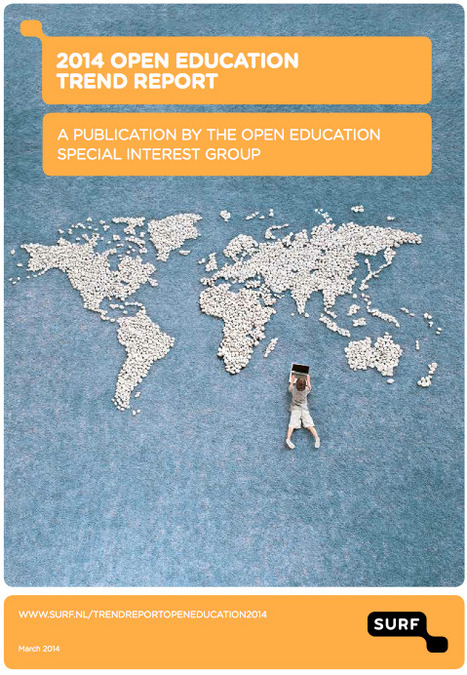
(From the foreword) The global development towards open education dates back more than ten years. In 2006, several Dutch universities followed suit with the publication of OpenCourseWare. Although several institutions had already embraced the concept of open education for some time, the issue seems to have truly taken hold in the Dutch higher education sector since 2013, largely due to the growing popularity of Massive Open Online Courses (MOOCs). The Trend Report supports this conclusion. The report accurately describes the latest developments and challenges facing the Dutch higher education sector in relation to open and online education. The articles also outline a concrete vision on future developments, such as the effects of recognising MOOC results, the impact of digitisation on postgraduate education and other forms of disruptive innovation.
Via Peter B. Sloep

Peter B. Sloep's curator insight,
March 11, 2014 5:51 AM
This is the third trend report in a row that Surf, in which Dutch higher education institutions collaborate on educational innovation with ICTs, has published. It features contributions by academics and support staff throughout higher education in the Netherlands, thus reflecting the current state of the art. Although the perspective is wider than MOOCed education, the term MOOC features 430 times, at least once on almost all of its 69 pages. It goes to show that in the Netherlands, but likely in Europe as a whole, there is an intimate link between MOOCs and open education. ‘Open’ here means making use of open licenses (such a creative commons licenses), it stands in contrast with ‘open’ in the sense of for free, without cost, which applies to the courses of the large MOOC platforms (see also the EUA report next http://sco.lt/6QxgvZ).
As indicated, all the topics covered in the report refer to MOOCs. To name a few of them: flexibility and quality, postgraduate education, apps for open education, economics of open education, platforms, recognition of credits, testing and assessment, MOOCs in formal education, learning analytics, student perspectives, privacy and other legal issues. As with the previous trend reports, a useful collection of insights. @pbsloep 
Manuel León Urrutia's curator insight,
March 24, 2014 9:18 AM
A trend analysis on MOOCs from all perspectives: institutional, educational, business, and technical. Interesting to see the insights of dutch scholars on how MOOCs can offer quality education, how can become sustainable business models. Of special interest is the second article about the potential of MOOCs to change education economics, supported with figures.
Scoop.it!

Getting started with Open Educational Resources (OER) (title); La Trobe University OER Working Group (author); Jelley, Ruth. (author); Jones, Mungo. (author); -- La Trobe University Research Online
Scoop.it!

MIT OpenCourseWare shares the course materials from classes taught on the MIT campus. In most cases, this takes the form of course documents such as syllabi, lecture notes, assignments and exams. O...
|
Scoop.it!

LONDON (Reuters) - The Bodleian Libraries of the University of Oxford and the Biblioteca Apostolica Vaticana (BAV) said on Thursday they intended to digitize 1.5 million pages of ancient texts and make...
Scoop.it!

The Diamond Model of Open Access Publishing: Why Policy Makers, Scholars, Universities, Libraries, Labour Unions and the Publishing World Need to Take Non-Commercial, Non-Profit Open Access Serious
Scoop.it!

One Australian university is pushing the boundaries of unrestricted access to its scholarly research.
Scoop.it!

Most of the links listed on this page offer resources with a less restrictive copyright licence under open access or creative commons rules.
What are Open Access Resources?
Open access resources are publications that have "free availability on the public internet, permitting any users to read, download, copy, distribute, print, search, or link to the full texts of these articles, [allow search engines to] crawl them for indexing, pass them as data to software, or use them for any other lawful purpose, without financial, legal, or technical barriers other then those inseparable from gaining access to the internet itself". (Budapest Open Access Initiative)
Scoop.it!
Ideas transform society & knowledge is power. What if there was a way to channel mankind's knowledge? What if there was a way to gain access to the most resp... Via Jeff Agamenoni

Jeff Agamenoni's curator insight,
May 7, 2014 4:14 PM
I probably should have understood about MOOC's and OER's before now...but my head has been jammed in a calculus book.
Scoop.it!

A Cool Flowchart to Teach Students How to Cite and Credit Images ~ Educational Technology and Mobile Learning http://t.co/762uGX1uJu #... Via Selena Chan
Scoop.it!

From
oeru

Open educational resources (OER), open educational practices (OEP), open access, open licensing, open source, open philanthropy … Join our international family to learn how to make open education work for your organisation.
Scoop.it!

Why invest lots of time, effort and energy creating new course materials from scratch when quality, freely-available resources may already exist? Why not adapt and use these resources, known as Open Educational Resources (OERs)?
Dr. Rory McGreal , Contact North | Contact Nord Research Associate and the UNESCO/Commonwealth of Learning Chair in Open Educational Resources shares his expertise in a series of 10 short, informative videos that address the what, why, where, and how of OERs. Through the videos, Rory guides you to effectively find and make use of OERs for more time- and cost-effective course development.
Scoop.it!
A discussion over the different definitions of "Open" (Open as in oer and open as in MOOC #connectivism #mooc http://t.co/YxhxvZSc5g via @patlockley)... Via Dr. Susan Bainbridge, Kim Flintoff

pru's curator insight,
March 14, 2014 7:02 PM
Useful discussion prompt for openness - in professional learning, and when considering development of MOOC learning materials. Massive benefit if these can become part of the OER ecosystem.
Scoop.it!
Oppia is a tool for creating interactive online activities that enable students to learn by doing. Its creators believe that this is often a more effective and efficient way of learning than either watching videos or reading texts, since it allows the student to engage more deeply with the activity in a way that videos or books often do not.
Oppia aims to simulate the one-on-one interaction that a student has with a teacher by capturing and generalizing “interaction dialogues.” For instance, a teacher might ask the student a question, and the student then responds in some way -- by either volunteering an answer, or saying that he/she is stuck. The teacher then responds in a way that is as helpful to the student as possible. However, the teacher will often not have time to address every individual misconception. Furthermore, it usually takes significant effort to figure out an appropriate response that helps a student get unstuck without denying them the experience of working through the problem and coming to terms with their misunderstanding. In many cases this effort will have already been expended by another teacher in a different school who is faced with the same question. If teachers use Oppia to record such interactions, they can share their knowledge with more students without duplicating effort.
We hope that having some of the student’s work addressed automatically will lighten the teacher’s load and help them focus on the questions that require a human’s response, as well as provide quick feedback to the student that would make the learning experience more enjoyable. Over time, as Oppia becomes able to address more misconceptions and understand more varied student inputs, we hope that it will become an increasingly useful and valuable resource for students and teachers worldwide.
Scoop.it!

Robert Schuwer's insight: A conceptual view on OER and its role in learning. Described from an historical perspective, assuming different types of open, open learning and licenses. Via Bob Jarman
|







Pour le plaisir de tous...
Imágenes Digitales del Metropolitan a Dominio Público.