Open source, open science, open data, open access, open education, open learning -- this course provides an introduction to the important concept of openness from a variety of perspectives, including education, publishing, librarianship, economics, politics, and more, and asks you to discover what it means to you. Open Knowledge is international and multi-institutional, bringing together instructors and students from Canada, Ghana, Mexico, the United States, and the rest of the world. It will challenge you take control of your own education, to determine your own personal learning objectives, to contribute to the development of the curriculum, to reflect on your progress, to learn new digital skills, and to take a leadership role in the virtual classroom. It will also provide you with the opportunity to connect with colleagues from different countries and professions, and to better understand areas where your interests overlap and where unexpected distincts exist. We hope you’ll consider taking this journey with us.
Led by Beck Pitt, the OER Research Hub has developed an open course (don't use the M word) on P2P University on being an open researcher. It is four weeks long, although you can study it anytime an...
"Open Curriculum is a new entry into the lesson depot market. Like similar sites, Open Curriculum offers a collection of thousands of resources for teaching mathematics. You browse the Open Curriculum resource lists according to grade level and topic. As you might guess, a lot of the featured resources are Khan Academy materials. In addition to the Khan Academy materials you will find lessons created and shared by other teachers."
This website gathers and publishes evidence about the impact of open educational resources (OER). It is maintained by the OER Research Hub project. The purpose is to help people understand the impact of OER.
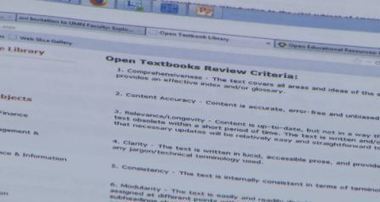
Open educational resources not only save students from triple-digit (or more!) textbook costs, but they also allow instructors to mix-and-match content for a more personalized, engaging learning experience. Here are 16 resources that offer a wide range of content and tools to help implement OER in just about any course.
Open educational resources (OER) are materials used to support education that may be freely accessed, reused, modified, and shared. These Guidelines outline key issues and make suggestions for integrating OER into higher education.
http://www.ted.com Rice University professor Richard Baraniuk explains the vision behind Connexions, his open-source, online education system. It cuts out th...
The Utah State Office and the Utah Education Network have gathered these Open Educational Resources, such as Utah's Open Textbooks, that support the Utah Core Standards.
We are approaching a decade and a half of experience in one strand of the higher education open agenda: the development and use of open-source software. Motivated by the three drivers of cost, performance, and control—as identified by Paul Courant, former librarian of the University of Michigan—open-source software has been widely adopted by higher education.1 It is useful to periodically draw lessons from this collective experience to inform the shape and direction of future initiatives.
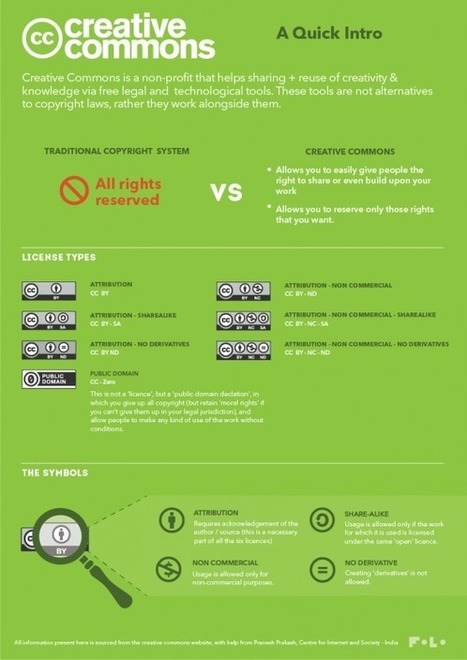
Videos Explaining Creative Commons Resources A2 Creative Commons poster.Download PDF CC Policies for Schools brochure. Download PDF. Free to Mix guide for students. Download PDF Open Access to rese...
Low-cost, high-quality textbooks may once have been a myth, but no longer: Open educational resources provide a wide variety of free learning content for practically any subject. CT asked three OER enthusiasts for their favorite tips and tools.
OER Defined
"OER are teaching, learning and research resources that reside in the public domain or have been released under an intellectual property license that permits their free use and repurposing by others. Open educational resources include full courses, course materials, modules, textbooks, streaming videos, tests, software and any other tools, materials or techniques used to support access to knowledge." — The William and Flora Hewlett Foundation
Publishing openly provides greater exposure, boosts prospects and can lead to more citations, says Erin McKiernan
We spend years teaching our children to share. Yet from the moment students enter academia, we discourage it. Lock up your work in prestigious subscription journals; keep your data close to your chest; compete instead of collaborate – these are the messages transmitted by peers and mentors. These are the tenets of our unhealthy academic culture. We need to change our priorities.
Yesterday I attended a mini conference dedicated to Open Educational Resources (OER). I found it to be quite interesting as there aren’t many events completely dedicated to OER these days. In fact,
The study found that the majority of all types of students were positive about many aspects of OERs and some were already making extensive use of a wide range of resources, not only within their course, but when selecting an institution to attend.
More than half of students expect OERs to play an increasingly important role in their learning experience in the future. However, the findings also point to a need for more clarity and reassurance for students about the role that OERs will play in learning in the future, as well as more practical support in their discovery and use.
Results of a study by the Higher Education Academy and National Union of Students in the UK about attitude towards and use of OER. For me, some remarkable results were:
"The spirit of open learning is one of sharing freely and openly yet both groups of students (traditional and non-traditional) said they were likely to share resources that they had found but with caveats, such as only with people they knew, or with just others in the same class or after they had finished using a particularly useful resource as they wanted to gain an advantage and the possibility of a higher mark than other students. Such comments highlight students' perceptions of assessment and competition. "
"There was less likelihood of sharing resources when the materials were produced by the students themselves. One reason was concerns over being accused of plagiarism."
"when asked whether materials from their courses should be made openly available, opinions were divided with views ranging from “not minding” to “no, it would devalue education and why pay for something that is made free for others not paying”."
"One of the highlights of technology is the free, open access to information that it allows. Here are some open education resources we think you'll enjoy! Free Online Courses: Use these links to enroll in free online courses, or download materials to learn at your own pace."
Jim Lerman's insight:
Excellent collection of resources for motivated learners, intended mainly (but not exclusively) for those of post high-school age. College Unbound is a fascinating organization founded by Dennis Littky and Elliot Washor.
The success of open government data is indisputable. By empowering data scientists as well as the general public to interrogate publicly shared government data sets, we have been able to discover new trends and correlations as well as spot malfeasance. Open data affects publicly funded academic research at a governmental and funder level as well, including the types of research supported and what happens with the data collected. Nonetheless, it took a recent statement from the Public Library of Science (PLOS) to ignite the conversation about open data between individual academic researchers.
Classroom is a new product in Google Apps for Education that enables teachers to send assignments, make announcements, and conduct question & answer with students. Classroom was designed hand-in-hand with teachers to help them save time, keep their classes organized, and improve communication with students.
The open seas of on-line learning has quite an interesting Eco-system. MOOCs, without any doubt, are one of the most dominating species, but there are others, often working in the background, keeping the system thriving and sustaining. Open Educational Resources are one of those entities that makes online learning all that rich and vibrant. These educational resources complement and supplement MOOCs on the one hand and, going further, they enable a large body of learners, both traditional school/ college going students as well as self learners and, the teachers as well, by providing open, share-able, often modifiable, mix-able and remix-able (depending upon the licenses), syllabi, contents, books, videos, slides, and other assets. These resources are mostly open, free, often downloadable as pdf, ePub, or other formats and, are quite valuable in terms of the contents.
Below is a list of the open educational resources/ repositories.
To get content containing either thought or leadership enter:
To get content containing both thought and leadership enter:
To get content containing the expression thought leadership enter:
You can enter several keywords and you can refine them whenever you want. Our suggestion engine uses more signals but entering a few keywords here will rapidly give you great content to curate.


 Your new post is loading...