Your new post is loading...

|
Scooped by
Gilbert C FAURE
November 5, 7:39 AM
|
If you haven’t had the chance to read, our article has free access for October, so time’s running out! It features strong research based advocacy for the role of #TeacherLibrarians in primary education. Link below. #StudentsNeedSchoolLibraries
|
|
Scooped by
Gilbert C FAURE
October 7, 4:15 AM
|
Thank you to Damiano Orru for editing the new Italian translation of the updated 2025 Metaliteracy Goals and Learning Objectives, expanding the international reach of the metaliteracy framework!
In a new guest post on our Metaliteracy site, Damiano introduces the translation and explores connections among metaliteracy, information literacy, and AI, with an emphasis on reflection, critical evaluation, and responsible engagement with information.
We welcome interest in translating the Metaliteracy Goals and Learning Objectives into additional languages. If you have an idea for a new translation, please reach out to Trudi Jacobson or me.
#Metaliteracy #InformationLiteracy #AILiteracy #Libraries #AcademicLibraries #InfoLit
https://lnkd.in/dTTAtK7c
|
|
Scooped by
Gilbert C FAURE
September 10, 11:13 AM
|
Jako Olivier thank you for this mention and for all you do to support literacy and Metaliteracy! You continue to bring people together from around the world in support of open, inclusive and innovative learning. I hope that everyone reads your post. Thank you!
|
|
Scooped by
Gilbert C FAURE
September 3, 7:15 AM
|
In August I, Bill Johnston and Dr. Pamela McKinney did a session to introduce the *Information Literacy Handbook* in my home department, the School of Information Journalism & Communication (IJC) at The University of Sheffield. The chair was Dr Dani Madrid-Morales (Co-Lead of the Disinformation, Information Integrity and Literacies (DIIL) Research Cluster in the IJC).
We've just put up the recording! It starts with an introduction to the Handbook and to the collaboration ILIAD, then Bill and I highlight some aspects of our introductory chapter, then Pam talks about her Theory of Change chapter and finally I talk about my chapter on Autoethnography. There is also a short question session at the end. *You can enable captions if you wish*.
The recording (51 minutes, or less if you speed it up 😄 ) is at https://lnkd.in/erfUAhpZ
|
|
Scooped by
Gilbert C FAURE
August 5, 8:59 AM
|
How can meme-based pedagogy help students recognize and respond to AI-driven disinformation?
Thanks to Changhong Wu, Information Literacy Librarian at Northeast Normal University (NENU), China, for writing a guest post about her innovative #metaliteracy research with undergraduate students.
Changhong and her colleagues will present their findings on August 8 at the International Federation of Library Associations and Institutions (IFLA) WLIC 2026 Information Literacy Section Satellite Meeting in Busan, Republic of Korea.
I'm honored to join remotely to explain how metaliteracy informs this important work.
Read more about the research and presentation on the Metaliteracy Blog:
https://lnkd.in/gvwiQdj9
#WLIC2026 #InformationLiteracy #InfoLit #AILiteracy #DigitalResilience #Disinformation
|
|
Scooped by
Gilbert C FAURE
May 28, 3:53 AM
|
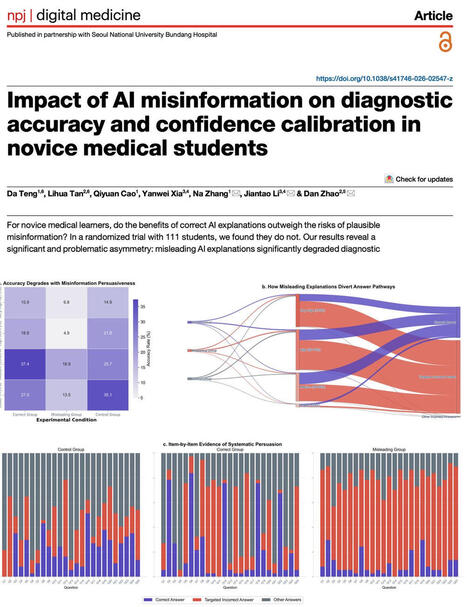
AI in medical education may be dangerous not only when it is wrong: it may be dangerous when it is "plausibly" wrong.
A very interesting study published in npj Digital Medicine examined the impact of AI-generated explanations on novice medical students, comparing correct explanations, misleading explanations, and no explanations.
The result is important because it touches one of the most delicate aspects of AI in medicine: the persuasive power of a well-structured explanation.
In clinical reasoning, an error that appears obviously wrong can often be recognized, questioned, and rejected. But an error that is coherent, fluent, and medically sophisticated is much more difficult to resist, especially for learners who have not yet developed strong internal models of disease.
Medical education is not only about reaching the correct answer: it is about learning how to evaluate the path that leads to that answer. If AI provides a wrong conclusion with a convincing explanation, the risk is not only diagnostic error. The deeper risk is that the learner may begin to trust the structure of reasoning without having the expertise to detect where that reasoning fails.
This is why AI literacy cannot simply mean knowing how to use AI; it must mean knowing how to interrogate AI.
Students and trainees will need to learn not only how to obtain explanations from artificial intelligence, but how to deconstruct them, compare them with biological plausibility, identify hidden assumptions, and recognize when confidence is not justified.
The future of medical education will not depend only on giving students access to better tools: it will depend on teaching them how to remain intellectually independent in front of tools that sound increasingly authoritative.
AI can support learning but it must not become a machine that teaches confidence before competence.
#ArtificialIntelligence #Medicine #MedicalEducation #ClinicalReasoning #DigitalHealth #MedicalAI #PatientSafety #FutureOfMedicine | 11 comments on LinkedIn
|
|
Scooped by
Gilbert C FAURE
May 21, 3:49 AM
|
The Chinese translation of Metaliteracy: Reinventing Information Literacy to Empower Learners, the first book introducing the metaliteracy model that I co-authored with Trudi Jacobson, has been published (https://lnkd.in/gNxkpnii). Many thanks to Wu Changhong (Bella Wu) at Northeast Normal University for initiating and completing the translation, and to ALA Editions for supporting the project. This new translation expands the global reach of metaliteracy among students and educators across academic and library communities in China. #metaliteracy #infolit #InformationLiteracy #HigherEducation #AcademicLibraries #GlobalLearning #DigitalLearning
|
|
Scooped by
Gilbert C FAURE
April 8, 10:48 AM
|
This study offers a striking demonstration of how easily fabricated health information can infiltrate the systems millions of people rely on for medical guidance. A fictional disease, seeded through two obviously bogus preprints, was repeated as fact across major AI platforms within weeks, and eventually cited in peer-reviewed literature. The researchers themselves were alarmed at how well it worked. https://lnkd.in/er24NDG2
Anyone familiar with how LLM developers collect content and sell their services as information intermediaries would not be surprised. Our information environments are more shaped by technology, design choices, and commercial interests than most people think.
This goes well beyond AI safety or academic integrity. We need to stop framing health misinformation as primarily a communication problem, solvable through better messaging or more trusted spokespeople. Marketers are already using LLMs to generate health content optimized for AI overviews. Developers are embedding AI into health apps without standardized evaluation. Researchers are using LLMs to shortcut analysis, sometimes without reading the sources those tools cite. At every node in this chain, the mere availability of an AI tool has become sufficient justification for its use, with almost no conversation about what skills, governance, or values should accompany that.
What would actually help: mandatory pre-deployment evaluation of health AI for misinformation susceptibility. Transparency requirements for AI-generated health content. Real health and algorithmic literacy in education. Independent, non-commercially driven health knowledge infrastructure. Stronger norms around AI use in scientific publishing. And public health voices in the rooms where these systems are designed, not just called in afterward to clean up.
Public health cannot message its way out of an information swamp. If this continues to be treated as a communication challenge rather than a structural one, we will keep arriving at the shore with a megaphone while the water keeps rising.
|
|
Scooped by
Gilbert C FAURE
March 25, 2:36 PM
|
The Information Literacy blog is previewing some of the #LILAC26 presentations that will be delivered by my colleagues at the University of Sheffield - first up is Laura Williams on - mushrooms and information literacy! https://lnkd.in/e2jy3yVQ
|
|
Scooped by
Gilbert C FAURE
March 16, 4:42 AM
|
Most parents don’t realise this.
The version of TikTok Chinese kids use is not the same one our kids get.
Not even close.
In China, if you’re under 14:
• The app shuts down at 10pm
• Usage is capped at 40 minutes a day
• The algorithm mainly shows science, museums, and educational content
Now compare that with the version our kids get:
• Infinite scroll.
• Endless dopamine loops.
• No off switch.
Same company: ByteDance runs Douyin in China and TikTok everywhere else.
For Chinese kids:
• Youth Mode enabled by default
• Real-name verification
• Educational feeds
• Hard time limits
For other kids all over the world?
An algorithm optimized for maximum watch time.
You don’t have to agree with China’s internet policies to notice something interesting here: The people who built these algorithms know exactly what they do to developing brains.
And they chose to protect their own kids from it.
The real problem isn’t just lack of regulation all over the world. It’s also lack of tech literacy among everyday non-tech people.
Engineers understand these systems. Many tech executives do too.
But most parents were never taught how algorithms actually work. So billions of kids are growing up inside systems their parents don’t understand.
And with AI-driven feeds, that gap is only getting wider.
Question:
Should platforms be responsible for protecting kids from their own algorithms?
________________
♻️ share this post to spread awareness.
➕ Follow Tiana Zivkovic for more on tech/AI posts. | 85 comments on LinkedIn
|
|
Scooped by
Gilbert C FAURE
February 7, 12:04 PM
|
|
|
Scooped by
Gilbert C FAURE
February 3, 8:08 AM
|
Happy New Year. I hope you are ready and set to improve health literacy. As we move into 2026, health literacy is no longer a niche academic concept, or a soft add-on to health communication. It has become a core societal capability that determines how well people, organizations, systems, and societies can navigate complexity, uncertainty, and rapid transformation. In my newsletter below, I share the trends I see will shape 2026.
#HealthLiteracy #2026 | 12 comments on LinkedIn
|
|
Scooped by
Gilbert C FAURE
January 4, 4:40 AM
|
Navigating AI Literacy: STEM Students’ Perceptions of Generative AI (The University of Queensland Australia):
https://lnkd.in/dA6STq9T
Glimpse: The need for AI literacy that goes beyond technical proficiency to incorporate ethical and professional competencies is growing as generative AI becomes more and more integrated into STEM education. Through the viewpoint of UNESCO's Digital Literacy Global Framework, this mixed-methods study investigates how STEM students see and apply generative AI, evaluating compliance with industry standards in an AI-driven workplace. Data from surveys and interviews with engineering and IT students (N = 22) reveals that although students acknowledge the productivity advantages of generative AI and exhibit developing critical thinking and adaptability skills, there are still significant gaps in ethical awareness and digital citizenship. In order to better prepare students for professional practice, the results highlight the need for more systematic integration of AI literacy into STEM curriculum, integrating technical skills with ethical reasoning and responsible technology use.
---
Free articles and analyses on soft counter-extremism, against online hate, and on the theory of mis-/disinformation (usually third-party content). Two-week reviews available via the following three websites:
• counter-terrorism.org
• preventhate.org
• strategism.org
The most recent LinkedIn posts, with summaries, on the above subjects can be accessed via:
• https://lnkd.in/eBarZAew
#policyinstitutenet #preventradicalization #preventextremism
#counterextremism #preventhate #disinformation #misinformation
|
|
|
Scooped by
Gilbert C FAURE
October 18, 5:13 AM
|
We need more meta-analyses of research on #science #communication. This is what Mike S. Schäfer, Elisa Tedaldi, and I argue in a new commentary, published in Public Understanding of Science Journal: https://lnkd.in/eJY35ujM #OpenAccess
Our main points:
🔎 Research on science communication has grown and diversified substantially, but we have few consolidated answers to key questions, such as: Does #hate speech against scholars affect public perceptions of them? Does political advocacy affect scientists' #trustworthiness? How are #socialmedia use and science #literacy related to each other? We do have several studies on these questions, but they are fragmented across different contexts, conceptual approaches, study designs, and construct operationalizations.
⚙️ Meta-analyses can provide answers to some of these questions – yet they are rare in #scicomm research, unlike in political, #health, and #environmental communication. They provide statistically robust estimates of effect sizes across many studies, including the conditions under which effects vary – so they are a powerful tool to synthesize the large portion of #survey-based and #experimental research in our field.
🧭 We propose a meta-analytical research #agenda: Use moderator analyses to account for cultural and topical differences, include multilingual and grey literature to counter the Western skew of the literature, weight evidence by its quality, handle the many operationalizations of concepts like #trust in science, and improve #OpenScience standards for reporting effect sizes and sharing data.
💢 Following this agenda can enable us to provide robust, cumulative evidence on overarching themes of science communication research. This, in turn, both benefits the progress within our field and increases its #impact beyond it.
Many thanks to my co-authors Mike S. Schäfer and Elisa Tedaldi! A shout-out also to Aart van Stekelenburg, Gabi Schaap, Harm Veling, Jonathan Van 't Riet', and Moniek Buijzen, as well as Zhuo Guo and colleagues whose meta-analyses on consensus and uncertainty communication show what's possible in our field 🙏
#scicomm #wetkomm #metaanalysis NeFCA Division Science Communication | Strategic Communication Chair Group | UZH Department of Communication and Media Research (IKMZ) | DGPuK-Fachgruppe Wissenschaftskommunikation | Metascience 2027 | Center for Reproducible Science and Research Synthesis UZH
|
|
Scooped by
Gilbert C FAURE
September 23, 1:13 PM
|
Affect, Certainty, and Mis/Disinformation (International Journal of Communication):
https://lnkd.in/d6Jed4x4
Glimpse: According to this article, affect is an embodied, relational force that influences how people perceive certain claims as certain or convincing. It makes the case that algorithmically optimized media formats and recurring affective patterns can strengthen emotional reactions and affect later information encounters. Fact-checking and moderation are not enough because misinformation and disinformation function not only through content but also through these affective and nonrepresentational processes. Therefore, in order to improve digital literacy and combat misinformation, the authors support strategies that address the intensity, ambivalence, and embodied dimensions of affect.
---
Free articles, analyses, and multimedia documents on soft counter-extremism, against online hate, and on mis-/disinformation. Third-party content, in most cases.
Our recent LinkedIn posts on the above subjects, along with our glimpses, can be accessed via:
• https://lnkd.in/eBarZAew
Reviews available via the following three Policyinstitute.net websites:
• strategism.org
• counter-terrorism.org
• preventhate.org
Views expressed in this post are those of the original authors, not Policyinstitute.net. We manually select all material and execute diligent editorial oversight. While we carefully prepare summaries of linked articles, documents, or recordings, we are not responsible for textual errors, inaccuracies, or changing contexts. Generative AI is used strictly for rewording, with no autonomous or agentic AI employed for compilation.
#policyinstitutenet #preventradicalization #preventextremism #counterextremism #preventhate #disinformation #misinformation
|
|
Scooped by
Gilbert C FAURE
September 10, 10:15 AM
|
New blog post - a reminder that more 'digital literacy' is very rarely the answer to any of the problems of the digital age ... but that critical digital literacy is definitely something worth encouraging!
https://lnkd.in/gFsRHfqH
|
|
Scooped by
Gilbert C FAURE
August 18, 7:55 AM
|
|
|
Scooped by
Gilbert C FAURE
July 10, 4:10 AM
|
Our President and CEO Jeff Schmid joined the podcast, Money and Wealth with John Hope Bryant, to discuss the work of the Federal Reserve, the U.S. financial system and financial literacy.
Listen to the full episode here: https://bit.ly/4ybLKZo
|
|
Scooped by
Gilbert C FAURE
May 25, 11:07 AM
|
How do you actually use your professional network to learn?
Most of us give some version of the same answer: we follow interesting people, scroll LinkedIn, catch a conference or two. If pressed, we say something like "I just… stay connected." That answer is not wrong. It is just not very useful.
The third post in my Linking Learning Advisory launch series introduces the LSA framework, which came directly out of my PhD research with practising teachers. It describes three distinct sets of connected learning practices: Linking (purposeful and goal-directed), Stretching (curious and expansive), and Amplifying (contributory and generative). These are not stages on a ladder. Most of us move between all three, depending on what our context and capacity allow at any given time.
What the framework offers is vocabulary. And vocabulary matters, because naming a practice is the first step towards being intentional about it.
The post also draws the connection between these learning practices and information literacy, and explains why the framework travels well beyond education into corporate and government contexts.
Read it at https://lnkd.in/gnY_yjJE
#linkinglearning #linkedlearningadvisory #professionallearning #PLN #connectedlearning #informationliteracy #LSAframework #knowledgemanagement
|
|
Scooped by
Gilbert C FAURE
April 9, 4:44 AM
|
🤳 Patients are already using AI to make health decisions, but we haven't started measuring it yet.
As someone who has spent the past decade developing and validating PREMs and PROMs, this gap is hard to ignore.
🏥 Our measurement frameworks currently measure a patient interacting with a health worker, inside a facility setting. Today, patients are interpreting symptoms with AI, exploring diagnoses before appointments, and potentially making decisions between or even instead of clinical encounters. We need to start making the shift to measure experience and outcomes beyond just care beginning and ending in the health facility.
The recent Lancet Primary Care paper by Riggare et al calls this shift "triadic care" : the evolving relationship between health worker, patient, and AI. We need to start responding as a research community because right now, a growing part of the patient experience exists outside our field of vision.
⚖️ Patients are navigating systems that may be inaccessible, stigmatizing, or dismissive of their needs. AI chats may offer new forms of support, but it also carries risks of bias, misinformation, and new forms of exclusion. Measurement must not only capture these experiences, but ensure they are visible for accountability.
How do we begin to question the experience we're trying to measure including whether patients are genuinely supported to make autonomous, informed decisions when it unfolds entirely outside the system?
We need to begin a new era of capturing experiences: Did you arrive with AI-generated information? Did it shape your understanding or your anxiety? Did it support your ability to make an informed choice or did it make that harder?
Critical AI health literacy on whether patients can evaluate and use AI-generated health information is a necessary foundation. But literacy alone doesn't tell us what people actually experienced, decided, or felt. That's what PREMs are for.
This is the next frontier in moving the needle forward on person-centered care 🚀.
🌍 It's time to further explore what we measure, and why.
https://lnkd.in/eM3ZpZps
(PREM: Patient Reported Experience Meaures; PROM: Patient Reported Outcome Measures)
|
|
Scooped by
Gilbert C FAURE
March 27, 2:37 PM
|
Media Literacy as Resilience: A Conceptual Framework ( Media and Communication):
https://lnkd.in/ddfnS8TT
Glimpse: The H.E.L.P. concept is presented in this article, which positions media literacy as a type of resilience in communities dealing with ongoing crises including starvation, war, migration, and climatic disasters. In order to direct media use, emotional involvement, and active media contact, the framework highlights four components: habit, escapism, listening, and participation. The study provides useful recommendations for using media literacy in high-adversity situations as well as research implications.
---
Free articles and analyses on soft counter-extremism, against online hate, and on the theory of mis-/disinformation (usually third-party content). Two-week reviews available via the following three Policyinstitute.net websites:
• counter-terrorism.org
• preventhate.org
• strategism.org
The most recent LinkedIn posts on the above subjects, with glimpses, can be accessed via:
• https://lnkd.in/eBarZAew
The views expressed in this post is that of the author(s) of the source content and do not necessarily represent those of Policyinstitute.net and its staff. While we carefully produce the glimpses to the articles, documents, or recordings that we hyperlink, we are not responsible for textual changes nor for imponderable parts of the original items.
#policyinstitutenet #preventradicalization #preventextremism #counterextremism #preventhate #disinformation #misinformation
|
|
Scooped by
Gilbert C FAURE
March 21, 6:59 AM
|
The UK government has just published its long awaited Media Literacy Action Plan. This sets out a whole-of-government vision for improving media literacy over the 2026-2026 period. The Plan explains what the government is doing to improve media literacy and the first steps it is taking to help people feel safer, more confident, and better informed online. In developing the Plan, the Department of Science, Innovation & Techonology (DSIT) has worked closely with other government departments to make media literacy part of wider policies and share best practice.
The Plan sets out three core principles and four priority areas for action:
(i) Core principles to delivering a more media literate UK
- supporting people where they are
- sharing and using what works
- helping everyone play their part in strengthening media literacy
(ii) Priority areas for action to achieve the government's vision of success
- building awareness of media literacy and support access to trusted information
- preparing children and young people for a digital future
- boosting local initiatives, to support people facing barriers to participation
- ensuring a coherent approach across government and supporting cross-sector coordination
https://lnkd.in/eKrTmHcU
|
|
Scooped by
Gilbert C FAURE
February 18, 4:03 AM
|
The seven roles of generative AI: Potential & pitfalls in combatting misinformation (Behavioral Science & Policy):
https://lnkd.in/dAQmpDCR
Glimpse: Since misinformation has the power to sway opinions and threaten democracy, it must be effectively mitigated. In this field, Generative Artificial Intelligence offers both opportunities and concerns. It can produce questionable content as well as identify and dispel false information on a large scale. AI's promise is highlighted by its capacity to encourage and persuade people, promote dialogue, and improve media literacy. But dangers like delusions, bias reinforcement, and manipulation draw attention to the necessity of implementation done carefully. Through the use of strengths, weaknesses, opportunities, and threats (SWOT) analysis, we investigate the functions of Gen AI as an informant, guardian, persuader, integrator, collaborator, teacher, and playmaker. In order to guarantee that gen ai can be used as a tool for truth rather than deceit, we emphasize for policymakers and technology leaders the significance of rules, transparency, human oversight, and AI literacy.
---
Free articles and analyses on soft counter-extremism, against online hate, and on the theory of mis-/disinformation (usually third-party content). Two-week reviews available via the following three Policyinstitute.net websites:
• counter-terrorism.org
• preventhate.org
• strategism.org
The most recent LinkedIn posts on the above subjects, with glimpses, can be accessed via:
• https://lnkd.in/eBarZAew
The views expressed in this post is that of the author(s) of the source content and do not necessarily represent those of Policyinstitute.net and its staff. While we carefully produce the glimpses to the articles, documents, or recordings that we hyperlink, we are not responsible for textual changes nor for imponderable parts of the original items.
#policyinstitutenet #preventradicalization #preventextremism #counterextremism #preventhate #disinformation #misinformation
|
|
Scooped by
Gilbert C FAURE
February 4, 6:24 AM
|
Mental health remains a priority in public health for good reasons. It is estimated that more than 84 million people in the EU are struggling with mental health problems.
|
|
Scooped by
Gilbert C FAURE
January 28, 10:32 AM
|
More than 40 million people use AI as a healthcare ally every day. Me included.
It is accessible, timely, and personal. Yet, not always reliable. However, my GP clinic has barriers too. There is currently a waiting time of 3-4 weeks, unless it is acute. Thus, it is difficult to get an appointment and not at all timely, even for minor ailments, although I do trust the staff highly. It leaves me with a challenge when I try to deal with my health.
So instead, I update myself on matters related to care, prevention and well-being using ChatGPT which is available when I need it and provides information in an understandable fashion. However, I am mindful that it requires a great deal of critical health literacy and AI literacy to appraise the content due to lack of its transparency.
More than 5% of ChatGPT messages globally are about healthcare. Google reports that health is one of the most common search terms too. Digital health provision is an important part of the way many of us deal with health information in a system full of bottlenecks and scarcity. For those of us with resources, insights and support, we find a way but many are still left behind due to lack of the same means.
There are many pitfalls to be aware of. Digital health literacy including AI is one of the assets, we can build to handle care, health and well-being better. Health literacy does not appear by default but requires implementation by design. Let's make sure that organizations and people are enabled to use AI sources wisely.
Check-out the report from OpenAi here: https://lnkd.in/eFB-nzMb
#HealthLiteracy #DigitalHealth #AILiteracy #DigitalHealthLiteracy #OpenAI | 16 comments on LinkedIn
|


 Scoop.it!