Your new post is loading...
What is Information Literacy? “Information literacy forms the basis for lifelong learning. It is common to all disciplines, to all learning environments, and to all levels of education. It enables learners to master content and extend their investigations, become more self-directed, and assume greater control over their own learning.”(1) The Presidential Committee on Information Literacy defined information literacy as a set of skills, which require an individual to: “recognize when information is needed and have the ability to locate, evaluate, and use effectively the needed information.”(2) In January of 2000, the Information Literacy Competency Standards for Higher Education were approved and in February of 2004, the American Association for Higher Education and the Council of Independent Colleges endorsed them.(3) The Standards dictate that an information literate person:
Via Elizabeth E Charles
With so much information readily available in a range of multimodal formats, from text to multimedia, apps and social networking, we need to blend technological learning and critical literacy together so that students can critically appraise the information that they are accessing. Teaching digital literacy is something that can be embedded into regular teaching in all subjects at all stages of education. To do that, it needs to be explicitly taught and reinforced by every teacher in every subject in a way that is appropriate for students.
Via Nik Peachey, Elizabeth E Charles
Technology can be an absolute lifesaver for students in higher education. It can help you communicate and collaborate, keep you organized, help to improve your writing, and even help expand your future employability. Unfortunately, too many students already have poor tech habits that can undermine their education and future success, such as engaging in portable …
Via Elizabeth E Charles
The tsunami of information in today’s world has urged modern societies to explore and develop new intelligent search skills and behaviors while accessing and using information from different sources. Such skills are known as information literacy (IL) skills. Information literacy (IL) has therefore become a new paradigm and the most critical sets of skills in today's and tomorrow’s advanced information and communication world. According to the UNESCO, the empowerment of people through Media and Information Literacy (MIL) is an important requirement for fostering equitable access to information and knowledge and “promoting free, independent and pluralistic media and information systems.” Click headline to read more--
Via Chuck Sherwood, Former Senior Associate, TeleDimensions, Inc
Understanding digital behaviour can help us improve the way we deliver and facilitate access to information.
Via Elizabeth E Charles

|
Rescooped by
Gilbert C FAURE
from PhD
June 30, 2015 2:30 AM
|
Social-networking sites such as Facebook can help students learn scientific literacy and other complex subjects that often receive short shrift in today's time-strapped classrooms.
Via Enrico De Angelis
|
|
Rescooped by
Gilbert C FAURE
from eLearning Industry
June 19, 2015 2:26 AM
|
For students to grow into their digital voices, they must understand the value of personal communication and projecting their own work on the global stage.
Via Dr. Tom D'Amico (@TDOttawa)
When I first learned about ThingLink late last summer, I was immediately impressed. My mind started racing about all the ways that ThingLink could be used by teachers, students and even beyond the ...
Via Suvi Salo, Mika Auramo
|
|
Rescooped by
Gilbert C FAURE
from Information Science
January 12, 2015 2:58 PM
|
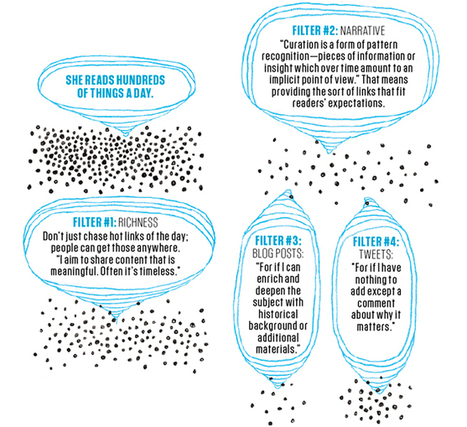
Ibrar Bhatt writes: "Digital curation therefore is not just about finding relevant material, although that is a significant part of it, but is also about creating a specific and unique experience by utilising the resulting materials which then become contextualised within a new space. A curator, therefore, whether she is a journalist-by-proxy such as Popova or a student completing an assignment in a classroom, not only collects and interprets, but also creates a new experience with it. In this respect, curation is a process of problem solving, re-assembling,re-creating, and stewardship of other people’s writing."
Via Mary Reilley Clark
|
Theo Bothma presented Reflecting on Diverse Teaching Methodologies for an Information Literacy Programme for Large Groups (coauthored with Ann-Louise de Boer) at the European Conference on Information Literacy 2015 in Tallinn.
Via Elizabeth E Charles
|
|
Rescooped by
Gilbert C FAURE
from Information Science
September 26, 2015 5:04 AM
|
Twenty-five years ago, the term “literacy” was synonymous with the printed word. Today, that definition has evolved and being literate necessitates more than simply interacting with text. We must be digitally literate, too. Teachers have an even harder task; we must cultivate this ability to adapt t
Via Elizabeth E Charles
|
|
Rescooped by
Gilbert C FAURE
from Content Curation World
August 13, 2015 8:38 AM
|
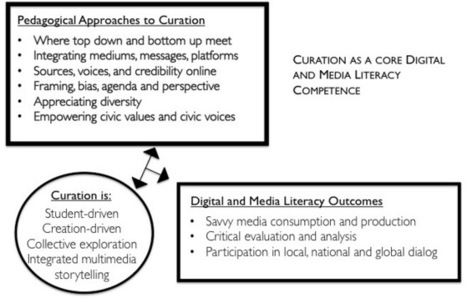
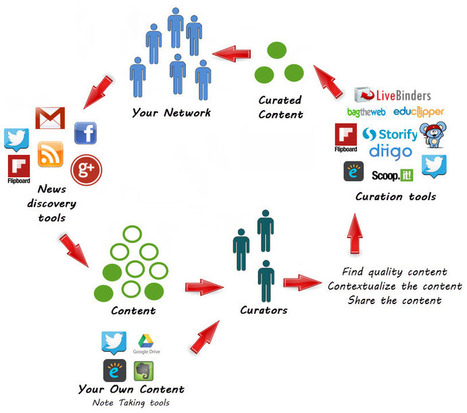
Exploring Curation as a core competency in digital and media literacy education
Via Robin Good
Where do you find new valuable content for your area of interest? Here a few selected tools that can help you out.
Via Elizabeth E Charles
|
|
Rescooped by
Gilbert C FAURE
from Learn for Yourself
June 24, 2015 11:09 AM
|
Work is learning, and learning is the work. I have repeated this hundreds of times over the past six years and I know some people may think it is a trite statement. But the fact that learning is usually supported by an organizational department that has less influence than sales, marketing, operations, or information technology, shows that learning is not a priority in most enterprises. It’s often bolted on after the major decisions have been made. Several times on consulting engagements I have been perceived as ‘the learning guy’ dealing with a minor aspect of the ‘real’ project.
Via Edumorfosis, Jay Cross
Alice Chen writes: "We all know that our digital natives are very at ease with technology. In fact, they’re in love with technology, but does that automatically make them digital proficient?
When I originally pondered this question, I began to realize that the 5 C's often discussed in education today - communication, collaboration, creativity, critical thinking, and citizenship - needed to be expanded to include these other areas as well: curation, copyright, character and connectedness."
Via Mary Reilley Clark, Lynnette Van Dyke, juandoming
|
|
Rescooped by
Gilbert C FAURE
from Lighting in history
March 7, 2015 3:21 PM
|
This is the seventh in a series of blog posts highlighting the digital literacies our students will need to succeed. The first posts covered financial literacy, visual literacy, media literacy, historical literacy, numeracy, and data literacy. This post will provide you with some ideas on how to infuse information literacy and digital literacy skills into the curriculum.
The thirteen literacies I feel need to be explored, practiced and mastered by students can be found in the graphic below. Click headline to read more, view the graphic and access hot links--
Via Chuck Sherwood, Former Senior Associate, TeleDimensions, Inc, LIGHTING
|
|
Scooped by
Gilbert C FAURE
January 12, 2015 3:19 PM
|
Facebook and Twitter may be ubiquitous, but there are many other social media tools out there that can enhance teaching and learning. Here, three educators share their favorites.
|
|
Scooped by
Gilbert C FAURE
August 29, 2014 4:03 AM
|
Curation is a life skill and an important part of being digitally literate. Educators need to know how to curate information so they can teach students how they can curate content for research, their interests and passion. As part of this process educators need to encourage students to curate information using techniques that address their own personal learning needs.
|