


Notebook or My Personal Learning Network
21.1K views |
+23 today

a personal notebook since summer 2013, a virtual scrapbook
Curated by
Gilbert C FAURE
 Your new post is loading...
 Scoop.it! 
A look at a new generation of cutting edge search tools.
Gilbert C FAURE's insight:
Is searching contents a service or the task of researchers for discovery?

Scoop.it!

Are you having trouble staying on top of the ever-growing body of scientific knowledge? These researchers’ tips are here to help
Scoop.it!

Quantitative analysis of researchers' use of scholarly networks shows that they are more likely to be used for individual interests than for collaborative purposes.
Scoop.it!

Search Engine Marketing - Last year, I wrote about five SEO trends you needed to know in 2016. Much has stayed the same since I made those predictions, but much has changed, too
Scoop.it!
A blog about Research Tools, e-skills,Publication marketing, Increase H-Index and Research impact.
Scoop.it!

Globalization has opened the world up like never before, connecting far-flung places through communication and transportation. We feel its impact through experience, but what does the big picture look like?
Scoop.it!
We are building a visual interface to the world's scientific knowledge to change the way we discover research.
Learn more / En savoir plus / Mehr erfahren:
http://www.scoop.it/t/21st-century-learning-and-teaching/?tag=Research
Via Gust MEES

Gust MEES's curator insight,
December 2, 2016 4:21 PM
We are building a visual interface to the world's scientific knowledge to change the way we discover research.
Learn more / En savoir plus / Mehr erfahren:
http://www.scoop.it/t/21st-century-learning-and-teaching/?tag=Research

Victoria Marín's curator insight,
December 6, 2016 9:01 AM
Interesting open project aimed at visually mapping scientific knowledge.
Scoop.it!

Investigating journals: The dark side of publishing
Scoop.it!

Medical researchers are no longer ignoring the people who have the most to gain — or lose. But as patient advocates become more influential, they risk being co-opted by the biomedical industry.
Scoop.it!

A DIGEST OF Harzing, A-W & Alakangas, S. Microsoft Academic: is the Phoenix getting wings? Scientometrics . (in press)
Scoop.it!

Academia.edu, the online academic network for sharing research papers, appears to be expanding its user base within the academic community and drawing interest from the wider public. Alistair Brown…
|
Scoop.it!
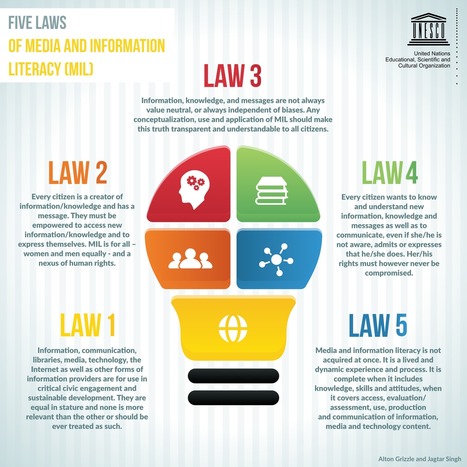
UNESCO has launched the Five Laws of Media and Information Literacy (MIL). The graph is in five languages (English, French, Spanish, Chinese, Portuguese). The graphs are also available on the UNESCO MIL website. Via Elizabeth E Charles
Scoop.it!

Six-plus years later, it's time to revisit Michael Clarke's now-classic post about disruption, or rather the lack thereof, in scientific publishing.
Gilbert C FAURE's insight:
back fron London Info International, will scientific publishing survive?
Scoop.it!

This blog is produced by the Cardiff University Learning Technology Community, inspiring and supporting innovation in learning and teaching. To submit a post, please contact CEILT@cardiff.ac.uk.
Scoop.it!

Bibliographic Analysis of Nature Based on Twitter and Facebook Altmetrics Data
Scoop.it!

Roger Schonfeld analyses how the sector's scientific books are faring in the digitized, open-access era.
Scoop.it!

PARIS DANS LES ARCHIVES DU FIGARO -Le dernier né des Apple Store parisiens ouvre ses portes le 3 décembre dans le marché Saint-Germain totalement rénové.
Scoop.it!

Only 22% of US employees consider themselves curious. Discover why curiosity is crucial for our future. #catchcurious
Scoop.it!

La recherche d’informations médicales sur la toile a profondément modifié les relations entre patients et médecins.
Scoop.it!

Le modèle même d'internet est celui de l'attention. Les algorithmes prédictifs sont l'échafaudage de ce système : ils anticipent nos besoin pour nous retenir.
Scoop.it!

Actin assembly and inward flow in the plane of the immunological synapse (IS) drives the centralization of T cell receptor microclusters (TCR MCs) and the integrin leukocyte functional antigen 1 (LFA-1). Using structured-illumination microscopy (SIM), we show that actin arcs populating the medial, lamella-like region of the IS arise from linear actin filaments generated by one or more formins present at the IS distal edge. After traversing the outer, Arp2/3-generated, lamellipodia-like region of the IS, these linear filaments are organized by myosin II into antiparallel concentric arcs. Three-dimensional SIM shows that active LFA-1 often aligns with arcs, whereas TCR MCs commonly reside between arcs, and total internal reflection fluorescence SIM shows TCR MCs being swept inward by arcs. Consistently, disrupting actin arc formation via formin inhibition results in less centralized TCR MCs, missegregated integrin clusters, decreased T–B cell adhesion, and diminished TCR signaling. Together, our results define the origin, organization, and functional significance of a major actomyosin contractile structure at the IS that directly propels TCR MC transport.
Scoop.it!

From
hwd3d

I hear, I forget I see, I remember I DO, I understand – Confucius (551 BC – 479 BC) Do you know how to jump rope? Imagine i
|






