Your new post is loading...
We all have old photos that are important to us. Vacations, family members who are no longer with us, good times in our lives—you know, important stuff. The thing is, pictures fade. The best way to keep these precious memories safe is by digitizing them, and what was once a lengthy process can now be done—with pretty exceptional results—directly from your phone.
No comment yet.
Sign up to comment
The more doctors communicate with their patients, the more social media and healthcare align on a daily basis. Dive into these 30 statistics on social media and healthcare. Via Marie Ennis-O'Connor
Searchable Directory of Canadian Researchers in Online, Blended and Distance Education | teachonline.ca https://t.co/CgDdgJl6Ap
"Anonymous search engine DuckDuckGo has announced that they have reached 10 billion private searches. The news was announced by the company's Ceo and founder ..." Via Leona Ungerer
Medieval West African culture traded across the Sahara desert
Gilbert C FAURE's insight:
archeobiology at its best
Inspire ran a survey against their user base and collected over 10-thousand responses from patients with chronic conditions. The results show what "engaged patients" are doing, who certainly over-index for most of these activities, but still this report is fascinating and gets our highest recommendation. Below are some selected highlights but the whole report is worth a download. 82% of respondents use social media for research/support, up from 67% in 2015. Notice below that Google+ and Blogs have the highest personal-to-health usage (we wonder if respondents mistook Google+ for the search engine -Ed.): Image modified from Inspire report They don’t concentrate only on those, however:
When using social platforms, treatment information is far and away the most sought information: Image modified from Inspire report When looking at information sources we see that patients look for information on a regular basis. Once they find a good source they will return and will know that website or blog by name. They will continue to search for new information as well on regular basis. Image modified from Inspire report Other findings in the report: 90% of patients use more than one information resource90% of patients think that some type of tools/materials would be helpful for people to use with their physician89% of patients ask about treatments at least once a year64% regularly go to doctor’s appointments prepared with notes and/or questionsDigital healthcare marketers owe it to themselves to download this report, every one of its 25 pages has new and interesting insights. Via Plus91, Lionel Reichardt / le Pharmageek
Portal for open access research theses. DART-Europe is a partnership of research libraries and library consortia who are working together to improve global access to European research theses. The DART-Europe partners help to provide researchers with a single European Portal for the discovery of Electronic Theses and Dissertations (ETDs).
Gilbert C FAURE's insight:
european open source theses
He may have lived a very rough-and-tumble life – but at least he had access to delicious cured meats.
T7 billion people on our planet, and that number is increasing daily, different travel requirements, routes and landmarks are clearly represented on whatever
As university professor, with great pressure to publish in academic journals, I find academic generalist networks essential, such as ResearchGate, Academia.edu or Mendeley, which help me to: Disseminate on the web my published articles to try to obtain citations and name among the scientific community in my field of expertise Find research papers quickly and easily…
I am a bit biased, but I don’t think there is really a bad time to go to... Read More
Washington's Department of Natural Resources is following through with a key safety recommendation that arose in the aftermath of the Oso mudslide, as it s
Bertalan Mesko, MD, PhD, has cracked the code on convincing medical students that digital literacy skills are equally as important as clinical knowledge. Seats in his Social MEDia course fill up within 45 seconds of registration opening. Former students report a 100 percent satisfaction rate with the class, and 80 percent of those enrolling in the course heard about it from a classmate. How does Mesko do it? As it turns out: daily educational challenges promoted on Facebook, an arsenal of high-tech gadgets and lots of chocolate. On Thursday at Stanford Medicine X|ED, Mesko shared his secrets with medical educators on how to develop a digital literacy curriculum that will engage millennial learners and keep pace with the ever-changing landscape. A self-describe medical futurist, Mesko launched his class on social media in medicine in 2008 when Facebook and Twitter were still in their infancy. “I wanted to design the curriculum for students to prepare them for the future that is coming toward us,” he said. “My goal was to help them understand how to use these tools to be more productive and stay up to-date.” Early on, the curriculum centered on his experience with social media tools, such as blogging, Twitter and Facebook. But as the field of digital media and medical devices has evolved, so has the class. These days, he’s constantly updating the coursework to the point where he never gives the same lecture twice. “Platforms come and go, but it’s the concepts and practices that really matter,” said Mesko, who teaches at Semmelweis University in Hungary. “Whenever I talk about these topics, I do everything live.” Most students have been active on Facebook, Twitter, Instagram, Snapchat and other social media accounts, long before they enroll in Mesko’s class. However, he still believes it’s important to provide an introduction to social media; discuss search engines and the Google story; and provide instruction on medical blogging, crowdsourcing and mobile health. “Students need some fundamental digital knowledge before diving into the topics of e-patients and how to empower patients,” said Mesko, author of the recently released book My Health: Upgraded . “Additionally, many students don’t fully understand the privacy polices of these services. I tell them to remember that there is no difference between offline or online conduct.” There’s never a dull moment in Mesko’s class. He leverages his 51,000 Twitter followers to demonstrate how to crowdsource a medical problem. He publicly shares his genomic and microbiome test results. He lets students try on an EGG headset and then sets a drone free to roam the room. He gives students digital assignment during class and provides decision trees to let them guide the discussion. And, let’s not forget about the chocolates. Mesko gives two high-quality Swiss chocolates for each presentation, as well as other tasks. “It’s like a circus! They love it,” he exclaims. As the conference master class came to a close, Mesko offered a simple roadmap to use in designing a digital literacy class for medical students. The first step is to determine what the curriculum should include. Next, identify what digital methods will be used. Then, decide how to evaluate the results. Finally, create a plan for how and when to measure students’ knowledge. Those interested in expanding, or testing, their own digital literacy can take the Social MEDia Course online. Several thousands worldwide have completed the online version of the course. Sadly, the online curriculum lacks drones and chocolates. But you can earn virtual badges and, if you pass all the tests, you’ll be rewarded with the “ultimate expert” badge. More news about the conference is available in the Medicine X category. Those unable to attend the event in person can watch via webcast; registration for the Global Access Program webcast is free. We’ll also be live tweeting the keynotes and other proceedings from the conference; you can follow our tweets on the @StanfordMed feed. Photo by Stanford Medicine X - See more at: http://scopeblog.stanford.edu/2015/09/25/integrating-digital-literacy-into-medical-education/#sthash.7yQcGahu.dpuf Via Plus91 |
PIX est un projet public de plateforme en ligne d'évaluation et de certification des compétences numériques en cours de développement.
As we’re entering 2017, we wanted to share with you a recap of our key achievements in 2016 and share some thoughts on what we’ll be working on this year. We’re grateful for your continuous support. On behalf of the whole team, thank you!
Gilbert C FAURE's insight:
3M users 185 M views
Content Curation for Health and Wellbeing. A way for MDs and Patients to survive infobesity.
Gilbert C FAURE's insight:
I missed the meeting, but they received PPT and paper
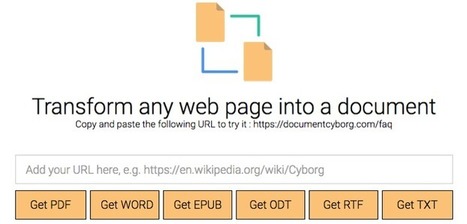
Document Cyborg est un outil en ligne gratuit qui convertit les pages web vers des formats de fichiers pdf, epub, word, pour lecture, impression ou édition. Il existe des outils simples qui, sans … Via FrancoisMagnan, Marie-Hélène Fasquel-Erhart
Brigitte Noirhomme's curator insight,
January 24, 2017 11:26 AM
Absolument génial! Pas d'inscription, j'adore!
From atmospheric, medieval halls serving Estonian banquets to contemporary vegan restaurants, discover the best of dining in Tallinn's Old Town.
As patients have better access to health information through the Internet and expect to be more engaged in health decision making, traditional models of the patient-provider relationship and communication strategies must be revisited to adapt to this changing demographic.
Physicians often don’t have the time to explain the complex world of medicine to patients. While more people are going online for health information the Internet can be like a jungle with many false trails to supposed health information. For the most part, it’s up to online health seekers to determine what is “real” and ‘trusted” as opposed to false and fake. Within lies a great opportunity for pharma companies. Via Pharmacomptoir / Corinne Thuderoz, Giuseppe Fattori, eMedToday, Chanfimao, Lionel Reichardt / le Pharmageek
Alejandro Buldón's curator insight,
January 26, 2017 4:21 AM
Journal of Internet Medical Research: "A medida que los pacientes tienen un mejor acceso a la información de salud a través de Internet y esperan estar más involucrados en la toma de decisiones de salud, modelos tradicionales de la relación entre el paciente y el proveedor y las estrategias de comunicación deben ser revisados para adaptarse a esta evolución demográfica".
The medical industry is beginning to embrace video streaming technology— here are a few areas where it's already making a major impact.
Anne-Sophie Pic, France's three-Michelin-starr
|
|
|
Scooped by
Gilbert C FAURE
January 23, 2017 5:16 AM
|
A leading website that monitored predatory open access journals has closed. This will make it harder to keep tabs on this corrosive force within science.
|
|
Scooped by
Gilbert C FAURE
January 22, 2017 2:10 PM
|
Business Insider France est un site d’information sur l’économie, les technologies, les entrepreneurs, l’innovation, les découvertes et bien plus encore. En texte, en images, en vidéos et en graphiques, de l’actualité essentielle et percutante.
|
|
Scooped by
Gilbert C FAURE
January 19, 2017 11:52 AM
|
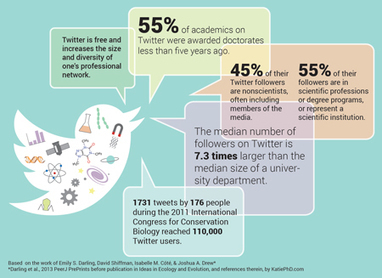
The Benefits of Twitter for Scientists
|
|
Scooped by
Gilbert C FAURE
January 17, 2017 11:52 AM
|
Europeana lance une radio contenant 200 000 contenus musicaux issus des archives audio européennes. La bibliothèque numérique européenne n’a de cesse
Your new post is loading...