Notebook or My Personal Learning Network
21.1K views | +22 today
Notebook or My Personal Learning Network
a personal notebook since summer 2013, a virtual scrapbook
Your new post is loading...
Scooped by Gilbert C FAURE
February 25, 2017 2:24 AM
Scoop.it!

IL-3 on DLD 2017: the only one event in France! 

IL-3 on DLD 2017: the only one event in France!  | Notebook or My Personal Learning Network | Scoop.it
IL-3 = Immunology Learning, Information Literacy for (Medical) Intern Learning:

February 23rd, 2017 was the Digital Learning Day!

Usage of Content Curation to learn Immunology and related medical disciplines in the context of Web 2.0 resources . Development of information literacy of end-users in Health related topics.

An afternoon dedicated to blended learning at CHU Brabois and Université de Lorraine for medical biology interns present in the Lab, with 3 main topics

Usage of Scoop.it for curation of scientific information.

Presentation at Bobcatsss 2017

Introduction to Immunoapedia, a project supported by IUIS educational committee

Gilbert C FAURE's insight:
Share your insight
No comment yet.
Scooped by Gilbert C FAURE
February 24, 2017 9:18 AM
Scoop.it!

Recommended | Springer Nature

Recommended | Springer Nature | Notebook or My Personal Learning Network | Scoop.it
Recommended is a personalised service that suggests relevant papers to you, based on what you’ve previously read, from all publishers.
No comment yet.
Scooped by Gilbert C FAURE
February 23, 2017 8:07 AM
Scoop.it!

Twitter Is Trending in Academic Medicine

Twitter Is Trending in Academic Medicine | Notebook or My Personal Learning Network | Scoop.it
Using social media allows health professionals to transcend geographical boundaries to engage more with colleagues and the public, and even influence policy sometimes.
No comment yet.
Scooped by Gilbert C FAURE
February 23, 2017 7:08 AM
Scoop.it!

Learning from the 80's

xerox
No comment yet.
Suggested by Société Francaise d'Immunologie
February 22, 2017 5:35 AM
Scoop.it!

Introducing oaDOI: resolve a DOI straight to OA

Introducing oaDOI: resolve a DOI straight to OA | Notebook or My Personal Learning Network | Scoop.it
Most papers that are free-to-read are available thanks to “green OA” copies posted in institutional or subject repositories.  The fact these copies are available for free is fantastic because anyone can read the research, but it does present a major challenge: given the DOI of a paper, how can we find the open version, given there are so …
No comment yet.
Scooped by Gilbert C FAURE
February 20, 2017 2:43 PM
Scoop.it!

Residents Spend More Time on Computer Than With Patients

Residents Spend More Time on Computer Than With Patients | Notebook or My Personal Learning Network | Scoop.it
Internal medicine residents at a Swiss teaching hospital spent nearly three times as much time on the computer as they did with patients, a new study showed.
Gilbert C FAURE's insight:
too bad
No comment yet.
Scooped by Gilbert C FAURE
February 20, 2017 6:46 AM
Scoop.it!

Science Curiosity and Political Information Processing

Science Curiosity and Political Information Processing | Notebook or My Personal Learning Network | Scoop.it
This article describes evidence suggesting that science curiosity counteracts politically biased information processing. This finding is in tension with two bodies of research. The first casts doub
No comment yet.
Scooped by Gilbert C FAURE
February 18, 2017 2:52 AM
Scoop.it!

Expert explains our 'digital biography' affects our sense of self

Expert explains our 'digital biography' affects our sense of self | Notebook or My Personal Learning Network | Scoop.it
An expert at the University of Western Ontario reveals the birth of social media has hindered our ability to forget past experiences. Our 'digital biography' is found to get in the way of us knowing who we are.
No comment yet.
Suggested by LIGHTING
February 16, 2017 2:52 PM
Scoop.it!

Iceland itinerary: How to get the best out of five days in Iceland in winter

Iceland itinerary: How to get the best out of five days in Iceland in winter | Notebook or My Personal Learning Network | Scoop.it
The best things to do in Iceland in winter – from ice caves to northern lights. A 5-day Iceland itinerary with tip for making the most of your time.
No comment yet.
Scooped by Gilbert C FAURE
February 15, 2017 8:39 AM
Scoop.it!

Pourquoi et comment organiser une veille collaborative ?

Pourquoi et comment organiser une veille collaborative ? | Notebook or My Personal Learning Network | Scoop.it
Comment et pourquoi mettre en place une veille collaborative ? il n’est plus possible pour une personne de maîtriser toute l’information de votre société.
Gilbert C FAURE's insight:
pour St malo et lighting!!
No comment yet.
Rescooped by Gilbert C FAURE from Information and digital literacy in education via the digital path
February 14, 2017 4:23 AM
Scoop.it!

Biggest challenges facing technology enhanced learning in higher education

How important is technology enhanced learning to higher education? In my experience of talking to and working with many academics and institutions, technology to enhance or engage students is very important. However, having been asked this recently I also think we should be asking: what are the challenges facing technology enhanced learning? 

Via Elizabeth E Charles
John Zuluaga's curator insight, February 23, 2017 6:32 PM

We for sure can overcome those challenges, it is just a matter of preparation. Training is not just a teachers' issue; in fact, learners are indispensable parties in the implementation of technology in institutions. Besides, it allows learners to be prepared for a future since in 21st century jobs, the use of virtual tools become a requierement for applying. 


Scooped by Gilbert C FAURE
February 14, 2017 4:22 AM
Scoop.it!

Just how big is Google Scholar? Ummm … 160 million indexed documents (plus or minus 10%), including journal articles, books, case law, and patents.

Just how big is Google Scholar? Ummm … 160 million indexed documents (plus or minus 10%), including journal articles, books, case law, and patents. | Notebook or My Personal Learning Network | Scoop.it
160 million indexed documents (plus or minus 10%), including journal articles, books, case law, and patents.
No comment yet.
Rescooped by Gilbert C FAURE from Patients & pouvoir d’agir | Expérience, participation & numérique — Pharmageek
February 13, 2017 4:43 AM
Scoop.it!

How do young adults engage with online health information?

How do young adults engage with online health information? | Notebook or My Personal Learning Network | Scoop.it

Social media, from blogs and wikis to sites such as Facebook or Twitter, are now common features of everyday life for many people. They provide the opportunity to share experiences of illness and to learn from the shared experiences of others, and previous research has shown this is particularly the case for people managing long-term health conditions.

The authors of this recent study (Fergie et al, 2016) wanted to explore not only how young adults with chronic conditions engage with health information they find online, but also how they contributed as ‘producers’ of that online information.


Via Marie Ennis-O'Connor, Giuseppe Fattori, Lionel Reichardt / le Pharmageek
No comment yet.
Suggested by LIGHTING
February 24, 2017 1:36 PM
Scoop.it!

Report: Millions of students reveal surprising online learning trends - eCampus News

Report: Millions of students reveal surprising online learning trends - eCampus News | Notebook or My Personal Learning Network | Scoop.it
New study reveals that collaboration is still not a prevalent online learning habit; mobile phones have yet to be used for serious learning.
No comment yet.
Rescooped by Gilbert C FAURE from TechnoVeille
February 24, 2017 2:32 AM
Scoop.it!

Robert Darnton : Les bibliothèques, les livres et l'avenir numérique.

Les rencontres Wallot-Sylvestre favorisent les échanges dans des domaines touchant le mandat de notre institution : la bibliothéconomie, les sciences d

Via Assane FALL™
No comment yet.
Scooped by Gilbert C FAURE
February 23, 2017 7:12 AM
Scoop.it!

8 Elements of Modern Learning Infographic - e-Learning Infographics

8 Elements of Modern Learning Infographic - e-Learning Infographics | Notebook or My Personal Learning Network | Scoop.it
This nfographic presents 8 eight important elements of modern learning you should incorporate into existing and future programs
No comment yet.
Rescooped by Gilbert C FAURE from Personal Learning Network
February 23, 2017 2:20 AM
Scoop.it!

Learning in the digital age - theory and practice

Learning technology is just about everywhere in education. Universities are replete with lecture capture tools, interactive media, web based content and person…

Via Ana Cristina Pratas, Elena Elliniadou
Francisco Restivo's curator insight, December 8, 2015 5:33 PM

Great presentation by Steve Wheeler.

Nancy Jones's curator insight, December 31, 2016 11:39 AM
while this presentation is really quite in depth (74 slides) it covers some important points. Semms like something that would be interesting to share with colleagues as it really covers a number of topics that apply to modern learners.
Ajo Monzó's curator insight, February 28, 2017 6:14 AM
Clarissim!
Suggested by Société Francaise d'Immunologie
February 21, 2017 11:51 AM
Scoop.it!

Cendre de Bois : 14 Utilisations Secrètes Que Personne Ne Connaît.

Cendre de Bois : 14 Utilisations Secrètes Que Personne Ne Connaît. | Notebook or My Personal Learning Network | Scoop.it
Vous avez de la cendre de bois à la maison ? Et vous ne savez pas quoi en faire ? Quand on se chauffe avec une cheminée ou un poêle à la maison, c’est souvent une question que l'on se pose. Enfi
No comment yet.
Scooped by Gilbert C FAURE
February 20, 2017 6:48 AM
Scoop.it!

Quantity vs quality: why a balance is key to content marketing success

Quantity vs quality: why a balance is key to content marketing success | Notebook or My Personal Learning Network | Scoop.it
It can be difficult to consistently create high-quality content. Learn how to find the right balance between content quantity vs quality for your strategy. 
No comment yet.
Rescooped by Gilbert C FAURE from Univers(al)ités
February 19, 2017 11:42 AM
Scoop.it!

AirVisualEarth. Une carte mondiale de la pollution – Les Outils Tice

AirVisualEarth. Une carte mondiale de la pollution – Les Outils Tice | Notebook or My Personal Learning Network | Scoop.it
AirVisualEarth est une mappemonde animée tout à fait spéciale. Cette carte mondiale présente en effet en temps réel la qualité de l’air dans tous les pays du globe. Une radiologie « étouffante » de l’état de notre pauvre planète.
Via Bernard Rentier
Suggested by LIGHTING
February 17, 2017 11:51 AM
Scoop.it!

Digital Learning Day is Feb. 23. Heres How to Celebrate -- THE Journal

Digital Learning Day is Feb. 23. Heres How to Celebrate -- THE Journal | Notebook or My Personal Learning Network | Scoop.it
The annual Digital Learning Day, started in 2012, gives educators an opportunity to collaborate with peers, share ideas, try out new digital tools, celebrate education innovation and play a role in the transformation of their own schools and communities. Digital Learning Day 2017 is Thursday, Feb. 23.
No comment yet.
Scooped by Gilbert C FAURE
February 16, 2017 2:51 PM
Scoop.it!

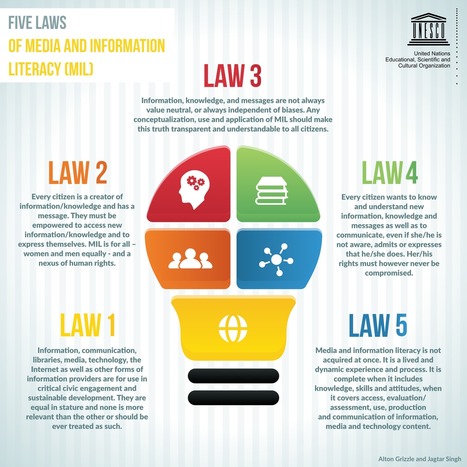
UNESCO launch Five Laws of Media and Information Literacy | Information Literacy

UNESCO launch Five Laws of Media and Information Literacy | Information Literacy | Notebook or My Personal Learning Network | Scoop.it
No comment yet.
Scooped by Gilbert C FAURE
February 15, 2017 3:24 AM
Scoop.it!

The World Needs Great Editors

The World Needs Great Editors | Notebook or My Personal Learning Network | Scoop.it
If you have a few minutes I highly recommend reading the transcript from a recent talk by Jenene Cossan at the MPA Magazine Sales Conference. I’ll quote liberally from the transcript and add additional thoughts but I suggest reading the transcript yourself. The talk is about much more than just the future of publishing. It’s more about... Read more »

No comment yet.
Scooped by Gilbert C FAURE
February 14, 2017 4:22 AM
Scoop.it!

Communicating Science: What Can We Do Better? - The Scholarly Kitchen

Communicating Science: What Can We Do Better? - The Scholarly Kitchen | Notebook or My Personal Learning Network | Scoop.it
Communicating Science: What Can We Do Better?
No comment yet.
Scooped by Gilbert C FAURE
February 13, 2017 1:45 PM
Scoop.it!

Data Sharing by Scientists: Practices and Perceptions

Data Sharing by Scientists: Practices and Perceptions | Notebook or My Personal Learning Network | Scoop.it
Background Scientific research in the 21st century is more data intensive and collaborative than in the past. It is important to study the data practices of researchers – data accessibility, discovery, re-use, preservation and, particularly, data sharing. Data sharing is a valuable part of the scientific method allowing for verification of results and extending research from prior results. Methodology/Principal Findings A total of 1329 scientists participated in this survey exploring current data sharing practices and perceptions of the barriers and enablers of data sharing. Scientists do not make their data electronically available to others for various reasons, including insufficient time and lack of funding. Most respondents are satisfied with their current processes for the initial and short-term parts of the data or research lifecycle (collecting their research data; searching for, describing or cataloging, analyzing, and short-term storage of their data) but are not satisfied with long-term data preservation. Many organizations do not provide support to their researchers for data management both in the short- and long-term. If certain conditions are met (such as formal citation and sharing reprints) respondents agree they are willing to share their data. There are also significant differences and approaches in data management practices based on primary funding agency, subject discipline, age, work focus, and world region. Conclusions/Significance Barriers to effective data sharing and preservation are deeply rooted in the practices and culture of the research process as well as the researchers themselves. New mandates for data management plans from NSF and other federal agencies and world-wide attention to the need to share and preserve data could lead to changes. Large scale programs, such as the NSF-sponsored DataNET (including projects like DataONE) will both bring attention and resources to the issue and make it easier for scientists to apply sound data management principles.
Gilbert C FAURE's insight:
researchers read between 12 and 25 hours par week, and a large portion dedicated to screening relevant content.
No comment yet.