


The evolution to a high-profit industry was never planned. Academics need to make the case for lower-cost journals


 Your new post is loading...
 Scoop.it! The evolution to a high-profit industry was never planned. Academics need to make the case for lower-cost journals
Gilbert C FAURE's insight:
and of databases and content hubs!

No comment yet.
Sign up to comment
Scoop.it!

Un dépaysement plein d’embruns sans quitter la région parisienne : c’est la promesse de ces quatre restaurants franciliens sélectionnés par nos soins à l’entame de ce long week-end de quatre jours.
Scoop.it!

"This study examined factors that contributed to persistent use, or discontinued use, of ePortfolios beyond the program of study, as perceived by former educational technology students in a graduate program. The related literature points to contemporary research that choice, ownership, voice, and authentic learning are growing trends emerging as persistent factors that contribute to ePortfolio ..." Via Leona Ungerer

Carole Hunter's curator insight,
May 22, 2017 6:09 PM
This is hardly surprising - basic motivation (autonomy, mastery, purpose)...but good to see it reflected here.
Scoop.it!
Analysis finds citation rankings can be very misleading
Scoop.it!

"Inviting students to contribute to IT service delivery pays off for students and institutions alike ..." Via Leona Ungerer

Gilbert C FAURE's comment,
May 16, 2017 4:11 AM
unfortunately, even teachers are not willing to participate ans share!!!!
Scoop.it!
From
ecdl

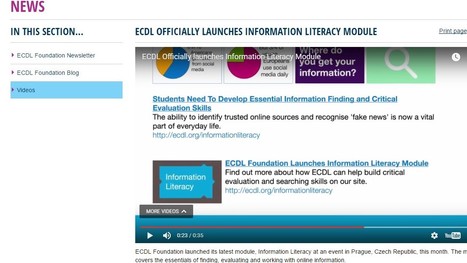
ECDL Foundation launched its latest module, Information Literacy at an event in Prague, Czech Republic, this month. The module covers the essentials of finding, evaluating and working with online information. Via Elizabeth E Charles
Scoop.it!
Gilbert C FAURE's insight:
ResearchGate has launched its own citation index by extracting citations from documents uploaded to the site and reporting citation counts on article profile pages. Since authors may upload preprints to ResearchGate, it may use these to provide early impact evidence for new papers. This article assesses the whether the number of citations found for recent articles is comparable to other citation indexes using 2675 recently-published library and information science articles. The results show that in March 2017, ResearchGate found less citations than did Google Scholar but more than both Web of Science and Scopus. This held true for the dataset overall and for the six largest journals in it. ResearchGate correlated most strongly with Google Scholar citations, suggesting that ResearchGate is not predominantly tapping a fundamentally different source of data than Google Scholar. Nevertheless, preprint sharing in ResearchGate is substantial enough for authors to take seriously.
Scoop.it!

中国最佳现代/当代短篇小说 Les meilleures nouvelles chinoises modernes et contemporaines
Scoop.it!

From Turkey to Thailand, some countries punch above their weight when it comes to university access and research. And where education takes root, economic growth soon follows, says Chris Parr of Times Higher Education.
Scoop.it!

Want to know about Motivation To Learn? Check why Motivation To Learn is the ultimate hope of educators and trainers when designing eLearning experiences.
Scoop.it!

Paris, le samedi 29 avril 2017 – Depuis quelques années, la nécessité de protéger et de promouvoir l’intégrité scientifique, notamment dans le cadre de la diffusion de l’information scientifique, a été l’objet de nombreux rapports et résolutions. Il s’agit de lutter tout autant contre les cas de fraudes avérées que contre les pratiques dévoyées, favorisées par certains diktats économiques et académiques. Cependant, de la déclaration d’intention aux actions réelles, il [...]
Scoop.it!

The impact factor is academia’s worst nightmare. So much has been written about its flaws, both in calculation and application, that there is little point in reiterating the same tired points here …
Scoop.it!
A curated conversation of the book Self-Determined Learning edited by Stewart Hase & Chris Kenyon featuring 50 words on every chapter trying to answer the ques… Via NLafferty
|
Scoop.it!

Si vous vous demandez où manger à Lisbonne, cet article est fait pour vous. Lors de notre dernier passage dans la capitale portugaise, on a vraiment pris s
Scoop.it!

Follow these five best practices to incorporate today’s SEO principles into your content – Content Marketing Institute
Scoop.it!
En France, notre quotidien fait état de nombreuses « innovations » qui sont supposées améliorer notre vie, dynamiser notre économie, faire baisser le chômage. Le monde de l’éducation n’est pas épargné et l’on nous présente des « innovations » censées permettre à tous d’apprendre sur les réseaux numé- riques, or la recherche a montré qu’apprendre sur les réseaux numériques, seul face à son ordinateur, est très complexe et n’est pas possible pour tous. La coopération et la collaboration peuvent-elles être des auxiliaires facilitateurs? En quoi et comment peuvent-elles contribuer à l’innovation pédagogique? Je propose une réflexion sémantique critique de ces différents termes à l’aune de mes travaux et de ma pratique.
Scoop.it!

Let's look at some of the reasons why many scientists are engaging in social media (especially Twitter), the benefits of participating, and the preferred platforms of avid users.
Gilbert C FAURE's insight:
Scientists should also use scoop.it, another kind of social network, most useful in research, teaching and life-long learning
Scoop.it!

Elizabeth Hutchinson, Head of Schools’ Library Service in Guernsey, writes that information literacy is at the centre of student learning, making the role of library staff as important as ever.
Scoop.it!

Academia.edu used to be a refreshing and very useful platform for academics and students all over the world. That has ended with academia.edu introducing the ‘paid search’, says Ico Maly (Tilburg University).
Scoop.it!
Stephen Walsh, Co Founder at Anders Pink, takes us through his session at Learning Live 2017: 'From filter failure to duration hero: why content curatio
Scoop.it!

It can be difficult to consistently create high-quality content. Learn how to find the right balance between content quantity vs quality for your strategy.
Scoop.it!

Content curation is a highly effective inbound marketing strategy and because of this there has been a rise of content curation tools and platforms. So we did w
Gilbert C FAURE's insight:
Free and paid version. The layout is similar to a magazine layout. Curating content is easy with their bookmarklet, they also have a community built right in. Scoop.it is one of few platforms we still use these days. This is a system we use quite a bit. We curate stuff on new media and Scott curates stuff on history and All Out Massive Action. It’s free to use and you can upgrade to get some additional features such as your own domain and branding.
Scoop.it!
Gilbert C FAURE's insight:
Progress in science has advanced the development of human society across history, with dramatic revolutions shaped by information theory, genetic cloning, and artificial intelligence, among the many scientific achievements produced in the 20th century. However, the way that science advances itself is much less well-understood. In this work, we study the evolution of scientific development over the past century by presenting an anatomy of 89 million digitalized papers published between 1900 and 2015. We find that science has benefited from the shift from individual work to collaborative effort, with over 90\% of the world-leading innovations generated by collaborations in this century, nearly four times higher than they were in the 1900s. We discover that rather than the frequent myopic- and self-referencing that was common in the early 20th century, modern scientists instead tend to look for literature further back and farther around. Finally, we also observe the globalization of scientific development from 1900 to 2015, including 25-fold and 7-fold increases in international collaborations and citations, respectively, as well as a dramatic decline in the dominant accumulation of citations by the US, the UK, and Germany, from 95\% to 50\% over the same period. Our discoveries are meant to serve as a starter for exploring the visionary ways in which science has developed throughout the past century, generating insight into and an impact upon the current scientific innovations and funding policies.
|






